

What if the longest mixing cycle isn’t caused by the mixer? A batch that takes too long or produces uneven dispersion can point to operating conditions, material behaviour or a mismatch between the mixer and its duty. If you’re working out how to improve mixing efficiency, replacing equipment before identifying the cause can add complexity without resolving the variation.
Cycle time and energy use are useful measures, but neither tells the whole story. Efficient mixing also means achieving the required uniformity consistently without unnecessary processing time or energy. A change that improves one material or batch may create quality problems in another.
This guide explains how to measure mixing performance, investigate likely causes and prioritise process changes. It also covers when the evidence points to equipment suitability, including whether an industrial mixer or blender fits your material and operating requirements.
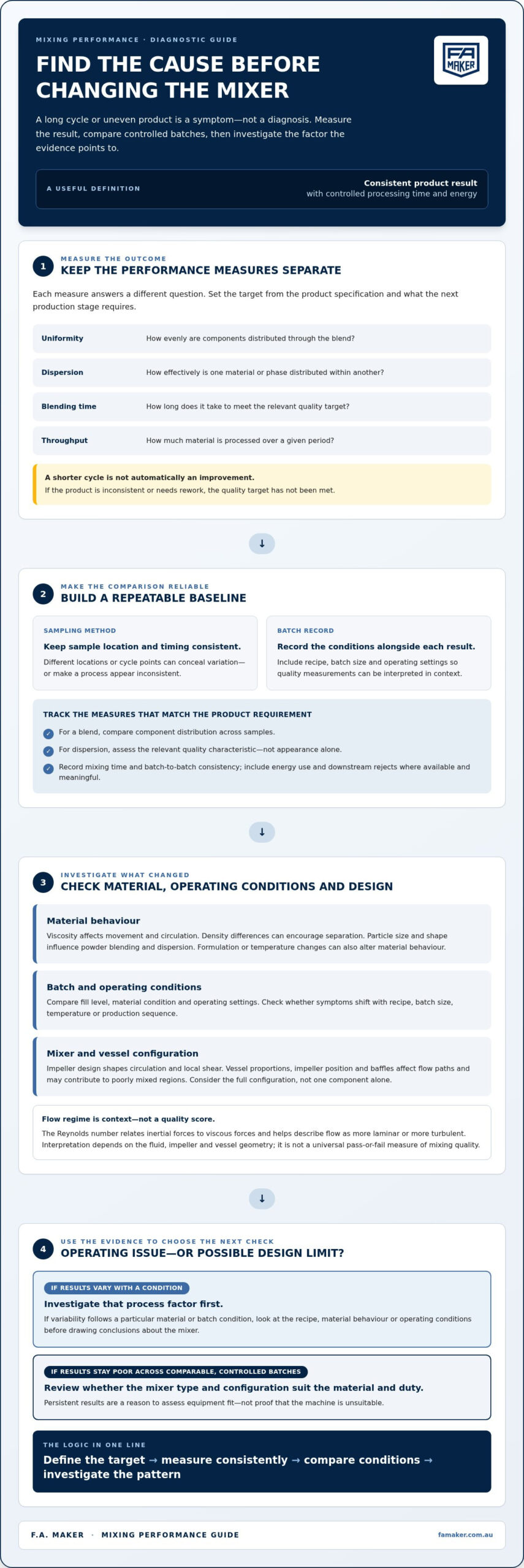
Mixing efficiency is the ability to achieve the required product result consistently, with controlled processing time and energy. There’s no single benchmark for every material or process. Set a target based on the product specification and what the next production stage requires.
Separate the outcomes you’re measuring. Uniformity describes how evenly components are distributed through a blend. Dispersion concerns how effectively one material or phase is distributed within another. Blending time is the time needed to meet the relevant quality target, while throughput is the amount processed over a given period. A shorter cycle isn’t an improvement if the product remains inconsistent or needs rework.
Look for observable signs that the process is missing its target. Samples may vary by location or batch; cycles may run longer than expected; ingredients may settle or form agglomerates; and downstream checks may identify product that needs rework. Each symptom helps narrow the investigation, but none identifies a cause on its own. Settling, for example, may relate to material behaviour, process conditions or equipment suitability.
Choose measures that reflect the product requirement. For a blend, compare component distribution across samples. For a dispersion process, assess the relevant quality characteristic rather than relying on appearance alone. Record mixing time and batch-to-batch consistency alongside energy use and downstream rejects, where those measures are available and meaningful.
Make sampling repeatable. Define where and when samples are taken, then use the same method for each comparison. Samples collected from different locations or at different points in the cycle can make a process appear inconsistent or conceal important variation. Record the recipe, batch size and operating settings with each result so you can interpret quality measurements in context.
Compare batches under recorded conditions. Note fill level, material condition and operating settings, then check whether symptoms change with the recipe, batch size, temperature or production sequence. If variability follows a particular material or batch condition, investigate that process factor before drawing conclusions about the mixer.
If results remain poor across controlled, comparable batches, review whether the mixer’s type and configuration suit the material and duty. This is a reason to assess equipment fit, not proof that the machine is unsuitable. A structured record helps distinguish a correctable operating issue from a persistent limitation and gives the next optimisation step a sounder basis.
That evidence provides a practical starting point for how to improve mixing efficiency: define the required result, measure performance consistently and use the pattern of results to choose what to investigate next.
Mixing requirements start with the material, not a standard machine setting. Viscosity affects how readily a liquid moves and circulates. Density differences can encourage ingredients or phases to separate, while particle size and shape influence how powders disperse and blend. Formulation or temperature changes can also alter material behaviour during a batch, so a setting that worked previously may no longer produce the same result.
Flow regime offers another way to understand what is happening inside a vessel. The Reynolds number relates inertial forces to viscous forces and is used to describe whether flow is more laminar or more turbulent. It can help frame equipment analysis, but its interpretation depends on the fluid, impeller and vessel geometry. It isn’t a universal pass-or-fail measure of mixing quality.
The same mixer settings can produce different results when material properties, batch conditions or flow behaviour change. Check whether the mixing task is comparable before carrying speed and duration settings across products.
Freely flowing powders may move readily through a suitable blending action, while cohesive solids can resist movement and form lumps. Low-viscosity liquids generally circulate differently from viscous fluids, which may move slowly or unevenly through the vessel. Changes in temperature or formulation can shift viscosity, affecting circulation and the energy required to move material.
Consider phase behaviour, too. A liquid containing suspended solids, for example, may need sufficient circulation to keep particles distributed. The suitable speed and mixing time depend on the product and process objective. Applying one fixed recipe to materially different products can lead to poor uniformity, excessive processing or unwanted shear.
Impeller design shapes how material moves. Some configurations promote bulk circulation, while others generate more local shear. Vessel proportions and impeller position affect the flow path. Baffles can interrupt circular flow and support circulation, while unsuitable geometry may leave poorly mixed regions. These effects depend on the full configuration, not one component in isolation.
Powder equipment works differently from a liquid agitator. A ribbon blender uses internal helical ribbons to move powder through the vessel, while a liquid agitator creates flow within a liquid. Treating them as interchangeable because both mix materials can obscure the actual duty, such as blending dry solids versus dispersing a phase in liquid.
To work out how to improve mixing efficiency, relate the material’s behaviour to the required mixing action before changing settings. If process trials point to a persistent mismatch, compare the duty and material requirements with the configuration and condition of used industrial mixers and blenders as part of an equipment-fit assessment.
Before changing equipment, separate possible causes into operating variables, material changes and design factors. This helps identify adjustments that are straightforward to test and reverse, while showing when a persistent constraint may sit in the mixer configuration. The comparison below is a starting point, not a substitute for controlled trials against the product’s quality requirements.
Operating variables
Examples: Speed, mixing duration, feed sequence, fill level and material addition rate.
Likely intervention: Adjust one setting or step in the sequence.
Expected effect: May improve circulation, contact between ingredients or cycle time.
Risk and reversibility: Product quality may be affected, but a trial setting is generally straightforward to reverse.
Measure: Compare product quality, cycle time and energy use under recorded conditions.
Material changes
Examples: Variation in viscosity, temperature, particle size, moisture or formulation.
Likely intervention: Control or account for material condition and compare like with like.
Expected effect: Can explain why an unchanged recipe behaves differently between batches.
Risk and reversibility: Changing formulation or conditioning may affect product requirements, so assess the implications before trialling.
Measure: Record relevant material properties alongside the batch result.
Equipment-design factors
Examples: Impeller or ribbon configuration, vessel geometry, baffles and working capacity.
Likely intervention: Review whether the mixer type and configuration suit the process duty.
Expected effect: May address persistent limits in circulation, shear or usable batch range.
Risk and reversibility: Equipment changes are less readily reversed than operating adjustments.
Measure: Assess the mixing result across controlled trials and relevant batch conditions.
Review speed, duration, feed sequence, fill level and addition rate against the observed problem. Where practical, change one variable at a time; otherwise, it’s difficult to tell which adjustment affected the result. Record each setting alongside product quality, batch conditions and energy use where available. Higher speed isn’t automatically better: it can increase shear, heat generation or energy demand, and may harm a sensitive product.
Persistent dead zones, weak circulation, insufficient shear or a working capacity that doesn’t suit the required batch range can point to a design limitation, especially when controlled process trials don’t resolve the issue. Compare the duty and configuration rather than nominal power alone. Vessel geometry matters too, so assess it alongside the mixer. The used stainless steel tank sourcing guide provides related context.
For a broader equipment comparison, the guide to used industrial mixers and blenders can help frame the fit assessment. This evidence-based sequence is central to how to improve mixing efficiency: test reversible process changes first, then assess equipment when results show a persistent mismatch.
Improvement depends on knowing what changed and whether it helped. A controlled sequence gives operators a sound basis for adjusting the process, protecting product quality and deciding whether a problem remains unresolved. Mixing optimisation is demonstrated by repeatable results, not speed alone.
Use the same batch size, recipe, sampling plan and measurement method when establishing the baseline and comparing trials. If those conditions shift between runs, it’s harder to attribute a change in performance to the adjustment being tested.
Before the trial, write down the target outcome, current settings, material condition, batch size and sampling method. Specify the single adjustment being tested and the acceptable result. This prevents a promising observation from being mistaken for a confirmed improvement. Record deviations, such as a temperature change or a different addition sequence, since they may help explain an unexpected result.
Repeat successful trials across comparable batches to check that the result holds beyond a single run. Record approved settings and relevant process conditions in operating documentation so the change can be applied consistently. Reassess performance if formulation, throughput or production scale changes, since those shifts can alter the mixing task.
Use this method to determine how to improve mixing efficiency without relying on speed increases that may compromise quality or equipment limits. If controlled trials point to a persistent equipment-fit issue, explore used industrial mixers and blenders as part of the next assessment.
A different machine is worth assessing when controlled process trials have not resolved a persistent performance limit. Examples include recurring areas of poor circulation, a batch range the current equipment cannot handle consistently, or a mixing action that doesn’t suit the material. These signs warrant a fit review, not an automatic replacement decision. Compare the process duty with the mixer’s configuration, working range and condition before deciding what change is justified.
Keep the assessment tied to the full operating task. Consider the required product result, material behaviour, batch volumes, cleaning needs and production conditions. Account for how the mixer connects with upstream feeding and downstream transfer or processing, too. A machine that appears suitable in isolation may not fit the way the wider line operates.
Match the equipment category to the required mixing action. Liquid agitation, powder blending and high-shear processing involve different duties, so don’t assume a machine suitable for one will suit another. Compare material characteristics and batch volume with the required outcome, including whether the process needs bulk circulation, distribution of dry ingredients or more intensive dispersion.
Motor power or nominal capacity alone doesn’t establish process suitability. The intended mixing action and quality result matter as well.
Review visible condition, drive components, mixing elements and vessel interfaces. Compare the machine’s configuration with the intended material, batch range and operating duty. Available records can help clarify the equipment’s history and configuration, but they don’t replace a practical assessment of whether the machine fits the process.
Consider cleanability and how the unit will connect with the existing process, alongside its condition. A machine may have an appropriate general capacity yet still be poorly matched to the material or required mixing action. Keep conclusions specific to the application, and distinguish verified details from assumptions. With used equipment, assess condition and configuration together.
The same evidence-led approach guides how to improve mixing efficiency: optimise process conditions first, then assess equipment if repeatable trials show a persistent limit. Review F.A. Maker’s used industrial mixers and blenders as part of that equipment-fit assessment.
Turn your findings into a practical next step. Keep a record of the process target, the adjustment tested and the result, then use it to guide production decisions. A clear record helps operators distinguish a repeatable improvement from a one-off result and gives the team a sound basis for reviewing the process as requirements change.
If trials show that the current setup remains a poor fit, compare equipment options against the actual duty, material and operating conditions. Focus on suitability, configuration and condition, not a single headline specification. This keeps the decision grounded in the work the mixer must perform.
F.A. Maker supplies used industrial mixers and blenders as part of its process-equipment range. To consider equipment as part of your next process review, explore F.A. Maker’s used industrial mixers and blenders. Use a measured approach to how to improve mixing efficiency, then contact F.A. Maker to discuss your equipment requirements.
No. A higher speed may improve circulation or dispersion in some processes, but it can also increase shear, heat generation and energy demand, or change a sensitive product. The useful setting depends on the material, mixer geometry and required result. If testing a faster speed, run a controlled trial and check for unintended product changes as well as quality against the established baseline before making it routine.
Use a measurement that reflects the product specification, such as comparing a relevant compositional or physical property across samples. For a coloured blend, colour measurements may be useful if colour is an appropriate quality indicator; other products may require a different test. Take samples from defined locations, prepare them consistently and review variation across batches. A single sample can miss local differences, so plan sampling to represent the batch.
Often, yes. Before replacing equipment, review variables such as material loading and the order ingredients enter the mixer. If one addition sequence leaves material poorly incorporated, for example, a controlled sequence trial may identify an adjustment. To understand how to improve mixing efficiency, compare each change with production results and retain the approved recipe and settings. If problems persist, assess whether equipment configuration or vessel geometry is limiting performance.
Dead zones are areas where material receives less movement or mixing action than the rest of the batch. Their cause varies with the machine, material and operating conditions, so appearance alone may not establish whether they affect product quality. Compare samples from different vessel positions using the same test. If results differ consistently by location, investigate circulation and whether loading conditions contribute to the pattern.
Yes. Changing the amount of material changes how it occupies the vessel and interacts with the mixing elements. Compare representative production batch sizes while keeping the recipe and test method consistent. Record the fill condition and quality result for each run. This helps define an operating range that meets the product target, rather than assuming one batch setting will suit every production requirement.
Consider a different mixer when documented trials leave the process unable to meet its quality target or support the required production duty. Before deciding, distinguish persistent equipment constraints from issues that vary with product or operating conditions. Then assess whether the machine’s configuration, condition and working range suit the application, including connections to the rest of the line. A newer or higher-powered machine isn’t automatically a better fit.