

An auction isn’t automatically the simplest way to sell surplus industrial equipment. The right route depends on the machinery’s condition, the quality of its records, your timeframe and how it can be removed without disrupting site operations. A stainless steel tank, centrifuge or conveyor may attract different buyers and require a different sale and removal plan.
A clear process matters, especially when specifications, maintenance history and access arrangements are spread across different records or teams. Accurate information helps buyers assess an asset, while planning removal early can reduce last-minute issues on site.
This guide explains how to prepare machinery for sale, compare auctions with direct sales and specialist equipment channels, and plan access and removal. You’ll learn which details to assemble, how to match a sale route to your equipment and timeframe, and what to consider before machinery leaves the site. F.A. Maker supplies used processing equipment and provides machinery relocation services, so this guide treats the sale and the move as connected parts of the decision.
Idle equipment can take up valuable floor space, tie up business assets and complicate a plant change or production-line reconfiguration. The pressure to clear a site is real, but an asset shouldn’t be labelled surplus simply because it isn’t running today. Before selling surplus industrial equipment, establish whether it’s no longer required, whether the business owns it, and whether its condition and removal fit the plan.
Featured snippet: Surplus industrial equipment is machinery a business owns and no longer needs for current or forecast production, backup capacity, spare parts or another operational purpose, and has approved for sale or removal.
Start with equipment whose function is no longer needed in the process. A stainless steel tank, separator, mixer, mill, pump or conveyor may be a sale candidate if it isn’t required by the current production plan or another line. The broad category of industrial machinery covers equipment used across many processes, so describe each asset by its actual role rather than relying on a general label.
Condition and completeness affect how a buyer can assess the asset. A complete machine that can be demonstrated in operation gives a different picture from one that is dismantled, missing components or untested. Record the actual status plainly. Note known faults, removed parts and whether testing was possible. Don’t describe an asset as operational unless that status is supported by evidence. Process relevance matters too: a machine’s suitability depends on its function and the buyer’s requirements, so avoid assuming that a particular asset will attract demand.
Some equipment is more useful retained than sold. A decommissioned pump, for example, may provide a critical spare, while a mixer might support backup capacity during maintenance or serve another production line. Compare its potential sale value with its operational value before classifying it as surplus.
Use a short approval process rather than making the decision based only on the current layout. Check the production forecast, planned maintenance needs and expected process changes. Confirm the asset’s ownership and whether an internal transfer could meet another site or line’s needs. Review site plans as well, since planned works may change the timing or access available for removal.
This decision record creates a clear boundary between equipment approved for sale and equipment being held for operational reasons. If the production plan or site schedule changes, update the asset’s status before marketing it. That control helps prevent a useful backup machine or needed component from leaving the business prematurely.
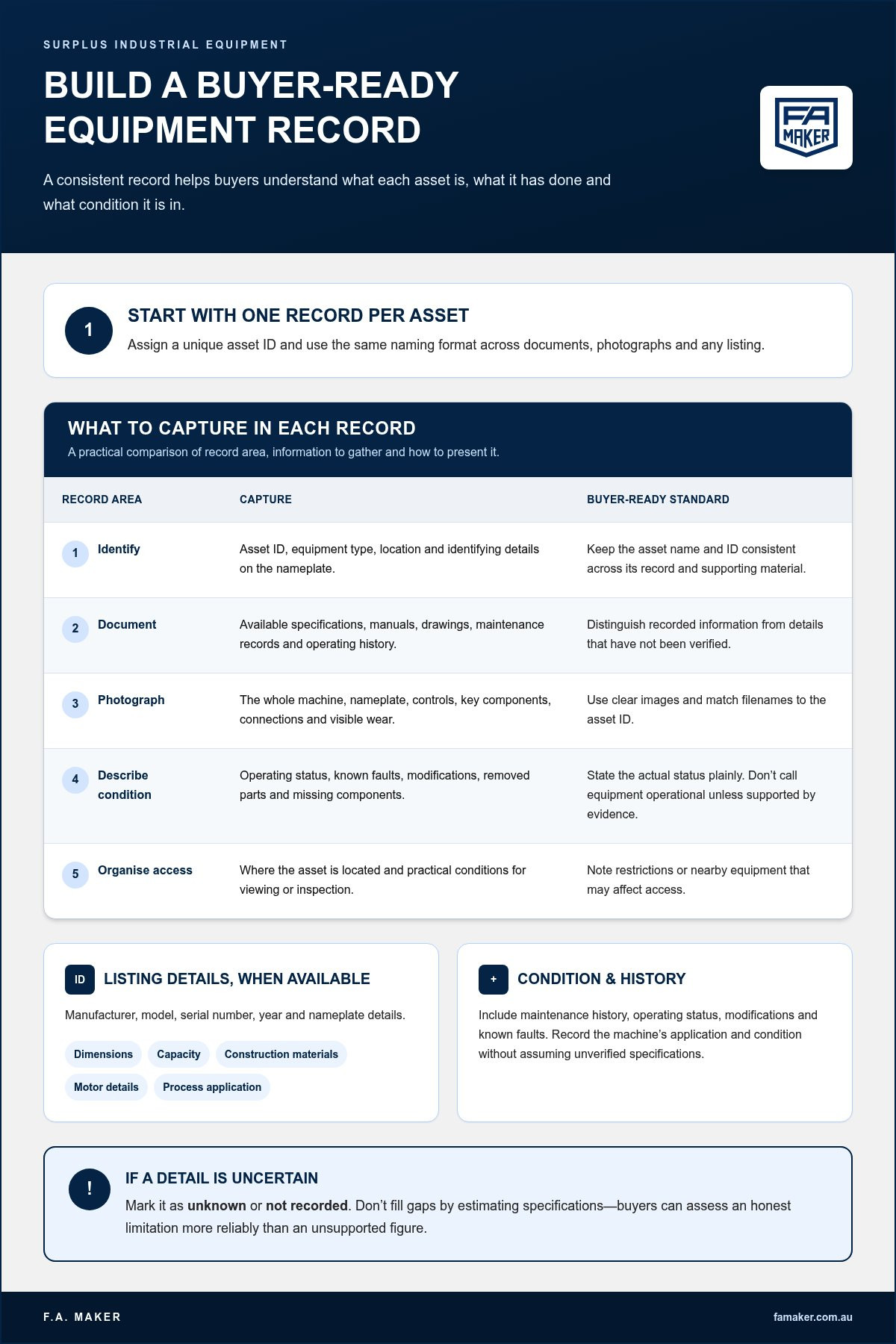
Clear, consistent records help buyers understand what an asset is, what it has done and what condition it’s in. For businesses selling surplus industrial equipment, a complete record also reduces avoidable back-and-forth when buyers compare machinery or plan an inspection. Create one record per asset, use a unique identifier, and apply the same naming format across documents, photographs and any listing.
Build each asset record in a set order:
If information is missing or uncertain, label it as unknown or not recorded. Don’t fill gaps by estimating specifications. Buyers can assess an honest limitation more reliably than an unsupported figure.
Capture the manufacturer, model, serial number, year and nameplate details where available. Add dimensions, capacity, construction materials, motor details and process application when supported by records or direct observation. Include maintenance history, operating status, modifications and known faults, distinguishing documented facts from information that hasn’t been verified. For example, describe a pump’s recorded application and condition rather than assuming its capacity from appearance.
Photograph the nameplate, controls, key components, connections and visible wear. Include an overall view that shows the machine’s configuration, then closer images that clarify details a buyer may need to assess. State whether it’s operating, disconnected, dismantled or untested. Keep manuals, drawings, service records and available test information together, using the asset ID in filenames so each item can be matched to the correct machine.
Accurate equipment records help buyers assess suitability by showing what the asset is, how it has been used and what is known about its condition. A consistent file also makes it easier to update the listing if new information emerges. F.A. Maker supplies used processing equipment, including tanks, separators, mixers, mills, pumps and conveyors. When planning a move, consider how the sale information and removal requirements fit together. Learn more about used processing equipment from F.A. Maker.
Once an asset is ready to market, choose a route that fits its characteristics and your capacity to manage the sale. An auction can expose equipment to competing bidders, while a direct sale gives the seller more involvement in finding and negotiating with a buyer. A specialist equipment channel may connect an asset with buyers familiar with a particular machinery category. None is automatically the best fit.
| Sale route | Buyer reach | Seller workload | Control over terms | Removal coordination |
|---|---|---|---|---|
| Auction | Can reach multiple bidders, depending on the auction and how the asset is presented. | Preparation and buyer enquiries may be handled through an auction arrangement; seller tasks vary. | Reserve or unreserved formats affect the seller’s control over the sale outcome. | Responsibilities and deadlines depend on the auction conditions. |
| Direct sale | Depends on the seller’s network, outreach and the asset’s relevance to potential buyers. | The seller generally manages enquiries and negotiations. | Seller and buyer can negotiate terms directly, subject to their agreement. | The parties need to agree who arranges and pays for removal. |
| Specialist equipment channel | May connect machinery with buyers interested in a defined equipment category. | Workload depends on the channel’s role and the agreed process. | Control varies with the sale structure and the parties’ terms. | Confirm responsibilities as part of the arrangement. |
Use the comparison as a starting point, then assess the asset’s type, condition, documentation and required timing. A clearly identified machine with a documented operating status may be easier to present through several routes. An incomplete or untested asset may need more explanation, which can affect the time and effort required to manage enquiries. Consider removal at the same time: a sale route only works operationally if access and collection can be coordinated within the site’s constraints.
Competitive bidding can suit machinery with identifiable market interest, particularly when the seller wants to expose an asset to multiple potential buyers. Auction formats differ. A reserve sets a minimum acceptable sale threshold, while an unreserved auction doesn’t use that threshold. Neither format guarantees a particular outcome. Auction conditions, fees and seller responsibilities vary by arrangement, so understand how the terms affect control, timing and collection before committing.
A direct approach may suit a clearly specified asset when the seller can identify relevant businesses and manage discussions. A specialist equipment channel may understand the terminology and applications associated with processing machinery, such as separators, mixers or mills. The level of support, seller control and removal coordination depends on the arrangement. Compare those practical responsibilities, not just the route’s potential reach, before deciding.
For selling surplus industrial equipment, match the route to the asset, how well its condition can be assessed and how much sale administration the business can take on. Set out the terms and removal responsibilities clearly so the sale process aligns with site requirements.
A sale isn’t complete operationally until buyers can inspect the equipment and the machinery can leave the site under an agreed plan. Access constraints, production schedules and removal responsibilities all affect how the process needs to be arranged. For selling surplus industrial equipment, treat inspection and removal as linked stages rather than tasks to resolve after a sale is agreed.
Work through the arrangements in sequence:
Give the site contact enough information to manage the visit: the asset’s location, the proposed access window and any relevant site procedures. Keep identification and records available, and make visible condition details accessible for review. Coordinate the visit with production and maintenance teams if the equipment is near operating processes. An inspection should not disrupt work or prompt unauthorised changes to the machine.
Map the machine’s route from its current position to the site exit. Note tight turns, changes in floor level, overhead restrictions, door clearances and areas that may need to remain clear. Align the removal plan with production, maintenance and facility teams, then confirm timing and responsibilities with the buyer. Complex moves benefit from deliberate relocation planning rather than assumptions made on collection day.
Removal planning is especially relevant for processing assets such as stainless steel tanks, centrifuges, mixers and conveyors, where location and access can shape the work involved. F.A. Maker provides machinery relocation services, connecting equipment handling with practical site planning. Its industrial machinery relocation guide outlines considerations for planning a move. Use the guide to build a removal plan around the equipment, site access and responsibilities involved.
A sound decision follows a clear sequence: confirm the equipment is genuinely surplus, prepare a reliable record, select a sale route that fits the asset and your requirements, then plan inspection access and removal. Each step informs the next. For example, an asset’s condition and documentation may affect how you present it, while the site’s access constraints can influence collection planning and timing.
Before starting a discussion about selling surplus industrial equipment, assemble a concise handover file for each asset. Include:
This gives the conversation a practical starting point without overstating what is known. It also helps distinguish the sale decision from the separate work of preparing machinery for inspection, dismantling or transport.
Bring the records you have, even if some fields are incomplete. A readable nameplate photograph, a clear note that a machine is untested, or a maintenance log with gaps is more useful than a guessed specification. Add the person responsible for the asset decision and any relevant site contact. This makes it easier to consider equipment details and access planning together.
F.A. Maker specialises in used processing equipment, including stainless steel tanks, centrifuges, separators, mixers, mills, pumps, valves and conveyors. Its range provides relevant context for discussing an asset’s role and available information. The business is family-owned and has a history dating to the 1920s. F.A. Maker also provides machinery relocation services when equipment movement is part of the plan.
When evaluating surplus machinery, keep the assessment grounded in the asset’s actual details: its condition, records, intended use and removal requirements. These factors help shape a practical sale and relocation plan.
With the asset list, records and site considerations assembled, you can move to a focused conversation about the practical options. Review F.A. Maker’s used processing equipment and machinery relocation services as you plan your next steps.
A surplus asset decision can also sharpen how your business manages future plant changes. Record why equipment is being released, what its operating history shows and which site factors shaped its removal. That information can help teams make later decisions with a clearer view of the asset’s role and the practical requirements around moving it.
For businesses weighing up selling surplus industrial equipment, a focused plan brings the machinery details and relocation needs into context. F.A. Maker is a family-owned Australian business with experience developed across several generations and a history dating to the 1920s. Its work in used industrial processing equipment and machinery relocation is relevant to businesses considering their next steps.
When you’re ready to plan the move, contact F.A. Maker about machinery relocation services.
Start by confirming the business has authority to sell the asset and that it isn’t committed to another site or production line. Then decide whether to offer it individually or as part of a group of related equipment, such as a process line with its ancillary components. The right approach depends on the asset and your requirements. Keep an internal record of the decision and any conditions that must be met before the equipment can leave.
Provide enough detail to distinguish the machine from similar assets and make clear what is included in the sale. Alongside its identifying information, list associated items such as control panels, tooling, guards or detachable components, and state whether these are included or separate. Note the equipment’s previous process application if known. Clear boundaries matter: a buyer should be able to tell whether the offer covers one machine, connected equipment or a larger production package.
Neither route is universally better. Consider whether the asset is best offered on its own, grouped with related machinery or presented as part of a larger plant change. An auction may provide a defined sale event, while direct discussions can allow more control over negotiation and terms. Your decision should account for the time available, the level of administration your team can manage and whether you need to coordinate several assets together.
Yes, equipment that isn’t operating may still be offered for sale, but describe its status precisely. Distinguish between a machine that’s disconnected but previously operated, one that hasn’t been tested, and one with a known fault. Include when it was last used if that information is available, and identify missing parts or changes from its original configuration. Don’t imply it can be demonstrated or is ready for production if that hasn’t been established.
Keep the machine and its associated components identifiable as you prepare it for review. Separate unrelated items from the equipment, but retain and label any parts intended to be included. Avoid changing the machine’s configuration or removing components without updating the asset information. If cleaning is planned, coordinate it with site procedures and the equipment’s condition. The goal is to present the asset clearly, not to conceal wear or make unsupported claims about its performance.
Responsibility depends on the sale arrangement, so define it before collection is scheduled. State who will arrange isolation, dismantling, loading, transport and any site preparation, rather than relying on assumptions about what “collection” includes. Also agree how access will be coordinated with site personnel and what condition the area should be left in. A written allocation of tasks helps the seller, buyer and site team work to the same removal plan.