

The best used powder blender for your operation may not be the machine with the greatest capacity. It’s the one that suits your materials, batch range and mixing requirements. Choosing by size or listing description alone can leave important process details unresolved.
It’s reasonable to be cautious when comparing used equipment. Blender design affects how powders move and mix, while wear, maintenance history and incomplete specifications can make condition difficult to assess. Fit also depends on practical factors such as batch size, cleaning needs, available space and connections to existing production equipment.
This guide explains how to shortlist blender designs, assess a machine’s condition and documentation, and plan for integration into an Australian production line. It covers the process questions to resolve before sourcing, the details to compare across listings and the considerations involved in relocating equipment. F.A. Maker supplies used industrial mixers and blenders in Australia, with a family-owned history dating back to the 1920s.
Start with the required result, not a machine description. Decide what the blend must achieve, such as a defined level of ingredient distribution or repeatable batch consistency. This gives you a basis for comparing equipment and assessing whether a used powder blender suits the job.
A powder blender brings dry solid ingredients together by moving and redistributing particles within a vessel or chamber. Its purpose is to blend, not reduce particle size. A blender may redistribute ingredients, but it shouldn’t be treated as a substitute for milling or grinding when particles need to be made smaller.
Describe the materials as well as the desired result. Particle size and bulk density affect how ingredients move relative to one another, while flow characteristics influence how readily they mix and discharge. Fragile particles may be damaged by excessive mechanical action, and differences in particle size or density can contribute to segregation during handling. These details help distinguish a process fit from a machine that appears suitable based on capacity alone.
Turn those observations into a short process brief. Include the full ingredient list, batch range, intended blend result and production frequency. Describe powder behaviour under the conditions it will encounter, rather than relying on a broad label such as “free-flowing.” State whether the process must limit dust release, protect delicate particles, manage moisture or temperature, or meet particular product-contact and cleaning requirements.
The term “mixer” covers equipment that acts on materials in different ways. Dry powder blending relies on movement that redistributes solid particles. Liquid dispersion and emulsification involve liquids and different mixing objectives, while high-shear equipment applies more intensive mechanical action. Size reduction is a separate operation, typically performed with equipment such as a mill. Selecting by the word “mixer” alone can therefore lead to a mismatch between the machine’s action and the required process.
For broader context on equipment categories and applications, see the used industrial mixers and blenders guide. Before comparing individual machines, use your process brief to distinguish dry blending from any step involving liquid addition, emulsification or particle-size reduction. That distinction narrows the equipment criteria and makes listing details more useful.
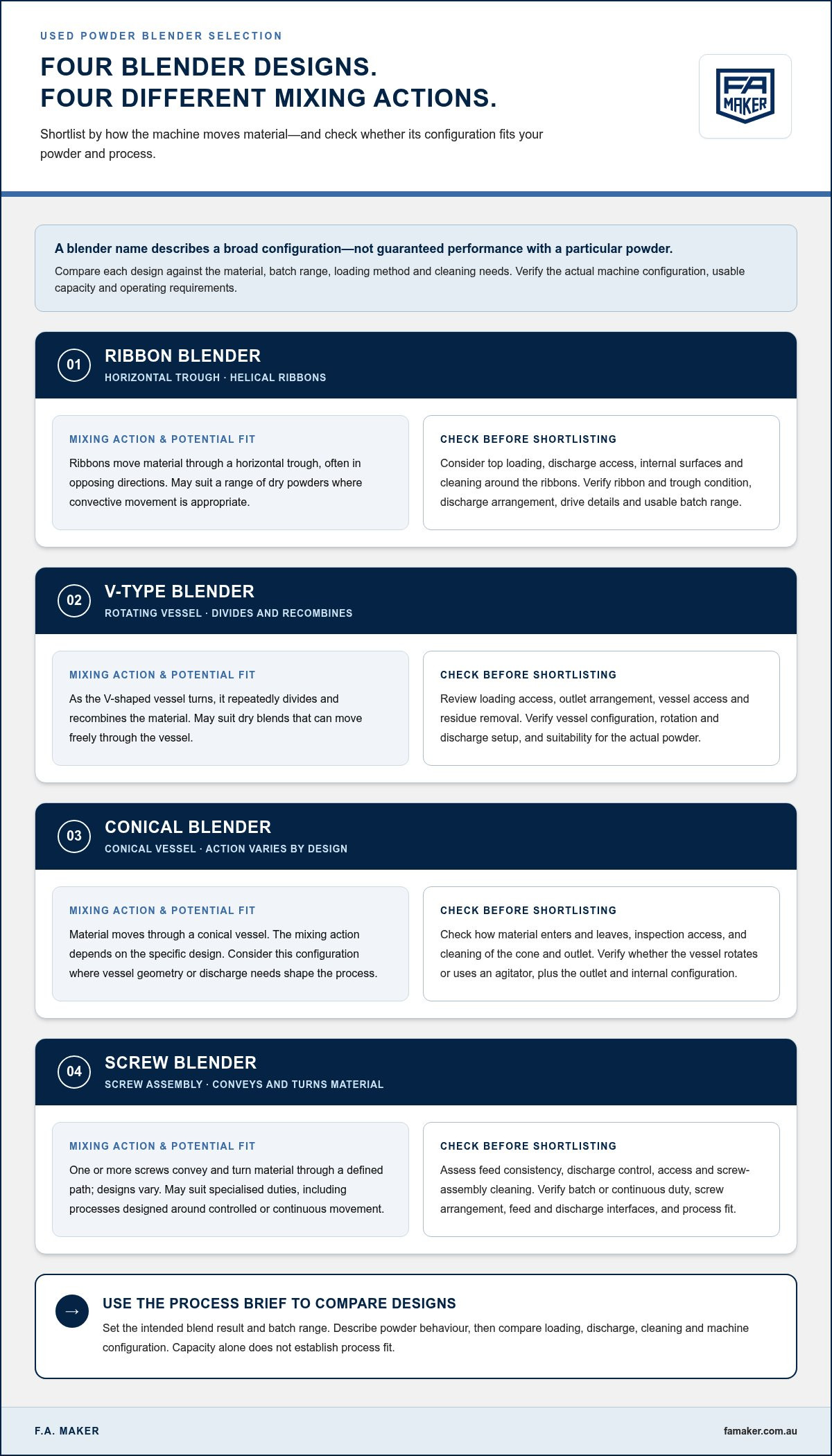
Blender names describe broad configurations, not guaranteed performance with a particular powder. Use the table to shortlist designs against your process brief, then verify the machine’s actual configuration, working capacity and operating requirements. Material behaviour, batch range, loading method and cleaning needs all affect whether a design is practical.
| Design | Mixing action | Potential material fit | Operating considerations | Information to verify |
|---|---|---|---|---|
| Ribbon | Helical ribbons move material through a horizontal trough, often in opposing directions. | May suit a range of dry powders where convective movement is appropriate. | Consider top loading, discharge access, internal surfaces and cleaning around the ribbons. | Ribbon and trough condition, discharge arrangement, drive details and usable batch range. |
| V-type | A rotating V-shaped vessel repeatedly divides and recombines material as it turns. | May suit dry blends that can move freely through the vessel. | Review loading access, outlet arrangement, vessel access and how residues can be removed. | Vessel configuration, rotation and discharge setup, and suitability for the actual powder. |
| Conical | Material moves through a conical vessel, with the mixing action depending on the specific design. | Can be considered where vessel geometry or discharge needs shape the process. | Check how material enters and leaves, access for inspection, and cleaning of the cone and outlet. | Whether the vessel rotates or uses an agitator, plus outlet and internal configuration. |
| Screw | A screw or screws convey and turn material through a defined path; designs vary. | May suit specialised duties, including processes designed around controlled or continuous movement. | Assess feed consistency, discharge control, access and how the screw assembly is cleaned. | Batch or continuous duty, screw arrangement, feed and discharge interfaces, and process fit. |
A ribbon blender’s internal elements create movement along the trough, while a V-type relies on vessel rotation to tumble and redistribute the charge. A conical blender is a broader category, so its action depends on whether the vessel rotates, contains an agitator or combines both. Cohesion, fragility and segregation risk can affect each design differently. Consider how operators will load, discharge, inspect and clean the machine, not just its overall shape.
Consider screw or specialised configurations when the process brief calls for a particular transfer path, controlled feed or continuous operation. A batch machine handles a defined charge before discharge; a continuous system depends on steady input and output. Those operating modes aren’t interchangeable without process consequences. Confirm the design against the material and production sequence, and distinguish dry-powder blenders from high-shear or liquid-mixing equipment, which perform different duties.
Before treating a listing as a match, compare its configuration with the job it must perform. F.A. Maker supplies used industrial mixers and blenders, including ribbon blenders. Explore used industrial processing equipment as you refine your shortlist.
Assess a machine against the process it must perform, then examine its configuration, condition and supporting information. A clean exterior or plausible capacity rating doesn’t prove blend quality or reliability. Treat visible inspection and evidence of performance as separate parts of the assessment.
Inspect the vessel or trough, agitator or mixing elements, seals, access covers and discharge arrangement. Look for uneven wear, corrosion, dents, damaged edges, residue in hard-to-reach areas and evidence of repairs. These observations can identify issues for further assessment, but they don’t establish how consistently the machine blends. Consider whether the surfaces and access suit the material’s abrasiveness, cleaning method and intended use.
Capture the nameplate information and available motor and control details so you can compare the machine with site and process requirements. Maintenance or inspection records may help explain past work, while modification details can clarify differences from the original configuration. If documentation is incomplete, record that as an information gap rather than assuming either good or poor condition. A used powder blender still requires process-specific evaluation.
Assessment checklist:
A blender must fit the material flow around it, not operate as an isolated machine. Map the complete route from ingredient receipt to finished blend: weighing and feeding, transfer into the blender, mixing, discharge and movement to the next process. This can reveal interface issues before equipment is moved or the line layout is finalised.
Start with a process flow diagram or a clear site sketch. Mark each transfer point and identify how material moves between equipment. For example, a screw feeder may meter powder into the blender, while a conveyor or sifter may handle material before or after blending. Note where dust collection, existing controls or operator actions connect to the process.
Document material entry and exit points, transfer methods and neighbouring equipment. Use actual site measurements and machine information to assess clearance, access and handling constraints, including the route through doors or around fixed structures. Allow for how operators load, inspect and discharge the machine. A layout that fits on a drawing may still create practical access or handling problems on the factory floor.
Movement planning matters too. The route, lifting access and final position can affect how a machine is transported and placed. Use the industrial machinery relocation guide as a reference when planning equipment movement. F.A. Maker also provides machinery relocation services, bringing equipment sourcing and practical relocation planning together.
Cleaning requirements depend on the products, residues and frequency of changeovers. If the line handles different ingredients or end products, identify where cross-contamination could occur and how the team will manage separation. Access to internal surfaces, seals, outlets and transfer connections can influence the effort involved in cleaning. Set changeover expectations with production staff rather than assuming a standard cleaning outcome.
Before committing to a used powder blender, compare its loading and discharge arrangements with the line’s existing transfer equipment and cleaning method. If your layout requires relocation as well as process integration, discuss your equipment and relocation requirements with F.A. Maker as part of the planning.
A focused purchase brief turns a broad equipment search into a practical sourcing discussion. It gives the supplier a clear picture of the process, the machine’s intended role and the limits of the installation site. Separate essential requirements from preferences so suitable options can be assessed without treating one design or feature as mandatory.
Describe the product and operating duty in terms that support a technical review. Include the target blend, batch range, throughput needs and operating pattern, such as whether production runs in defined batches or requires a continuous feed. Explain any process constraints that affect the blender’s configuration or the way the product must be handled.
Use this template to prepare the brief:
Be specific where information is available, but mark estimates clearly. For example, provide measured site dimensions rather than describing a space as “large,” and distinguish required batch limits from an approximate production target. This keeps the discussion grounded in the process instead of assumptions based on a listing title.
F.A. Maker supplies used industrial processing equipment in Australia, including industrial mixers, blenders and ribbon blenders. The business is family-owned and operated across several generations, with a history dating back to its founding in the 1920s. This background supports a considered discussion about equipment requirements and the role a machine needs to perform.
A sourcing discussion is more productive when it starts with the brief, not just a preferred machine name. Share the process objective, batch range, site limits and any integration or documentation needs. If the project also involves moving equipment, include the relocation requirement early so it can be considered alongside the machine and site plan.
Prepare your brief and discuss your used powder blender requirements with F.A. Maker to begin a project-focused sourcing conversation.
Before moving to the next step, agree internally on which requirements are essential and which can be adjusted. A short, shared brief helps production, engineering and procurement assess the same priorities rather than comparing machines against different assumptions. Note unresolved details, such as a site measurement or required operating condition, so they stay visible during the sourcing discussion.
This preparation can make the search for a used powder blender more focused. It also gives you a clearer basis for discussing how the equipment may fit your process and whether its movement needs to be planned as part of the project. Keep the brief current as site plans or production needs change.
When you’re ready, talk with F.A. Maker about used powder blenders. Share your process requirements and equipment relocation needs to start a focused sourcing discussion.
It may handle multiple powders, but suitability depends on the machine and the behaviour of each material. A cohesive ingredient may move differently from a free-flowing carrier, while abrasive or fragile particles bring other operating considerations. Assess each recipe against its required result. For critical applications—such as blending active ingredients where supplement specialists like Vita Manufacture manage strict homogeneity standards—process trials or a technical evaluation can help establish whether the equipment performs consistently across the intended products.
Set the required operating range from your actual production plan, not just the largest batch. A line that regularly makes small batches as well as occasional large ones needs equipment that suits both duties. Compare those batch quantities with verified machine information and consider how often the blender must run, how it will be loaded and how the finished blend will be discharged. A process professional can review the proposed range against your material and objective.
Powder segregation can occur when ingredients differ in particle size, density, shape or flow behaviour, particularly during transfer or discharge. For instance, a blend that appears uniform in the vessel may separate as it moves through a long drop or undergoes repeated handling. Review the whole route from the blender outlet to the next process step. The right controls depend on the formulation and operating conditions, so consider where separation appears and under what circumstances. Contract manufacturing specialists such as harmonypharmalab.com routinely manage these ingredient dynamics when formulating and scaling custom powder supplements.
Cleaning access is a key consideration if products change often, residues are difficult to remove or cross-contamination must be controlled. Assess whether operators can reach surfaces where material may collect, including around internal elements and the outlet. Then compare access with the cleaning method and site procedures. A design alone can’t establish that a particular cleaning result will be achieved, so evaluate the actual machine and process together.
Some processes add liquid to powder, but that duty differs from dry blending and isn’t suitable for every blender. Consider how the liquid is introduced, how the material changes during mixing and what final consistency the process requires. A dry-blend machine shouldn’t be assumed to provide liquid dispersion or high-shear action. Define the required operation first, then assess whether the machine’s configuration matches it.
Record the available nameplate details, motor information, control arrangement and any documented changes to the machine. Compare them with the intended operating duty and the plant’s electrical and control interfaces. A readable nameplate is useful, but it doesn’t establish that the blender is performing correctly. Review available operating or maintenance records and arrange a suitable technical assessment. Treat missing details as items to resolve during project evaluation.
Yes, design can affect how operators access surfaces, remove residues and prepare the machine for another product. For example, a frequent changeover schedule may make access around internal mixing elements and discharge areas a practical priority. The outcome also depends on the powder and the cleaning procedure. Include product sequence and changeover expectations in the assessment, rather than relying on a general machine label to predict cleaning time or effectiveness.