

What if the right machine for your next production step isn’t new? The benefits of buying refurbished industrial machinery can include a lower initial outlay and access to equipment that suits your process. But the label alone doesn’t tell you what work has been done or whether the machine will perform as needed in your plant.
It’s sensible to look beyond labels. “Used,” “reconditioned” and “refurbished” can describe different levels of inspection and repair. Compatibility, installation and ongoing support also affect the value of a purchase. Base your decision on the specific machine’s condition and fit, not on an assumed saving.
This guide explains the practical advantages refurbished equipment may offer and how to assess them before committing. You’ll learn what to check in a machine’s condition and documentation, how to compare its capabilities with your production requirements, and how to plan for testing and relocation. F.A. Maker offers workshop test runs to help buyers assess a specific machine, along with sourcing and machinery relocation support. The goal is a repeatable way to decide whether a particular tank, mixer, pump, centrifuge or conveyor can meet your operational needs.
Refurbished industrial machinery is previously operated equipment that has been restored or serviced to a stated scope, with its current condition assessed against the buyer’s requirements. The term does not, by itself, specify which components were replaced, what testing was completed or whether the machine suits a particular process. Refurbishment has no single scope that applies to every machine, so ask for details about the individual asset.
This distinction matters when weighing the benefits of buying refurbished industrial machinery. A label may indicate that work has been carried out, but it doesn’t say whether that work addressed wear, a known fault, controls or another specific requirement. The scope of work and the supporting evidence make the label useful.
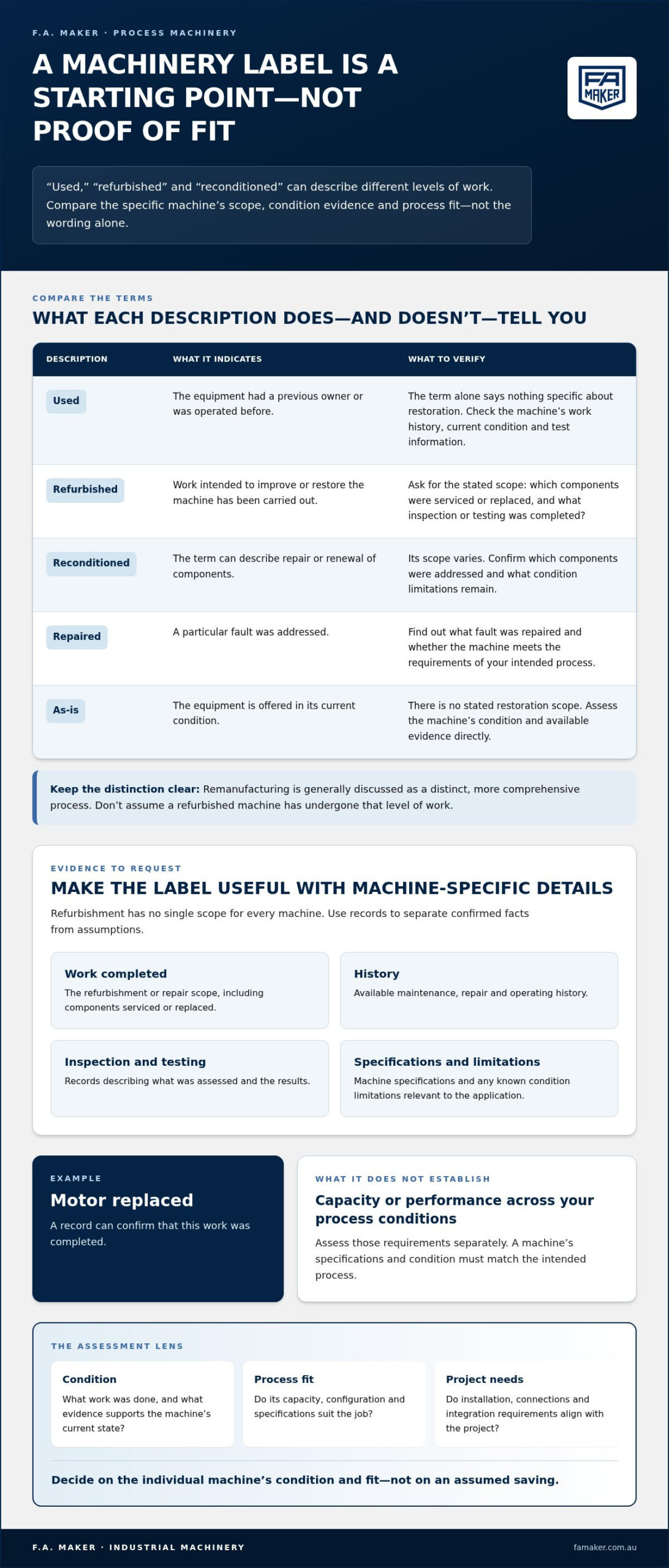
Used describes equipment that has had a previous owner or been operated before. It says nothing specific about restoration. Refurbished indicates work intended to improve or restore the machine, but the extent should be stated. Reconditioned can describe the repair or renewal of components, though the term’s scope varies. A repair usually addresses a particular fault. Equipment sold as-is is offered in its current condition without a stated restoration scope.
These descriptions can overlap in everyday use, so compare the actual work completed rather than relying on the wording alone. Remanufacturing is generally discussed as a distinct, more comprehensive process. Don’t assume a refurbished machine has undergone that level of work.
A machine’s suitability depends on its specifications and condition in relation to the intended process. A refurbished mixer may still have an unsuitable capacity or configuration for a production line. Prior use alone, likewise, doesn’t establish that a pump or conveyor is unsuitable. Assess evidence about the individual machine and the job it needs to do.
Useful information may include:
Records help separate confirmed facts from assumptions. For example, a note that a motor was replaced describes work completed, but doesn’t establish the machine’s capacity or performance across your process conditions. Assess those requirements separately.
Apply the same discipline to any listing: confirm the specific machine’s condition, work history and testing information rather than assuming every item described as used or refurbished has received the same work. The label is a starting point, not proof of process fit or operating performance.
The benefits of buying refurbished industrial machinery are practical, not automatic. A suitable second-hand machine may help preserve capital for other parts of a project, provide another procurement option and fit an established workflow. Each advantage depends on the asset’s condition and application fit. Its specifications, demonstrated operating condition, integration requirements and role in the production line all need to align.
Assess the whole project, not just the purchase. A machine that fits the process on paper may still require changes to the layout, connections, controls or material handling. Those requirements can affect the budget and schedule available for installation, commissioning and other facility priorities.
A second-hand asset gives project teams another option to consider when meeting an equipment requirement alongside other facility investments. Compare the machine’s purchase terms and required preparation with competing priorities, such as site modifications, utilities, integration or production capacity elsewhere. This is a planning exercise, not a presumed saving: the value depends on what the specific asset needs before it can perform its intended role.
Include operation and maintenance in your equipment lifecycle planning. NetSuite’s overview of equipment lifecycle management provides useful context for treating acquisition as one stage in a longer operational decision.
Equipment already on the market may provide an alternative procurement route for a project. Stock status alone, however, doesn’t establish when equipment can be dispatched, installed or brought into production. Allow time to assess the asset, organise transport and complete any required site work.
Familiar equipment types may also fit an established workflow, provided the specifications and interfaces match. A pump needs to suit the process duty and connections; a conveyor must work with the material flow and available space; a mixer must match the batch or production requirements. The equipment category is a starting point, not proof of compatibility.
Before deciding, map the machine’s role and requirements against the project plan:
F.A. Maker offers used process equipment, including pumps, conveyors and mixers, and product sourcing for buyers looking beyond current stock. Explore process equipment options as one step in assessing how an asset may fit your project. The decision still depends on the specific machine, its documented condition and the work it needs to do.
Prior use alone doesn’t establish whether a machine is suitable. The decision turns on whether its documented specifications, condition and support align with the process and project plan. A refurbished asset may be worth evaluating when it meets the required duty and its condition can be assessed. If it doesn’t meet key requirements, another route may be more appropriate.
Compare options against the same criteria rather than assuming one category is inherently better. This makes the potential benefits of buying refurbished industrial machinery easier to assess for a specific application. For a broader overview of the trade-offs, see this used versus new industrial equipment comparison.
Start with the process: define the machine’s role, required capacity, materials handled and operating conditions. Then compare those requirements with the specific asset’s documented specifications and condition evidence. Consider what happens if the machine is unavailable, needs additional work or cannot integrate with the rest of the line. These factors help set a practical threshold for evaluating alternatives.
| Option | Application fit | Condition evidence | Availability, timing and support |
|---|---|---|---|
| Refurbished equipment | Assess capacity, materials, dimensions and interfaces against the process. | Review the stated restoration scope, machine records and available test information. | Check the asset’s actual stock status and account for assessment, transport and installation planning. |
| Used equipment sold as-is | Prior use does not determine fit; compare specifications with the same process requirements. | Establish the known condition and available operating or maintenance history. | Evaluate the work needed and how it fits the project schedule and available support. |
| New equipment | Consider it where process requirements call for specifications unavailable in the options under review. | Assess the supplied specification and documentation for the intended application. | Include procurement and integration planning in the project timeline. |
| Refurbish equipment you own | Determine whether the existing machine can continue to serve the process after the planned work. | Base the decision on its current condition and the work required. | Plan around the work scope and the equipment’s role during the project. |
A refurbished machine may not be the right choice if it has a material specification gap, lacks evidence needed for a sound assessment or requires changes that conflict with project priorities. A new machine may merit evaluation when the required configuration isn’t available among suitable second-hand options—a dynamic seen in sectors like commercial catering and food production, where operators often evaluate dedicated equipment manufacturers like hopkins.biz alongside refurbished models. Refurbishing equipment you already own is a separate decision: it concerns the condition and potential of that asset, not the selection of another machine.
There’s no universal winner. Compare documented capability, condition, timing and practical support for each option. If a route can’t meet the process requirements, its apparent procurement advantage may not matter.
A structured assessment turns a machine listing into a practical procurement decision. Work through the process in order: establish what the operation needs, compare the machine’s details, assess its condition and work history, then arrange testing where appropriate. This keeps the review focused on the specific asset rather than assumptions about refurbished equipment generally.
Specifications are useful when they answer the requirements of your process. For example, a tank’s capacity and material must suit its intended use, while a pump’s connections and operating requirements need to match the system. Review the available records alongside the physical condition and work completed. A specification sheet can describe configuration, but it doesn’t replace an assessment of the individual machine.
For buyers assessing tanks, the used stainless steel tank sourcing guide offers more specific sourcing considerations.
F.A. Maker offers workshop Try Before You Buy test runs. A test run lets buyers observe a specific machine in operation and assess relevant functions before purchase. Use it alongside the machine’s specifications and condition information. A workshop test doesn’t, by itself, establish how the equipment will perform once integrated into a different plant or process.
Plan relocation separately from selection. Access, disassembly, transport and reassembly can all affect how a machine moves into its new facility. F.A. Maker’s machinery relocation services can include these stages. The industrial machinery relocation guide covers move-planning considerations.
Use this assessment sequence to evaluate the available process machinery against your application and facility requirements.
A considered purchase involves more than finding a machine in the right category. Buyers need a practical way to identify suitable equipment, assess a specific asset and plan how it will reach the facility. F.A. Maker supports this process through product sourcing, workshop test runs and machinery relocation, helping buyers evaluate equipment against their project requirements.
F.A. Maker is an Australian, family-owned business founded in 1928, with over 85 years of experience supplying process equipment. Its machinery categories include tanks, centrifuges, mixers, pumps and conveyors. Condition, refurbishment scope and testing history are specific to each machine, so assess the individual asset rather than assuming all used equipment has received the same work.
If the required machine isn’t currently available, F.A. Maker’s product sourcing service helps buyers look for equipment suited to their application. Once a specific machine is under consideration, F.A. Maker offers workshop Try Before You Buy test runs. These let buyers observe the equipment in operation and consider its function alongside the available specifications and condition information.
F.A. Maker also offers engineering and mechanical repairs, including repairs, custom fabrication and full mechanical overhauls. These services aren’t a blanket description of every machine offered. The work required depends on the particular asset and its condition. Focus the assessment on what has been done, what remains necessary and how the machine’s documented capabilities match the intended process.
Equipment selection and relocation are connected, but they’re separate planning stages. Before a machine moves, consider how it will be removed, transported and positioned at the destination. F.A. Maker’s machinery removals and relocations can include disassembly, transport and reassembly, helping buyers plan the physical move as part of the wider procurement process.
Worldwide shipping is also offered. Consider transport arrangements alongside the machine’s dimensions, site access and installation sequence, so the move fits the project plan. Prices are available on request.
The benefits of buying refurbished industrial machinery depend on sound evaluation and practical support, not the label alone. To explore process equipment options for your operation, visit F.A. Maker’s industrial process equipment.
Before moving forward, turn the production need into a concise purchasing brief. Separate essential specifications from preferences, identify the evidence your team needs to make a decision, and map the machine’s role within the wider project. This gives technical and procurement teams a shared basis for assessing options and reduces the risk of focusing on the equipment label instead of its operational fit.
The benefits of buying refurbished industrial machinery matter when a specific asset can meet your process requirements and its condition, testing and support align with the project. There’s no need to decide on a category in the abstract. Start with the job the equipment must do, then assess suitable machinery against that requirement.
F.A. Maker supports buyers exploring industrial process equipment, with sourcing, repairs, relocation and worldwide shipping among its services. Explore F.A. Maker’s industrial process equipment as you plan your next purchase. A clear brief and considered assessment can help you move ahead with confidence.
It can be, provided the particular machine’s condition and capabilities suit the production duty. Review its service and repair history, the work completed and any available test information. Consider how it will operate within your line, including the demands placed on connected equipment. The benefits of buying refurbished industrial machinery depend on this machine-specific assessment. The refurbished label alone can’t establish reliability or guarantee production performance.
Yes. F.A. Maker offers workshop Try Before You Buy test runs for machinery. A test run gives you a chance to observe the specific machine operating and assess relevant functions against your intended use. Before attending, identify the operating behaviours that matter to your process, such as movement, mixing action or material flow, where applicable. Use your observations alongside the machine’s specifications and condition information.
There isn’t one set price for refurbished industrial machinery. The amount depends on the individual asset, its specifications, condition and work history. F.A. Maker prices are available on request. To make a useful comparison, define the configuration you need and consider project requirements associated with the purchase, such as transport and site preparation. This helps your team evaluate options consistently without relying on general market estimates.
Yes. F.A. Maker offers product sourcing for buyers looking for machinery that isn’t currently available. Provide a clear description of the required function, capacity, materials and essential configuration details. For example, a buyer seeking a mixer for a defined production task can use these requirements to guide the search. Sourcing broadens the options under consideration, while the final machine still needs an individual suitability and condition assessment.
Yes. F.A. Maker offers worldwide shipping for industrial machinery. Shipping arrangements form part of the purchase plan, particularly for large process equipment that may require specific packing or loading. Timing and transport details depend on the individual shipment and destination. Include the delivery location and site access needs in your planning so transport can be considered alongside equipment selection and the facility’s readiness to receive it.
Yes. F.A. Maker provides machinery removal and relocation services that can include disassembly, transport and reassembly. This can help coordinate the move of process equipment from its current location to a facility. Plan the route, access, equipment position and sequence of work around the machine and site. Relocation is a separate operational stage from selecting equipment, so include it in project planning before arranging the move.