

A mixer built for higher throughput may be the wrong fit for a process with frequent recipe changes. When comparing a continuous mixer vs batch mixer, consider production volume alongside product variation, ingredient behaviour and lot-tracking needs.
Batch mixing processes a defined quantity at a time. Continuous mixing feeds ingredients through the system and produces a steady stream. Either method can deliver suitable results when the equipment and operating conditions match the process.
This guide compares the methods using practical criteria: production patterns, recipe changes, traceability, ingredient properties and the requirements of the rest of the line. Use these factors to build an equipment brief and assess industrial mixers and blenders. Workshop test runs can then help you evaluate a machine against your product and process requirements.
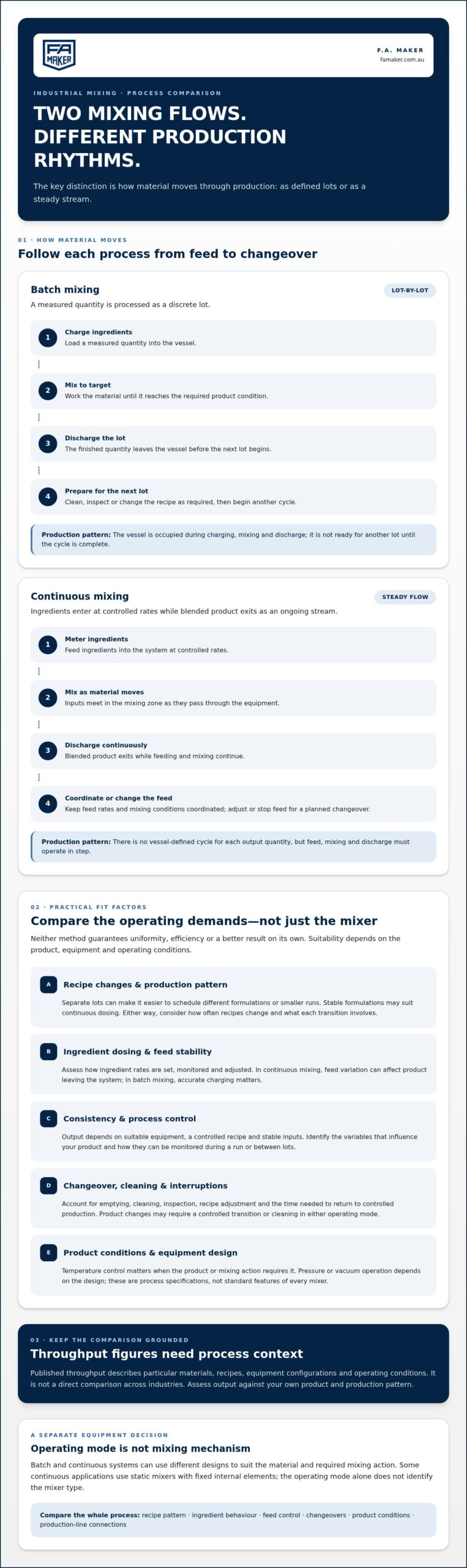
Batch mixing processes a defined quantity as a discrete lot: ingredients are charged, mixed, then discharged before the next lot begins. Continuous mixing feeds ingredients into a mixing zone while blended product exits as an ongoing stream. This distinction describes how material moves through production, not the mixer’s mechanism or design. Neither approach suits every product or process.
Batch flow: Charge ingredients → Mix to target → Discharge lot → Change over or clean → Charge next lot
Continuous flow: Meter ingredients → Mix as material moves → Discharge continuously → Adjust or stop feed for changeover
Operators or an automated system load a measured quantity of ingredients into a vessel. The mixer works the material until it reaches the process target, which may be defined by blend uniformity or another product condition. The finished lot is then discharged. After any required cleaning, inspection or recipe changeover, the vessel is ready for another cycle. Recipe composition and batch size depend on the product, production requirements and equipment.
Ingredients enter at controlled rates and meet in the mixing zone as they move through the equipment. Mixed product exits continuously, so feed rates and mixing conditions need to stay coordinated during operation. Changes in ingredient flow can affect the product leaving the system, making stable feeding and process control central to this method. Continuous operation does not guarantee greater consistency or efficiency; results depend on how the process is configured and controlled.
Mixing mechanism is a separate decision from batch or continuous operation. Batch and continuous systems can use different designs to suit the material and required mixing action. Some continuous applications use static mixers, which have fixed internal elements rather than moving mixing parts. The Static Mixer Wikipedia overview describes how these elements divide and redirect flow to promote mixing. Other systems use different mechanisms, so the operating mode alone does not identify the mixer type.
The flow pattern also determines where production pauses occur. In batch processing, the vessel is occupied during charging, mixing and discharge, and cannot handle another lot until it is ready. Continuous production avoids a vessel-defined cycle for each output quantity, but depends on feed, mixing and discharge operating in step. A recipe or product change may require a controlled transition, adjustment or cleaning. Mapping these stages helps identify the equipment and plant connections the process needs.
The practical difference in the continuous mixer vs batch mixer decision becomes clearer when you examine recipe changes, ingredient dosing and interruptions. A method that suits a long production run may create unnecessary adjustment or cleaning work when formulations change often. A process built around discrete lots may introduce pauses that don’t fit a steady production schedule. Compare the complete operating pattern, not a single claimed advantage.
Discrete batches can make it easier to schedule different formulations as separate lots. Each recipe is prepared and processed as a defined quantity, which can suit frequent changes or smaller runs. Changeovers still take time: the vessel and associated equipment may need emptying, cleaning or adjustment before the next recipe.
In continuous production, dosing equipment feeds ingredients at set rates. This can support repeatable feeding while the formulation and operating conditions remain stable. Changing an ingredient, adjusting a proportion or switching products may require new settings, changes to the feed arrangement or a planned transition. Before comparing nominal run rates, consider how often changes occur and what each changeover involves, including cleaning.
Consistent output depends on suitable equipment, a controlled recipe and stable inputs. In continuous mixing, variation in ingredient feed can affect the product leaving the system. In batch mixing, accurate charging and control of the mixing cycle matter. Neither mode guarantees uniformity on its own. Identify the variables that influence your product, then assess how they can be monitored and controlled during a run or between lots.
Temperature control matters when the product or mixing action requires it; it is not an automatic benefit of either method. Atmospheric requirements also depend on the design. Some equipment can be designed for pressure or vacuum conditions, but these are process specifications, not standard features of every continuous or batch mixer. Britannica’s discussion of continuous mixers describes pumped batter and rotating disks in a baking application, illustrating how equipment and controls reflect a particular product and process.
Be cautious with published throughput figures. They describe particular materials, recipes, equipment configurations and operating conditions, so they aren’t direct comparisons across industries. Start with your own product and production pattern. For context on equipment options, explore industrial mixers and blenders as you define your process requirements.
Compare operating conditions rather than equipment labels alone. A plant making several formulations in planned lots has different priorities from a line supplying a steady stream of one product. The table matches common requirements to potential advantages, but product behaviour and the rest of the process still matter.
| Factor | Batch mixing may suit | Continuous mixing may suit |
|---|---|---|
| Production pattern | Intermittent runs with defined lots | Steady demand and ongoing production |
| Recipe variation | Multiple formulations or frequent changes | A stable formulation produced over a run |
| Ingredient dosing | Ingredients charged for each lot | Ingredients metered into the process as it runs |
| Changeovers | Distinct lots create clear points to change recipes | Transitions and adjustments must be planned for the line |
| Process control | Conditions managed for each defined batch | Feed rates and operating conditions coordinated continuously |
Consider batch processing if production is intermittent, recipes vary or batch sizes change with demand. Separate lots create defined points to record a formulation, adjust the next run and manage a product transition. This can help when different materials need different operating conditions. It doesn’t automatically mean cleaning is easier or quality is higher; those outcomes depend on the product, equipment and changeover procedure.
A continuous system may suit steady demand for a repeatable formulation, particularly when mixing is integrated with upstream ingredient supply and downstream processing. It depends on coordinated feeding and stable conditions across the line. Assess recipe changes, start-up and transitions for the specific setup. If formulations change often, the time and control needed for adjustments may affect the overall fit.
Consider the material and what happens after mixing, too. Powder flow, liquid viscosity, particle differences, moisture sensitivity or a tendency to separate can influence feeding and mixing requirements. The product may next move to a conveyor, sifter, dryer, filler or another process stage. Check that the mixer’s discharge pattern and operating rhythm align with that equipment instead of assessing the mixer in isolation.
Production targets alone don’t settle the continuous mixer vs batch mixer decision. Compare expected run length and recipe range with ingredient characteristics, control needs, lot identification and downstream capacity. High output demand may still require distinct lots. A process with variable ingredients may still run continuously if feeding and controls are designed around those variations. The practical question is how the full line will operate.
Quotable summary: The process requirement determines a mixer’s suitability, not whether its label says batch or continuous.
Define the process requirements before comparing machines. This gives your team a consistent basis for assessing batch and continuous options, checking equipment configuration and identifying integration issues early. Record the details in a process brief that production, engineering and maintenance staff can use together.
Start with the material, production pattern and needs of the rest of the line. Make the continuous mixer vs batch mixer decision after this assessment, rather than relying on assumptions based on a machine’s label.
This brief separates essential requirements from preferences. It also gives equipment evaluation a practical basis: compare a candidate machine’s documented configuration with the material, output, operating conditions and plant connections it must serve. For more context on equipment types and selection considerations, consult the guide to used industrial mixers and blenders.
Compare the machine’s documented configuration with your process brief, including its mixing arrangement and relevant feed and discharge points. F.A. Maker offers workshop machinery test runs through its “Try Before You Buy” service. Where the process and equipment allow, a representative test using suitable material can help your team assess the machine for its intended duty. Decide what to observe beforehand, such as the operating sequence or discharge behaviour.
Use your requirements to explore industrial mixer options on a clear basis for comparison.
Once you’ve defined your product, production pattern and plant requirements, you can assess equipment against a clear brief. F.A. Maker supplies industrial mixers and blenders as part of its used and new process-equipment range. Focus on finding equipment for the process you’ve established, not choosing a machine based on the continuous mixer vs batch mixer label alone.
Bring together the key details from your assessment: material characteristics, recipe range, target output, operating pattern and plant connections. These details help frame the equipment search around its intended duty. If a suitable machine isn’t available, F.A. Maker’s Product Sourcing service will try to find one.
Equipment prices are available on request. A specific enquiry can focus the discussion on your process and equipment configuration, including whether you’re considering a batch or continuous arrangement. If you’re comparing used equipment with other options, the used versus new industrial equipment comparison offers further context.
Equipment selection is only one part of a project. F.A. Maker offers workshop test runs through its “Try Before You Buy” machinery testing service. A test run gives your team an opportunity to assess the machine against your documented requirements. Where the process and equipment allow, use representative material and agree in advance on the operating points you want to observe. A test supports evaluation, but it isn’t a guarantee of results under every plant condition.
Plan for the physical move as well. Access routes, available space and connection locations can affect how equipment is positioned and integrated at the destination facility. F.A. Maker provides machinery relocation services, including disassembly, transport and reassembly. Include relocation requirements early so the selected machine can be considered in relation to the intended plant layout.
A concise process brief gives equipment sourcing, testing and relocation discussions a practical starting point. It keeps the focus on your production requirements and the details that matter for assessment.
Discuss your mixer requirements with F.A. Maker when you’re ready to compare equipment with your process brief.
Turn your production requirements into clear selection criteria. Decide which factors are essential, such as recipe range, output pattern, product characteristics and plant fit, and which are preferences. This keeps discussions focused on what the equipment needs to do in your operation rather than broad claims about either mixing method.
For a continuous mixer vs batch mixer decision, compare suitable equipment against the same documented requirements. F.A. Maker was founded in 1928 and has over 85 years of experience in process equipment. That experience provides a practical starting point for discussing industrial mixer requirements and equipment options.
Bring your process brief to the conversation and use it to guide the next stage of evaluation. Discuss your industrial mixer requirements with F.A. Maker and take a considered step towards equipment that fits your operation.
A batch mixer processes and discharges a defined quantity before starting another cycle. The wider plant can still run continuously while mixing happens in separate batches. For example, production may feed material into a holding stage as the mixer completes a lot. The distinction is between the mixer’s own operating cycle and the schedule of the overall line.
No. Neither method guarantees consistent output on its own. Continuous mixing relies on stable ingredient feed and operating conditions; batch mixing relies on repeatable charging, mixing and discharge procedures. Product characteristics, equipment configuration and process management also influence results. For the continuous mixer vs batch mixer decision, compare how reliably each proposed setup can meet the product’s defined requirements under the intended operating conditions.
Yes. A continuous system can accommodate multiple recipes, but changing formulations may require adjustments to ingredient feeds, process settings or equipment configuration. The work involved depends on how much the recipes differ and how the line is designed. For example, changing one ingredient proportion may call for a different adjustment from introducing a new ingredient. Consider the frequency and complexity of transitions alongside the option of separating production into batches.
Prepare a short process brief covering the material, ingredient forms, desired product characteristics, production pattern, recipe variation and target output. Add practical plant details, including available space, access for installation, feed and discharge arrangements, and downstream connections. A clear brief helps compare a machine’s documented configuration with its intended duty. Note which requirements are essential and which are preferences to keep equipment discussions focused on process fit.
Yes. F.A. Maker offers workshop machinery test runs through its “Try Before You Buy” service. Before a run, provide process information and agree on what you want to evaluate, such as the operating sequence or how the material discharges. Use representative material where the process and equipment allow. A focused test gives buyers a practical basis for assessing a machine against their requirements, beyond relying on a general description.
Both methods can suit food and chemical manufacturing, depending on the material, production pattern, recipe changes and required process controls. A dairy process, confectionary line or chemical operation may each have distinct product and operating demands, even within the same sector. Start with the material and intended process, then assess equipment accordingly. An industry label alone won’t determine whether batch or continuous mixing is the right arrangement.