

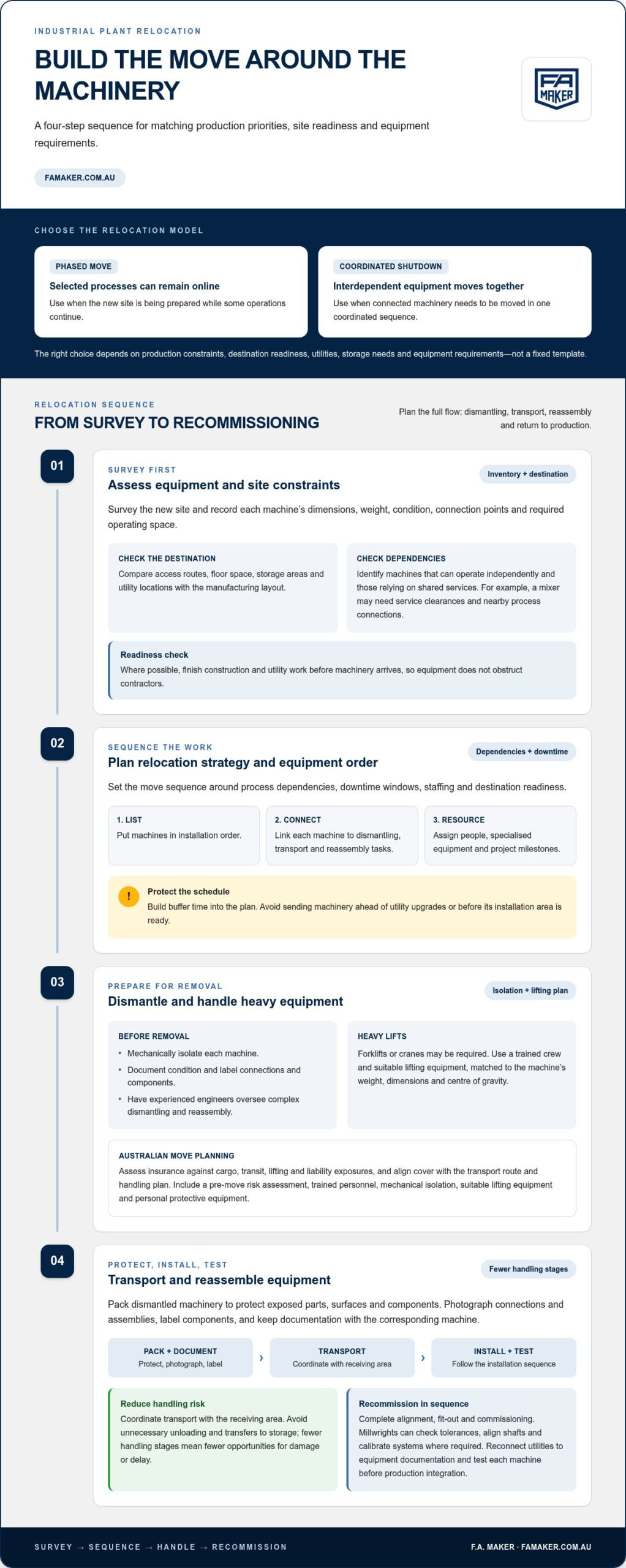
The fastest industrial plant relocation logistics plan is not always the best. The right approach depends on production priorities, site readiness and how carefully machinery must be handled. A phased move can keep selected processes operating while the new site is prepared. A single shutdown may suit operations where equipment needs to be moved and reconnected in one coordinated sequence. Choose the model that fits the plant’s constraints, not a fixed template.
Minimising production disruption matters, but delicate or specialised machinery needs equal attention. Equipment condition, dismantling sequence, protective packing, transport arrangements and installation order all affect how smoothly a move proceeds. Fewer handling stages also mean fewer opportunities for damage or delay.
This guide explains how to compare relocation models for an Australian manufacturing plant, assess whether a phased move is practical, and plan machinery packing, storage and transport routes. It also covers site preparation, risk planning and recommissioning, helping you build a relocation sequence that protects equipment and supports a controlled return to production.
Choose a relocation model by matching production priorities with site readiness and machinery requirements. A phased move can keep selected processes operating while construction or utility upgrades are completed elsewhere.
Start with a survey of the new site and an equipment inventory. Record each machine’s dimensions, weight, condition, connection points and required operating space. Compare access routes, floor space, storage areas and utility locations with the manufacturing layout. For example, a mixer’s position may depend on both service clearances and nearby process connections.
Assess production constraints, storage needs and utility readiness before choosing a move model. Identify machines that can operate independently and those that rely on shared services. Compare these requirements with the destination’s available space and planned upgrades. Where possible, complete construction and utility work before machinery arrives, so equipment does not obstruct contractors.
Set the move sequence around process dependencies, downtime windows, staffing and destination readiness. List each machine in installation order, then connect it to its dismantling, transport and reassembly tasks. Plan the full relocation flow, not just the order in which equipment can be removed.
Choose a phased move when selected processes can remain online as the new site is prepared. Choose a coordinated shutdown when interdependent equipment must move together. Set project milestones, assign people to each task and identify the specialised equipment required. Build buffer time into the schedule, and avoid sending machinery ahead of utility upgrades or its installation area.
Before removal, isolate each machine mechanically, document its condition, and label connections and components. Have experienced engineers oversee dismantling and reassembly, particularly for complex production lines. Heavy equipment may require forklifts or cranes operated by a trained crew using suitable lifting equipment. Match the lifting method to the machine’s weight, dimensions and centre of gravity.
For Australian moves, assess insurance against cargo, transit, lifting and liability exposures, and align cover with the transport route and handling plan. Safety planning should include a pre-move risk assessment, mechanical isolation, trained personnel, suitable lifting equipment and personal protective equipment.
Pack dismantled machinery to protect its exposed parts, surfaces and components. Photograph connections and assemblies, label components, and keep documentation with the corresponding machine. Coordinate transportation with the receiving area and installation sequence. Fewer handling stages reduce the risk of damage or delay, so avoid unnecessary unloading and transfers to storage.
At the destination, install equipment in sequence, then complete alignment, fit-out and commissioning. Use millwrights to check tolerances, align shafts and calibrate systems where required. Reconnect utilities according to the equipment documentation, then test each machine before integrating it into production. Heavy or delicate machinery benefits from logistics expertise during transport, dismantling and installation.
Start with a feasibility review, then plan the site, route, packing, storage, permits and installation sequence. The practical steps below connect those decisions with transport execution and contingency planning.
Build a timeline around site selection, equipment dismantling, transportation and recommissioning. Manufacturing relocations may need planning one to three years ahead, depending on operational complexity. Set milestones for site readiness, packing, dispatch and installation, then assign an owner to each task. Include buffer time for route changes, permit delays, extra civil work or machinery arriving before its installation area is ready.
Complete a feasibility study before setting the move date. Assess relocation costs, risks, potential savings, production effects, workforce availability, infrastructure and government incentives. Record assumptions and decisions, then update the schedule when site works or production constraints change. A written contingency plan helps teams respond to delays while keeping the next installation stage in view.
Map the proposed route and identify the approval process in each jurisdiction crossed by oversized equipment. Australian state and territory requirements can vary by road authority, load dimensions, mass, route and travel conditions. Plan for these route-specific differences instead of assuming one approval covers the entire journey.
Identify the permits and regulatory approvals required for the move, as well as approvals for destination construction, operation and waste management. Keep approval records with transport documents and project decisions. Requirements depend on the load and locations involved, so account for relevant local processes before dispatch.
Create a packing schedule from the equipment inventory and installation order. Protect exposed surfaces and components, label dismantled parts, and keep machine records with each packed load. For example, group a machine’s fasteners, connection notes and protective covers together. Clear identification reduces sorting during installation and helps prevent components from becoming separated in storage.
Arrange secure indoor storage if equipment must wait between dispatch and installation. Stage machines in the order crews will install them, not simply by arrival date. For warehouse racking, finalise the layout and installation sequence before moving stock or machinery into the work area. Keep access clear for lifting equipment and incoming loads.
Compare route options for road access, clearances, turning space and destination entry points. Coordinate carrier timing with loading crews, site access and available storage. Confirm that the receiving area is ready before dispatch, especially if a machine needs to be lifted directly into position. Minimise transfers between vehicles and storage locations to reduce handling and delay risks.
For machinery-specific planning, machinery relocation services can support coordination across packing, transport and installation.
Protect production continuity by identifying dependencies before scheduling shutdowns. A practical plan links every move task to its operational effect and restart conditions.
Map the production processes affected by each machine move. Record which lines rely on shared utilities, upstream materials or downstream packaging. For example, a bottle-filling line may stop even if its filler remains operational when conveyors or supply systems are unavailable.
Rate readiness factors from 1 to 5, weighting those that most affect business continuity. Score destination readiness, utility availability, staffing, transport timing and commissioning tasks. Low scores identify constraints to resolve before shutdown. Use the ratings to compare move sequences, rather than treating every machine as equally urgent.
Set a shutdown window during the least disruptive production period, then identify which machines can move first. Prioritise equipment with the least production impact while protecting critical process dependencies. Allow buffer time for transport changes, incomplete site work or permit delays. Record each risk, its operational consequence and the action that will limit its effect.
Set measurable restart conditions for each production area. These might include completed installation, verified utilities, successful equipment tests and trained operators. Communicate the schedule to suppliers, freight carriers and key customers at least 30 days before warehouse move day. Clear notice helps teams coordinate stock, deliveries and customer expectations.
Stage the move so the existing site can continue production while the new facility is prepared. Transfer independent processes first, then move equipment that depends on shared systems. This approach can keep selected operations online, provided staffing, materials and utilities remain available at both sites.
Define which production can continue during each phase. For example, keep unaffected lines running while a separate area is isolated for removal. Coordinate work zones, access routes and shift handovers so relocation crews do not obstruct active operations. Schedule shutdown tasks together when they share a production dependency.
Don’t treat a nearly complete destination as ready for production. A warehouse that is 90 percent ready on move day may lose two days of productivity resolving unfinished readiness tasks. Close outstanding work before equipment arrives, including installation-area preparation, access clearance and utility connections.
Restart in controlled stages. Install, level, align, anchor and integrate equipment before resuming full production. Test each machine and confirm operational performance before connecting it to the next process stage. Track output, quality issues and equipment stoppages during the first 30, 60 and 90 days after commissioning. Use those reviews to assign corrective work and refine the operating sequence.
Relocation can support changes to operating costs, infrastructure or production requirements. Plan the business case, shutdown and restart together so the new facility can begin operating in a controlled sequence.
Document the expected operational changes, such as a different production layout or access to required services. Then assess whether the proposed facility supports the manufacturing process and workforce needs. A clear business case gives decision-makers criteria for evaluating site readiness and post-move performance.
Identify the roles needed for dismantling, transport, installation and commissioning. Train or reskill employees so they understand the new processes, equipment and regulations at the destination. Record workforce responsibilities in the move schedule, and keep staff informed as milestones and task ownership change.
Coordinate inventory, staffing and service availability across both facilities during the transition. Set clear conditions for transferring each production stage, including prepared work areas and completed installation tasks. This supports continuity without treating every machine or work area as independent.
Track performance for the first 30, 60 and 90 days after commissioning. Review production measures and equipment issues with key stakeholders, then assign follow-up actions. A post-move review can identify where coordination worked, where delays arose and what should change in future relocation planning.
Delicate machinery needs a handling plan tailored to its condition, configuration and installation requirements. A successful relocation involves controlled isolation, documented dismantling, protective packing and careful coordination at the destination.
Include the machine’s role in the production process and its planned position at the new facility. This information helps align packing, transportation and arrival with the installation timeline. Keep documents accessible to the people handling the equipment, rather than separating instructions from the corresponding machine.
Match the handling method to the machinery and its lifting points. Trained crews and suitable lifting equipment help maintain control during removal and positioning. Plan the movement path through the facility, including access restrictions and the destination installation area. This reduces unplanned repositioning, which adds handling stages and can cause damage or delay.
Reduce handling stages wherever the transport sequence allows. Each additional transfer creates another opportunity for delay or damage. Coordinate dispatch and receiving teams around the machine’s installation order, rather than moving loads solely for convenience. Have the destination area ready before arrival, with a clear path from unloading to the final position.
For a move involving delicate or specialised machinery, plan machinery relocation around handling, transport and installation requirements. Keep the schedule connected to the equipment’s actual readiness, not just its arrival date. That discipline helps crews complete a controlled handover into commissioning.
F.A. Maker can help when a plant relocation involves reviewing or sourcing process equipment for the new facility. Its range includes Used Stainless Steel Tanks, Centrifuges and Separators, Industrial Mixers and Blenders, and Pumps and Valves.
Use the relocation plan to identify equipment gaps before production restarts. For example, compare the destination process layout with the required tank, mixing and pumping functions. This connects equipment decisions to the plant’s intended operating sequence, rather than treating procurement as a separate task.
For equipment that suits your facility, contact F.A. Maker or visit famaker.com.au.
Before committing to a relocation model, turn the plan into a working decision document. Record the production priorities, equipment requirements, site dependencies and restart criteria that will guide each approval. This gives operations, engineering and management a shared basis for addressing changes as the move progresses.
Use the same review to identify process equipment that may need replacing or adding at the destination. F.A. Maker offers Used Stainless Steel Tanks, Centrifuges and Separators, and Industrial Mixers and Blenders. These options can inform equipment planning alongside the wider industrial plant relocation logistics strategy, particularly when production needs are changing as part of the move.
For a practical discussion about your equipment and relocation requirements, discuss your move with F.A. Maker. A clear next step can help turn a complex transition into a coordinated plan for the new facility.
Unplanned civil work, route changes, extra storage and delayed recommissioning can add costs during a move. For example, a machine may arrive before its installation area is ready, creating extra handling and storage needs. Budget planning should also account for skilled labour, equipment transport, reinstallation, downtime and lost production. Tie a contingency allowance to identified risks, such as incomplete site works or a revised transport route.
Industrial plant relocation logistics coordinates equipment, people, facilities and transport from shutdown through restart. The work includes preparing an asset register, managing dismantling records, matching loads to transport, coordinating delivery windows and maintaining documentation. A single move schedule linking each machine to its responsible team, destination position and operational dependencies helps make handovers visible across engineering, production and site teams.
There is no single cost for an Australian plant relocation because scope depends on machinery, distance, access, packing, storage, labour and reinstallation needs. Downtime and production losses also affect the project budget. The price is provided after a quote request. Build the estimate by separating transport, skilled-worker labour, site preparation, equipment reinstallation and contingency costs, so you can trace changes to their source.
The duration depends on plant complexity, distance, site readiness and the amount of equipment being moved. Physical execution of a warehouse relocation typically takes one to four weeks, while a manufacturing move may require a different schedule. Treat planning, shutdown, transport, installation and recommissioning as separate phases. This helps identify whether a delay affects the whole operation or only a specific production area.
Key risks include machinery damage, lifting incidents, transport delays, incomplete site preparation and production interruptions. Manage them through a risk register that names each hazard, its operational effect, its owner and its control. For example, record route access and unloading constraints against each heavy load. Keep change decisions, permits, inspections and issues in a shared project record so teams can act on current information.
Reduce downtime by setting clear cutover conditions for each production area. Before transferring a process, confirm that required materials, operators and downstream capacity are ready. For example, a line should not restart if its packaging stage cannot receive output. Use a staged acceptance checklist for equipment tests, process integration and operator handover, then release production in controlled stages instead of restarting every line at once.
In-house teams understand production dependencies, staffing and site routines, while specialist relocation teams bring focused experience coordinating machinery removal, transport and reassembly. Divide responsibilities clearly: internal staff manage production decisions and operational handovers, while relocation personnel handle technical move activities. Define a project lead, escalation path and documentation process early so engineering and production decisions stay aligned throughout the transition.
Requirements vary by state or territory, road authority, load dimensions and mass, route, and travel conditions. Identify and obtain route-specific transport approvals, along with any destination construction, operating and waste-management permits. The article’s market sources advise following WorkSafe NSW and SafeWork Australia standards for Australian plant relocations.