

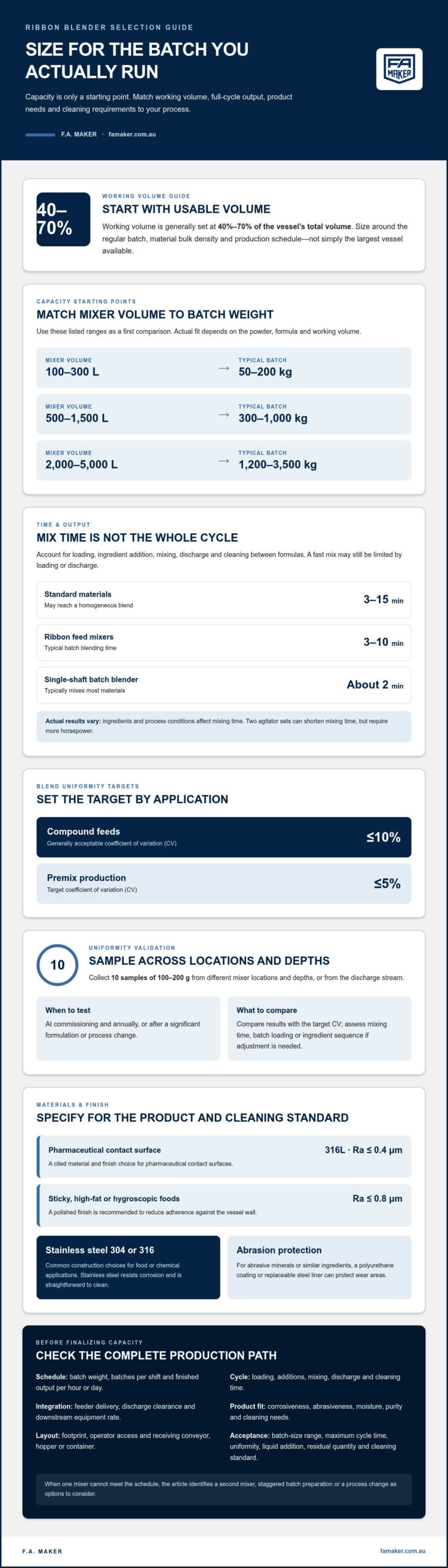
The right ribbon blender is sized around the batch you actually run, not simply the largest capacity available. The main criteria for selecting a ribbon blender are batch size and production rate, with working volume generally set at 40%–70% of the vessel’s total volume. Mixing time, product characteristics, construction materials, surface finish and wear protection also affect whether the machine suits your process.
Capacity is a sensible place to start, but it is only one of the criteria for selecting a ribbon blender. The blender must handle your ingredients consistently, meet the production schedule, and suit your operation’s cleaning and wear requirements.
Assess output and full-cycle time, choose materials and finishes to suit the product, and account for abrasion. Comparing these practical specifications helps narrow the options to a blender suited to your batches and production needs.
Start with the production schedule. Record the required batch weight, batches per shift, and finished output per hour or day. Then account for loading, ingredient addition, mixing, discharge, and cleaning between formulas. Mixing time alone does not describe the full cycle: a blender that mixes quickly may still limit output if loading or discharge takes longer.
For ribbon blender mixing time and blend uniformity, standard materials may reach a homogeneous blend in 3–15 minutes; ribbon feed mixers typically blend a batch in 3–10 minutes. A single-shaft batch blender typically takes about 2 minutes to mix most materials, but actual results depend on ingredients and process conditions. For compound feeds, a coefficient of variation (CV) of ≤10% is generally acceptable; premix production should target ≤5%.
Use batch weight and bulk density to compare capacity ranges. A 100–300 L mixer is listed for typical batches of 50–200 kg, while a 500–1,500 L unit is listed for 300–1,000 kg. Larger production may suit a 2,000–5,000 L mixer, listed for 1,200–3,500 kg batches. These ranges are starting points, not substitutes for matching the actual powder and formula to a working volume.
Estimate batch frequency using the complete cycle. Divide planned production volume by usable batch weight, then compare the required batch count with available operating hours and changeover time. If one mixer cannot meet the schedule, consider a second mixer, staggered batch preparation, or a process change. Two agitator sets can shorten mixing time, but require more horsepower.
Check the proposed equipment against the facility layout before settling on capacity. Map the mixer footprint alongside ingredient feed, operator access, discharge clearance, and the next conveyor or packaging stage. Test future batch weights against the same layout and line sequence to allow for planned production growth. A mixer that fits today’s formula may restrict a larger batch or an additional ingredient stream later.
Check integration at both ends of the vessel. Confirm that upstream feeders deliver ingredients without interrupting batch timing and that the discharge outlet aligns with the receiving conveyor, hopper, or container. A fast discharge can still create a bottleneck if downstream equipment cannot accept material at the same rate.
Set measurable acceptance criteria before purchase. Define the batch-size range, maximum cycle time, blend uniformity, liquid-addition needs, allowable residual quantity, and cleaning standard. For difficult chemical formulas or high-consequence products, testing representative product is more reliable than relying on assumptions based on a similar application.
Validate uniformity by collecting 10 samples of 100–200 g from different mixer locations and depths, or from the discharge stream. Test at commissioning and annually, or after a significant formulation or process change. Compare results with the target CV, then assess whether mixing time, batch loading, or ingredient sequence needs adjustment.
For food or chemical applications, stainless steel grades 304 or 316 are common construction choices. Pharmaceutical contact surfaces may use 316L stainless steel with a finish of Ra ≤ 0.4 μm. Hazardous volatile powders may require explosion venting arranged to direct blasts away from workers. These options address different process risks, so match the material and features to the ingredients and operating conditions.
Stainless steel resists corrosion and is straightforward to clean, making it a practical option for corrosive products, food processing, or frequent washdowns. Carbon steel costs less but can corrode, potentially affecting product-contact surfaces. For abrasive minerals or similar ingredients, a polyurethane coating or replaceable steel liner can protect areas exposed to repeated wear.
Surface finish affects how ingredients behave against the vessel wall. Sticky, high-fat or hygroscopic food materials can adhere to rough surfaces, so a polished finish of Ra ≤ 0.8 μm is recommended for these applications. A finer finish may be appropriate for stricter purity needs. Specify the required finish for product-contact surfaces rather than describing the vessel simply as polished.
Sanitation depends on more than the base metal. Rounded internal corners and crevice-free welds can reduce places where material collects and bacteria may build up. A polished interior can support cleaning validation in pharmaceutical blending and help limit cross-contamination between formulas. Specify cleaning methods alongside finish requirements, particularly when operators change between products.
Seals contact both ingredients and cleaning agents. Check whether the seal material is compatible with the powder, any liquid addition, wash chemicals, and process temperatures. A seal that degrades or leaks can let product enter the shaft area or create a path for contamination. Include seal access and replacement in the maintenance plan.
Ribbon, paddle, ploughshare, and V-blenders use different mixing actions. A ribbon blender moves powders in opposing directions with inner and outer helical ribbons; paddle and ploughshare designs use their respective mixing tools. A V-blender tumbles material as its vessel rotates. The right action depends on product flow, fragility, required turnover, and whether the process needs more than blending.
For an efficient specification, list each ingredient’s corrosiveness, abrasiveness, moisture, cleaning needs and purity requirements. Then match those conditions to vessel material, finish, lining and seals. If you’re comparing machinery with process vessels, stainless steel process equipment can be part of the wider production-line review.
Calculate vessel capacity using the largest batch weight, bulk density at plant conditions, and target fill fraction. Working volume equals batch weight divided by bulk density; total vessel volume equals working volume divided by the target fill fraction. This calculation translates production requirements into a practical machine size.
For example, a 300 L batch may call for a mixer with approximately 500–600 L total volume. A 2 cubic metre batch may require approximately 3.3–5 cubic metres of total vessel volume. These examples show why batch size and total volume are not interchangeable: the vessel needs space for the ribbons to move material through the mix.
Ribbon blenders generally work within a product-dependent fill range. A useful starting range for working volume is 40%–70% of total vessel volume. Filling below 30–40% can reduce consistent contact with the upper outer ribbon; filling above 70–80% can restrict the space needed for shearing and convective movement. Use actual bulk density and the product’s flow behaviour to refine the target.
Choosing capacity also means checking the smallest regular batch, not only the maximum. If production varies, compare both extremes with the mixer’s rated volumetric capacity. A batch should contain at least 30–40% of rated capacity for optimal mixing. If low-volume runs fall below that range, a smaller machine or a separate production plan may prevent inconsistent ribbon contact.
Assess throughput by comparing working batch weight with the required production schedule. Divide the required output by batch weight, then account for loading, mixing, discharge, and changeovers. A mixer sized for the largest batch may still fall short of the required daily output if each formula needs extended cleaning or frequent ingredient changes.
Dimensions matter alongside volume. A batch ribbon blender typically has a length-to-width ratio of 2:1, but the overall footprint must also accommodate loading access, drive components and discharge equipment. Measure the available plant space, including the route for moving the machine into position. For pharmaceutical production, include access for inspection and cleaning in the layout review.
Allow for process changes without oversizing every batch. A blender with capacity about 20% greater than the largest batch can provide flexibility as demand changes. However, keep routine batches within the suitable fill range. Compare expected future batch weights against both the minimum and maximum working volumes before finalising specifications.
Record bulk density, batch weight, and target fill level for each formula. Use the highest and lowest values to test the proposed capacity, then assess the footprint and discharge arrangement. This makes mixer selection a measurable fit between product volume, production needs, and available facility space.
Choose the internal finish to match the product and cleaning method. A standard industrial-grade finish is listed as Ra ≤ 0.8 μm. For pharmaceutical or high-purity ribbon blender surfaces, a finer Ra ≤ 0.2 μm finish with electropolishing is specified. For food materials that are sticky, high-fat or hygroscopic, a polished finish of Ra ≤ 0.8 μm can reduce surface adhesion.
Weld geometry matters as much as the measured finish. Rounded internal corners and crevice-free welds help limit places where product can accumulate or bacteria can build up. In pharmaceutical blending, a polished interior can support cleaning validation and reduce cross-contamination risk. Include the vessel, shaft, ribbon, discharge area, and product-contact joints in the finish specifications.
For Australian installations, assess hazards and workplace controls as part of equipment selection. Consider guarding, safe access, lockable electrical disconnects for maintenance, and explosion venting for volatile powders. These features address different risks, so specify them according to the material handled and the operating environment. A smooth finish alone is not a complete safety measure.
Motor and speed selection must suit the product load. The drive needs enough power to move the ribbons at the target speed under full load, including startup under load. Ribbon feed mixer shaft speeds typically range from 30 to 100 RPM, adjusted for ingredient bulk density and fragility. Higher speeds can improve mixing efficiency but may increase wear, while excessive speed can incorporate unwanted air.
Temperature-sensitive ingredients may need a jacket around the vessel, which can circulate steam or cool water to heat or cool the contents. Match the discharge valve to sanitation needs, product flow, sealing, and the transfer equipment below. A drop-bottom gate opens across the bottom for rapid discharge; a single gate suits longer batch cycles without a rapid discharge requirement.
Loading and cleaning arrangements affect day-to-day operation. Fully openable lids can help with manual cleaning and inspection, while dust-proof sealed covers suit fine powders. Clean-in-place spray balls can support automated cleaning without disassembly, and full-diameter access doors improve visual inspection. For wet cleaning, consider drainage and whether cleaning coverage suits the product and soil type.
Ribbon geometry also influences movement and wear. The inner and outer ribbons move ingredients in opposite directions, creating convective mixing. A typical recommended gap between the blade edge and inner trough wall is 3–6 mm. Include this clearance in specifications, then consider how abrasion, buildup or blade damage could alter it during operation.
Plan maintenance around inspection, lubrication, drive alignment, and component replacement. When plant maintenance teams handle in-house repairs, shaft modifications, or machining upkeep, technical guides from ridiculousmachinetools.com can assist with workshop tooling setups. Wear can change clearances and leave residues, while retained product can contaminate the next formula. Specify access for inspecting welds, seals, blades, and discharge surfaces so maintenance teams can identify buildup or damage before product quality is affected.
Match the mixer to the product’s behaviour, not just its name. Ingredients with different particle sizes, shapes, moisture levels, or densities can mix unevenly, even when the batch fits the vessel. Record ingredient ratios and trace-addition levels for each formula, then identify properties that could cause segregation or poor distribution.
Density differences are especially important. Ribbon blender configurations can be customised for bulk-density ratios as wide as 1:3, but that does not make every formulation suitable. A large difference in ingredient density, combined with a small quantity of an active ingredient, calls for representative product testing and a defined uniformity target.
Treat the agitator and construction as a matched system. The inner and outer ribbons move material in opposite directions, creating convective movement through the trough. A double-ribbon arrangement adds a ribbon and shaft, which can improve turnover for dense or difficult-to-blend products. The drive must still suit the material’s resistance and operating conditions.
Liquid addition changes the mixing task. Assess the liquid-to-solid ratio, viscosity, temperature, pump, nozzle, addition duration and cleaning method. For minor liquid ingredients, atomising nozzles on a spray bar can distribute the addition across dry material. Introduce liquid after the dry ingredients have partially blended, at approximately 60–70% of total mix time, to help limit local wet spots.
Recognise when a ribbon blender is not suited to the application. Very cohesive powders, sticky materials, high-liquid formulations, and products requiring intensive deagglomeration may need another mixing approach. Ribbon blenders may also be unsuitable for rapid vacuum drying, reaction control, intensive emulsification, or continuous processing. Matching the equipment’s action to the process objective helps avoid a poor fit.
Specify discharge and retention separately. For high-value formulations, material left inside can affect yield, allergen control, active-ingredient accountability, and the next batch’s quality. Define the allowable residual quantity, product flow needs, sealing, and receiving equipment. Paste-like or slurry applications need liquid-tight discharge valves, since some blender valves are only dust-tight.
Turn the criteria for selecting a ribbon blender into measurable acceptance requirements: formula range, density variation, liquid addition, blend uniformity, maximum cycle time, residual quantity, and cleaning standard. Test representative product when formulation behaviour is difficult to predict or failure has serious consequences. This turns a general equipment description into a process-specific purchase specification.
Use these requirements to compare ribbon blender options against your applications and production process.
F.A. Maker supplies industrial mixers and blenders, including ribbon blenders, alongside used stainless steel tanks. Once you have defined batch range, material compatibility, cleaning needs, and discharge requirements, these specifications provide a practical basis for identifying equipment suited to your process. F.A. Maker also supplies pumps and valves, as well as centrifuges and separators, for production lines that need supporting equipment.
Turn to F.A. Maker when assessing process equipment against documented production requirements or considering a used stainless steel tank alongside a blender. Have your batch details and operating requirements ready to make your enquiry specific.
Contact F.A. Maker or visit famaker.com.au to discuss your equipment requirements.
Before committing to a machine, turn the criteria for selecting a ribbon blender into a specification your production and maintenance teams can use. Record process requirements, constraints, and acceptance measures in one place. This document can guide equipment comparisons and keep purchasing decisions aligned with your plant’s needs.
Include the people who will operate, clean, and maintain the equipment in the final review. Their practical input can reveal access, changeover, or integration details that are easy to miss in a desk-based assessment. A clear specification also gives future teams a useful reference when formulas or production plans change.
For a practical next step, contact F.A. Maker about your mixer. Bring your process requirements into the discussion and move forward with a clearer basis for choosing equipment.
Choose a ribbon mixer by matching its working range and mixing action to the product and production sequence. Start with the formulas that are hardest to handle, such as one containing a fragile ingredient or a small trace addition. Consider how ingredients enter, how the finished blend transfers, and how often batches change. A practical selection also accounts for operator access, maintenance tasks, and the space needed to connect the mixer to surrounding equipment.
Ribbon blenders suit many free-flowing powders, including premixes, spice blends, dry chemicals, mineral products, and animal nutrition products. Suitability depends on how ingredients flow and respond to the ribbons, not just on the industry. A dry spice blend and a mineral product, for example, may both be powders but place different demands on the mixer. Very cohesive powders, sticky materials, and high-liquid formulations can be poor fits for conventional ribbon blending.
Match ribbon arrangement and shaft design to the material’s density, fragility, and turnover needs. The inner and outer ribbons move material in opposite directions; a double-ribbon arrangement can improve turnover for dense or difficult-to-blend products. Check blade-to-trough clearance against the intended product and equipment condition, since clearance affects movement and potential buildup. Include full-load drive performance in the specification, especially if the mixer may start with material already in the trough.
Select construction material according to product contact, corrosion exposure, cleaning method and wear. Stainless steel grades 304 or 316 are common choices for food or chemical use, while abrasive products may call for a polyurethane coating or replaceable steel liner. Define the internal finish by its required roughness value, then consider weld geometry and corners where residue could collect. Seals should also suit the product and cleaning agents, helping limit leakage and contamination during changeovers.