

A powder blend is only as consistent as the material entering the mixer. A de-lumping mill for powders breaks down agglomerates before or during mixing, helping powder flow and blend more uniformly without necessarily reducing particle size. This matters because intact lumps can disrupt how ingredients move and distribute through the process.
Powder caking can develop during storage, transport, crystallisation, granulation or spray drying. Breaking down agglomerates can restore a more workable texture, support a consistent particle-size distribution and prepare material for the next processing step. The right approach depends on the powder’s condition and the outcome the process requires.
This article explains why de-lumping matters for mixing, how a lump breaker works and where screening may fit in bulk material handling. It also covers particle size and flow, cleanable food-processing equipment, and how to assess machinery for a production line. Use these points to decide whether de-lumping belongs before mixing, during preparation or at another stage of your process.
De-lumping matters because powder agglomerates can interrupt how ingredients move through a mixer and distribute in the blend. Breaking them apart before or during mixing helps powder flow and blend more uniformly, without necessarily reducing particle size. This can support consistency in food, pharmaceutical and chemical processes.
In food production, stored powders can cake or form lumps, making it harder to feed ingredients steadily into a mixer. De-lumping can restore agglomerated material to its prior crumbed, flaked, powdered or clumped state. For example, a process may break up caked dry ingredients before blending them with other components. The goal is a workable feed, not automatically a finer powder.
Uniformity is especially important in pharmaceutical powder processing. Powder texture can be one consideration in tablet and capsule production. Powder flow also affects how reliably material moves between preparation and mixing. When preparing for wet granulation, the powder’s condition helps determine how to break down lumps and refine particle-size distribution.
In pharmaceutical cGMP manufacturing, equipment and process controls are considered alongside the material’s intended use. A practical sequence is to inspect the incoming powder, identify agglomerates, select a suitable de-lumping method, then assess the result for consistency. Chemical powders may also need de-lumping before mixing, since breaking agglomerates can expose more particle surface area for chemical interactions.
Several mill types can de-lump powder. A lump breaker uses rotating blades that pass through stationary comb-shaped blades, while a fixed grid or grate controls which particles pass through. Screen mills, hammer mills and pin mills are other equipment categories. The right choice depends on whether the task is to break soft agglomerates or reduce particle size further.
For Australian installations, assess machinery hazards and combustible-dust risks in relation to the material and operating conditions. Dust collection, containment, ignition-source control and suitable explosion protection are considerations in the risk assessment. Applicable Australian safety requirements depend on the installation and powder. Do not assume a general-purpose mill is suitable for combustible dust.
The cost of a powder de-lumping mill in Australia depends on the machine, its condition, capacity and process requirements. Pricing is provided after a quote request. These factors help define the equipment needed, as powders and production lines have different requirements.
Australian industrial process-equipment suppliers sell mills for powder handling, while hire availability depends on the equipment and arrangement. Compare the required feed condition, desired output and process fit when assessing supply options. A de-lumping mill for powders isn’t suitable for every material: abrasive powders can accelerate wear, heat-sensitive powders may be affected by friction, and combustible dust can create ignition and explosion hazards without appropriate controls.
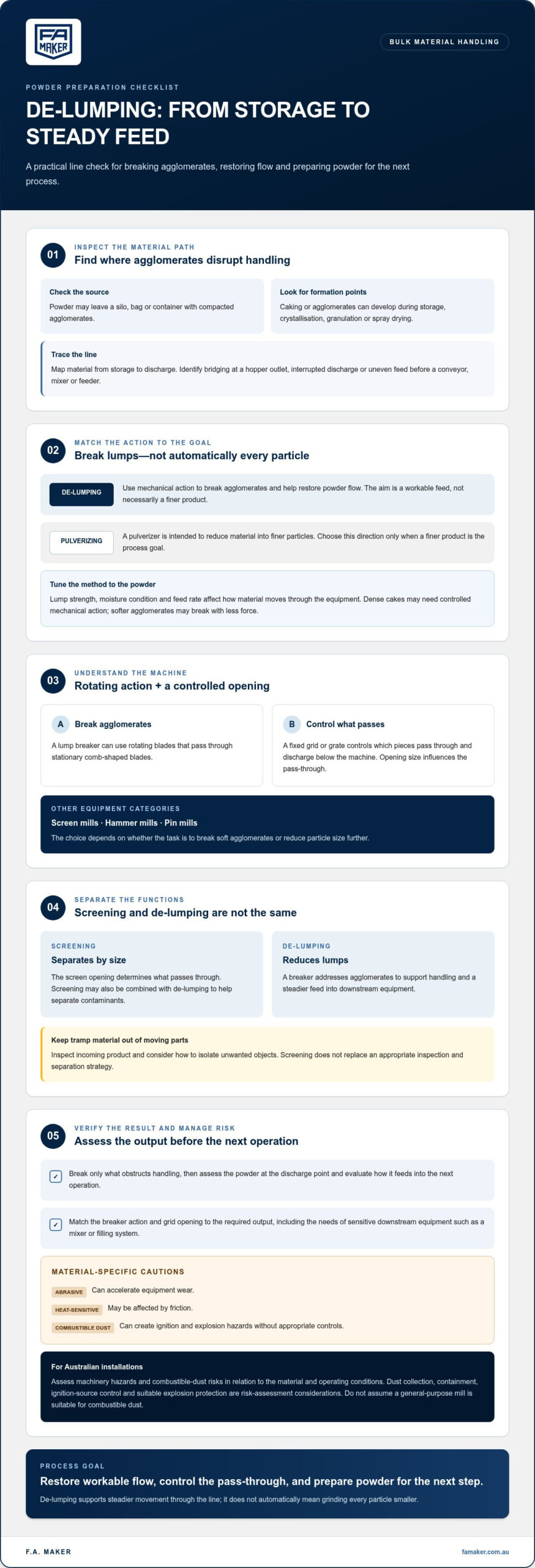
In a bulk-handling line, de-lumping is a preparation step between storage and the next process. Powder may leave a silo, bag or container with compacted agglomerates that interrupt discharge or create uneven feed. Breaking these masses helps material move into downstream equipment more steadily. The aim is to restore flow, not necessarily to grind every particle smaller.
A typical sequence starts by inspecting the incoming material and identifying where lumps form. After storage, crystallisation, granulation or spray drying, agglomerates may need breaking before a conveyor, mixer or feeder. A lump breaker can use rotating blades that pass through stationary comb-shaped blades. A fixed grid or grate then controls which pieces pass through and discharge below the machine.
“De-lumping mill” and “lump breaker” often describe overlapping equipment used to break agglomerates, while a pulverizer is designed to reduce material into finer particles. The distinction is the process goal: restoring flow by breaking lumps, or intentionally producing a finer product. Choose according to the powder’s condition and the particle size required downstream.
Compacted material needs controlled mechanical action. A dense cake can bridge at a hopper outlet, while softer agglomerates may break with less force. Feed rate, moisture condition and lump strength affect how material moves through the equipment. Assess the powder at the discharge point, break only what obstructs handling, then evaluate how it feeds into the next operation.
Screening can be combined with de-lumping to help separate contaminants from material. The screen opening determines what passes through, while de-lumping addresses agglomerates. These functions are related but distinct: a screen separates by size, while a breaker reduces lumps. Account for both in the process line, especially before sensitive downstream equipment such as a mixer or filling system.
Address tramp material before it reaches moving parts. Inspect incoming product and consider how to isolate unwanted objects before they enter the breaker. Screening may help remove contaminants, but it does not replace an appropriate inspection and separation strategy. The arrangement depends on the contaminant, powder properties and equipment layout.
For a reliable handling sequence, map the material path from storage to discharge, then identify where bridging or inconsistent feed occurs. Match the breaker’s action and grid opening to the required output, and place screening where separation is useful. If the line continues into packaging, review downstream process equipment as part of the overall material-handling layout.
De-lumping supports powder flow by breaking agglomerates while preserving particle characteristics needed downstream. The goal is a suitable size distribution, not maximum size reduction.
Powder integrity means retaining useful particle characteristics rather than grinding material unnecessarily. Excessive size reduction can change how a blend handles and create fines that move differently from larger particles. Assess how the powder discharges, feeds and mixes after treatment. A material that bridges only because of soft agglomerates, for example, may need gentle breaking rather than further grinding.
Improved flow depends on how particles interact, not simply on achieving the smallest particle size. A broad size distribution can affect how powder packs and moves through equipment. Compare samples before and after processing, focusing on visible lumps, discharge consistency and feed behaviour. These observations help determine whether de-lumping has restored usability while maintaining the material’s required integrity.
Choose equipment by matching its breaking action to the powder’s condition and required throughput. Consider whether the feed is cohesive, compacted, fragile or free-flowing, then assess how consistently it enters the mill. De-lumping should address agglomerates without imposing unnecessary particle-size reduction. The required throughput also depends on feed rate and how the material behaves during discharge.
Review the process as a connected line. A steady mill output is useful only if the next feeder, mixer or conveyor can accept it. Note where feed surges or interruptions occur, then compare operating conditions before and after treatment. This makes throughput a practical line requirement rather than an isolated machine figure.
Output particle size depends on the mill’s breaking mechanism and the opening size of its grid, grate or screen. In a lump breaker, material small enough to pass through the openings discharges, while larger agglomerates remain for further breaking. Capacity depends on feed behaviour, equipment configuration and required output. Together, these factors determine the usable operating range.
Internal particle-size classification occurs when a screen or grate retains oversize material while allowing smaller particles through. This can support a more controlled output, but it does not make every particle identical in size. Define the acceptable size distribution for the next process, then assess discharged material against that requirement. With a de-lumping mill for powders, evaluate particle size and throughput together, since changing the opening or feed rate can affect both flow and output consistency.
Nor does screening remove the need to assess powder after processing. In pharmaceutical manufacturing, refining particle-size distribution and removing lumps can improve powder flow through processing equipment. For wet granulation preparation, breaking down powder lumps can help achieve a more uniform particle-size distribution; the method depends on the powder’s condition. Match the de-lumping action to the material while keeping the desired distribution in view. The goal is more uniform material that flows better through processing equipment, not size reduction for its own sake.
For food processing, cleanability starts with the machine’s product-contact surfaces and internal access. Powder residues can collect around screens, blade assemblies, seals and discharge points. When selecting equipment, map these areas against your facility’s cleaning method. A design that allows practical inspection and access can make routine cleaning more manageable.
Assess food-grade construction against the product, cleaning regime and production environment. Confirm that product-contact materials suit the powder and cleaning agents, and review the finish of surfaces, joints and seals. For example, sticky confectionery powder may leave deposits in corners where a free-flowing ingredient would not. The machine’s construction must suit the actual material and changeover needs.
Install the machine in line with the process layout, allowing access to the feed, discharge and components that need inspection. Connect upstream and downstream equipment so powder transfers without unnecessary ledges or residue traps. Follow the equipment instructions and site procedures for cleaning and maintenance, including isolation before access and inspection for retained product after cleaning.
These steps matter during product changeovers. Residue from one food powder can carry into the next batch if inspection misses a screen edge or discharge housing. A documented sequence helps operators clean the same areas consistently. Tailor it to the machine’s construction, the powder’s tendency to adhere and the cleaning method used on site.
Maintenance also affects cleanability and flow. Worn seals, damaged screens or poorly seated components can create places where powder collects. Include these parts in planned inspections, and check for buildup when flowability changes or discharge becomes uneven. Service or replace components according to equipment guidance and site maintenance procedures.
For Australian food production, treat cleanability as a process-design criterion, not merely a surface feature. Review how the machine fits the facility’s hygiene procedures, changeover sequence and powder characteristics. A suitable arrangement makes inspection practical while supporting reliable material flow through the production line.
Powder agglomerates form when particles adhere during storage, transport or exposure to environmental conditions. Moisture, pressure and handling can change how a material behaves, leaving powder that no longer feeds as it did originally. De-lumping restores the material towards its prior crumbed, flaked, powdered or clumped condition. The objective is to address unwanted clumping, not automatically to produce finer particles.
Choose the method according to whether the material is dry or dispersed in liquid. Dry milling breaks agglomerates through mechanical action without adding liquid. Wet milling uses mechanical agitation while powder is dispersed in liquid media. Ultrasonic mixing uses cavitation generated by ultrasonic waves to disrupt agglomerated material. Each method works differently, so match the process to the material’s condition and the next operation.
For example, dry powder that cakes after transport may need mechanical de-agglomeration before feeding or blending. Powder already suspended in liquid may call for a wet process instead. The distinction matters: adding liquid to a dry-handling line changes the process, while dry milling does not address a suspension in its current state. Identify the powder’s physical state first.
De-agglomeration can also support chemical processing. Breaking clumps exposes more particle surface area for chemical interactions, which can improve mixing efficiency and increase reaction rates. This is relevant when pretreating catalysts and other reactive substances. The useful endpoint is material prepared for its intended interaction, not maximum milling energy or the finest achievable output.
In suspensions, larger agglomerated particles can settle towards the bottom. Breaking them apart can help limit settling and improve mixture stability. Dispersants, including surfactants, can help prevent particles from agglomerating by reducing surface tension. They complement mechanical processing rather than doing the same job, so consider whether the issue is existing clumps or particles forming new ones.
A practical selection sequence is to:
These checks help distinguish deagglomeration from size-reduction milling and guide a process that uses only the action required. To consider equipment for powder handling, explore powder-processing equipment suited to your production line.
De-lumping is useful when material changes form during storage, transport or exposure to environmental conditions. It can restore agglomerated material to its prior crumbed, flaked, powdered or clumped state. The appropriate target is that prior condition, not an assumption that every powder must become finer. For dry material, dry milling breaks down agglomerations through mechanical action without using liquids, distinguishing it from processing a suspension.
In a suspension, de-lumping can help prevent larger particles from settling to the bottom and improve mixture stability. During pretreatment, de-lumping catalysts and other reactive substances can expose more particle surface area and support chemical mixing efficiency. These applications have different goals: maintaining mixture stability or preparing reactive material for chemical mixing. Select the process according to the material’s state and the task.
F.A. Maker supplies used stainless steel tanks and industrial mixers and blenders for processing lines where powder preparation connects with storage or mixing. Once you’ve identified where de-lumping fits, consider the surrounding equipment: a suitable mixer receives prepared powder, while tanks can support storage or other process stages. F.A. Maker also supplies pumps and valves, and centrifuges and separators for broader process-equipment needs.
Turn to F.A. Maker when assessing equipment for a production line that handles powders alongside storage, mixing or transfer operations. Considering these offerings together helps you assess the line as a connected process rather than treating each machine in isolation.
For information about F.A. Maker’s process equipment, visit famaker.com.au.
Before selecting a de-lumping mill for powders, define the material condition the next stage needs to receive. Record how the powder behaves at the feed point, what output condition supports your process, and how operators will assess the result. These criteria provide a practical starting point for equipment discussions and keep the decision tied to production requirements.
Consider the wider line as well. Powder preparation may need to work alongside mixing, storage or separation equipment, so pay attention to the interfaces between stages. F.A. Maker offers Industrial Mixers and Blenders, Used Stainless Steel Tanks, and Centrifuges and Separators for processing operations. These categories can help you consider equipment needs across connected stages without losing sight of the specific powder-handling task.
Use your process requirements to guide the next conversation. Contact F.A. Maker about powder-processing equipment and take the next step towards a setup that fits your operation.
A de-lumping mill for powders breaks soft or compacted powder agglomerates so material can feed more consistently into the next process. For example, a production line may place one between a storage hopper and a mixer when caked feed disrupts dosing. Assess the incoming material and desired output, then select a suitable machine arrangement. De-lumping does not automatically mean grinding the powder finer.
Cost depends on the machine, its condition, capacity and process requirements. Pricing is provided after a quote request.