

Choosing a jacketed mixing vessel for sale involves more than comparing tank capacity. You also need to decide whether an external jacket or an internal coil better suits your process. Assess the heating or cooling arrangement, stainless steel grade, working capacity and mixer configuration together, based on the product and how it will be processed.
Stainless steel is a practical focus when comparing mixing vessels, but the grade, dimensions and fittings still need to suit the application. A larger tank is not automatically the better option if its working volume or heat-transfer arrangement does not match your batches.
This guide explains how jackets and coils differ, what to consider when selecting stainless steel and capacity, and how Australian pricing and GST affect comparisons. It also outlines the details that help narrow down suitable used industrial mixing equipment, so you can assess options against your process requirements.
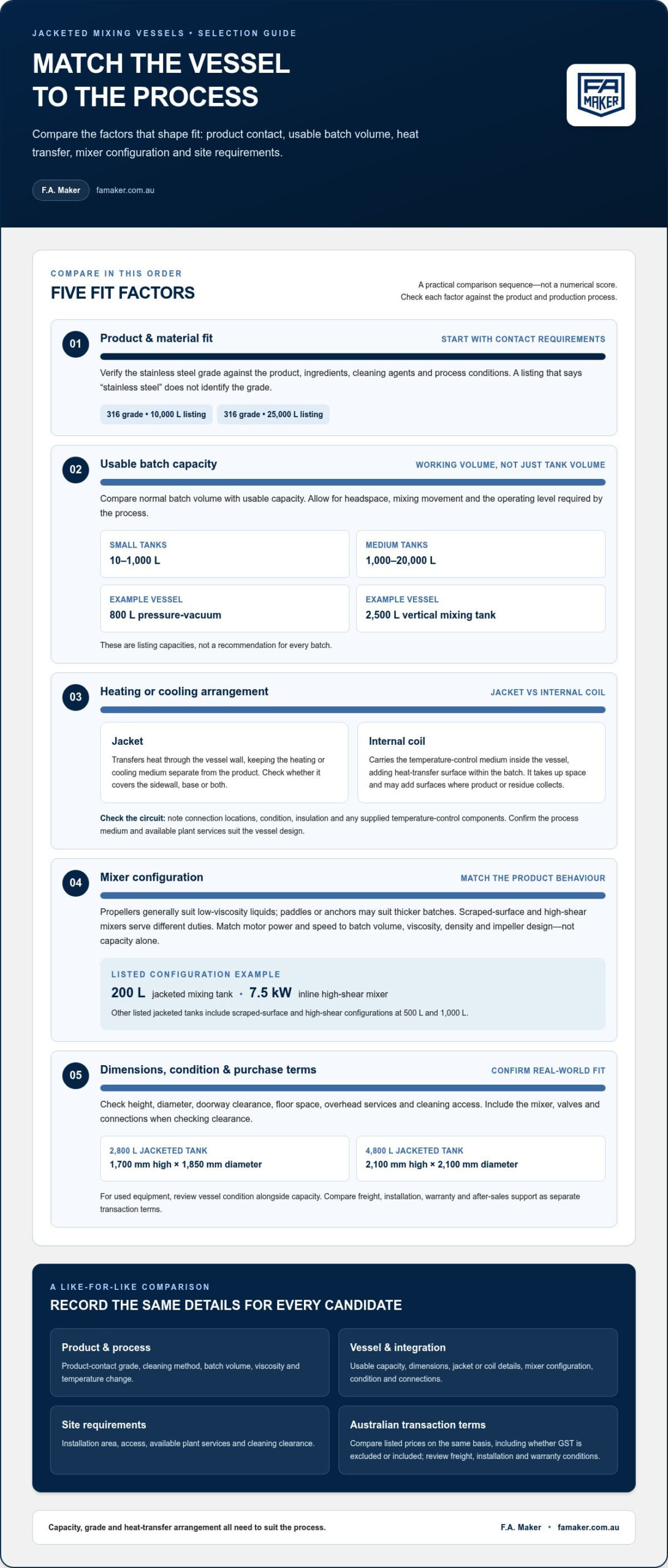
A jacket transfers heat through the vessel wall, keeping the product separate from the heating or cooling medium. Depending on its design, the jacket may cover the sidewall, base or both. An internal coil carries the temperature-control medium inside the vessel, adding heat-transfer surface directly within the batch. The choice affects product contact, cleaning access and how the vessel fits into the process.
For a jacketed vessel, identify which surfaces are heated or cooled and where the connections are located. A jacketed base, for example, transfers heat through the bottom but not the full sidewall. A dimple jacket uses formed channels on the vessel exterior, and its suitability depends on the required service and operating conditions. An internal coil provides heat exchange within the tank, but takes up space and adds surfaces where product or residue may collect.
Compare the vessel with the product and production sequence, not just the heating method. Record the batch volume, target and starting temperatures, required temperature change, product viscosity and cleaning method. Then establish whether the process needs heating, cooling or both. If the product fouls surfaces, pay particular attention to coil access and cleaning. A jacket keeps the heat-transfer element outside the product zone, while an internal coil may suit a process that needs that arrangement.
Check the complete heat-transfer circuit before comparing equipment. Note the jacket or coil connections, their condition, insulation and any temperature-control components supplied with the vessel. Confirm that the process medium and available plant services suit the equipment design. These details affect integration: having a jacket does not establish that the site can provide the required heating or cooling.
Choose an agitator to suit the product’s behaviour. Propellers are generally suited to low-viscosity liquids, while paddles or anchors may suit thicker batches; scraped-surface and high-shear mixers serve different mixing duties. Match motor power and speed to batch volume, viscosity, density and impeller design, not capacity alone.
For a concrete Australian example, a listed 200-litre jacketed mixing tank has a 7.5 kW inline high-shear mixer. Other listed jacketed tanks include scraped-surface and high-shear configurations at 500 litres and 1,000 litres. These examples show why the mixer should be assessed alongside the heating arrangement. A high-shear head, paddle or scraped-surface agitator changes the mixing action and the clearance needed inside the vessel.
For Australian purchases, freight, installation, warranty and after-sales support are separate transaction terms. Freight depends on the vessel’s dimensions, access and destination; installation and warranty conditions depend on the seller’s offer.
Start with the product’s contact requirements, then compare vessel grade and usable volume. A listing marked stainless steel doesn’t identify the specific grade, so treat grade as a core specification, not a general material label. For example, Australian listings include jacketed tanks made from 316 grade stainless steel, including a 25,000-litre tank and a 10,000-litre tank. These examples show why grade and capacity should be recorded as separate details when comparing equipment.
Choose the grade according to the product, cleaning regime and process conditions. Match the material to everything that contacts the vessel, including ingredients and cleaning agents, and consider whether the tank will handle one product or several formulations. If the process requires a particular grade, use that requirement to narrow the options first. Then compare the tank’s condition, internal finish and fittings against the same needs. A larger nominal capacity cannot make up for a material specification that does not suit the product.
Capacity should reflect the working batch, not simply the vessel’s stated total volume. Allow for headspace, mixing movement and any operating level required by the process. Australian listings show a wide range: small stainless steel tanks are described as holding 10 to 1,000 litres, while medium tanks are described as holding 1,000 to 20,000 litres. Individual examples include an 800 L stainless steel pressure-vacuum mixing vessel and a 2,500-litre vertical mixing tank. These are listing capacities, not a recommendation for every batch.
Dimensions matter as much as volume during installation and daily operation. A listed 2,800-litre jacketed food-grade tank measures 1,700 mm high and 1,850 mm in diameter. A 4,800-litre jacketed food-grade stainless steel tank measures 2,100 mm high and 2,100 mm in diameter. Compare those measurements with doorway clearance, available floor space, overhead services and access for cleaning. Also account for the mixer, valves and connections, which can affect required clearance.
Use the same checklist for every candidate. A 13,000 litres mixing tank and a 900-litre jacketed stainless steel tank serve different production scales, but each needs a verified grade, dimensions and useful working volume. For a broader comparison, review used stainless steel tanks alongside the process requirements.
A jacketed mixing vessel combines a tank, heat-transfer surface and agitator in one process unit. Australian listings range from a 200-litre jacketed tank with a 7.5 kW inline high-shear mixer to a 15,000-litre GEA stainless steel jacketed horizontal mixing tank system. These examples differ in scale and configuration. A jacketed mixing vessel for sale should be assessed by its intended duty, mixer arrangement, heating connections and site requirements, not capacity alone. Confirm whether the tank is designed for heating, cooling or both, and whether its jacket suits available process services.
Australian standards and safety requirements depend on the vessel’s design, pressure conditions, installation and intended workplace use. Assess its pressure rating, guarding, controls, operating instructions and site-specific risks before putting it into service.
When inspecting a used jacketed vessel, check the product-contact surfaces, welds, jacket, connections, agitator and motor. Look for corrosion, leaks, damage, deposits and signs of previous repairs. Compare the nameplate and available records with the intended process.
Make the inspection systematic. Record the maker, model, serial details, material grade and stated capacity, then compare them with the equipment description. Check the jacket and pipe connections for visible damage, corrosion or signs of leakage. Examine the tank interior for pitting, dents, residue and weld condition. Inspect the agitator shaft, impeller and seals for wear or movement. A visual inspection can flag concerns, but it cannot establish operating performance.
Next, assess the drive and controls. Record the motor nameplate details, inspect electrical enclosures and note whether a control panel is present. Check that guards cover accessible moving parts and, during an appropriate test, that the agitator turns without unusual noise or vibration. Functional testing should follow safe site procedures and suit the equipment’s condition. A dry visual check alone does not prove that the jacket holds pressure or transfers heat correctly.
Compare equipment configurations carefully. A listed 400-litre jacketed insulated stainless steel mixing tank differs from a 340-litre steam-jacketed mixing pan. Neither capacity alone establishes suitability. Match the heating medium, mixer duty, product-contact surfaces and batch requirements. A 15,000-litre GEA system is another scale and configuration, with two units available in the listing. Before shortlisting a jacketed mixing vessel for sale, compare its supplied components and intended process role against your requirements.
Document faults and missing components before comparing equipment. A written inspection record helps distinguish repair needs from a mismatch with your process, and supports a more accurate assessment of the vessel’s suitability.
Stainless steel mixing tanks vary in geometry, access and fitted equipment, even at similar capacities. Australian listings include a 4,000-litre vertical stainless steel mixing tank, a dual 315-litre stainless steel paint-mixing vessel and a 785-litre stainless steel process vessel. These examples represent different duties, not interchangeable configurations. Compare the tank’s shape, mixer arrangement and outlet position with the production task before focusing on volume.
Start with the product path. Identify how ingredients enter, where the agitator sits, how the batch discharges and how the tank is cleaned. A vertical vessel can suit a compact floor layout, while a dual-vessel arrangement may support separate batches or formulations. For paint mixing, the listed dual 315-litre vessel is a useful example of configuration affecting workflow. Check whether the intended process requires one vessel or separate vessels, rather than assuming a single tank meets both needs.
Next, examine construction details that affect operation. Review the internal finish, welds, top opening, manway, drain and connection locations. A tank’s nominal capacity doesn’t reveal whether the outlet clears settled product or whether the opening allows access for cleaning. For a used vessel, record visible repairs, corrosion, dents and residue, then assess these against the product and cleaning process. The 785-litre process vessel illustrates why the category name alone doesn’t establish its fittings or suitability.
The mixing equipment also affects how a stainless steel tank performs. Compare the shaft and impeller position with the batch’s viscosity and required mixing action. Check the motor and control details, and note whether the mixer is supplied with the tank. A mixing unit listed in Victoria and a vertical tank listed in New South Wales may both be described as stainless steel equipment, but their components and integration needs can differ. Assess each listing as a specific assembly.
Use a structured comparison for each candidate:
A listed 1,750-litre stainless steel open-top tank shows another key distinction: an open-top tank is not automatically a complete mixing system. Confirm that the vessel, agitator and support arrangement work together for the intended duty. This comparison makes it easier to separate tanks suited to storage from assemblies designed for active mixing, and to shortlist equipment by function rather than material label alone.
Australian buyers can find jacketed mixing equipment through used process-machinery suppliers, equipment manufacturers and industrial auction channels. These routes offer different kinds of equipment: a used-equipment listing may describe an existing vessel, while a manufacturer may supply a new build. Compare the actual configuration rather than relying on the seller category or the word “jacketed” alone.
Listings illustrate the range available in Australia. Examples include a heated, jacketed mixer in South Australia, a 400-litre jacketed insulated stainless steel mixing tank, and a 15,000-litre GEA jacketed horizontal mixing tank system. These are distinct equipment types and scales. A smaller vessel may suit controlled batches; a larger system calls for a different site footprint and production plan. Treat each example as a starting point for matching specifications, not as a universal solution.
Before narrowing your options, build a like-for-like comparison. Record the following for each candidate:
A 10,000-litre jacketed tank with a scraped-surface and paddle mixer, for example, is configured differently from a standalone jacketed vessel. The integrated mixer may align with a specific process, but its suitability depends on product behaviour and required mixing action. Compare supplied components carefully. Two listings with similar capacities can have different mixer arrangements, outlet positions and heat-transfer connections.
Supplier location can affect logistics. A vessel listed in South Australia, for example, may require transport planning for a facility elsewhere in Australia. Compare the vessel’s dimensions with transport access and the final installation area, including doorways, floor space and overhead clearance. For a large unit, planning the unloading route is as important as checking that the tank will fit inside the plant.
Use the shortlist to weigh specification against condition and integration effort. A lower-capacity vessel is not automatically easier to install, and a larger tank is not automatically more productive. The decisive factors are the batch duty, usable capacity, jacket arrangement, mixer configuration and site fit. Explore suitable process equipment options as you refine the vessel requirements for your operation.
F.A. Maker supplies used stainless steel tanks for processing lines. Compare a vessel’s capacity, material and condition with your batch requirements, then consider how it will work alongside the mixing equipment and supporting components. F.A. Maker also offers industrial mixers and blenders, centrifuges and separators, and pumps and valves for process operations.
If your shortlist includes used stainless steel tanks or related process machinery, F.A. Maker can help you assess equipment options. Have your required capacity, product, mixer duty and site constraints to hand to focus the comparison. Contact F.A. Maker or visit famaker.com.au for information about equipment options.
Before choosing a jacketed mixing vessel for sale, turn your process needs into a clear equipment brief. Specify the product, batch workflow, mixing duty, temperature-control method and site constraints. This gives you a practical basis for assessing whether a vessel suits the operation, rather than choosing by capacity or appearance alone.
F.A. Maker offers used stainless steel tanks, industrial mixers and blenders, and centrifuges and separators. These categories help you consider a vessel alongside related processing equipment when planning a purchase or reviewing a production line.
Use your shortlist to guide the next discussion: identify the equipment type and process role you’re addressing, then outline the requirements that matter to your operation. Contact F.A. Maker about a vessel to discuss your equipment needs. A careful brief makes the next step more focused and helps you assess options against the work the vessel must do.
Australian listings include jacketed tanks, process mixers, melting tanks and jacketed vessels with different agitator configurations. Examples include a 7,000-litre jacketed high-shear vacuum process mixer, a 30,000-litre jacketed chocolate tank with a full-sweep mixer, and a 30,500-litre jacketed cream tank with a multi-paddle mixer. These examples show how product duty and mixer design shape the equipment category. Compare the complete configuration, not just the vessel type.
Prices depend on the vessel’s capacity, material, condition, jacket arrangement and included mixing equipment. Listings may also differ in whether GST is included, so compare the ex-GST or GST-inclusive basis consistently. A listed 400-litre jacketed insulated stainless steel mixing tank and a large integrated process system represent very different equipment specifications. The price for a particular vessel depends on the case and is given after a quote request.
Australian listings span vessels from small batch equipment to large process tanks, including a 7,000-litre jacketed mixer and 30,000-litre jacketed vessels. Stainless steel options include 316 grade equipment. Pressure-vacuum designs are also listed, but that description alone doesn’t state an allowable operating pressure. Match the required material and pressure duty to the product and process, and distinguish the vessel’s total capacity from the batch volume the operation needs.
Dimple jackets use formed points and channels across the vessel’s outer surface to carry a heating or cooling medium. Half-pipe jackets use welded pipe sections arranged around the vessel, while a full jacket encloses a broader area of the tank wall. Coverage, construction and flow paths differ. Compare the jacket’s actual coverage and connections with the required heat-transfer duty; the style name alone does not establish suitability for a particular process.
Steam is one heating option represented in Australian jacketed-vessel listings. Other heating or cooling media suit a vessel only when its jacket design, connections and operating conditions are compatible. Assess whether the site’s available service matches the jacket circuit, then consider the product’s temperature-control needs and operating sequence. An internal coil is a separate heat-transfer arrangement, so its connections and suitability for the process also need assessment.