

The right grade and profile matter as much as nominal capacity when selecting large capacity stainless steel tanks. Grade 304 suits most food and dairy applications, while grade 316 offers enhanced corrosion resistance in aggressive cleaning or chemical environments. A tall, squat or ultra-tall round profile should be chosen to fit the available footprint, headroom and process layout.
Capacity alone doesn’t determine whether large capacity stainless steel tanks will suit a plant. Height, diameter, cleaning access and connections to surrounding equipment all affect the choice.
This guide explains the practical differences between 304 and 316 stainless steel and how to assess tall, squat and ultra-tall round tanks for an Australian operation. It also outlines the key dimensions and process requirements to consider, so you can narrow the options to a tank that fits both the material being handled and the space available.
Material grade affects how a tank performs with its contents and cleaning process. Before choosing, consider the liquid, cleaning agents and operating conditions.
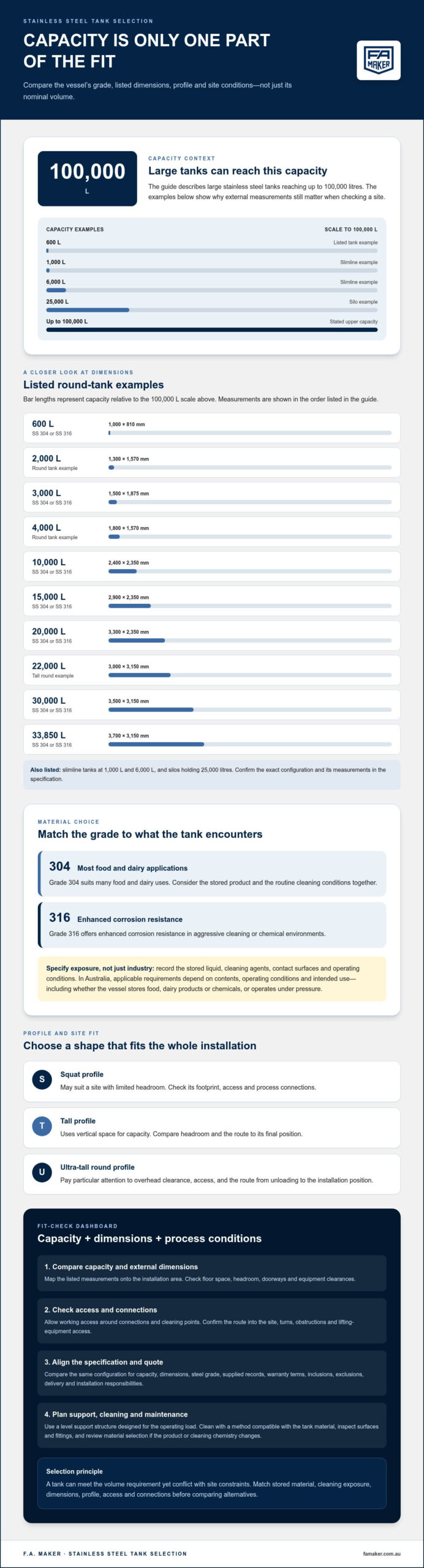
Grade 304 stainless steel suits most food and dairy applications. Grade 316 provides enhanced corrosion resistance in aggressive cleaning or chemical environments. For example, a dairy process with routine cleaning may favour different material considerations from chemical storage. Match the grade to the tank’s actual exposure, not capacity alone.
Assess the stored product, cleaning agents and contact surfaces together. A tank can encounter different conditions during filling, processing and cleaning. Record each exposure in the specification, then compare it with the intended grade. This step helps avoid choosing 304 or 316 based solely on an industry label.
In Australia, applicable standards and regulations depend on a tank’s contents, operating conditions and intended use. Identify relevant requirements in the design specification, including whether the vessel will store food, dairy products or chemicals, or operate under pressure.
Corrosion risk depends on the material grade and exposure to the stored liquid and cleaning agents. Residues or unsuitable cleaning practices can also lead to contamination. Specify the operating conditions and select a design suited to the tank’s intended duty.
Large stainless steel tanks serve processes where the stored material and cleaning regime suit the selected grade. Food and dairy operations are common examples for grade 304. Chemical storage or aggressive cleaning environments may call for grade 316’s enhanced corrosion resistance. The liquid’s properties and process conditions remain central to selection.
Before installation, confirm the route into the site, final position and connection points. Prepare a level support structure designed for the tank’s operating load. During transport, secure the vessel and protect its surfaces and fittings from impact or distortion.
Cleaning requirements depend on the product, tank design and process hygiene needs. Remove residues with a method compatible with the tank material, then inspect internal surfaces, welds and fittings. For food or dairy use, include all product-contact areas in the cleaning plan and monitor for residue build-up.
During routine maintenance, inspect for corrosion, leaks, damaged fittings and signs of contamination. A change in stored liquid or cleaning chemistry can alter the tank’s exposure. Review the material selection if the process changes, and treat pressure conditions as part of the design and operating specification.
Round tank profiles balance floor area, height and access. Compare the listed dimensions with site clearances, handling routes and process connections.
When reviewing specifications, certifications, warranties and quotes, compare documented capacity, dimensions, steel grade, supplied records and warranty terms. Check which inclusions, exclusions, delivery and installation responsibilities are specified.
A squat profile may suit a site with limited headroom, while a taller vessel uses vertical space for capacity. For ultra-tall profiles, pay particular attention to overhead clearance, access and the route from unloading to the final position.
For example, a listed 22,000 L tall round tank measures 3000 mm by 3150 mm. Compare both measurements with the installation area, doorways and equipment clearances before selecting a profile.
Round tanks range across capacities and footprints. A listed 600 L tank measures 1000 mm by 810 mm, while a 3,000 L model measures 1500 mm by 1875 mm. Both are available in SS 304 or SS 316.
At larger capacities, a listed 10,000 L tank measures 2400 mm by 2350 mm. A 15,000 L option measures 2900 mm by 2350 mm, and a 20,000 L option measures 3300 mm by 2350 mm. Each is available in SS 304 or SS 316.
For greater volume, a 30,000 L round tank measures 3500 mm by 3150 mm. The 33,850 L model measures 3700 mm by 3150 mm. Both options are available in SS 304 or SS 316.
These examples show why capacity alone cannot determine fit. A 2,000 L tank measures 1300 mm by 1570 mm, while a 4,000 L tank measures 1800 mm by 1570 mm. Compare dimensions against the footprint and access clearances, not just the nominal volume.
Before accepting a specification, match its capacity and measurements to the process layout. Ensure the grade, tank orientation and required connections are consistent across the specification and quote. Compare documents for the same configuration so differences in capacity, dimensions or included work are clear.
Transport and placement also affect profile selection. Measure the route from delivery access to the operating position, including turns and obstructions. Plan how lifting equipment can reach the tank and where it can be positioned safely. A tall tank may fit its final location but be difficult to move through the site.
Use the listed measurements as a starting point, then map the tank onto the actual installation area. Allow working access around connections and cleaning points. This helps distinguish a suitable tall, squat or ultra-tall round profile from one that meets volume needs but conflicts with site constraints.
Available configurations range from compact slimline vessels to industrial silos. Examples include 1,000 L and 6,000 L slimline tanks, plus silos holding 25,000 litres. Large tanks can reach capacities up to 100,000 litres. Capacity, footprint, height and material grade need to be assessed together.
Slimline dimensions show how much the footprint can vary. A listed 1,000 L tank measures 600 mm by 1200 mm by 1570 mm. A 1,500 L model measures 750 mm by 1500 mm by 1570 mm. Both are available in SS 304 or SS 316.
For greater slimline capacity, a listed 5,000 L tank measures 1150 mm by 2600 mm by 1875 mm. A 6,000 L model measures 1150 mm by 2500 mm by 2350 mm. Both options are available in SS 304 or SS 316. Compare all three dimensions with the delivery route and installation footprint.
Food-grade silos provide another scale reference. A listed 10,000-litre dimple-jacketed silo and a 25,000-litre version are available examples. The 25,000-litre silo measures 5,600 mm high and 2,800 mm in diameter. Those measurements make headroom and access essential specification checks.
Other listed large vessels include a 30,000-litre jacketed stainless steel milk silo. A listed stainless steel tank has a capacity of 4,500 litres. These examples span different process needs, but capacity alone doesn’t establish suitability. Match the stored product, operating conditions and cleaning process to the tank’s intended duty.
Grade options also matter. Listed slimline and round tanks are available in SS 304 or SS 316. Grade 304 suits most food and dairy applications. Grade 316 offers enhanced corrosion resistance in aggressive cleaning or chemical environments. Choose by evaluating product contact and cleaning exposure, rather than assuming one grade fits every application.
Build a comparison schedule before narrowing the options. Record required capacity, maximum height, available floor area, access clearances and preferred grade. Then compare each tank’s listed dimensions and configuration against that schedule. For example, a 25,000-litre silo measuring 5,600 mm high needs a different site assessment from a low-profile rectangular vessel.
A listed CIP skid tank wash system has a capacity of 500 litres, providing another capacity reference alongside storage vessels. Price listings offer a separate point of comparison.
Review capacity, dimensions, grade and listed price together when comparing options.
Food, dairy and chemical operations use stainless steel tanks for different purposes. Suitability depends on the stored material, cleaning regime and tank configuration.
In dairy processing, stainless steel tanks can store milk and support production processes. A jacketed stainless steel milk silo is one example of equipment designed for dairy operations. The intended duty matters: storage requirements differ from those for mixing or temperature-controlled processing. Specify the product and process before selecting a vessel.
Food processing also uses tanks for holding ingredients or product within a production line. Grade 304 is suitable for most food and dairy applications. However, the complete specification still needs to reflect product contact and cleaning conditions. For example, a food manufacturer should describe both the stored material and its cleaning process when defining the tank’s duty.
Chemical operations may use large tanks for bulk chemical storage. Grade 316 offers enhanced corrosion resistance in aggressive cleaning or chemical environments. That does not mean every chemical is suitable for every stainless steel tank. Identify the specific chemical and operating conditions, then match them to the tank material and intended use.
Large tanks can have capacities up to 100,000 litres. Industrial milk silos and bulk chemical storage are examples at this scale. Higher capacity affects more than storage volume: it also changes how the tank fits the process, site and handling arrangements. Select the required working capacity around actual production or storage needs, rather than choosing the largest available vessel.
These steps help distinguish a suitable tank from one that simply has the right volume. A 100,000-litre storage requirement has different process implications from a smaller production vessel. Consider how the tank connects to receiving, transfer and downstream equipment, then include those interfaces in the specification.
Before selecting a tank, document the product, required capacity, process role and cleaning conditions. For example, a dairy operation storing milk should assess the vessel as part of the wider production workflow. A chemical facility should evaluate the material against the chemical and operating environment. These details provide a practical basis for selection.
Stainless steel, poly, other steel and concrete can suit different storage duties. Compare materials against the stored product, cleaning process, operating conditions and site requirements. Choose based on those conditions, rather than assuming one tank type suits every Australian facility.
Stainless steel can be a practical option where product contact and cleanability matter. A well-designed stainless steel water tank can last several decades under suitable conditions. Stainless steel water systems can often exceed 50 years of service under suitable conditions. These examples relate to water systems, not a guaranteed service life for every tank or process.
Poly tanks are another option to assess for storage. Compare their suitability with the liquid, site conditions and process requirements. Consider cleaning and connections to other equipment. Apply the same assessment to stainless steel: product compatibility and operating conditions guide material selection.
For steel tanks, define the exact material and intended use before comparing options. “Steel” is a broad category, so the specification should identify the material and conditions it needs to handle. Compare maintenance needs and exposure to the stored contents and cleaning process with the stainless steel alternative.
Concrete tanks also call for a duty-based comparison. Assess whether the design suits the stored material, site layout and cleaning practices. A facility handling process liquids, for example, may prioritise internal access and cleaning, while a water-storage installation may weigh capacity and expected service life differently.
Use the same criteria for each material to keep the comparison practical:
For a water-storage project, for example, compare stainless steel’s documented service-life potential with site conditions and the maintenance plan. Food or chemical processing requires closer attention to product contact and cleaning compatibility. In either case, capacity alone doesn’t determine the material choice.
Build a specification for each candidate material before evaluating quotes. Include the intended liquid, operating conditions, cleaning requirements, dimensions and connections. This makes stainless steel, poly, steel and concrete easier to compare without assuming they perform identically.
For process equipment selection, explore used stainless steel tanks as one option for matching tank material and duty.
F.A. Maker supplies used stainless steel tanks for industrial processing and storage. Consider a used tank once you’ve defined the required capacity, grade, profile and site constraints, then assess it against those specifications.
Compare each tank’s stated dimensions and material with the product, cleaning regime and installation plan. For a wider process line, F.A. Maker also supplies industrial mixers and blenders, centrifuges and separators, and pumps and valves. These can be relevant when assessing how a tank fits with other process equipment.
Use your specification to guide the next conversation, including the intended duty and layout requirements. Contact F.A. Maker to discuss used stainless steel tanks for your operation.
Before shortlisting large capacity stainless steel tanks, turn your process requirements into a working specification. Record the intended contents, operating conditions, grade, capacity, dimensions, cleaning needs and connection points. Include site access and installation constraints so you can assess the tank in context, not as a standalone vessel.
This preparation can also help identify related equipment needs across the process line. F.A. Maker supplies used stainless steel tanks, centrifuges and separators, and industrial mixers and blenders. Consider how each fits the planned operation while keeping the tank’s duty and site requirements clear.
A defined specification gives your equipment search a practical starting point. Use it to compare suitable options and identify what best aligns with your operation. Contact F.A. Maker about tank options and take the next step with a clear basis for discussion.
Australian options include round and slimline tanks, open-top vessels, mixing tanks, jacketed tanks and silos. For example, a process line may use an open-top vessel for accessible handling, while a silo may suit bulk storage. Configurations vary by capacity, dimensions and grade. Compare the shape and fittings with how your site receives, stores and transfers product, not capacity alone.
F.A. Maker supplies used stainless steel tanks for Australian industrial operations. When comparing options, assess each tank’s stated capacity, dimensions, grade and process suitability against your requirements. F.A. Maker also supplies related process equipment, including pumps and valves, which may be relevant when planning the wider production setup.