

A factory move involves more than transporting machinery between sites. Effective factory relocation project management coordinates the schedule, workforce, equipment, shutdown and site readiness from planning through commissioning. The same principles apply to moves within a plant, across Australia and internationally, with the project scope shaped by the route and operational constraints.
Production schedules and workforce coordination are central to a relocation, which can require detailed work across multiple teams and sites. This guide explains how to plan and manage a move, including the decisions that shape the work sequence and the return to production.
We cover project milestones and personnel planning, equipment and site assessments, shutdown and safety coordination, and machinery removal, installation and commissioning. We also explain how requirements vary for plant, interstate and international moves.
A relocation schedule links production requirements with equipment moves, workforce responsibilities and project milestones. Factory relocation project management turns those dependencies into a coordinated plan for each site and production area.
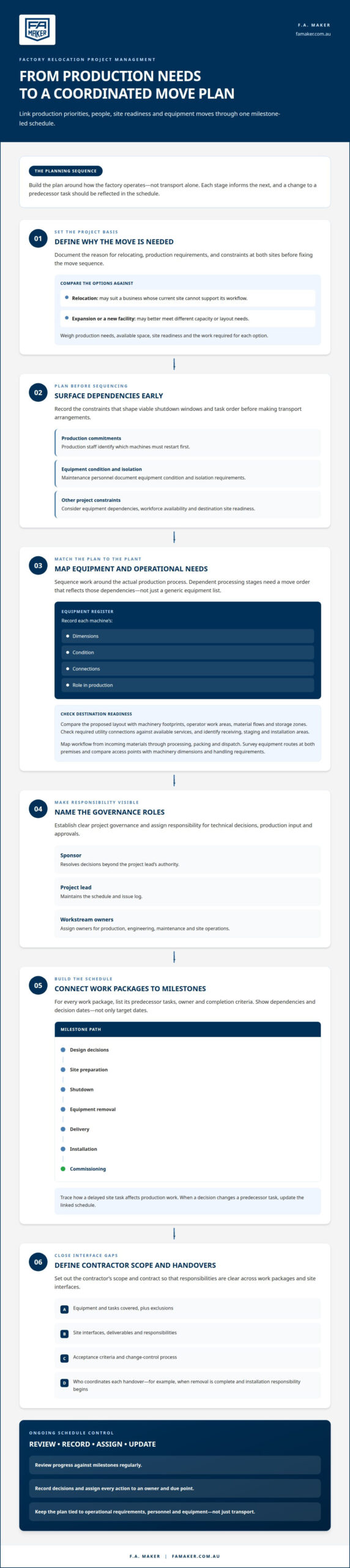
Start by documenting why the move is needed, the production requirements and the constraints at both sites. Then compare relocation with expansion or a new facility. Relocation may suit a business whose current site cannot support its workflow, while expansion or a new facility may better meet different capacity or layout needs. Weigh production needs, available space, site readiness and the work required for each option.
Tailor the plan to the plant’s actual sequence of operations. For example, a line with dependent processing stages needs a move sequence that reflects those dependencies, not just a generic equipment list. Identify the people responsible for technical decisions, production input and approvals, then assign each responsibility to a named role.
Start planning as soon as the relocation decision is made, before fixing the move sequence. Early planning can reveal dependencies between equipment, production commitments, workforce availability and site readiness. Record these constraints so the project team can compare viable shutdown windows and sequence tasks around operational priorities.
For example, production staff can identify which machines must restart first, while maintenance personnel document equipment condition and isolation requirements. Use these inputs to shape the schedule before making transport arrangements. Early planning also gives managers time to address decisions that could delay later milestones, such as access requirements or installation dependencies.
List each work package, its predecessor tasks, owner and completion criteria. Set milestones for design decisions, site preparation, shutdown, equipment removal, delivery, installation and commissioning. Show dependencies and decision dates, not just target dates, so the team can trace how a delayed site task affects production work.
Establish clear project governance by naming a sponsor, project lead and workstream owners for production, engineering, maintenance and site operations. The project lead maintains the schedule and issue log, while the sponsor resolves decisions beyond the lead’s authority. Review progress against milestones regularly, record decisions and assign every action to an owner and due point.
Define the contractor’s scope and contract, including the equipment and tasks covered, site interfaces, deliverables, responsibilities, exclusions, acceptance criteria and change-control process. Make clear who coordinates each handover, such as the point when removal is complete and installation responsibility begins. This helps prevent gaps between work packages from becoming schedule problems.
IMS notes that businesses may move their machines or factories only once or twice, underscoring the value of clear task ownership and specialist coordination. Use the schedule to connect personnel, equipment and milestones, and update it when a decision changes a predecessor task. This keeps the plan focused on operational requirements, not just transport.
A site assessment checks whether each machine and production activity can transfer to the proposed layout. Before confirming the move sequence, compare equipment requirements with available space, utilities, storage and workflow.
Start with an equipment register recording each machine’s dimensions, condition, connections and role in production. A processing unit, for example, may need both room in the production line and clear access for maintenance. Mark its position, orientation and access route on the proposed floor plan.
Compare the site plan with machinery footprints, operator work areas, material flows and storage zones. Check that receiving, staging and installation areas will not block production or equipment access. List the utility connections each machine requires and compare them with the services available at the destination. Differences may affect installation sequencing or require site work before delivery.
Storage requirements also depend on the move sequence. Distinguish machinery awaiting transport from equipment already delivered, and identify where components, tooling and protective materials will be kept. For dairy equipment, for instance, assess how its production position relates to connected process stages and the space needed for installation.
Map the workflow from incoming materials through processing, packing and dispatch. This shows whether the proposed layout supports an efficient sequence or creates extra handling between stages. Record constraints against the relevant machine or area so the design team can resolve them before finalising the schedule.
Survey both premises using the same checklist. Record doorways, corridors, floor transitions, loading areas and obstructions along each equipment route, then compare these observations with machinery dimensions and handling requirements. A machine may fit its production bay but still be difficult to move through a narrow access point.
Assess how each proposed route interacts with people, operating equipment and site services. Note where access needs coordination, work areas need separation, or activities could interrupt production. For every constraint, record its location, likely effect on the move sequence and the action required before work proceeds.
Assess the whole operating system, not just individual machines. Trace how a change to one station affects upstream supply, downstream capacity, operator positions and storage. If a relocated bottle filler sits between processing and packing, for example, confirm that its position maintains the intended product flow and provides workable access.
Involve engineering, production and site personnel in the review. They can identify different constraints: an engineer may flag connection requirements, while operators can explain how materials move during a shift. Record agreed decisions against the layout and equipment register.
A coordinated machinery relocation plan can connect survey findings with equipment handling and site requirements. Use the completed assessment to resolve layout conflicts and operational dependencies before confirming the final move sequence.
Minimise downtime by linking the shutdown sequence to equipment dependencies, production priorities and restart requirements. Map which lines can stop independently, which services need isolation and what must be ready before production resumes.
Build the shutdown plan around the production sequence, not just the transport schedule. Identify the last production run, the equipment handover point and the tasks required before restart. If one line feeds another, plan their shutdowns together or document how materials will be managed between them.
To limit supply-chain disruption, coordinate production, inventory and delivery commitments with the planned outage. Record which products need to remain available during the transition and which equipment must return to service first. A staged move may suit independent production areas, while closely connected equipment may require a coordinated shutdown.
Hold a readiness review before stopping equipment. Confirm that the destination work area, assigned personnel, handling arrangements and required services are prepared. Resolve any incomplete prerequisite before the shutdown milestone, rather than letting idle equipment extend the outage.
Assign engineers and trades to defined work packages, such as isolating services, dismantling machinery, preparing the destination and reconnecting equipment. Set a clear handover point for each package. For example, removal should not begin until the equipment is isolated and the work area is ready.
Sequence tasks to prevent crews from working across one another. An engineer may need to complete a technical assessment before trades disconnect or remove a machine. The project lead should track dependencies, work locations and access windows, then communicate changes to production and site personnel.
Keep a shared record of work status, site constraints and outstanding actions. If a connection or access issue delays a task, the team can see which later activities depend on it. This makes schedule changes visible to the engineers, trades and production managers affected.
Coordinate equipment isolation, site safety and services as part of one shutdown activity. Before removal, identify the equipment and services involved, define access boundaries and communicate the sequence to everyone working in the area. Base the work plan on site procedures and applicable industry regulations.
Give specialist suppliers defined arrival points, work areas and handovers. Align their activities with machinery access, site readiness and the work of engineers and trades. For example, before a supplier begins work at the destination, make sure the relevant equipment and work area are ready.
Use a pre-start review to confirm that task instructions, responsible personnel and site access arrangements reflect the day’s work. Record changes and communicate them to affected crews before work proceeds. This keeps safety controls aligned with actual site conditions instead of relying on an outdated shutdown plan.
Manage machinery relocation as a connected sequence, from removal through commissioning. At the new site, coordinate utilities and IT with installation, then assess each machine against its intended operating requirements before production resumes.
Before moving machinery, plan mechanical isolation, dismantling, protective packing and documentation. Record each machine’s condition and identify components that must travel together. This information supports controlled handling and gives the installation team a reference for reassembly.
Heavy equipment may need forklifts, cranes and a trained crew for safe removal. Its dimensions, weight, access route and handling points shape the movement plan. Confirm the route from the operating position to the loading area, including tight turns or obstacles that could affect handling.
Document the handover between removal, transport and installation teams. Identify each machine, its destination and the records accompanying it. Keep components and related documentation together so the receiving crew can reconcile deliveries before reassembly.
At the destination, follow the planned installation sequence and compare each machine’s position with the approved layout. Check alignment with adjoining equipment and the intended production flow. If the layout needs to change, document the revision and assess its effect on connected machinery before proceeding.
Commission equipment after installation and any required modifications. Check its functions in a controlled sequence, recording observations and outstanding work. A machine is not ready for production just because it has arrived or been positioned; assess its operation against its intended role.
Coordinate handovers between the installation crew, engineers and production personnel. Production staff can explain the operating sequence, for example, while engineers assess the machine’s functional response. Document results so unresolved items remain visible and can be addressed before the equipment enters routine production.
Before installation, map each machine’s utility connections and compare them with the services available at the new site. Coordinate connections with the installation sequence so machinery is not positioned before its supporting services are ready. Include IT interfaces where equipment depends on production data or control-system connections.
Once connections are made, check that the equipment and its interfaces operate as intended. Validate individual machines first, then assess how they work with adjoining equipment and the wider production process. Record results, faults and corrective actions for each machine instead of relying on a general site sign-off.
Keep commissioning records with the equipment documentation. They help the team track what has been installed, tested and cleared for operational use. The project manager can coordinate outstanding tasks and confirm that the handover reflects the actual readiness of each production area.
The route changes the work, but every move still depends on equipment, site access and production priorities. Match the relocation scope to the distance, destination and operational interfaces involved.
A move within one plant may avoid long-distance transport but still needs a clear route between operating areas. Plan access through production zones, identify staging areas and sequence the move around nearby machinery and active work. Moving one processing unit, for example, may affect material flow to an adjoining line.
Interstate moves require coordination between the origin, transport route and receiving site. Confirm destination access, delivery sequence and site readiness before dispatch. A route change or delay at the receiving site can affect where equipment is held and when installation can begin.
International moves require extra attention to shipment documentation and import preparation. In one shipment from a UK publishing house to Australia, machinery had to be cleaned, certain packaging heat-treated and import documentation completed to avoid transit complications. Treat these as shipment-specific planning tasks, not assumptions that apply to every move.
For every move, define who controls each handover: removal, transport, receipt and installation. Tie those handovers to the destination’s production sequence. A plant move may focus on access and staging, while an interstate or international move also depends on route and shipment coordination.
In Australia, relocation costs depend on the route, machinery dimensions, transport method, installation scope and downtime. Pricing varies by project and is provided after a quote request. Other cost drivers include dismantling, protective packing, site preparation, required modifications and commissioning work.
Compare the full project scope, not transport alone. A machine that needs extra dismantling or installation work has different requirements from equipment moved intact. A prolonged production interruption can also affect the project’s business impact, even when transport itself is straightforward.
For a useful cost assessment, map each machine to its origin, destination and required work. Record access constraints, handling needs, installation tasks and production dependencies. Then distinguish costs driven by distance from those related to equipment condition, site readiness or downtime.
Use that breakdown to compare relocation options. Moving equipment within a plant may reduce transport needs but still require staging and production coordination. An interstate or international route adds shipment planning and receiving-site interfaces. Plan your machinery move around the complete route, installation scope and operational impact.
F.A. Maker supplies used stainless steel tanks for manufacturers assessing process equipment needs during a factory move. If the new layout calls for a different tank capacity or other process equipment, compare the required function with the available plant configuration before finalising the equipment plan.
F.A. Maker also supplies centrifuges and separators, industrial mixers and blenders, and pumps and valves. These categories may be relevant when reviewing requirements for a relocated production line. Assess each item in relation to workflow, available space and the planned installation sequence.
Discuss used stainless steel tanks and process equipment for your relocation with F.A. Maker.
Turn the relocation concept into decisions your team can act on. Use the proposed production layout to identify equipment gaps, surplus machinery and process requirements before committing to a final configuration. This gives the project team a clearer basis for coordinating equipment sourcing and relocation work.
F.A. Maker supplies used stainless steel tanks, centrifuges and separators, and industrial mixers and blenders. These equipment categories may be relevant when assessing a new or reconfigured production line. Align equipment decisions with the move plan to keep the intended process and site layout connected.
Effective factory relocation project management places each decision within the wider operational plan. Once your priorities are clear, discuss your move and equipment requirements with F.A. Maker.
Contact F.A. Maker to discuss your move and take the next planning step with confidence.
The main stages are defining the move scope, preparing the destination, coordinating shutdown, moving equipment and restarting production. First, confirm which assets and processes are moving and what must remain operational. Then assign accountable leads for production, engineering and site readiness. At handover, compare the installed equipment and operating results with agreed acceptance criteria. For a move across state or territory borders, include route and receiving-site coordination in the plan.
There is no single reliable duration for an industrial factory relocation. The schedule depends on the equipment, route, site readiness and production constraints. Moving connected production stages requires more coordination than transferring an isolated machine. Timing also depends on dismantling, transport arrangements, destination preparation and commissioning. Build the estimate from task dependencies and confirmed handover points, then revise it if a delay affects downstream work.
Start with an asset and materials register identifying machinery, connected line components and hazardous substances. Isolate equipment and document its condition before dismantling. Keep associated components and records identifiable through packing, transport and receipt. Identify hazardous materials separately and arrange handling appropriate to their properties, rather than treating them as ordinary machinery cargo. Coordinate the people responsible for each part of the move and keep records to support safe receipt and reinstallation.
Applicable approvals depend on the state or territory, destination site and work involved. Assess whether site alterations, transport of oversized machinery, hazardous materials or waste handling trigger specific requirements. Include work health and safety planning for isolation, lifting, access and contractor interfaces. Consider environmental matters such as waste streams and potential releases. Record requirements and responsible parties before work starts, as there is no universal approval checklist for every plant move.
Common project risks include missed dependencies, access problems, equipment damage, delayed installation and prolonged production interruptions. Reduce them by linking each machine to its route, destination, supporting services and restart sequence. Assign owners to unresolved issues and record decisions that change the plan. A walkthrough of the receiving site can reveal practical conflicts, such as stored materials obstructing a delivery route. Track issues through handover, not just until the machinery arrives.