

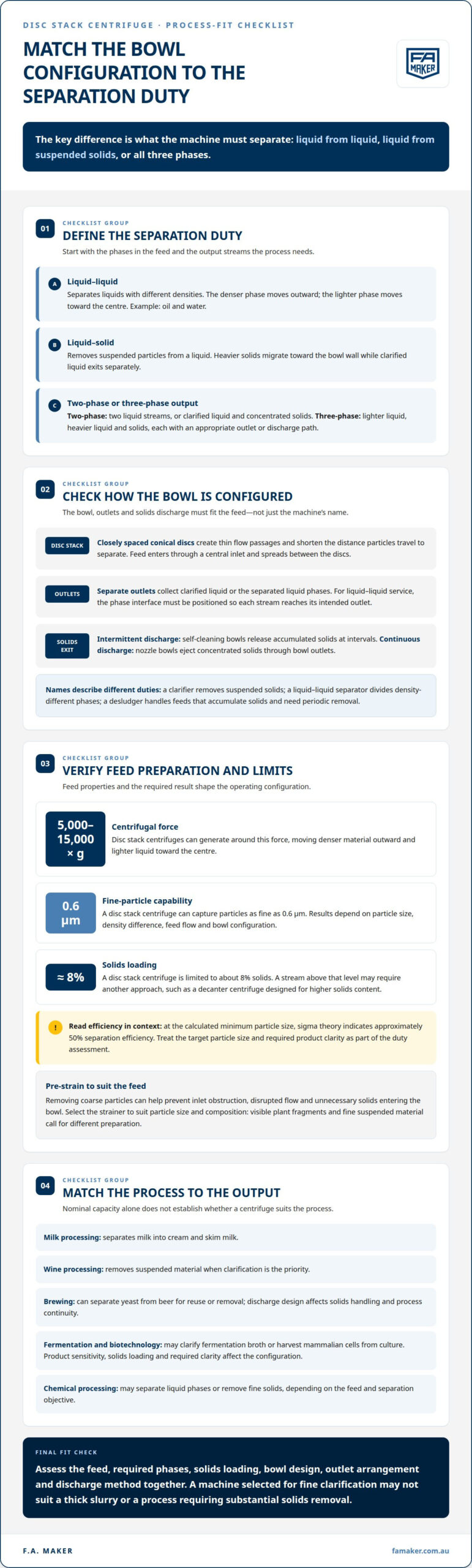
The key difference is the material being separated: liquid-liquid separation divides liquids of different densities, while liquid-solid separation removes suspended particles from a liquid. A used disc stack centrifuge for sale can perform either task by spinning the feed through stacked conical discs, generating centrifugal forces of around 5,000 to 15,000 × g. Denser material moves outward in the bowl, while the lighter liquid moves towards the centre.
That principle is straightforward, but the right machine depends on the feed and the separation required. A unit designed to clarify liquid may not suit separating two liquid phases. Bowl design, discharge arrangement and construction materials all affect whether it fits your process.
This article explains how disc stack separation works, which components and materials to assess, and how to source a used disc stack centrifuge for sale in Australia. It also compares liquid-liquid and liquid-solid duties, helping you judge a centrifuge by its configuration and process fit, not its name alone.
Inside the bowl, rapid rotation creates centrifugal force that separates materials according to density. Disc stack centrifuges can generate around 5,000 to 15,000 × g, moving denser material outward while lighter liquid travels inward. The feed enters through a central inlet and spreads between closely spaced conical discs. These discs shorten the distance particles must travel before separating from the surrounding liquid.
As feed moves through the disc stack, heavier suspended solids migrate towards the bowl wall. In liquid-liquid separation, the denser phase moves outward and the lighter phase towards the centre. Separate outlets collect the clarified liquid or separated liquid phases. The bowl and discharge design determine whether solids leave intermittently or through a continuous discharge.
Feed preparation affects separation. Pre-straining removes coarse particles that could obstruct the inlet, disrupt flow or add unnecessary solids to the bowl. Choose a strainer to suit the feed’s particle size and composition. For example, a food-processing stream with visible plant fragments needs different preparation from a fermentation broth containing fine suspended material.
Food and beverage applications include milk and cream separation, wine processing, oil purification and fermentation broth clarification. In dairy processing, a separator divides milk into cream and skim milk. In wine processing, clarification removes suspended material. In each case, the feed’s properties and required output matter more than the centrifuge’s nominal capacity alone.
Pharmaceutical and biotechnology processes may use disc stack centrifuges to clarify fermentation broth or harvest mammalian cells from culture. Chemical processing may use them to separate liquid phases or remove fine solids. The same bowl principle serves these duties, but product sensitivity, solids loading and required clarity affect the operating configuration.
Solids loading matters because a disc stack centrifuge is limited to about 8% solids. A stream above that level may require another separation approach, such as a decanter centrifuge, which is designed for higher solids content. The appropriate choice follows from the feed and separation objective. A machine selected for fine clarification may not suit a thick slurry or a process requiring substantial solids removal.
Discharge design affects whether a process can run continuously. Self-cleaning bowls release accumulated solids at intervals, while nozzle designs can eject concentrated solids continuously. The right arrangement depends on whether solids settle and how the process handles discharged material. In brewing, for example, a disc stack centrifuge can separate yeast from beer for reuse or removal.
The bowl separates material by density, while the outlet and solids-discharge design must suit the feed. A two-phase duty separates two liquids or a liquid from solids. A three-phase duty separates two liquids and solids.
Two-phase separation produces either two liquid streams, such as oil and water, or clarified liquid and concentrated solids. Three-phase separation divides the feed into a lighter liquid, a heavier liquid and solids. Each phase needs an appropriate outlet and discharge path. An oil-water-solids feed, for example, requires all three fractions to leave the bowl separately.
A clarifier removes suspended solids from liquid; a liquid-liquid separator divides phases of different densities. A desludger handles feeds that accumulate solids and need periodic removal. These names describe different duties and discharge arrangements, not guaranteed performance. Match the configuration to the feed: wine clarification prioritises liquid clarity, while oil purification separates liquid phases.
Nozzle bowls discharge solids continuously through outlets in the bowl. They suit processes where concentrated solids can flow out continuously. Other designs retain solids until they are discharged intermittently. This choice affects process continuity and solids collection. A steady solids load creates a different duty from a mostly liquid stream with occasional particles.
Stacked conical discs create thin flow passages, helping particles travel towards the bowl wall over a shorter distance. A disc stack centrifuge can capture particles as fine as 0.6 µm. This capability is relevant to fine suspensions, including microalgae cells separated from culture medium. The result depends on particle size, density difference, feed flow and the bowl’s operating configuration.
Centrifugal force moves denser material outward and lighter liquid inward. In liquid-liquid service, the interface between phases must stay positioned so separate outlets collect each stream. In liquid-solid service, particles move outward and clarified liquid exits separately. Feed volume and solids concentration affect the load on the bowl and how discharge must be managed.
Separation efficiency describes how effectively the machine divides the target phases; product quality depends on the purity or clarity required downstream. At the calculated minimum particle size, sigma theory indicates approximately 50% separation efficiency. That figure highlights why the target particle size matters when assessing a duty, rather than treating clarity as a simple yes-or-no result.
For an Australian installation, assess applicable electrical and workplace safety requirements, including guarding, isolation, commissioning and operating procedures. Bowl rotation, electrical supply and solids discharge all need to fit safely within the plant process. For example, the layout should provide access to the bowl and a suitable route for collecting discharged solids.
A disc stack centrifuge separates process streams inside a rotating bowl. Its main components include a feed inlet, spindle, drive, bowl, disc stack, liquid outlets and solids-discharge arrangement. The drive turns the spindle and bowl, while the inlet directs feed into the separation zone. Conical discs create narrow passages through which the flow separates. Bowl design and operating speed must suit the process.
The discs are stacked with spacing that can range from 0.4 to 2 mm. Their conical shape creates a large effective separation area within a compact bowl. Disc angles commonly sit around 40 to 50 degrees. Bowl diameters can range from around 7 to 24 inches or more, depending on equipment design. These dimensions affect the available separation area and the machine’s process capacity.
Capacity is duty-specific. Dairy cream separation applications can run around 5,000 to 10,000 L/hr, while a listed Alfa-Laval PX 55 separator operates at 6250 RPM. Another example, the GEA Westfalia GSE 125-06-777, has a bowl speed of 5900 rpm. These figures describe different machines and applications, not a single standard operating point. Feed properties and process requirements determine the relevant combination of speed and throughput.
The bowl also determines how solids are retained or removed. A solid-wall design holds solids within the bowl until discharge, while a nozzle arrangement can eject concentrated solids continuously. Liquid outlets collect separated product streams. For example, the Westfalia BKA-35-86-076 solid-bowl disc centrifuge has a maximum bowl speed of 5000 rpm. Bowl design therefore influences both discharge handling and the process’s operating pattern.
Cleaning is part of process configuration, especially where product changeovers matter. A bowl-rinsing cycle uses a process-compatible liquid to flush residues from internal surfaces and disc passages. The cleaning sequence needs to cover the bowl, disc stack and product-contact pathways. In pharmaceutical processing, removing residues between batches supports controlled product transitions. Cleaning access and discharge design also affect how the machine fits the plant’s routine.
Compare bowl speed, disc arrangement, throughput and discharge type with the actual feed. High RPM alone does not establish suitability: the bowl must also handle the required volume and solids behaviour. A dairy separator set up for cream separation, for example, has a different duty from a pharmaceutical clarifier. The benefits of a disc stack design depend on matching its core specifications to the process.
Used and new-surplus centrifuges differ in history, condition and configuration. Assess each machine against the process duty and the work needed before installation.
Condition describes the machine’s present state, while refurbishment covers work to restore or adapt it. This distinction matters because a complete-looking centrifuge may still lack process-critical parts. For example, a listed Westfalia SA14-06-076 clarifier is missing its bowl, a major component that affects whether the equipment can perform its intended duty.
Assess the bowl, disc stack, drive, controls, outlets and discharge arrangement individually. Wear, corrosion or damage to product-contact surfaces can change the refurbishment scope. A used Alfa Laval unit may have a different configuration from the same model set up for another process. Record the required clarification duty and compare it with the equipment’s actual configuration.
Refurbishment and maintenance costs depend on the machine’s condition, required parts and work scope. Request a quote: bowl damage, bearings, seals, controls and labour can all affect the estimate.
Used equipment lead times are measured in days or weeks, rather than the months often required for new disc centrifuge orders. New-surplus equipment offers another sourcing route: it is unused stock, but storage history and supplied configuration still matter. Compare delivery timing with the work needed to prepare the machine for its intended process.
For example, an Alfa Laval MAB-104B-24 lube oil centrifuge purifier is listed with a 1.5 kW motor. The motor specification alone doesn’t establish suitability. Bowl condition, outlet arrangement and compatibility with the feed also shape the practical refurbishment and installation scope.
Purchase risk is the possibility that condition, configuration or missing components differ from the needs of the process. This matters because repair work or a required replacement can affect the machine’s overall suitability. The Westfalia SA14-06-076 example shows why a missing bowl is more than a cosmetic issue.
Purchase documents should identify the equipment supplied, its condition and any completed refurbishment. They should also specify whether a warranty applies and, if so, its duration, coverage and exclusions. A warranty’s value depends on those written terms, not the model name alone. Make the scope clear for components such as the bowl, drive and controls.
New-surplus machines still need a configuration review. Check that the supplied bowl and discharge arrangement match the separation duty, then account for required process connections and commissioning. For used equipment, maintenance records and test results help establish operating history. They provide useful context but do not replace an assessment of the machine’s current condition.
Compare options by how ready they are for the job, not just by acquisition timing. A unit requiring a bowl replacement presents a different project from a complete centrifuge with a suitable configuration. For Australian plants, include transport, installation and integration with the existing process line in your sourcing plan.
Material selection affects product contact, cleaning and service life. In food, beverage and pharmaceutical applications, the bowl, discs and wetted outlets need materials suited to the feed and cleaning process. Stainless steel is common in process equipment because it resists corrosion in many operating environments. However, the grade alone cannot establish whether a machine suits a particular product or cleaning routine.
Two listed centrifuges provide specific material examples: the Westfalia SIG 15007 nozzle-type disc centrifuge and the Delaval BRPX-207-39S automatic disc centrifuge are made of 316 stainless steel. Those model details can help frame an equipment assessment, but they don’t describe every component or establish the condition of a used machine. Inspect product-contact parts and compare their material with the process fluid, cleaning agents and operating conditions.
Surface condition matters as much as alloy selection. Scratches, pitting, deposits or damaged welds can complicate cleaning and leave places for product residues to collect. Inspect the bowl, individual discs, feed zone and liquid outlets. For example, residue between discs can be difficult to remove if the stack is damaged or assembled incorrectly.
Sanitary design combines material, geometry and access for cleaning. Smooth product-contact surfaces and drainable passages support effective cleaning, while crevices and retained liquid can make it harder. Review how the machine opens, how the bowl and disc stack are accessed, and how cleaning liquid moves through the process path. These details are particularly important when product changeovers require a defined cleaning routine.
Construction must also suit the solids stream. Abrasive particles or concentrated sludge create different wear conditions from a low-solids liquid. A decanter centrifuge may suit heavier solids loading, while a disc stack design may fit fine clarification. The right choice depends on the feed, required separation and equipment configuration.
Manufacturers specify materials and surface finishes for particular designs, so assess the actual machine rather than relying on its brand or model family. Check that the bowl, discs, gaskets and outlet components suit the intended process. Confirm that the surfaces can be cleaned using the plant’s established method, and consider how continuously the machine will operate. These checks help identify whether refurbishment or component replacement is needed.
For an equipment assessment, record the material grade, condition of product-contact surfaces, cleaning access and signs of corrosion. A written inspection can distinguish cosmetic wear from defects affecting process suitability. To discuss related process equipment, explore available decanters for duties involving concentrated solids.
F.A. Maker supplies centrifuges and separators for industrial separation duties, as well as used stainless steel tanks. Turn to F.A. Maker when assessing equipment for a process line and considering how a centrifuge fits with storage, mixing or fluid transfer requirements.
Matching the centrifuge with related equipment helps clarify what the full line needs. Industrial mixers and blenders support process preparation, while pumps and valves handle fluid movement and control. The right combination depends on the feed, process sequence and required output.
Contact F.A. Maker to discuss your equipment requirements and how a centrifuge or separator could fit into your process.
Before shortlisting a used disc stack centrifuge for sale, define its process duty and the outcome your line requires. Then compare that with the equipment’s configuration, condition and fit with surrounding plant systems. This gives your team a practical basis for weighing options and identifying the information needed to make a purchase decision.
Consider the centrifuge as one part of the production line. Feed preparation, storage, transfer and downstream handling all affect how equipment works together. Mapping these connections can show whether your priority is separation alone or a broader process-equipment requirement.
F.A. Maker can help you explore centrifuges and separators alongside other process equipment relevant to your plant. If you’re ready to discuss the application and equipment requirements, contact F.A. Maker about centrifuges. A clear description of your process and intended duty is a useful place to start.
Vibration, uneven solids discharge and deposits on product-contact surfaces are common factors to monitor. Vibration readings around 2 mm/s to 4 mm/s can signal that maintenance is needed; levels exceeding 7 mm/s may warrant immediate shutdown. Changes in feed composition can also affect operating stability. Keep a record of vibration trends, cleaning observations and discharge behaviour to help distinguish gradual wear from a developing fault.
The stacked discs create thin channels, increasing the area available for particles to separate from liquid. Disc spacing and surface condition influence flow through the bowl. Deposits or damaged disc edges, for example, can disrupt flow through the stack. During inspection, look for even spacing, clear passages and wear that could affect separation consistency.
F.A. Maker supplies centrifuges and separators for Australian process operations. To narrow your search, define the feed, separation duty, plant connections and preferred discharge arrangement. This gives you a practical basis for comparing equipment with your process instead of relying on a model name alone. Plan transport and installation around the destination site and its existing production line.
The price is provided after a quote request and depends on the machine, its condition and the work required for the intended duty. Bowl completeness, drive configuration, controls, refurbishment and transport can all affect the overall project cost. Request pricing in Australian dollars and compare equipment on its required preparation as well as its purchase price. A machine needing major component work has a different cost profile.
Used equipment examples in the market include Alfa Laval, GEA Westfalia and Delaval models. Models and configurations vary, so treat a model name as a starting point, not proof of suitability. Clarifiers, separators and nozzle-type bowls, for example, perform different duties. F.A. Maker supplies centrifuges and separators; compare a machine’s configuration with your feed and process requirements.
Compare capacity and bowl speed under the same process duty and feed conditions. Rated throughput alone does not establish how a machine will perform with your product. Review required flow, solids load, separation target and operating configuration together. A stated capacity for dairy cream separation, for example, is not a direct rating for a different liquid or solids mixture.
Request records identifying the machine and documenting maintenance, repairs, operating history and refurbishment. Inspect the bowl, disc stack, drive, controls, outlets and discharge components for wear, damage or missing parts. Compare the configuration with the intended duty, then record any work needed before installation. Clear documentation helps distinguish observed condition from assumptions based on age or brand.
Typical refurbishment and maintenance costs for used disc stack centrifuges
Vibration readings around 2-4 mm/s can signal that maintenance is needed.