

For hammer mill screen size selection, the opening sets the maximum particle size that can pass, but it doesn’t determine the average size or the full particle-size spread. For corn, a 3/32-inch (2.38 mm) screen is associated with an approximate particle size of 350-500 µm, while a 1/4-inch (6.35 mm) screen is associated with about 1,200-1,400 µm. Open area matters too: more open area can increase material flow and mill capacity, but may reduce screen strength and durability.
Choosing a screen means balancing target particle size, throughput and the material being milled. Smaller openings generally produce finer material, while larger openings can support coarser grinding and greater flow. Screen design, material friability and moisture also affect the result, so corn conversions are starting points, not universal settings.
This article explains how screen openings relate to particle size, how open area affects throughput, and how round-hole, slotted and other screen designs perform. It also outlines approximate corn-to-micron conversions and factors that can shift results in an operating mill.
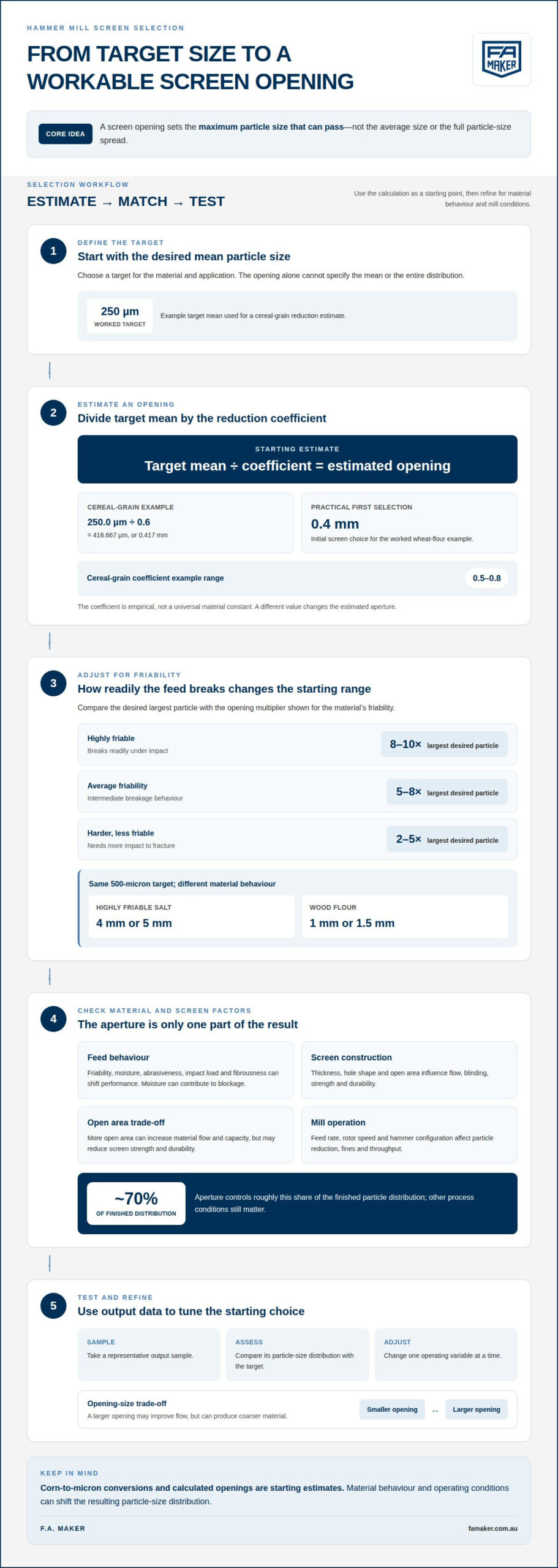
A screen opening sets the maximum particle size that can pass from the grinding chamber, but not the average size or the full particle-size spread. For a 250.0 µm target mean, a cereal-grain reduction coefficient of 0.6 gives a calculated opening of 416.667 µm, or 0.417 mm.
The reduction coefficient relates a target mean particle size to an estimated screen opening. Divide the target mean by the coefficient, then select a practical opening close to the result. For wheat flour, 250.0 µm divided by 0.6 gives 416.667 µm, or 0.417 mm; a 0.4 mm screen is the recommended initial selection for that worked example.
Friability describes how readily a material breaks under impact, and it helps determine the opening needed for a desired particle size. For highly friable material, openings can be 8 to 10 times the largest desired particle size; for average-friability material, use 5 to 8 times; for harder, less-friable material, use 2 to 5 times.
Material type narrows the starting range. Resins, minerals and chemicals use a 5x to 8x multiplier in the guide, while wood, fibre and grain hulls use 2x to 5x. A 500-micron target for highly friable salt is illustrated with 4 mm or 5 mm openings; the same target for wood flour is illustrated with 1 mm or 1.5 mm openings. Fibrous material may behave differently from brittle grain, even at the same aperture.
Screen size influences particle distribution, but it cannot specify the average or spread on its own. The screen determines the maximum particle size able to pass, while hammer action and repeated contact reduce particles inside the chamber. Aperture controls roughly 70% of the finished distribution, so the remaining process conditions still matter.
Screen thickness, hole shape and open area affect flow and durability. Greater open area can increase material flow and capacity, but may reduce screen strength. Feed rate, rotor speed and hammer configuration also influence how particles encounter the hammers and screen, shifting fines and throughput without changing the aperture.
To reduce fines while improving capacity, take a representative output sample and assess its particle-size distribution. Then change one operating variable at a time. A larger opening may improve flow but produce coarser material; feed rate, rotor speed and hammer configuration can also affect particle reduction. Roller mills use a roll gap rather than a perforated screen. A tighter gap generally creates finer material, so adjust the gap against the target distribution.
Begin with the material’s behaviour, target particle size and mill operating conditions. Grain, glass, wood and e-waste differ in friability, moisture, abrasiveness and impact load, so a single aperture or screen construction won’t suit every application.
Material-specific selection matches the opening and screen construction to how the feed breaks, flows and wears equipment. Grain is generally free-flowing, while wood and grain hulls can be fibrous; moisture can also contribute to blockage. Glass and e-waste require attention to impact and wear, particularly when the feed contains hard, non-friable pieces.
Typical openings range from 0.3 mm to 3 mm for sugar, salts and grains, and 3 mm to 12 mm for wood, fibre and grain hulls. Screens for e-waste recycling are often 1/4 inch or thicker to handle impact from non-friable material. Glass has no single opening specified here: the target distribution and the feed’s breakage behaviour guide the choice.
Screen material and thickness affect wear resistance, corrosion performance and the ability to withstand impact. Carbon steel screen holes typically range from 0.3 mm to 10 mm; stainless steel screen holes typically range from 0.6 mm to 5.0 mm. Choose material to suit the process environment, including abrasive particles or corrosive conditions.
For food-processing applications, specify the screen material and finish for the intended use; stainless steel alone doesn’t establish food-grade suitability. Screens are made in thicknesses from 24 gauge to 5/8 inch. Thicker material can better withstand impact, but a 1/2-inch-thick opening is more likely to catch slightly sticky or fibrous feed than a 1/8-inch-thick opening.
Friability describes how readily a material fractures during milling and helps narrow the aperture for a target particle size. Highly friable feed breaks readily, while hard material may need repeated impact to reach the desired size. Compare the resulting particle-size distribution with the target instead of choosing an opening based on the material name alone.
For example, a 500-micron wood flour target is illustrated with a 1 mm or 1.5 mm screen. The opening is only a starting point: moisture, feed condition and mill settings affect how particles break and pass through. Fibrous material can bridge or catch in openings, so hole shape and screen thickness matter alongside diameter.
High moisture and agglomeration can blind screen openings. Drying or conditioning the feed can help reduce blockage. Abrasion and impact contribute to wear or damage, so regular inspection and timely replacement support milling efficiency and product quality.
Measure worn openings during inspection: replace a screen when holes have elongated by 5%. At a consistent feed rate, a 10% to 15% rise in motor amperage can signal a blinded or worn screen. Check for these changes alongside visible damage and altered output, then address the feed condition or screen wear causing the change.
For equipment context, review hammer mill screen applications alongside the material and target distribution.
Open area is the proportion of a screen’s surface occupied by openings rather than solid material. It affects how readily particles pass through, making it central to balancing mill capacity and screen strength.
Open area describes the passage available for particles through a screen and influences how much material the mill can process. More open area can increase flow and capacity by giving particles more room to exit the grinding chamber. Less open area restricts passage and may reduce throughput even when hole size is unchanged.
Hole size and open area are related but distinct. A screen can retain a desired aperture while changing the spacing between holes. For example, a screen with 1/8-inch holes on 1/4-inch centres has 23% open area; with the same holes on 3/16-inch centres, it has 40%. The second pattern provides more open surface, but the choice still needs to suit the required capacity and screen strength.
For a given hole size, use the least open screen area that meets the capacity requirement. This avoids treating maximum openness as the only performance goal. A 20% open-area screen has 80% solid surface, illustrating how much of the screen remains material supporting the openings.
Increasing open area leaves less solid screen surface between openings, which can reduce strength and durability. This trade-off matters when impact or abrasive material puts greater demands on the screen. Lower open area may improve screen life but restrict throughput, requiring a balance between capacity and durability.
Square-hole screens offer the highest open area for a given hole size, making them suitable for maximising capacity with dry, non-abrasive material. They are not automatically the right choice for every application. Consider abrasiveness and impact, as well as the required particle-size distribution, before prioritising more openings.
Open area also provides routes for air to move through the screen alongside the material. A higher opening ratio can increase material flow and support pulveriser capacity, while a larger effective sieve area can improve screening efficiency. When openings become blocked, the available passage falls, disrupting particle movement and airflow.
Assess airflow alongside the material’s ability to pass through the screen, rather than relying on open-area percentage alone. A more open pattern, for example, may suit dry, free-flowing feed, while sticky or fibrous feed can obstruct openings. The aim is to pass the desired material at the required capacity while retaining enough solid area for the application.
Screen geometry affects how material moves through the grinding chamber, how openings resist blinding and the resulting particle-size distribution. Compare hole shape and layout as well as aperture size, particularly when milling fibrous or moisture-sensitive material.
Screen patterns describe the shape and arrangement of openings, both of which influence passage and material flow. Round-hole screens are an industry standard for durability and consistent particle shape with free-flowing material. Slotted screens suit fibrous or high-moisture feeds because their openings can help prevent blinding and improve throughput.
Conidur and herringbone screens are other pattern options, but their names alone do not determine aperture or performance. Compare their opening geometry and layout with the feed and required particle-size distribution. Staggered hole patterns can promote a more uniform distribution and reduce blinding, so layout matters as much as hole shape.
A screen number can describe the number of passages per inch rather than state an aperture directly. A screen-number designation may offer a rough guide to opening size, but it is not a direct measurement of the aperture. This gives a practical reference for interpreting the designation and relating it to the opening.
Use the stated hole dimension when matching a screen to a target, rather than relying only on its number. For example, a #6 designation describes the particular passage spacing and approximate hole size in that example. Checking both the number and the aperture helps avoid confusing screen labels with measured particle size.
Hole shape influences how material exits and how much open surface a screen provides. Round-hole screens typically have 30% to 60% open area. Square holes offer the highest open area for a given size and suit dry, non-abrasive material when capacity is the priority. A smaller opening generally retains particles longer during milling.
For fibrous or damp material, compare slotted geometry with round holes to manage blinding and throughput. For dry, free-flowing material, round or square openings may better support consistent passage or higher open area. Match the pattern to the application, then specify the hole shape, dimensions and arrangement.
Corn screen openings offer a practical reference for estimating particle size during hammer milling. The conversions below show approximate associations for typical setups and feed applications. Use them to narrow a starting point, bearing in mind that the machine, material condition and operating settings also influence the finished size distribution.
To convert an opening from microns to millimetres, divide the micron value by 1,000. For example, 2,380 µm equals 2.38 mm. To compare the screen opening with the listed particle-size estimate, keep the units consistent: 350 µm is 0.35 mm, while 1,400 µm is 1.4 mm.
These figures describe approximate particle sizes, not a direct one-to-one conversion from aperture to finished particle. A screen opening determines which particles can pass through, while repeated impacts inside the grinding chamber affect the distribution below that maximum. That is why a 3.18 mm opening is associated with a 500-800 µm range, rather than one exact particle size.
When optimising a machine, treat the feed application as a starting reference and assess the product against its required size distribution. Moisture, feed rate, rotor speed, hammer configuration and screen condition can all influence output. If the product is too coarse, a smaller opening may reduce the passing size. If capacity is limited, assess throughput alongside the target rather than changing aperture alone.
Use the conversions to shortlist a corn screen, then match the opening to the required feed and operating conditions. Explore available hammer mills for equipment suited to corn processing.
F.A. Maker supplies hammer mills for processing applications where screen opening, target particle size and required throughput need to work together. Once you have established a suitable aperture and screen design, consider the mill as part of the wider production line, including the material being processed and the required product distribution.
Consider F.A. Maker when assessing a hammer mill for a new process or reviewing equipment needs around an existing line. Its processing equipment range also includes pin mills, ribbon blenders, pellet mills, pumps and valves, which may suit connected production requirements.
When discussing equipment options, share your material, target particle size and throughput requirements. Contact F.A. Maker to discuss hammer mills for your processing application.
Turn your screen decision into a clear equipment requirement by recording the material, desired output, current operating conditions and production objective. This gives hammer mill screen size selection a practical basis, connecting the opening choice to the process it needs to serve. As production needs change, focus the requirement on the product and operating conditions rather than treating a screen dimension as a standalone specification.
F.A. Maker supplies hammer mills and other processing equipment, including used stainless steel tanks, centrifuges and separators, and industrial mixers and blenders. If you’re assessing equipment for a process line, these offerings may be relevant alongside your milling requirements.
Contact F.A. Maker to discuss hammer mills for your process. A clearly defined requirement is a useful starting point for your next equipment decision.
Screen thickness affects how freely material exits and how well the screen withstands impact. A thick screen can obstruct sticky or fibrous feed more readily than a thinner one, while an overly thin screen may not withstand the application’s impact force. For example, a 1/2-inch-thick screen opening is more likely to catch slightly sticky or fibrous material than a 1/8-inch-thick opening. Balance passage with durability for the feed.
A screen uses apertures to control which particles leave the grinding chamber, while a bar grate uses spaced bars to create discharge openings. The shape and spacing of either component affect passage and the resulting material. For a fine, controlled product, a perforated screen is commonly considered; a grate may suit a process focused on coarser discharge. Compare the required output and machine design before treating the two as interchangeable.
Choose round holes for free-flowing material when durability and consistent particle shape matter. Slotted openings can help fibrous or higher-moisture feed pass without blinding. Square holes provide the highest open area for a given size and can suit dry, non-abrasive material when capacity is the priority. For example, consider slots for damp fibre, while dry grain may suit round or square apertures depending on the required throughput.
A smaller opening generally holds material in the grinding chamber longer, which tends to produce finer output and can restrict throughput. A larger opening allows more rapid discharge and can support greater capacity, but the resulting product may be coarser. For example, a 3 mm screen produces finer particles than a 5 mm screen. The output distribution also depends on feed properties and operating conditions, not aperture alone.
Choose an opening based on feed type, required product and animal stage or end use. For pig feed, the listed ranges are 1.2-1.5 mm for piglets, 1.8-2.0 mm for growers and 2.5-3.0 mm for finishers. Cattle feed uses 2.0-4.0 mm, while high-output coarse grinding of corn and biomass uses a 5 mm screen. Biomass fibre and moisture also affect passage.
Fine grinding uses smaller openings, while coarse grinding uses larger ones; medium settings sit between those requirements and depend on the target product. For ultra-fine grinding, openings of 1 mm or smaller are recommended, with 0.4-0.8 mm examples. A 5 mm screen is recommended for high-output coarse corn and biomass grinding. Match the aperture to the desired distribution rather than relying only on a fine, medium or coarse label.
A sound hammer mill screen size selection process starts with the target mean particle size and an appropriate reduction coefficient, then uses the calculation as an initial aperture estimate. For example, a cereal-grain target of 250.0 µm and a 0.6 coefficient calculate to a 0.417 mm opening, with a 0.4 mm screen as the initial selection. For mesh specifications, hammer mill screen size selection should focus on the required opening in microns or millimetres, since mesh number alone may describe passage count.
Screen openings vary by material and task. Common examples include 0.4 mm for an initial wheat flour selection, 1.2-3.0 mm for different pig-feed stages, and 5 mm for coarse corn or biomass grinding. Corn conversion examples include 3/32 inch (2.38 mm), 1/4 inch (6.35 mm) and 1/2 inch (12.7 mm). Check the actual aperture, since screen labels and hole dimensions aren’t always interchangeable.