

The largest mixer isn’t automatically the right fit. A heavy duty paddle mixer used in Australian industry can range from a listed unit with an approximate 300 L internal capacity to industrial mixers exceeding 10,000 litres.
Choosing a size is more than matching a number on a specification sheet. The material, required batch size, available space and mixing duty all affect whether a machine suits the process. This guide explains the capacity examples available, how used mixer brands and configurations differ, and what to assess before buying. It also covers how paddle action works, why fill level matters and which drive, construction and discharge details can influence a mixer’s suitability. With those points in view, you can narrow the options to equipment that aligns with your production requirements.
Used paddle mixers range from compact process units to large industrial machines. Capacity alone does not determine the right batch size: material properties and operating limits matter too.
Australian listings show capacities in litres, cubic feet and pounds. One used stainless-steel mixer has an approximate 300 L internal capacity. A Phlauer / A&J Mixing modular paddle mixer is approximately 74 cubic feet.
Another listed mild-steel paddle blender has a 40 cubic foot capacity and a 15 horsepower drive. At the larger end, industrial paddle mixers are used at sizes exceeding 10,000 litres. These examples show why you should compare machines using the same capacity unit wherever possible.
Volume and weight ratings are not interchangeable. When comparing a used heavy duty paddle mixer, assess its rating against your actual batch and material, rather than relying on another machine’s nominal capacity.
Batch size is the quantity processed in one mixing cycle. It must fit within the mixer’s suitable working capacity, which may differ from its internal volume. Leave operating headroom rather than filling the trough to its physical limit.
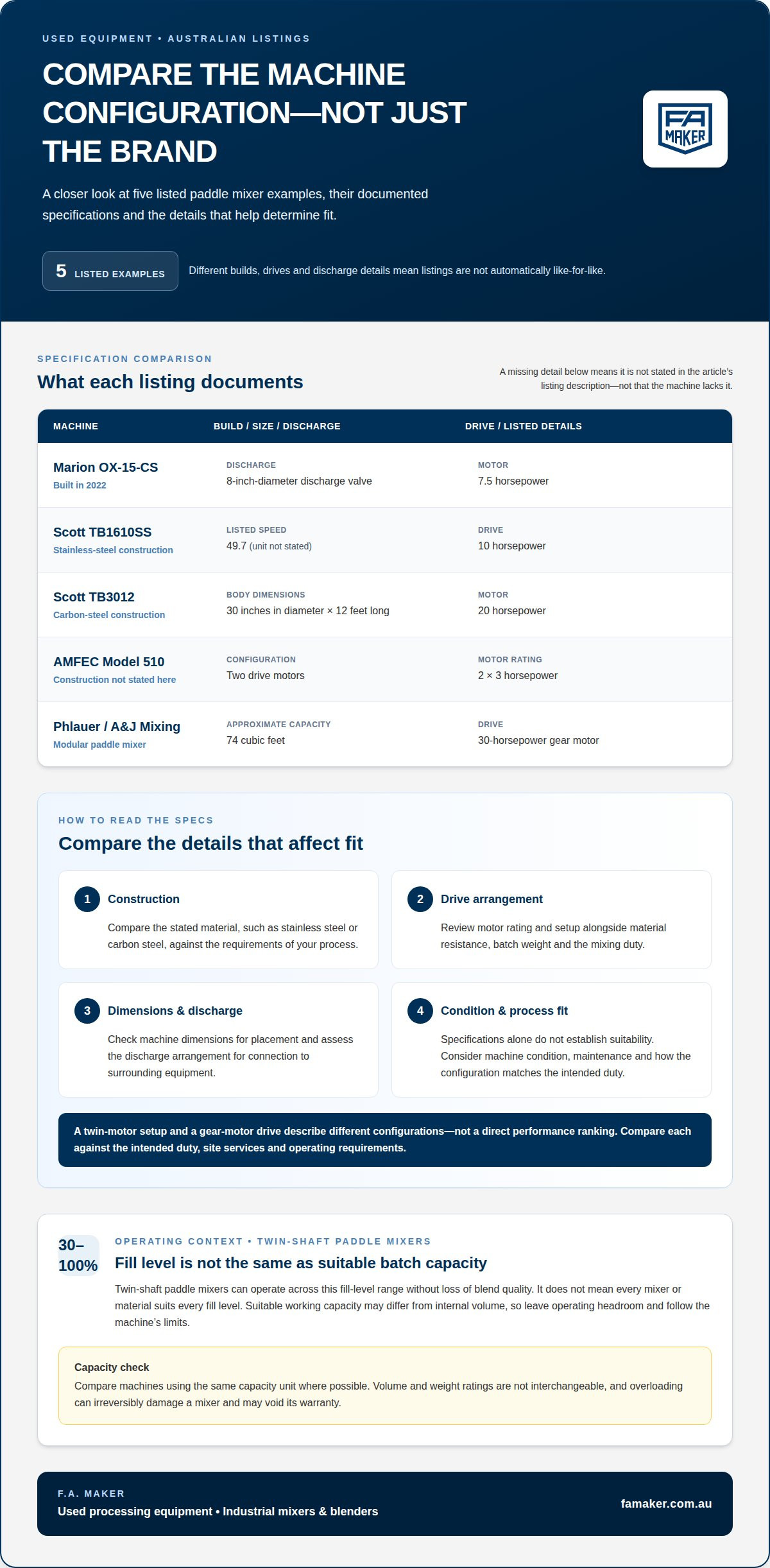
Twin-shaft paddle mixers can operate at fill levels from around 30 to 100 percent without loss of blend quality. That range doesn’t mean every mixer or material suits every fill level. Follow the machine’s operating limits and account for how the product moves through the mixing zone.
Overloading can irreversibly damage a mixer and may void its warranty. Keep ingredients below the machine’s maximum capacity, then increase speed as you become familiar with its operation. In Australia, key risks include entanglement, unexpected movement and damage from overloading. Safe operation relies on effective guarding, isolation before cleaning or maintenance, and following the machine’s operating instructions.
What mixer capacity and motor power suit different jobs? Match capacity to the required batch, then select drive power according to material resistance and mixing duty. Higher-viscosity materials call for higher-wattage equipment, while thinner materials such as paint and varnish need less power.
The listed 40 cubic foot mild-steel paddle blender, for example, has a 15 horsepower drive. Treat that as a machine specification, not a universal recommendation for every 40 cubic foot batch. Product density, viscosity and the required mixing action affect the power demand.
Compare the material, batch weight and mixer capacity together, then consider whether the drive can handle the load throughout the cycle. A larger capacity does not automatically mean the motor suits a demanding product. A dense or resistant batch, for example, can place different demands on the drive than a lighter, free-flowing material.
Before selecting equipment, define the batch quantity and material behaviour. Use these details to narrow the capacity range, then compare motor power and operating limits. This helps avoid choosing a machine based only on its largest advertised capacity.
Used paddle mixer listings in Australia cover different manufacturers, constructions and drive arrangements. A brand identifies the maker, but the model and configuration reveal more about suitability. Compare construction material, motor rating, discharge arrangement and mixing chamber with your batch requirements. Machines designed for similar duties can still differ in maintenance and integration needs.
The Marion OX-15-CS, built in 2022, provides one example of a documented machine configuration. It has a 7.5 horsepower motor and an 8-inch-diameter discharge valve. Those details help assess the drive and product-emptying arrangement, but they don’t alone establish whether it suits a particular material. The process duty and machine condition remain important parts of the comparison.
These examples show why construction deserves close attention. Stainless steel and carbon steel are different material choices, while a model’s dimensions can affect its placement and connection to surrounding equipment. For instance, the Scott TB3012’s stated diameter and length give a useful starting point for considering installation space. The drive rating and construction then help distinguish its configuration from the Scott TB1610SS.
Other Australian listings include an AMFEC Model 510 with two 3-horsepower drive motors and a Phlauer / A&J Mixing modular paddle mixer driven by a 30-horsepower gear motor. These specifications describe distinct drive arrangements, not a direct ranking of performance. A twin-motor setup and a gear-motor drive should be compared against the machine’s intended duty, available site services and operating requirements.
Availability varies across listed makes and configurations, so treat each listing as a specific machine rather than assuming every model is continuously available. For a practical comparison, record the manufacturer, model, construction, drive, dimensions and discharge details for each candidate. Then match those particulars to the process and site. If you’re reviewing options, used industrial mixer options can help frame the next equipment search.
Price is another point of comparison, but listed figures apply to specific machines rather than establishing a general market range. Listings may differ in stated capacity and power arrangement, so consider asking amounts alongside the machine details, not as direct like-for-like comparisons.
Taken together, these examples show why buyers should verify each listing’s configuration, condition and included equipment before comparing costs. Confirm whether the quoted amount excludes GST, and check that the construction and drive arrangement suit the intended process. Price alone cannot establish suitability: weigh it against documented specifications and site requirements when shortlisting machines.
A sound purchase starts with the process, not the machine listing. Define the material, required output, batch pattern and cleaning method first. These details help distinguish useful specifications from features that will not affect your operation. A mixer suited to a dry, free-flowing blend, for example, may not suit a viscous product requiring greater drive power.
Material viscosity affects motor demand. Higher-viscosity materials call for higher-wattage equipment, while thinner materials such as paint and varnish need less power. Consider how the product behaves throughout the cycle, not just when first loaded. A material that thickens, coats the paddles or contains lumps can place different demands on the mixer than a consistent, easy-flowing batch.
Assess the machine as a working assembly. Inspect the trough, paddles, shafts, seals, bearings, gearbox, motor and discharge mechanism for wear or damage. Look for corrosion, distortion, residue build-up and signs of repairs around high-load areas. On a stainless-steel machine, inspect product-contact surfaces and welds. On a carbon-steel unit, assess coatings and exposed areas in relation to the process environment.
Operational history can help explain what a used mixer has handled. Review available maintenance records and note any changes to the motor, gearbox or controls. Compare those records with the machine’s current condition and intended duty. A machine used for a different material may need closer assessment for residue, abrasion or contamination risks. Check that its discharge arrangement suits the downstream process.
Site fit matters as much as process fit. Compare the machine’s footprint and access points with the intended installation area. Consider how ingredients enter, how the batch leaves and whether operators can access the equipment for routine cleaning. Confirm that the electrical supply, controls and connected production equipment suit the installation. A mismatch can add work even when the mixer is mechanically sound.
Should you buy or hire a heavy-duty paddle mixer in Australia? Purchase suits a recurring production requirement where the machine can be integrated into ongoing operations. Hiring may suit a temporary requirement, provided the hire arrangement and equipment meet the process needs. F.A. Maker sells industrial mixers and blenders, not equipment leasing.
Before deciding, compare each candidate against a short set of process criteria:
For a used mixer, suitability comes from the combination of process duty, condition and installation fit. Comparing these factors can narrow the choice more reliably than selecting by brand or nominal capacity alone.
Used paddle mixers generally cost 30-40% less than new models, a potential advantage for buyers comparing options. Any saving should be weighed against the machine’s condition and fit with the intended process before a decision is made.
A paddle mixer uses paddles mounted on one or two shafts. They move material upwards and towards the centre of the trough, creating a fluidised zone for mixing. This action differs from the mixing mechanism of a rotating drum or ribbon arrangement.
A drum mixer tumbles material as its vessel rotates. A ribbon blender uses ribbon-shaped agitators, with mixing typically taking 10 to 20 minutes, compared with under a minute for a paddle mixer. The suitable machine depends on the material and the required mixing action.
Twin-shaft paddle mixers can produce a homogeneous blend in 20 to 60 seconds. Depending on handling, they can allow 30 to 60 batches per hour. Actual throughput also depends on loading, discharge and the time required to handle each batch.
What materials can a heavy-duty paddle mixer mix? Paddle mixers can blend dry powders and granules, and suit gentle, low-shear mixing when materials are fragile or easily degraded. In coating applications, they can handle liquid contents up to around 40 percent.
Some duties need additional features. Choppers can break up lumps and disperse agglomerates, while internal or external heating systems can add heat. These options affect the machine’s configuration, so relate them to the product and process rather than assuming every paddle mixer includes them.
How do you use a heavy-duty paddle mixer safely? Follow the machine’s operating instructions, keep guards in place and stay clear of moving shafts and paddles. Stop and isolate the mixer before cleaning, clearing a blockage or carrying out maintenance.
Loading and speed also affect operation. Keep ingredients below the mixer’s maximum capacity, then increase speed as you become familiar with the machine. Overloading can irreversibly damage the mixer and may void its warranty.
Construction affects cleaning access. Many paddle mixers use stainless steel and curved corners to facilitate cleaning. Product build-up around paddles, shaft seals and discharge points can still make cleaning more difficult, particularly with sticky or coating materials.
How do you clean and maintain a heavy-duty paddle mixer? Stop and isolate it, remove product residue using the machine’s cleaning procedure, then inspect the paddles, shafts, seals and discharge components. Examine wear points regularly and address damage before returning the mixer to production.
For example, a jacketed paddle blender adds a process feature beyond mixing. The American Process Systems FPB-125 fluidized paddle blender has a jacket rated at 125 PSI at 350 degrees Fahrenheit and minus 20 degrees Fahrenheit. That specification matters when the process requires jacketed operation.
Compare the mixing action, product characteristics and machine configuration. A paddle mixer’s rapid blending, gentle action or optional choppers may suit one process, while a ribbon or drum mixer may better match another. Choose the equipment that fits the actual production duty.
A heavy-duty paddle mixer is used to combine industrial materials into a consistent batch. Typical examples include dry powders, granules and ingredients that need controlled, even distribution. In production, the mixer can prepare a blend before it moves to another process, such as filling or packaging. Its role is to produce the required mixture, not simply hold material.
Powder blending is one practical application. Ingredients with different particle sizes or proportions need thorough distribution throughout the batch. A paddle mixer moves material through the mixing chamber, helping combine components that might otherwise remain unevenly spread. For example, an operator may blend a minor ingredient into a larger powder batch before downstream processing.
Granular products also use paddle mixing when the process calls for a uniform combination. The same principle applies to fragile materials that benefit from gentle, low-shear mixing. Rather than relying on aggressive treatment, the operator selects a mixing action suited to the product. This can help preserve material characteristics while bringing the batch together.
Some processes require more than combining ingredients. A coating application may need liquid distributed across a solid material, while a product with agglomerates may need additional lump reduction. Paddle mixers can be fitted with choppers to break up lumps and disperse agglomerates. These examples show how a mixer’s configuration can support a specific production task.
Batch preparation is another important use. A mixer can combine ingredients before they enter a production line, allowing the next operation to receive a prepared blend. For example, a consistent batch can feed a filling step more predictably than separately handled components. The mixer’s discharge arrangement and the downstream process both affect how smoothly material transfers.
Product characteristics guide the application. A free-flowing dry blend behaves differently from a sticky coating mixture or fragile material. Consider how the product moves, whether it forms lumps and how much mixing it requires. These conditions determine whether a paddle mixer’s action fits the duty better than another mixer type.
For a heavy duty paddle mixer used in an existing plant, the surrounding process matters too. Consider the material entering the mixer, the batch leaving it and the equipment on either side. A machine that suits the product but cannot connect effectively with the production sequence may create handling bottlenecks. Fit the mixer to the complete process.
Define the intended application before comparing machines: identify the product, the desired blend, and the next processing step. That gives a practical basis for selecting industrial mixing equipment. Explore industrial mixing equipment for options relevant to production requirements.
F.A. Maker supplies used stainless steel tanks and industrial mixers and blenders. If you are assessing a used paddle mixer, match equipment to your material, batch requirements and production layout. F.A. Maker also supplies centrifuges and separators, as well as pumps and valves for processing operations. These categories may be relevant when reviewing a wider production line rather than sourcing a mixer in isolation.
Bring your process requirements into the equipment discussion, including the material handled and how the mixer fits the surrounding operation. This provides a practical basis for considering suitable machinery. Contact F.A. Maker to discuss equipment for your operation.
Turn your production needs into a clear equipment brief. Record the material, expected batch pattern, installation constraints and how the mixer must connect with the rest of the line. This gives equipment selection a practical basis and keeps attention on operational fit rather than a specification in isolation.
Choosing a used heavy-duty paddle mixer means weighing the machine against the work it must perform and the production system around it. If those requirements are still taking shape, define the process first, then discuss suitable equipment options with F.A. Maker.
Contact F.A. Maker about used mixers to discuss your equipment requirements. A well-defined brief is a sound starting point for your next purchasing decision.
Used paddle mixers range from smaller process units to large industrial machines, and listings describe capacity in different ways. Before comparing models, distinguish a vessel’s internal volume from its rated batch load, since material density affects how much product fits by weight. Compare the required batch, material behaviour and machine operating limit, rather than relying on capacity labels alone.