

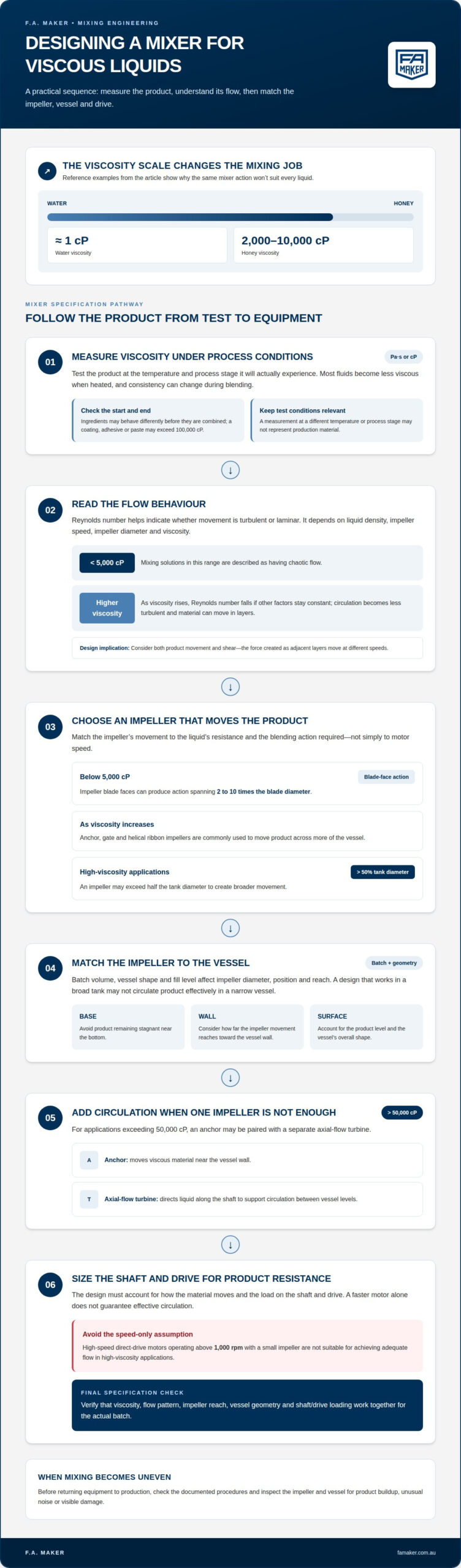
A high viscosity liquid mixer needs an impeller that moves the whole product, not simply a high-speed motor. Below 5,000 cP, mixing solutions are considered to have chaotic flow; as viscosity rises, anchor, gate and helical ribbon impellers are commonly used to create broader movement. In high-viscosity applications, an impeller may exceed 50% of the tank diameter.
It’s easy to assume that a faster, smaller impeller will mix more effectively. But high-speed direct-drive motors operating above 1,000 rpm with a small impeller aren’t suitable for achieving adequate flow in these applications. The design has to account for how the material moves, as well as the load on the shaft and drive.
This guide explains how viscosity affects flow and impeller choice, and why measuring it accurately matters when specifying a high viscosity liquid mixer. It also covers impeller diameter, shaft dimensions, motor power and gear ratios, showing how these choices work together.
From choosing an anchor or helical ribbon to allowing for the torque needed at lower speeds, the sections below outline practical engineering factors in mixing viscous liquids in Australian processing operations.
Viscosity affects how readily ingredients circulate and how much resistance an impeller encounters. Reynolds number helps indicate whether flow is turbulent or laminar, informing mixer selection as viscosity increases.
Flow describes how liquid moves through a vessel; shear is the force created when adjacent layers move at different speeds. An impeller produces both movement and shear, but their effects depend on the liquid and equipment. A low-viscosity liquid may circulate widely, while a thick paste resists movement. Considering both helps match the mixer’s action to the process.
Viscosity measures a liquid’s resistance to flow and is expressed in Pa·s or centipoise (cP). Water has a viscosity of approximately 1 cps, while honey ranges from 2,000 to 10,000 cP. These examples illustrate why ingredients with different viscosities respond differently to the same impeller. As resistance increases, the liquid circulates less readily, so the mixing action must move more of the material rather than rely on local agitation.
Turbulent flow involves irregular movement and mixing across the vessel; laminar flow moves in more orderly layers. Mixing solutions below 5,000 cP are considered to have chaotic flow. Above that range, viscous resistance can limit broad circulation, leaving regions moving at different rates. Some materials reach hundreds of millions of centipoise, so a single high-speed impeller cannot be assumed to create effective movement throughout the batch.
Reynolds number compares the forces driving flow with the viscous resistance opposing it. It depends on factors such as liquid density, impeller speed, impeller diameter and viscosity. If viscosity rises while other factors stay constant, Reynolds number falls, indicating less turbulent circulation. This explains why the same impeller running at the same speed can create different flow patterns in water and honey, even in the same vessel.
An axial-flow turbine directs liquid along the shaft, supporting circulation between different vessel levels. For applications exceeding 50,000 cps, an anchor impeller may be paired with a separate axial-flow-turbine mixer. The anchor moves viscous material near the vessel wall, while the turbine contributes additional circulation. High-speed direct-drive motors operating over 1,000 rpm with a small impeller aren’t suitable for adequate flow in high-viscosity applications.
Rotor-stator batch mixers use a four-stage mixing and shearing action. This illustrates how equipment can combine shear and movement, although the liquid’s resistance still affects circulation. For high-viscosity products, account for both the shearing action and how material moves through the vessel. Speed alone does not ensure effective circulation.
Viscosity measurements, batch volume and vessel geometry help determine which impeller can blend ingredients throughout the vessel. In Australia, electrical connection and machinery safety requirements depend on the installation and workplace context. Competent personnel should assess the equipment against applicable requirements.
Batch size and vessel geometry describe the volume and shape the mixer must handle. A tall vessel, a wide tank and a partly filled batch each create different circulation demands. Impeller diameter, position and movement must suit the vessel to prevent product from remaining stagnant near the base, wall or surface. An impeller that works in a broad tank, for example, may not circulate ingredients effectively in a narrow vessel.
Cleaning and maintenance depend in part on access to the tank and impeller. Follow the equipment’s documented procedures, and inspect the impeller and vessel for product buildup. If blending becomes uneven, look for residue, unusual noise or visible damage before returning the equipment to production.
Viscosity testing measures a product’s resistance to flow under defined conditions. The result informs impeller selection and the drive load required for mixing. A measurement taken at a different temperature or process stage may not represent the material during production. Most fluids become less viscous when heated, so test conditions should reflect the relevant process state.
Products can also change consistency during blending. A coating, adhesive or paste may exceed 100,000 cps, while its ingredients may behave differently before they are combined. A useful test profile considers the material at the start and end of mixing, including any changes caused by heating or ingredient addition. This gives mixer selection a closer basis in actual process conditions.
Impeller selection matches the mixer’s movement to the liquid’s resistance and the required blending action. Below 5,000 cP, impeller blade faces can produce action spanning 2 to 10 times the blade diameter. As viscosity increases, anchor, gate and helical ribbon impellers are commonly used to move product across more of the vessel.
For applications exceeding 50,000 cps, an anchor impeller may be paired with a separate axial-flow turbine. The anchor sweeps material near the wall, while the turbine supports additional circulation. This combination can suit industrial viscosity mixing where one impeller alone cannot provide the required movement throughout the batch.
Mixer viscosity ranges depend on the design and mixing element, rather than a universal limit. Double planetary mixers can handle products from a few thousand to several million centipoise. High-viscosity mixer end products usually start at several hundred thousand centipoise and can reach several million centipoise.
These ranges provide a starting point, but viscosity alone does not determine performance. Batch size, vessel geometry, ingredients and the required blending result also matter. A product that thickens during processing, for example, places different demands on an impeller than one that remains consistent throughout mixing.
A purpose-selected agitator moves thick material through the vessel instead of concentrating action near the impeller. This matters when a process combines ingredients with different consistencies, such as a paste and a liquid carrier. Matching the mixer’s movement to the product can support more even blending and reduce poorly mixed zones. The key is process fit, not speed alone.
A dual-shaft mixer, for example, combines two mixing elements, typically a high-speed disperser and a low-speed paddle or anchor. The disperser can assist incorporation and dispersion, while the slower element moves material through the vessel. This arrangement addresses distinct tasks within one batch and may suit applications where a single element cannot provide the necessary combination of product movement and local shear.
Double planetary mixers offer another approach for viscous products. Their planetary movement carries blades through the material, rather than relying only on rotation around one fixed shaft. They can mix products ranging from a few thousand to several million centipoise. Double planetary mixers are also reported to mix 30% faster than other planetary mixers. That reported comparison makes the design relevant when mixing time is a technical consideration, though the product and process still shape performance.
Agitator design matters because viscous products resist movement and can cling to vessel surfaces. An anchor or gate-style element sweeps near the vessel wall, helping move material that might otherwise remain outside the main circulation path. A helical ribbon has a different geometry, designed to encourage movement along the vessel. These options help process engineers match flow patterns to batch behaviour instead of treating every thick product alike.
In pharmaceutical manufacturing, for example, a formulation may need both ingredient incorporation and consistent distribution through a viscous base. The agitator influences how these tasks happen during mixing. A slower element can maintain bulk movement while a separate disperser provides more local action. These features may be useful when product structure, ingredient distribution and batch consistency are important to the application.
High-viscosity agitators can support varied product types within an industrial operation. Double planetary designs accommodate materials from a few thousand to several million centipoise, while dual-shaft arrangements combine distinct mixing actions. This can provide flexibility across different mixing demands. Selection still depends on the ingredients, vessel geometry and required result, not the agitator type alone.
Impeller diameter and shaft dimensions determine how a mixer transfers force into a viscous batch. For high-viscosity mixing, impellers may exceed 50% of the tank diameter, creating a broad working area inside the vessel.
A larger impeller can engage more product, but it also increases resistance against the blades, affecting the shaft, drive and supports. Engineers assess diameter alongside viscosity in centipoise, vessel dimensions and the required mixing action. Choosing a diameter without considering these conditions may lead to uneven movement or excessive equipment load.
Tank geometry helps determine the impeller’s reach. In a wide vessel, a small impeller may leave material near the walls moving slowly; a larger engineered assembly can cover a broader area. In a tall vessel, however, diameter alone does not ensure circulation from top to bottom. Impeller position and configuration must suit the vessel and batch, including areas near the base and liquid surface.
Shaft sizing depends on the forces generated during operation. A thick product resists blade movement, and a larger impeller presents more area to that resistance. The shaft must transmit the resulting torque while limiting bending and vibration. Engineers assess unsupported shaft length, impeller position and operating load together, since a long span can deflect more than a short, well-supported arrangement.
Start-up conditions matter too. A batch may resist movement more strongly before it begins circulating, particularly if the product is highly viscous or has settled. The shaft and drive must accommodate this starting load as well as the load during steady mixing. For example, an anchor impeller close to the tank wall must be engineered for product resistance and operating clearance.
Impeller diameter and shaft dimensions are connected design decisions, not separate specifications. Increasing diameter can improve engagement with the batch, while also increasing torque demand and shaft loading. A design for a several-hundred-thousand-centipoise product will differ from one for a thinner liquid, even in a vessel of similar dimensions.
In practice, selection balances the impeller’s reach against the mechanical demands it creates. Vessel diameter, batch consistency, shaft support and the mixing task all influence that balance. The aim is an engineered assembly that transmits force into the product without relying on impeller size alone to solve circulation problems.
Motor power and gearing must match the resistance created by the mixture. A high-viscosity mixer typically needs lower shaft speed and higher torque to move product effectively.
A gear ratio of 5:1 or more can reduce motor speed and increase torque for high-viscosity mixing. The motor supplies rotational energy; the gearbox changes the balance between speed and turning force. This matters because a thick mixture can demand substantial torque even when the impeller turns slowly. Selecting a drive around speed alone may leave insufficient force to achieve the required movement.
Planetary mixer blades may rotate from 40 to 370 rpm, while Z-blade mixers rotate from 14 to 60 rpm. These operating ranges illustrate how mixer designs use different speeds for different material properties. A Z-blade mixer’s lower rotation range suits a mixing action that works through resistant material. Planetary blades use a different motion, so their speed range should be interpreted alongside their blade path and process task.
Motor power selection takes account of viscosity, impeller geometry, batch condition and the required mixing result. A mixture that thickens during processing can create greater resistance as the batch develops. Starting a stationary batch can also place a different load on the drive than maintaining movement after circulation begins. Engineers assess these conditions together when specifying the motor and gearbox.
Potential issues include motor overload if resistance exceeds the drive’s capacity, and heat buildup if energy is dissipated faster than the process removes it. Air can become entrapped when the mixing action draws it into the product, affecting mixture quality. Impeller design, operating speed, product properties and batch conditions all influence these risks.
Motor selection also depends on the intended operating pattern. Gradual incorporation may require a different speed and torque profile from intensive blending. For example, a high-viscosity product that thickens as ingredients combine places changing demands on the drive. The motor and reduction gearbox should support the relevant processing stages, not just the initial condition.
A sound specification therefore connects motor power, gear ratio, impeller and product behaviour. A ratio of 5:1 or more is one useful reference for reducing speed and increasing torque, but the required drive depends on the full mixing duty. Match the equipment to the product properties and the movement needed throughout the batch.
For help matching mixer requirements to industrial equipment, discuss your mixing requirements.
F.A. Maker supplies Industrial Mixers and Blenders for businesses evaluating equipment for viscous-product processing. If your selection also involves the vessel or surrounding process equipment, its range includes Used Stainless Steel Tanks, Centrifuges and Separators, and Pumps and Valves.
These categories can help when planning how mixing equipment fits into a wider production line. The right combination depends on the product, vessel and process requirements outlined in this guide. F.A. Maker supplies equipment across these categories, providing a practical starting point for reviewing your machinery needs.
Contact F.A. Maker to discuss your industrial equipment requirements.
Before specifying a high viscosity liquid mixer, define the production task it must support. Consider how the product behaves throughout processing, how the mixing step connects with the rest of the line, and whether existing equipment can accommodate the required arrangement. This gives equipment planning a clear operational basis.
F.A. Maker offers Industrial Mixers and Blenders alongside Used Stainless Steel Tanks and Centrifuges and Separators. These categories may be relevant when reviewing mixing equipment as part of a broader process setup. Discuss the application and equipment requirements together to keep the conversation grounded in your production needs.
Contact F.A. Maker about your mixer to discuss your requirements and identify a practical direction for your project.
A considered specification gives your team a stronger starting point for planning the next stage of production.
A high viscosity liquid mixer is equipment designed to move and combine products that resist flow, such as pastes, adhesives or thick coatings. Its drive turns an impeller that applies force to the material, helping distribute ingredients through the batch. The working action depends on the product and process: a formulation needing gentle incorporation calls for a different mixing approach from one requiring strong dispersion.
The best type depends on whether the process needs bulk movement, close wall coverage or intensive dispersion. Planetary mixers suit products worked by blades travelling through the batch; anchors sweep near the vessel wall, while ribbons promote movement along the vessel. High-shear mixers focus on dispersing or reducing agglomerates, so they may complement rather than replace an agitator that moves the whole product.
Start with the product’s measured viscosity during processing, then consider batch volume, vessel dimensions and the required result. These factors determine the resistance the impeller must overcome and the reach needed through the batch. A product that thickens as ingredients combine may place changing demands on the drive. Specify the mixing duty across the process, rather than only the initial condition or desired shaft speed.
Batch volume and vessel proportions affect how far the impeller must move product and where stagnant areas may form. Heating or cooling can also change product behaviour: most fluids become less viscous when heated, which can alter resistance during processing. Include the required temperature conditions and vessel arrangement in the equipment specification. A batch mixed warm, for example, may behave differently from the same formulation before heating.