

The pump with the highest flow rating may still be the wrong choice for your product. Knowing how to choose a sanitary pump starts with matching its operating principle and capacity to the product’s viscosity, temperature, shear sensitivity, solids and air content. Sanitary centrifugal pumps generally suit thin fluids requiring high flow, while positive-displacement pumps are often better suited to thicker or shear-sensitive products.
Flow and pressure matter, but they are only part of the selection. The pump must handle the product under actual process conditions and meet the operation’s cleaning requirements. Assessing these factors together helps narrow the options and avoids relying on a nameplate maximum that does not reflect the actual duty.
This article explains how centrifugal and positive-displacement pumps move product, and how viscosity, temperature, solids and entrained air affect performance. It also covers shear sensitivity, cleaning and operating conditions, helping you assess which pump type suits your process.
Sanitary pump capacity depends on how the product behaves under actual operating conditions. Record its properties across the process range, not just at room temperature.
Product properties are the measured characteristics that determine how readily a pump can move a liquid. Viscosity, temperature and solids content affect the pump’s operating capacity and suitability.
To calculate required capacity, divide the volume to be transferred by the available transfer time. Then assess that duty against the product’s viscosity at minimum, typical and maximum operating temperatures. Include the size, hardness and concentration of solids. Higher viscosity generally calls for a larger pump or motor, while suspended solids can affect which pump design is suitable.
Temperature can change viscosity, so a figure measured under one condition may not represent the product during production or cleaning. Compare the product’s measured properties at each relevant operating temperature with the pump’s duty. A model-specific limit is not a general rating: for example, the STP125 sanitary pump handles temperatures up to 300°F.
Shear sensitivity describes how a product responds to the forces created during pumping. It matters when the process needs to preserve the product’s texture, structure or other characteristics.
Assess the product after it passes through the intended process, not just in a stationary sample. A shear-sensitive beverage or pharmaceutical liquid may need gentle handling, while a less sensitive product may tolerate different pumping conditions. Rotary lobe pumps can suit viscous or shear-sensitive products and moderate solids loads. Centrifugal pumps generally suit thinner fluids, and their performance falls as viscosity increases.
Assess contaminants separately from the intended solids load. Identify whether particles are part of the formulation or unwanted material, and consider their size, hardness and concentration. Upstream screening may protect pump components from unwanted debris, but the screening choice must also meet hygienic process requirements without obstructing the intended product flow.
Maintenance access affects how quickly wear can be addressed. Front-loaded product seals simplify replacement and reduce replacement time. Some sanitary pumps also provide quick-strip access, making inspection and maintenance more direct. Seal compatibility with the product and cleaning chemistry is also part of hygienic design.
Include future production needs in the duty assessment. Consider expected changes in throughput, product temperature, viscosity or solids content before selecting capacity. A pump chosen only for today’s easiest-to-move product may not suit a later formulation or process change. Documenting the operating range helps identify when a different pump configuration or process upgrade may be needed.
A sanitary centrifugal pump uses a rotating impeller to move liquid through a process line. It suits low-viscosity products requiring high flow at relatively low pressure, with consistent, non-pulsing flow.
To select capacity, calculate the required flow rate from the volume moved and available transfer time, then match it to the required head and suction conditions. For example, transferring 1,000 litres in 20 minutes requires 50 litres per minute.
Flow rate is the volume moved over time, while total head describes the height the liquid must reach. Pump pressure, also called head, is commonly expressed in psi or bar. Select a pump for the operating point the process requires, rather than relying on its nameplate maximum.
Suction conditions affect performance as well as capacity. If available net positive suction head falls below the pump’s required value, cavitation can damage the pump and disrupt flow. Smooth suction plumbing, fewer bends and fewer changes in pipe diameter help limit resistance and losses.
Centrifugal pumps are used in food processing, brewing and distilling, agriculture, pharmaceuticals and other industries. Suitability depends on the liquid, required flow rate, pressure and product sensitivity. A thin, non-shear-sensitive liquid may suit a centrifugal pump, while increasing viscosity reduces its performance.
Assess flow, pressure and temperature together. The process duty includes the actual liquid conditions and line resistance, not just the desired output. Matching the duty correctly supports efficient handling and helps reduce avoidable operating problems and downtime.
Flow control should match process demand. A variable speed drive can adjust pump speed and flow, while excessive throttling can add resistance to the system. Defining a clear operating point helps distinguish normal flow variation from changes caused by suction restrictions or process conditions.
For hygienic use in Australia, pump design must support the relevant industry’s sanitary requirements and cleaning process. Relevant design references include 3-A, ASME BPE and EHEDG. The International Association of Food Industry Suppliers maintains 3-A Sanitary Standards, a voluntary standard for sanitary construction and installation of dairy processing equipment.
Compare energy use at the required operating point, then consider maintenance, energy demand and potential downtime over the pump’s service life. Lifecycle costs depend on the duty, operating conditions and maintenance needs, not just the purchase price.
Useful selection records include material mill certificates, a measured Ra surface-finish specification, seal elastomer compatibility and CIP validation for the exact model. Review warranty scope and exclusions alongside spare-part requirements. Keeping suitable seal kits and elastomers available can support timely maintenance.
Connecting the pump duty to wider process equipment requirements helps keep flow, cleaning and production needs in view.
Sanitary pumps move or meter liquids, solutions and slurries through hygienic pipeline systems. Applications include food processing, brewing, distilling, agriculture, horticulture, medical production, pharmaceuticals, biotechnology and chemical processing. The product and process determine which pump features matter most.
Start with the product, required flow, pressure and cleaning conditions. A thin liquid transferred at high volume presents a different duty from a viscous product containing suspended solids. Industry labels alone do not define operating conditions. Knowing how to choose a sanitary pump means matching its construction and operation to the actual application.
A sanitary centrifugal pump suits low-viscosity fluids requiring high flow at relatively low pressure. Food processing and brewery lines may use this type for thinner products. Its continuous, non-pulsing flow can suit processes that prioritise steady transfer and throughput.
Viscosity is a key limitation. Centrifugal pumps may be less suitable as product viscosity rises or air is present in the suction line. A thick product or air in the suction line may call for a different design. Closed impellers are generally more efficient, while open impellers can handle solids better but may be less hygienic.
Rotary lobe pumps handle a broad range of viscosities and provide gentle, low-pulsation flow. They may suit shear-sensitive products, viscous foods such as chocolate or honey, and moderate solids loads. Some models can also self-prime, which may help when suction conditions are a concern.
These pumps typically have a lower maximum flow than centrifugal pumps and more moving parts to maintain. For a high-throughput line, weigh their product-handling advantages against the required flow and maintenance needs.
Twin screw pumps may suit higher-viscosity products, higher differential pressure, or aerated and two-phase products. They can also handle suspended solids, such as fruit purée. This makes them a potential fit for processes combining thick product with entrained air or particles.
Their seals and timing gears require more complex maintenance, which should be weighed against the process need. A twin screw design may be unnecessary if a simpler pump meets the duty.
An air-operated double-diaphragm pump may suit low-flow applications requiring gentle handling or dry-running capability. Consider it when protecting product structure matters more than steady, high-volume flow.
Its flow is pulsating, and it requires an air supply. Both characteristics affect downstream metering and process consistency. Compare the available air supply, required flow pattern and product sensitivity before selecting this pump type.
Across all four designs, weigh product handling against flow, energy use, hygienic construction and maintenance. To choose a sanitary pump for a specific process, match its strengths and limitations to the full duty rather than selecting by industry alone.
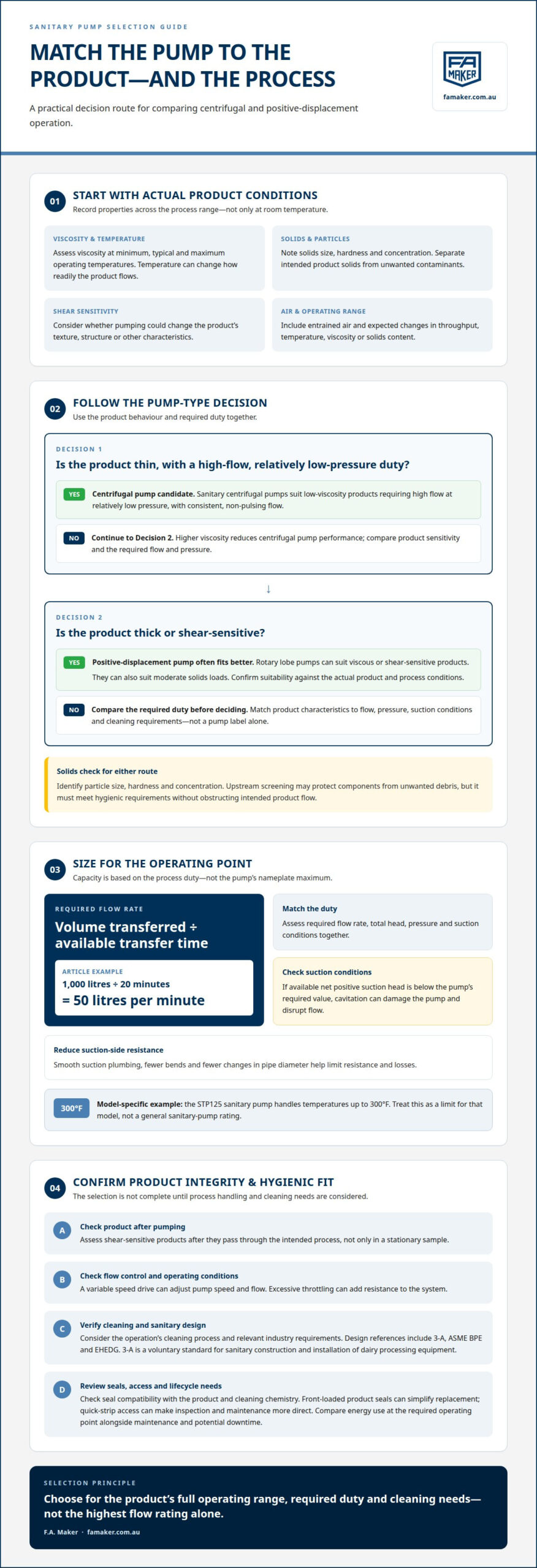
Selection starts with the product’s measured behaviour and the process conditions. Record viscosity at minimum, typical and maximum operating temperatures, then include particle size, hardness, concentration and air content. These details help distinguish a duty suited to centrifugal equipment from one better served by positive-displacement pumps.
For food, beverage and pharmaceutical hygiene, wetted surfaces should be smooth, easy to clean and free of crevices or dead zones where residue can remain. Stainless steel grades 304 and 316L are used in sanitary centrifugal pumps. According to the research, 316L may be needed for wetted parts handling highly acidic or caustic products and wash solutions. A measured Ra surface-finish specification gives the finish a defined value.
Viscosity changes with temperature, so a room-temperature measurement may misrepresent the process. Compare measured viscosity across the operating range with the pump’s duty. A higher-viscosity product generally needs a larger pump or motor. For example, a thick product transferred at its coldest temperature may require different capacity from the same product after warming.
Describe solids by size, hardness and concentration rather than simply noting that the product contains particles. Sanitary centrifugal pumps can handle suspended solids, but particle characteristics still affect design suitability. A moderate solids load or shear-sensitive product may suit a rotary lobe pump. Entrained air also matters: a self-priming sanitary pump clears air from suction lines on its own.
Include cleaning requirements in the model decision. For clean-in-place processes, the seal must withstand the cleaning chemistry, and the internal geometry must allow effective cleaning. Assess the actual chemistry, cleaning temperature and cycle duration against the exact pump model. Hygienic design also depends on smooth surfaces and minimal areas where product can collect.
Seal and elastomer selection must match the product chemistry and cleaning solutions. Incompatible seals can wear or leak, while unsuitable internal materials can corrode in acidic or caustic service. Include seal compatibility and CIP validation for the exact model in the equipment documentation. Material mill certificates can support traceability for wetted components.
Common selection mistakes include using only typical viscosity, overlooking air content or choosing a pump from its maximum capacity rating without matching the operating duty. Size and model selection should account for the actual product range, required flow and cleaning cycle. For future production changes, include anticipated shifts in viscosity, temperature or solids concentration. This assessment helps prevent a pump selected for one formulation from restricting a later process upgrade.
Centrifugal and positive-displacement pumps create flow differently, so their operating limits differ. A centrifugal pump uses an impeller to impart velocity to the liquid, then converts that motion into pressure. A positive-displacement pump repeatedly encloses a fixed volume and moves it mechanically. This construction affects flow response, product handling and system protection.
In centrifugal pumping, flow changes with system resistance and operating conditions. It generally suits thin liquids requiring high flow and moderate head, but performance falls as viscosity rises. Suction conditions also matter: insufficient available net positive suction head can cause cavitation, damaging components and disrupting flow. Assess the pump at the actual process duty, including suction and discharge conditions.
Positive-displacement pumps move a defined volume with each cycle. At a given speed, a positive-displacement pump produces the same flow regardless of discharge pressure. Pressure still matters: system resistance affects the load on the pump and its components. A blocked discharge can cause a dangerous pressure rise, so these pumps must not deadhead. A properly set relief valve protects the system.
Flow control differs between the two types. For a positive-displacement pump, a variable speed drive is the most practical way to control flow. Slowing the drive reduces the number of pumping cycles over time. Rotary lobe pumps can also run in reverse, supporting loading, unloading and line clearing. Their gentle, low-pulsation flow can suit viscous or shear-sensitive products, though the rotor and seal arrangement adds maintenance needs.
Compare pump operation with the process profile, not just the desired peak output. A centrifugal pump may suit steady transfer of a thin liquid. A positive-displacement design may fit a thicker product or a duty requiring controlled metering. For aerated products or higher differential pressure, a twin screw pump may suit the application, but its seals and timing gears require more complex maintenance.
Construction and cleaning requirements also shape the choice. Smooth wetted surfaces, cleanable internal geometry and compatible seals matter for either pump type. Confirm the required flow and head during normal operation, then account for product changes, start-up and line clearing. This comparison helps narrow the options before matching a specific model to the complete process duty.
Use these operating differences to guide your next equipment decision, or discuss suitable process equipment options for your application.
F.A. Maker supplies Pumps and Valves for industrial process applications. Once you have assessed product viscosity, solids, air content, flow and cleaning needs, the next step is matching those requirements to suitable equipment.
Discuss your process duty when considering a pump or planning an equipment change. Details such as the product being transferred, operating conditions and required flow help define the selection. If the wider process line is relevant, F.A. Maker also offers Used Stainless Steel Tanks, Centrifuges and Separators, and Industrial Mixers and Blenders.
Contact F.A. Maker to discuss Pumps and Valves for your process.
Knowing how to choose a sanitary pump is most useful when the selection reflects the full production line, not just an isolated transfer point. Before finalising equipment, define the operating conditions the process must accommodate and consider how future product or throughput changes could affect the duty. This gives the pump decision a practical basis within broader plant planning.
Where pump selection is part of wider equipment planning, F.A. Maker also offers Used Stainless Steel Tanks, Centrifuges and Separators, and Industrial Mixers and Blenders. Considering these needs together can help frame equipment choices around the process as a whole.
For a discussion focused on your application, contact F.A. Maker about your pump needs. A clear description of your product and process is a useful starting point for the next equipment conversation.
Sanitary pumps support hygienic product transfer through cleanable wetted surfaces and designs that limit residue traps. This can help reduce contamination risks between production runs, particularly when a line handles different products or cleaning cycles. Selecting seals and materials compatible with both the product and wash solutions also supports equipment reliability. The practical benefit is a pump suited to the process, cleaning regime and product quality requirements.
Build the checklist around the complete duty, not just the pump. Record the product range, operating temperatures, required flow and head, particle characteristics, air content and shear sensitivity. Add the cleaning chemistry, temperature and cycle duration, then include seal compatibility, wetted materials, hygienic construction and maintenance access. Note facility space, dry-running risk and system protection needs, such as a relief valve for positive-displacement equipment.
A rotary lobe pump suits a broad viscosity range, gentle, low-pulsation transfer and moderate solids loads. Some designs can run in reverse for line clearing. A twin screw pump may suit higher viscosity, higher differential pressure, or aerated and two-phase products. Consider maintenance as well: lobe pumps have moving parts to maintain, while twin screw designs require more complex seal and timing gear maintenance.
Choose a centrifugal pump for thin, non-shear-sensitive liquids requiring high flow. Consider a rotary lobe pump for viscous or shear-sensitive products and moderate solids. A twin screw pump may suit higher differential pressure, thicker products or aerated, two-phase flow. An air-operated double-diaphragm pump can suit low-flow duties requiring gentle handling or dry-running capability. Its pulsating flow and need for an air supply must suit the process.
CIP compatibility matters when equipment must be cleaned without removal from the process. The seal must withstand the cleaning chemistry, and the pump’s internal geometry must let cleaning solution reach product-contact areas. Assess the actual chemistry, cleaning temperature and cycle duration for the specific model. If the process relies on CIP to reduce disassembly and downtime, cleanability is a selection criterion alongside pumping performance.
Hygienic construction helps prevent product residue from remaining in hard-to-clean areas. Smooth wetted surfaces, minimal dead zones and an absence of crevices support effective cleaning and limit places where bacteria can proliferate. Material choice matters too: product chemistry and wash solutions affect corrosion risk. For food, beverage or pharmaceutical processes, consider the relevant industry standards and ensure the pump’s construction and cleaning method suit the application.
A sanitary pump is designed to move or meter liquids, solutions and slurries through hygienic process systems. Applications include food processing, breweries and distilleries, agriculture, medical production, pharmaceuticals, biotechnology and chemical processing. The product determines design priorities: a beverage line may need consistent transfer, while a fruit-purée process may need to accommodate suspended solids. Cleaning requirements and process conditions also influence the appropriate pump type.
Calculate flow by dividing the required transfer volume by the available transfer time. Then determine total dynamic head by accounting for the elevation the product must reach, pipeline resistance and any pressure required at discharge. Use the resulting flow-and-head operating point to assess pump performance, rather than relying on a nameplate maximum. Include suction conditions, since insufficient available NPSH can cause cavitation and interrupt flow.