Age alone doesn’t rule out refurbishment. Older industrial machinery can be rebuilt when its core components are sound, faults are identifiable and the work suits its intended use. A used industrial equipment procurement guide should assess condition alongside refurbishment costs and scope, rather than relying on age or purchase price alone.
Caution is reasonable when equipment has an incomplete service history, visible wear or uncertain performance. A structured assessment helps distinguish manageable repairs from issues that affect safety, reliability or project economics.
This guide explains how to assess refurbishment potential, inspect machinery and review its maintenance and repair history. It also covers supplier readiness and how to match capacity, utilities, dimensions and site conditions to your project, helping you decide based on the equipment’s full role in your operation.
Key Takeaways
- Assess the machine’s core condition, maintenance history and repair needs to judge whether refurbishment is practical.
- Arrange a pre-purchase inspection to identify faults and likely repair work before committing to a used machine.
- Include freight, installation and site preparation when calculating the equipment’s total cost of ownership.
- Match capacity, dimensions, utilities and operating conditions to the project, and consider existing equipment before buying.
- Confirm actual stock availability and written lead times early so delivery and mobilisation fit the project schedule.
Supplier delays, negotiation issues and quality checks
Used equipment can be refurbished, but the purchase decision depends on its condition, supplier reliability and clear contract terms. Treat supplier checks as part of the technical assessment, not as paperwork to complete after choosing a machine.
Warranty, return and finance options depend on the written offer and contract. Before committing, clarify any warranty coverage, return conditions and payment arrangements rather than assuming they are included.
- Define the purchase requirement before sourcing. Record the process, required output, operating conditions and essential machine capabilities. For example, a mixer handling a viscous product may need different operating characteristics from one used for dry blending. A clear specification helps suppliers respond to the same demand and makes quote differences easier to identify.
- Source across relevant seller types. Private sellers, auctions and specialist suppliers can each provide access to used machinery, but the sale process and available information may differ. An auction listing may give limited time for assessment, while a specialist supplier may provide machine details and arrange inspection. Match the source to the equipment and the assessment time available.
- Assess supplier readiness, not just the listing. Ask for the machine’s service history, repair records, condition report and current operating status. Confirm who can provide access for inspection and who handles dismantling, loading and dispatch. A seller who cannot establish the machine’s identity or condition creates uncertainty around defects, breakdown risks and the delivery schedule.
- Compare complete written quotes. Check that each quote describes the same configuration, condition and included components. Separate the equipment price from delivery, loading and any minimum hire periods where a hire option is being compared. A lower headline figure may not represent a lower total commitment if transport or handling is excluded.
- Negotiate the contract around observable terms. State the machine’s identifier, condition, included components, delivery arrangements and agreed inspection process. Record any warranty scope, exclusions, return conditions and responsibility for damage or non-compliance. For purchases from China or India, include agreed warranty terms, third-party inspection arrangements and payment protections such as a letter of credit where appropriate.
- Control delays before fixing the project schedule. Obtain the supplier’s lead time in writing, including dispatch and delivery assumptions. Confirm stock availability against the actual machine, rather than relying on a general listing. Compare the promised timing with inspection, transport and site-readiness tasks, then document who bears liability and insurance responsibilities during each handover.
Should I arrange an inspection before buying second-hand machinery?
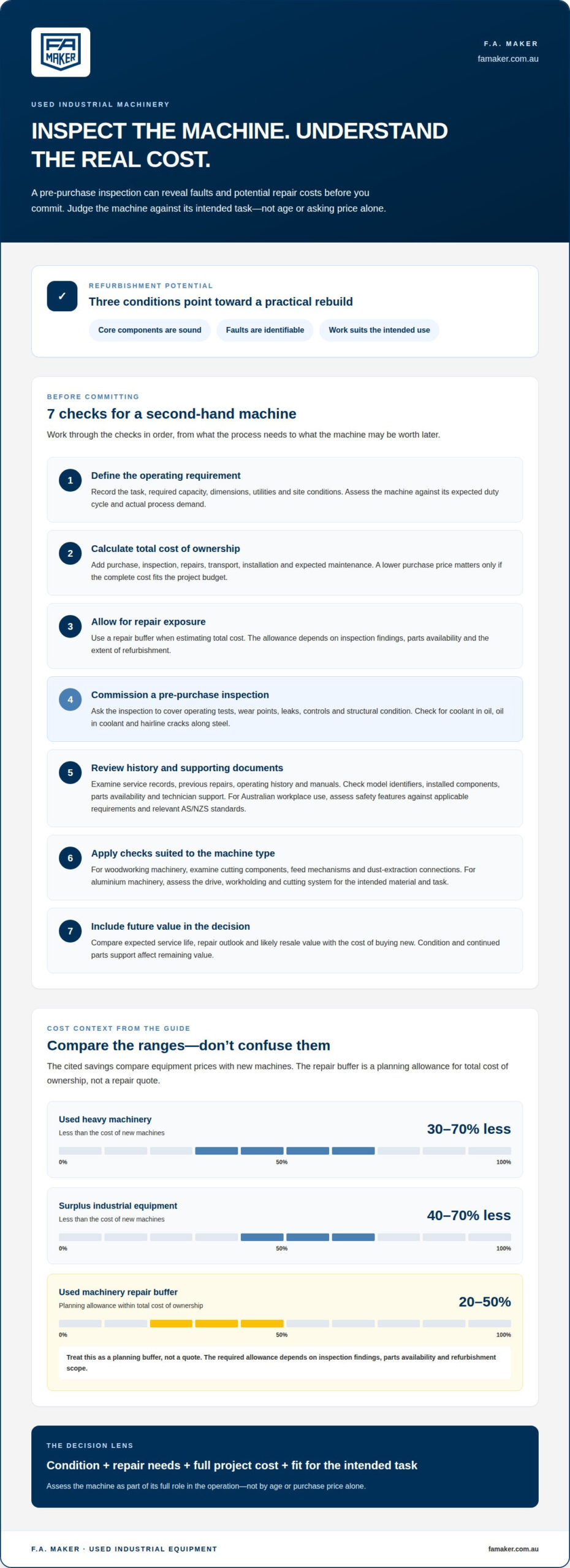
Yes. A pre-purchase inspection can identify faults and potential repair costs before you commit. Assess the machine against its intended task, not just its age or asking price.
- Define the operating requirement. Record the task, required capacity, dimensions, utilities and site conditions. For example, a machine intended for continuous production needs assessment against its expected duty cycle. A specification tied to actual demand helps rule out machinery that cannot fit the process, even if its condition appears sound.
- Calculate total cost of ownership. Include the purchase, inspection, repairs, transport, installation and expected maintenance. Used heavy machinery is described as costing 30-70% less than new machines, while surplus industrial equipment typically costs 40-70% less. A lower purchase price matters only if the complete cost still fits the project budget.
- Allow for repair exposure. Build a repair buffer of 20-50% when estimating used machinery’s total cost of ownership. The required allowance depends on inspection findings, parts availability and the extent of refurbishment. Treat this as a planning buffer, not a quote. A machine with worn components may need a different allowance from one with sound major assemblies.
- Commission an inspection before purchase. A pre-purchase inspection can reveal faults that photographs or a brief demonstration miss. Ask the inspection scope to cover operating tests, wear points, leaks, controls and structural condition. Check for coolant in oil, oil in coolant and hairline cracks along steel.
- Review history and supporting documents. Examine service records, previous repairs, operating history and available manuals. Compare the stated configuration with the machine itself, including model identifiers and installed components. Check whether replacement parts are available and technicians can service the equipment. For Australian workplace use, assess safety features against applicable requirements and relevant AS/NZS standards.
- Apply the right checks to the machinery type. A woodworking machine may need close attention to cutting components, feed mechanisms and dust extraction connections. For aluminium machinery, assess the drive, workholding and cutting system against the intended material and production task. These examples show why one generic inspection checklist cannot cover every machine type.
- Include future value in the decision. Compare the expected service life, repair outlook and likely resale value with the cost of buying new. Used machinery has already passed through its initial depreciation phase, but condition and continued parts support affect its remaining value. Proceed when inspection findings, repair allowance and production fit align.
Can older industrial machinery be refurbished or rebuilt?
Yes, older machinery can be refurbished when its condition, repair scope and intended production role justify the work. In Australia, procurement includes defining requirements, assessing the machine, agreeing on purchase terms, planning freight and preparing the site.
- Define the refurbishment scope. Separate essential repairs from optional upgrades. For example, replacing worn seals may restore operation, while a damaged frame could make rebuilding impractical. List affected assemblies, required parts and commissioning tasks. This gives the refurbishment plan a clear boundary and helps prevent unrelated work from expanding the project.
- Estimate the full ownership cost. Combine the purchase commitment with repairs, freight, transit insurance, unloading, installation and setup. Add commissioning materials, connections and production downtime where relevant. Compare that total with the cost and operational impact of a suitable alternative. The purchase price alone cannot show whether refurbished machinery is the better investment.
- Build freight into the plan. Transport costs depend on distance, dimensions, weight, loading needs and delivery access. Regional or interstate movement can require different handling from a straightforward metropolitan delivery. Fuel prices also affect mobilisation budgets. Confirm collection and delivery arrangements early, so freight assumptions don’t undermine the project estimate.
- Allow for transit protection and handling. Identify who arranges insurance and when responsibility transfers during transport. Consider whether the machine needs dismantling, packing or protection for sensitive components. A pump shipped with exposed connections, for instance, needs suitable protection against impact and contamination. Record handling requirements alongside the transport plan.
- Prepare the destination before dispatch. Confirm site access, floor or ground readiness, lifting arrangements, power and required services. Match these needs to the machine’s installation instructions and layout. A delivery should not be scheduled before the receiving area and utilities are ready. Otherwise, storage, rehandling or delayed commissioning can add avoidable cost.
- Plan installation and setup as project work. Identify who will position, connect, align and test the machinery. Include any required interfaces with upstream and downstream equipment. For example, a refurbished machine may need a revised conveyor connection to fit the production line. Sequence these tasks with repairs, site preparation and commissioning.
- Compare the finished cost with production needs. Assess whether expected output, reliability and operating fit support the total investment. Account for the time needed to complete repairs and installation, not just the machine’s eventual capacity. A lower upfront commitment may be offset by extensive setup work or a longer production interruption. Keep those factors visible when selecting between refurbishment and another solution.
Assessing fleet and project requirements
- Map the work before selecting a machine. Write down the project tasks, production sequence and operating conditions. Separate ongoing demand from short-term peaks. For example, a packaging line may need steady filling capacity, while a shutdown project may need temporary material handling. This distinction helps prevent buying machinery that sits idle after one project ends.
- Review assets already on the books. Use asset management records to identify equipment that could meet the requirement. Note each machine’s capacity, location, condition and scheduled use. A suitable machine at another site may be reassigned instead of replaced. This gives procurement a clear starting point and avoids treating every new demand as an automatic purchase.
- Compare required capacity with actual output. Base the specification on the process rate, operating hours and product characteristics. A machine rated for a high peak may be poorly matched to routine production if demand remains low. Conversely, insufficient capacity can constrain the line. Define required output and interfaces before evaluating models or configurations.
- Check the complete site fit. Measure available floor space, access routes and workshop constraints. Record electrical, water, air or other utility requirements relevant to the machine. Include clearance for operation, cleaning and maintenance. A machine that fits the production target but cannot pass through the doorway or connect to existing services isn’t a practical project solution.
- Include transport and installation in the comparison. Map the route from collection point to operating position, including site access and unloading arrangements. Freight and installation costs can change the economics of a purchase, especially for regional projects. Add setup and connection work to the project plan, then compare complete costs rather than equipment price alone.
- Match ownership to utilisation. Consider maintenance, finance, downtime, resale value, mobilisation and expected use together. High, predictable utilisation can support ownership. Short-term or specialised demand often favours hiring. For example, a machine required for one defined project may not justify long-term ownership if it has limited use afterward.
- Connect procurement to the project programme. Align purchase decisions with the current construction or production schedule. If the programme changes, review delivery timing and equipment demand before proceeding. This keeps procurement tied to the work actually planned, rather than locking in a machine that arrives after its key task or before the site can receive it.
- Set capacity by project scale, not assumption. Large mining sites may require 20+ ton machines, while a smaller operation may need a different class and configuration. Treat the project’s material, duty and access conditions as selection inputs. A competitive choice is one that meets the operating requirement without excess capacity or avoidable mobilisation demands.
Checking equipment availability and lead times
- Check the actual machine, not just the listing. Confirm that the specific unit remains in stock, where it is located and what configuration it includes. A catalogue entry may describe a machine type without establishing that the pictured unit is available. Record its identifying details and current status before building a schedule around it.
- Separate ready stock from future supply. Ask whether the machine is available for inspection, awaiting refurbishment or still in service. Each status affects when assessment, payment, collection and installation can occur. For example, a unit being used in production may not be released immediately, even if the seller has agreed to a purchase.
- Map the lead-time stages. Break the expected timeline into inspection, contract completion, preparation, dispatch, transport and site installation. Surplus industrial equipment lead times can fall from 6-18 months to 2-6 weeks. Treat that comparison as a possible advantage, not a substitute for the actual machine’s schedule.
- Account for Australian location and mobilisation. Availability varies by region. Metropolitan areas generally have a deeper vendor pool and faster mobilisation than regional or remote sites. For a remote project, allow schedule contingency for transport, access and handling. A machine located closer to the site may reduce logistical complexity, even if another listing appears attractive.
- Coordinate supply with project milestones. Compare the equipment timeline with site access, installation readiness and the date production needs to begin. If a production line is due for a planned shutdown, align delivery with that window. Earlier arrival can create storage or handling demands; late arrival can extend downtime and disrupt the project sequence.
- Use research to compare suitable alternatives. Track each candidate’s stock status, configuration, condition, location and estimated dispatch timing in one comparison. Include the impact of repairs or preparation on readiness. Consider depreciation and potential resale value alongside service life, rather than treating a low purchase price as proof of better value.
- Keep a contingency plan for uncertain supply. Specialised machinery and remote sites can face less predictable lead times, transport and mobilisation. Identify a technically suitable alternative and decide which project tasks depend on the equipment. This lets the team adjust sequencing if supply timing changes, without treating an unverified delivery estimate as a fixed commitment.
For equipment sourcing aligned with your project schedule, review available machinery.
F.A. Maker: Used Stainless Steel Tanks
F.A. Maker supplies used stainless steel tanks for process operations where their storage or handling role fits the project. Once you have assessed refurbishment potential, site fit and total ownership costs, match the equipment category to the production task and process layout.
For mixing or blending duties, F.A. Maker also supplies industrial mixers and blenders. Centrifuges and separators may suit separation processes, while pumps and valves support fluid transfer and control. Consider these options when the equipment type fits your application and specifications.
Share your process requirements, capacity needs and site constraints when discussing equipment options. Contact F.A. Maker to discuss your used industrial equipment requirements.
Turn the assessment into a procurement decision
Turn your findings into a concise procurement brief. Record the machine’s intended role, essential operating requirements, acceptable refurbishment scope and handover conditions. Assign an internal owner to coordinate approvals, installation planning and purchase-order close-out. This gives production, maintenance and procurement teams a shared basis for the decision.
A used industrial equipment procurement guide is most useful when its checks lead to clear acceptance criteria. Define what the equipment must demonstrate before entering service, who will review the result and how any outstanding work will be managed. Keep these decisions with the project record to support future maintenance and replacement planning.
For process equipment, F.A. Maker offers Used Stainless Steel Tanks, Centrifuges and Separators, and Industrial Mixers and Blenders. Discuss your project requirements with F.A. Maker and identify equipment options relevant to your operation. A clear brief is a practical foundation for the next procurement decision.
Frequently Asked Questions
Does used industrial machinery need to comply with Australian safety requirements?
Yes, used industrial machinery in Australian workplaces is subject to applicable work health and safety requirements. Older equipment isn’t automatically non-compliant, but inadequate guarding or other safety features may require modification before safe operation. Assess the machine in its intended workplace, including how operators access, clean and maintain it. For example, a change in installation layout may affect how existing guarding protects operators.
Looking for Quality Used Industrial Machinery?
Start by matching the machine’s function and condition to your production task. F.A. Maker supplies used industrial process equipment in Australia. Before choosing a machine, define the required output, product characteristics, available utilities and installation constraints. Compare these requirements with the equipment’s configuration and records. A clear specification narrows the options and gives your procurement team a practical basis for assessing suitability.
What Is Equipment Procurement?
Equipment procurement involves identifying a business need, selecting suitable machinery and arranging its purchase and implementation. A used industrial equipment procurement guide can organise the stages of a second-hand purchase, from defining the specification to reviewing records and agreeing on contract terms. For example, a production manager may set the capacity requirement while maintenance staff identify connection and access constraints. Procurement brings these operational needs into a single decision.
Where can Australian businesses buy used industrial equipment?
Australian businesses can source used machinery from specialist suppliers, private sellers and auctions. F.A. Maker supplies used industrial machinery nationally. The right source depends on the equipment type, available information and time for inspection. A specialist supplier may suit a process-equipment search, while an auction can involve fixed sale conditions and limited assessment time. Compare the purchase terms and machine details before deciding.
How much does used industrial equipment cost in Australia?
There is no standard cost for used industrial equipment in Australia. The price depends on machine type, condition, age, configuration, included components and work needed before operation. Freight, installation and site preparation also affect the total budget. F.A. Maker provides pricing for each machine on request. Compare total project costs, not just the equipment price.
How do you inspect and assess used industrial equipment before purchase?
Use the inspection sequence in a used industrial equipment procurement guide to compare the machine with its intended task and capacity requirements. Inspect its structure, moving assemblies, controls and connections, and look for leaks or damage. Where possible, observe the equipment operating under relevant conditions. For example, when assessing a pump, consider its role in the process and the connected pipework. Record findings by component to clarify repair priorities and acceptance decisions.
What documents and maintenance records should buyers request?
Request the operating manual, service history, repair records, available parts information and the machine’s model and serial details. These documents help establish how the equipment was configured and maintained. Ask for records of replaced components and outstanding faults, then compare them with the machine’s current condition. For a complex production line, request available connection or layout drawings to support installation planning.
How can buyers verify equipment condition, age, hours, and ownership?
Compare the identification plate and serial details with the seller’s records, service documents and purchase paperwork. Treat meter readings as one data point: check whether dated maintenance entries and visible wear align with the recorded hours. Request documentation showing the seller’s ownership or authority to sell. If records conflict, pause the purchase until the discrepancy is resolved and accurately reflected in the contract.

