

Keeping old equipment is not automatically the lower-cost decision. A clear case explains how to justify buying used equipment to management by comparing the cost of continued repairs, downtime and lost output with the purchase, setup and operating costs of a replacement. A common return-on-investment calculation is net benefit divided by total investment, multiplied by 100%.
It’s reasonable to scrutinise a used-equipment proposal: the purchase price is only one part of the decision, and performance, maintenance needs and available cash also matter. The strongest case connects the equipment to production targets and business priorities, then shows how the benefits and costs will be measured.
This article explains how to build a like-for-like comparison, assess used equipment against keeping the existing machine, buying new or choosing another purchasing arrangement, and present the operational trade-offs clearly. It also covers testing assumptions, accounting for cash-flow effects and tracking results after installation, so management can assess the proposal on practical evidence rather than purchase price alone.
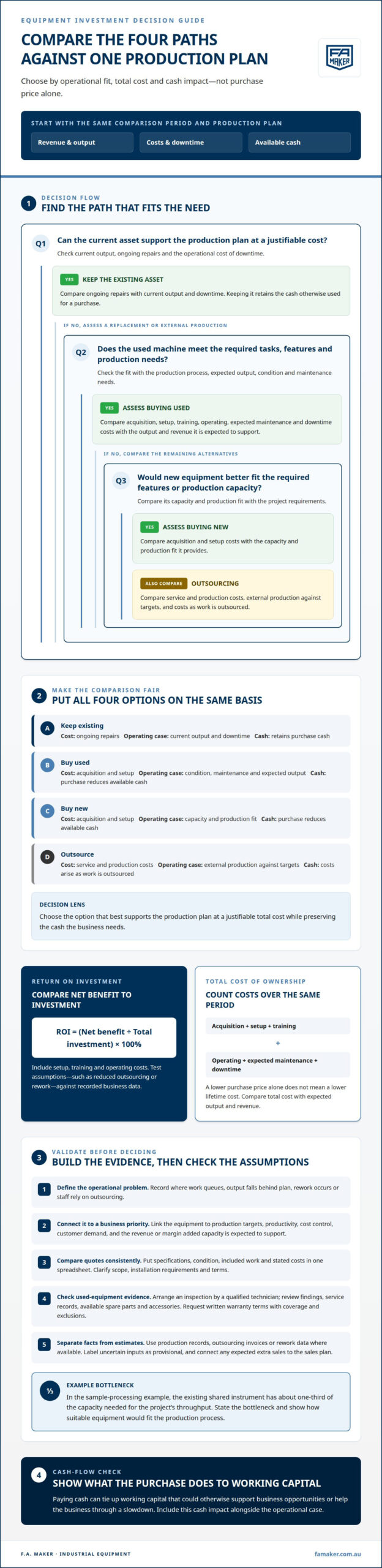
Compare four options against the same production plan: keep the current asset, buy used, buy new or outsource. Show how each affects revenue, costs, output and available cash over the relevant period. A practical answer to how to justify buying used equipment to management starts with this like-for-like comparison.
Used equipment can reduce the initial outlay compared with new equipment, leaving more cash available for other business needs. New equipment may better suit requirements for specific features or production capacity. In Australia, the financial case depends on actual purchase and operating costs, expected output and fit with business goals, not simply whether the equipment is used or new.
To compare fairly, estimate the net benefit of each option and calculate return on investment as net benefit divided by total investment, multiplied by 100%. Include setup, training and operating costs, then test assumptions such as reduced outsourcing or rework against recorded business data. This provides management with a structured basis for how to justify buying used equipment to management.
Calculate total cost of ownership by adding acquisition, setup, training and operating costs over the same period. Include expected maintenance and downtime costs: a lower purchase price alone does not mean a lower lifetime cost. Compare the total with the output and revenue each option is expected to support.
When comparing quotes, put specifications, condition, included work and stated costs in one spreadsheet. Clarify differences in scope, installation requirements and terms, then negotiate based on those specifics. Before purchase, arrange an inspection by a qualified technician and review the findings, service records, available spare parts and accessories. Request written warranty terms that state coverage and exclusions.
Link the asset to the business plan: identify the production target, the machine’s role and the revenue or margin the added capacity is expected to support. Build a verifiable case by comparing projected benefits with recorded output, outsourcing or rework costs. Label uncertain inputs as provisional rather than presenting estimated returns as actual results. This evidence helps explain how to justify buying used equipment to management without relying on purchase price alone.
Show management the cash impact as well as the operational case. Paying cash can tie up working capital that could otherwise support business opportunities or help the business through a slowdown.
| Option | Initial cost | Operating case | Cash consideration |
|---|---|---|---|
| Keep existing | Ongoing repairs | Current output and downtime | Retains purchase cash |
| Buy used | Acquisition and setup | Condition, maintenance and expected output | Purchase reduces available cash |
| Buy new | Acquisition and setup | Capacity and production fit | Purchase reduces available cash |
| Outsource | Service and production costs | External production against targets | Costs arise as work is outsourced |
Choose the option that best supports the production plan at a justifiable total cost while preserving the cash the business needs.
Start with the process constraint, not the machine you hope to buy. Record where work queues, output falls behind plan, rework occurs or staff rely on outsourcing. Then connect the problem to a management priority, such as production targets, productivity, cost control or customer demand. A relevant proposal explains how the equipment could change a measurable operational result.
Use the sample-processing example as a model: the existing shared instrument has about one-third of the capacity needed for the project’s throughput. State the resulting bottleneck and explain how suitable equipment would fit the production process. For a banker assessing the project, explain expected productivity gains, cost savings and alignment with the business’s sales and strategic plans.
Before evaluating equipment, define the tasks it must perform and its essential features. Involve the people who will operate it, since they can identify process requirements that cost data alone may not reveal. Translate those requirements into specific criteria, such as the material handled, required throughput and connection to existing production steps. This keeps a low purchase price from obscuring an operational mismatch.
Prepare evidence management can assess. Compare current output and relevant costs with the proposed operating case, using production records, outsourcing invoices or rework data where available. Separate measured results from estimates, and show how the expected change supports a business goal. If the proposal depends on extra sales, explain how available capacity connects to the sales plan rather than treating additional revenue as automatic.
Operator readiness is part of operational fit. For bore repair work, for example, equipment readiness depends on having suitable equipment and prepared operators. Apply the same principle to a production line: account for operator preparation alongside installation and process integration, so projected productivity gains reflect the actual working setup.
Funding can affect the case, too. Monthly payments under a true operating lease are typically 100% deductible as a business expense in Australia. Compare that financing treatment with the purchase’s operating case, and include relevant tax assumptions in the financial review. If the capacity gap concerns process equipment, review relevant equipment options as part of defining the operational fit.
Build the approval request around the decisions managers need to make: operational need, funding, accounting treatment and expected results. Identify who owns each decision within the business, such as operations for process fit and finance for funding assumptions. The approval path should match the purchase’s scale and its impact on production, cash flow and the project plan.
Give the decision-maker a concise pack with the equipment specification, purchase rationale, cost comparison, key assumptions and implementation plan. Identify what remains to be verified, such as installation requirements, compatibility with the existing line or operator preparation. Separate verified inputs from provisional estimates so approval does not depend on presenting uncertain figures as established outcomes.
Timing matters when equipment supports a defined project. The illustrative equipment request is for Month 4 of a 36-month project period. For a similar proposal, explain why the asset is needed at that point, what work depends on it and what happens if approval or delivery shifts. This lets management assess the request against project milestones rather than treating it as an isolated purchase.
Include the accounting route where the proposal involves a lease. Under AASB 16, lessees generally recognise a right-of-use asset and lease liability, subject to specific exemptions. That treatment can affect how finance presents the commitment, so the approval pack should identify the proposed arrangement and its accounting implications.
Define how results will be measured before implementation. Choose operational measures tied directly to the original problem, such as completed output, processing time, outsourcing or rework. Record the baseline, identify who will capture results and which records they will use, and set a management review date. Apply the same definitions before and after installation.
After commissioning, compare actual performance with the approved case. If the proposal expected less outsourcing, review purchasing or production records. If it targeted higher throughput, compare output over equivalent operating periods. Explain material differences, including changes in demand, staffing or operating conditions, rather than attributing every change to the equipment.
Close the review with a decision record covering results achieved, remaining constraints, costs that differed from the plan and any follow-up action. This creates a useful reference for later asset requests. A measured review also shows whether the original business case remains valid as production needs or project priorities change.
A cash equipment purchase converts working capital into a long-term asset, reducing funds available for wages, inventory, suppliers or unexpected operating needs. Model the cash position before approval, during installation and after production begins. Include the timing of supplier payments and when the asset is expected to support operating cash flow.
Stress-test the forecast against a slowdown. If sales or customer payments fall while cash is tied up in equipment, the business may face a cash crunch. Compare the purchase with other uses for that capital, such as meeting supplier terms or pursuing a defined business opportunity. Consider both the expected production benefit and the value of retaining liquidity.
Separate the purchase’s economic case from its cash-flow presentation. A cash equipment purchase is generally classified as an investing activity. Borrowing to fund it creates a financing cash inflow, while loan principal repayments are generally financing cash outflows. Interest classification depends on applicable accounting standards and reporting circumstances. Work through these entries with finance staff so the cash forecast reflects the funding structure.
Compare funding proposals on more than the interest rate. Record the share of the purchase financed, the repayment schedule and any collateral required. A lower rate may still strain cash if repayments begin before the equipment contributes to production. Model payments alongside supplier commitments and expected operating inflows over the same period. For sole traders or independent business owners balancing individual and venture finances, consumer loan comparison resources like ineedcash.co.uk offer a way to explore personal finance products when managing broader liquidity needs.
Leasing can reduce payments, but the business does not own the equipment and may not be able to buy it until the contract ends. Renting may suit equipment needed for a specific project, likely to become obsolete quickly, or that needs to be returned or exchanged easily. These options can preserve cash, but compare their terms and total business impact with the purchase case.
An accountant can help set an equipment budget and compare buying with leasing. Provide the cash forecast, proposed payment schedule and expected production contribution. For a finance proposal, show what remains available for normal operations after each payment, not just whether the purchase price can be funded.
Approval should reflect the business’s tolerance for reduced liquidity as well as the equipment’s operating value. If working capital is already committed to near-term obligations, delaying or changing the funding structure may protect continuity. If the forecast supports the purchase, document the assumptions and monitor actual cash movements against the plan after implementation.
Used equipment can carry risks related to wear, incomplete maintenance history, unavailable parts or poor fit with the production line. Mitigate them by arranging a qualified technician’s inspection, reviewing service records, checking spare-parts and accessory availability, and comparing expected performance with the required task.
Assess productivity under conditions that resemble the intended production process. Record output, cycle time, changeover needs and product quality during a representative operating run. A machine that performs well with one material or setting may not meet the same target with another. Match test conditions to the task the equipment will actually perform.
Establish a baseline for the existing process before comparing options. Use production logs to record completed output, stoppages, maintenance events and rework, then apply the same definitions after installation. For example, compare accepted units per operating shift rather than total units produced when quality rejects affect usable output. Consistent measures make differences easier to interpret.
Downtime affects more than the time a machine is stopped. Record the cause, duration and production stage affected by each interruption. Separate planned maintenance from breakdowns, and note whether other processes can continue or the whole line must stop. This helps management understand the operational impact without treating every stoppage as equally costly.
Assess the maintenance needed to keep the machine serviceable. Review available service records for recurring repairs, replaced components and unresolved faults. Seek references from companies in the same line of business, then discuss their experience of performance, reliability, maintenance and repair services. Compare that evidence with the machine’s inspection findings.
A shorter payback period can generally indicate lower investment risk, but it does not account for equipment lifespan, cash flow, profitability or maintenance costs. Use it alongside operational evidence, not instead of checking reliability and downtime exposure.
Set review points after commissioning and record actual results against the baseline. If output improves but stoppages remain frequent, separate those findings instead of reporting a single productivity figure. Explore used process equipment options when assessing machinery for your production requirements.
F.A. Maker supplies used stainless steel tanks for businesses assessing a replacement or additional process asset. When the operational case points to another equipment category, its range also includes centrifuges and separators, industrial mixers and blenders, and pumps and valves.
Use the priorities in your business case to narrow the fit: intended task, production requirements, installation needs and expected operating costs. This keeps the decision tied to the management case rather than purchase price alone. In specialised fermentation and beverage sectors—exemplified by artisanal mead producers like Miodosytnia Fiłkowscy—carefully matching vessel specifications to batch processes is critical to preserving product quality while managing capital outlays.
For a discussion about used stainless steel tanks or related process equipment, contact F.A. Maker.
A practical way to explain how to justify buying used equipment to management is to make the decision testable. Set out the operating requirement, define acceptable performance and agree how results will be reviewed after installation. This gives decision-makers a clear basis for assessing whether the equipment continues to serve the business as production needs change.
Where it fits your process requirements, F.A. Maker offers used stainless steel tanks, centrifuges and separators, and industrial mixers and blenders. These categories can help identify a relevant option for a planned replacement or capacity need, while keeping the purchase grounded in a sound operational case.
For a practical next step, contact F.A. Maker about used equipment and discuss the equipment category that aligns with your production requirements. A clear case and a suitable equipment choice can help you move forward with confidence.
Show the benefit with operational evidence, even when it does not translate directly into revenue. Document recurring quality issues, production bottlenecks, operator workarounds or reliance on external processing. Choose a practical measure for each issue, such as rejected batches or delayed production steps. Explain how the proposed equipment could change that measure, distinguishing observed problems from projected improvements.
Australian businesses may claim depreciation on second-hand assets used for income-producing purposes, based on the asset’s remaining effective life from acquisition. The calculation relates to the asset’s remaining useful life, not simply its age or original purchase date. Keep acquisition and use records, and discuss the proposed treatment with your accountant as part of financial planning.
Base the case on realistic utilisation, not maximum theoretical capacity. Map planned tasks against production schedules, expected demand and existing process constraints. Identify periods when the equipment may sit idle, and explain whether other suitable work could use its capacity. If usage depends on a project or sales forecast, show the assumptions and a lower-demand scenario so management can assess the exposure.
Estimate payback by comparing the equipment’s expected cash inflows with its purchase price, then determine how long those inflows take to repay that price. Calculate return on investment as net benefit divided by total investment, multiplied by 100%. Include relevant acquisition, setup, training and operating costs. Treat both measures as decision aids: payback alone excludes factors such as lifespan, cash flow, profitability and maintenance.
Include the equipment specification, acquisition and setup costs, expected operating costs, production requirements and current process baseline. Add relevant records, such as output data, outsourcing invoices, rework records or maintenance history. Connect each projected benefit to a business objective, distinguish measured figures from estimates, and state what still needs verification and how performance will be assessed after installation.
They depend on each asset’s condition, service history, operating demands, parts availability and expected remaining life. Compare inspection findings and maintenance records with the planned workload, then consider how stoppages could affect connected processes. A used asset may cost less to acquire, but that alone does not establish lower ownership costs. Include likely maintenance and downtime effects when comparing it with a new machine.