

The asking price is only one part of a fair machinery deal. To work out how to negotiate used machinery prices, compare similar models and consider age, condition, operating hours, maintenance history, attachments and transport. A sound offer reflects the machine’s value and any costs or work required.
It’s reasonable to focus first on price, but the overall terms matter too. If the seller won’t reduce the asking price, attachments, delivery or servicing may still help create a practical agreement.
This guide explains how to research Australian listings, auction results and dealership prices, assess a machine’s history and condition, and prepare an evidence-based offer. You’ll also learn how to negotiate attachments, delivery and servicing, then record the agreed terms. The aim is a clear, fair purchase that suits the machine’s condition and your operational requirements.
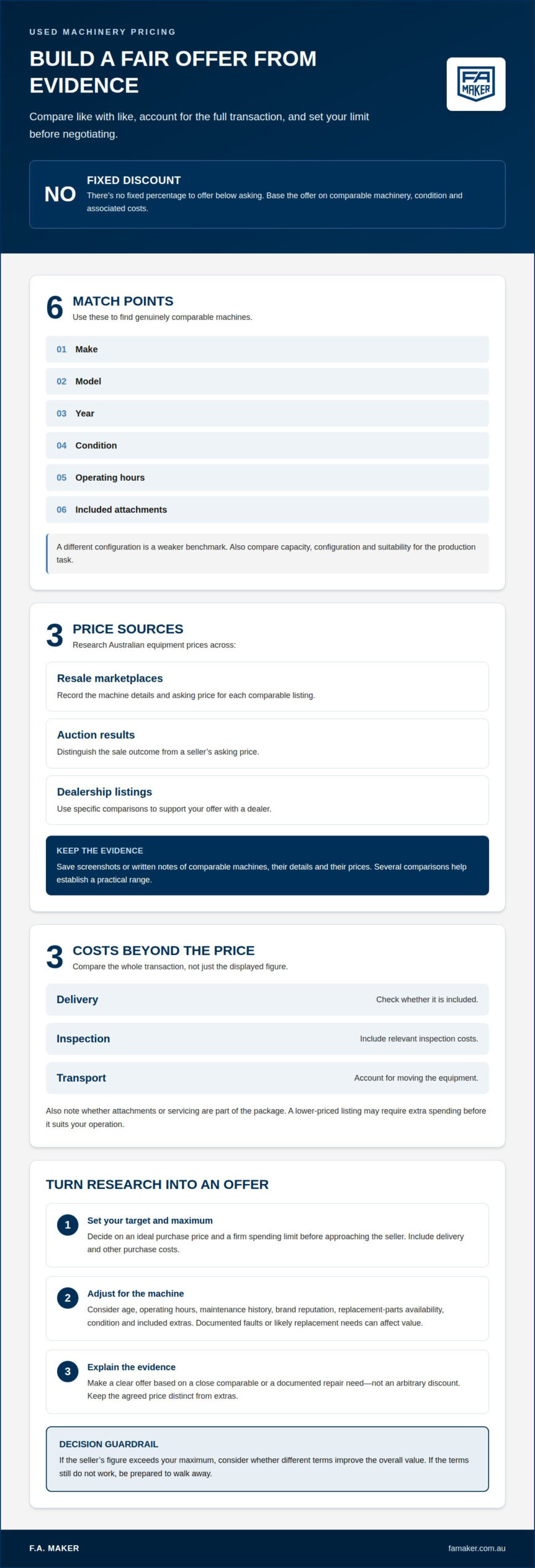
There’s no fixed percentage to offer below a used machine’s asking price. Base your offer on comparable listings, condition and associated costs. Set an ideal purchase price and a maximum before approaching a dealership, then support your offer with specific comparisons.
Start by identifying the machine’s make, model, year, capacity, configuration and operating hours. Compare its specifications with the production task it must perform: similar-looking equipment can differ in throughput, included components and suitability.
Assess the machine using documented condition, not appearance alone. Age, operating hours, maintenance history, brand reputation and replacement-parts availability all affect value. For example, two machines of the same model may warrant different offers if one has complete service records and the other shows wear or is missing attachments.
Record the details in a comparison sheet before reviewing prices. Note which specifications meet your requirements and which differences could affect performance or future costs. Don’t assume a lower-priced machine is better value until you understand its condition and configuration.
Search Australian resale marketplaces, auction results and dealership listings for comparable equipment. Match make, model, year, condition, operating hours and attachments as closely as possible. A listing for a different configuration is a weaker benchmark.
Compare the full transaction, not just the displayed price. Include delivery, inspection and transport costs where relevant, and note whether attachments or servicing are included. A cheaper listing may represent a different package or require extra spending before the equipment suits your operation.
Use several comparable listings to establish a practical range, then keep screenshots or written notes of each machine’s details and asking price. For auction results, distinguish the sale outcome from dealership asking prices. They reflect different transaction settings, so neither alone establishes fair value.
Set your target using the comparisons, then adjust it for the machine’s condition, operating hours, maintenance evidence and included extras. If an inspection identifies a fault or a component nearing replacement, estimate how that issue affects value before making an offer.
Make a clear offer and explain the evidence behind it. Refer to a closer comparable listing or a documented repair need instead of choosing an arbitrary discount. A very low opening offer may be dismissed, so keep the discussion grounded in the machine and the transaction.
Decide your maximum before negotiations begin, including delivery and other purchase costs. If the seller’s figure exceeds that limit, consider whether different terms improve the overall value. Keep the agreed price separate from extras so both parties understand what the offer covers.
Write down the conditions that would make the purchase unacceptable, such as unresolved operational faults or unclear ownership arrangements. A written threshold keeps the decision focused on the equipment’s value, rather than the time already spent negotiating.
Keep the conversation polite and focused on the machine. Don’t turn a price disagreement into a dispute about the seller’s motives or the equipment’s reputation. A respectful exchange leaves room for agreement if circumstances change, while keeping your maximum intact.
Consider other equipment that can perform the task, including different configurations or models. Alternatives make it easier to assess the current offer on its merits. Don’t proceed just because you’ve spent time inspecting or discussing a machine if its condition or terms fail your requirements.
Before leaving, confirm that no agreement has been reached and keep your notes for comparison with other options. If the seller later proposes a material change, assess it against the same requirements. Being willing to walk away protects your decision from urgency and keeps the focus on machinery that suits the operation.
Ask the seller about ownership, operating conditions, repairs and faults, then compare each answer with the machine’s condition. Auction prices can differ from dealership and private-sale prices because sale terms, bidding and included services vary. No single channel sets a fair price.
Arrange an inspection before making a final offer, and test the equipment’s major functions under suitable operating conditions. Look for fluid leaks, unusual noise or vibration, visible wear and inconsistent engine behaviour. For example, observe a conveyor’s belt and drive components during operation rather than relying on photographs.
Ask the seller to demonstrate functions relevant to your process. If an in-person inspection isn’t practical, request a detailed video showing the machine starting, running and performing key operations. Video can clarify visible condition, but it can’t provide the same direct examination as an inspection.
Ask why the seller is selling, how long they’ve owned the equipment and whether it has worked in harsh conditions. Where relevant, ask about exposure to salt-heavy environments or demanding demolition work. Record the answers so you can compare them with observed wear and service documents.
Request maintenance records, repair invoices and details of replaced components. Compare the dates and work described with the seller’s account. If the seller says a pump was replaced, ask for the record and check the component for signs consistent with that repair.
Reduce the risk of undisclosed faults by asking the seller to identify known problems in writing and include agreed condition details in the purchase documents. Ask for evidence that the seller can transfer ownership, and establish whether a security interest or lien affects the machinery before paying. A verbal assurance isn’t a substitute for documentation.
If records are incomplete, factor the uncertainty into your assessment and negotiation. A missing service history doesn’t prove a fault, but it provides less evidence about past care. Keep unanswered questions separate from confirmed defects, then decide whether you need further inspection or clearer written terms.
Compare listings across used-equipment websites, but match model, configuration, condition and operating hours before drawing conclusions. For heavy earthmoving machinery and plant equipment, browsing dedicated dealer inventories such as africaplant.com can provide useful benchmarks for machine specifications and pricing. An auction machine sold as-is isn’t automatically comparable with a dealer listing that has different terms.
Consider finance before committing. Pre-arranged finance can preserve working capital, but assess the down payment, interest rate and repayment schedule against the purchase’s total demands. Available finance isn’t a reason to accept unresolved faults or unsuitable terms.
Use maintenance evidence to judge whether the machine’s condition matches its recorded history. Then determine which parts, repairs or support arrangements could affect the purchase.
Request service records, repair invoices and details of replaced parts. Compare each document with the seller’s account and the machine’s visible condition. For example, an invoice for a replaced bearing should correspond with the component identified during inspection.
Look for consistent records of routine maintenance, along with notes about recurring faults or repairs. Repeated work on the same assembly may signal an ongoing issue rather than a completed repair. Ask which parts were replaced, when the work took place and whether supporting documents are available.
Consider parts availability for the specific make and model. If a critical component is difficult to source, that may affect downtime and the value you place on the machine. Distinguish confirmed defects from missing records, then reflect each differently in your assessment and offer.
Compare the machine’s operating condition with its documented maintenance. Check for fluid leaks, unusual sounds or vibration, visible wear and engine problems. Tidy records don’t rule out faults during operation, so use both the documents and inspection findings to assess condition.
Ask what maintenance or support arrangements are included in the sale, and record the seller’s answer. Clarify whether recent repairs are complete, whether operating instructions or service documents are included, and what assistance the seller agrees to provide. Don’t treat a general assurance as a defined support commitment.
Use unresolved maintenance needs to assess the purchase’s practical value. For example, if a dryer has an identified issue and no evidence of completed repair, distinguish that concern from routine wear. Ask for the repair scope in writing or base your offer on the work still required.
Summarise the evidence before settling terms: list documented repairs, visible issues, parts that may be needed and any included support. If the seller agrees to complete work before handover, record the work and timing in the purchase documents. Clear records help both parties understand the machine’s condition and the basis of the agreement.
Buying used machinery involves more than agreeing on the equipment’s price. Negotiate the complete package, including attachments, transport, servicing, payment terms and written sale conditions.
In Australia, calculate the total by including transport, loading, installation, servicing and any GST or stamp duty that applies. Their treatment depends on the transaction and jurisdiction, so distinguish applicable charges from the machine’s asking price.
If the seller won’t reduce the equipment price, ask whether an essential attachment can be included instead. Compare the package’s value with buying the machine without that item, and record the agreed inclusions in the sale documents.
Clarify when responsibility for the machine transfers and who bears freight costs. If relocation is part of the plan, arrange machinery relocation as part of the purchase discussion so transport requirements are considered alongside the equipment and delivery terms.
If the seller offers a warranty, review its coverage, exclusions, duration and claims process. Assess whether it addresses critical components and suits your operating needs. If the price can’t be reduced, a clear servicing commitment or useful warranty term may improve the overall deal.
Compare the completed agreement with the negotiated terms before signing. Clarify payment milestones and handover conditions, including what happens if agreed work remains incomplete. A written record gives both parties a precise reference and reduces disputes about what the sale included.
F.A. Maker is a practical next step when your production requirements point to used processing equipment. Its offerings include used stainless steel tanks, centrifuges and separators, industrial mixers and blenders, and pumps and valves.
Before deciding, define the machine’s role in your process and the specifications that matter, such as capacity, configuration and condition. Use these requirements to assess suitable equipment and compare purchase terms, including included components and delivery arrangements. This keeps the decision tied to operational needs, not price alone.
If you’re sourcing used process machinery for a production operation, contact F.A. Maker to discuss your requirements.
Use your next purchasing decision to define what the equipment must do, what condition is acceptable and which commercial terms matter most. Knowing how to negotiate used machinery prices is useful beyond one transaction: a clear buying brief keeps future equipment decisions connected to production requirements, not negotiation pressure.
For processing operations considering used stainless steel tanks, centrifuges and separators, or industrial mixers and blenders, F.A. Maker offers these equipment categories. Match the equipment type to your process, then assess each option against your technical requirements and purchase terms.
When you’re ready to discuss equipment for your operation, discuss your machinery requirements with F.A. Maker. A well-defined brief gives the conversation a practical starting point and helps you move forward with confidence.
A fair price reflects comparable equipment, its condition and the complete purchase terms. Compare machines with similar specifications and included components, then account for differences that affect usefulness or future costs. For example, a machine with fewer attachments may not be equivalent to a listing that includes them. Use several comparisons to establish a reasonable range rather than treating one asking price as market value.
Assess age and operating hours alongside condition, service history, brand reputation and replacement-parts availability. These factors work together: low hours don’t establish value if records are poor or the machine shows wear. Conversely, a well-maintained older machine may remain useful for a specific process. Compare its documented history and configuration with similar equipment, then adjust your valuation for confirmed defects or missing components.
Review Australian resale marketplace listings, auction results and dealership advertisements. Filter for the same make, model, year, operating hours, condition and attachments before comparing figures. Separate asking prices from completed auction sales because they represent different transaction stages. Keep notes on each comparable machine and its sale terms, so your benchmark reflects the equipment package, not just a headline figure.
Review maintenance logs, repair records and evidence of replacement parts, then compare them with the seller’s description. During inspection, observe the machine operating and note leaks, unusual sounds or vibration, visible wear and problems with major functions. For instance, if records describe a replaced component, check that the stated work matches the machine’s present condition. Treat documented defects differently from gaps in paperwork.
Make a specific offer supported by comparable listings, inspection findings or identified repair needs. Keep the discussion polite and focused on the equipment, not personalities. If the seller won’t reduce the price, negotiate useful terms such as attachments, delivery, servicing or spare parts. A sound approach to negotiating used machinery prices also sets a maximum before discussions begin, so you can decline terms that don’t suit your operation.