

The heaviest machine isn’t always the most expensive to move. Industrial equipment shipping costs in Australia depend on a load’s dimensions and weight, as well as the route, transport method and handling required. A compact but awkward machine may need specialised loading or transport, while equipment that is straightforward to move can cost less.
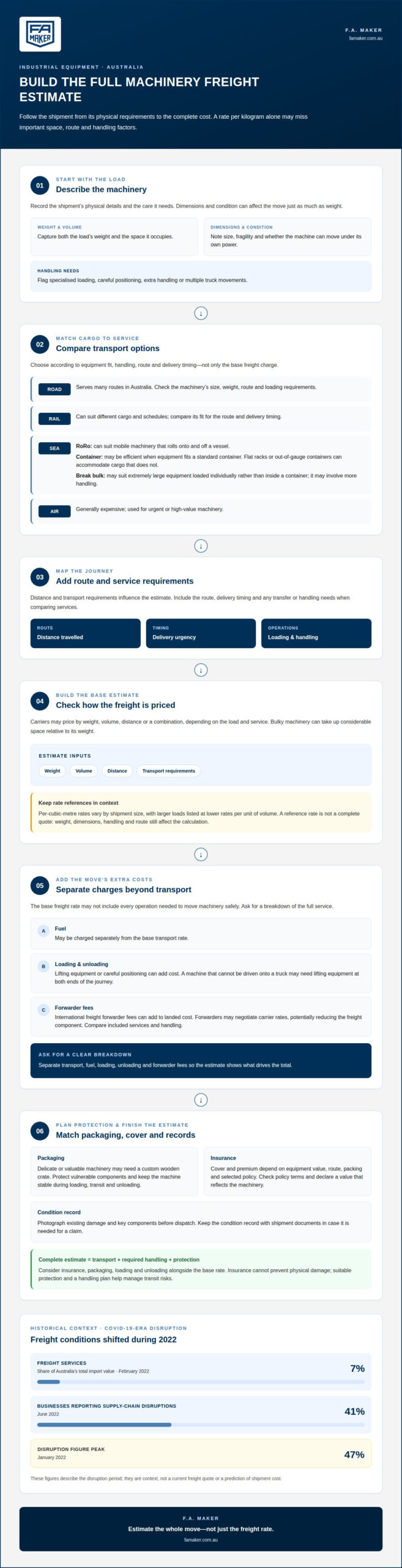
Freight charges typically reflect shipment weight or volume, distance and transport requirements. Fuel, insurance, loading, unloading and extra handling can add to the total. A useful estimate therefore considers the complete move, not just a rate per kilogram.
This guide explains how freight is priced and what affects the final amount. It covers equipment dimensions and condition, road, rail, sea and air options, and the impact of fuel, insurance and loading. Understanding these cost components helps you assess which transport method suits the machinery and journey before arranging a shipment.
Freight estimates combine shipment weight, volume, distance and transport requirements. For an import into Australia, the equipment’s dimensions and handling needs can affect the charge as much as its weight.
Freight calculations take account of the space a shipment occupies, its weight and the distance it travels. Depending on the load and service, carriers may price by weight, volume, distance or a combination.
The example shows why reviewing the calculation’s separate components helps explain the total.
Per-cubic-metre rates vary by shipment size, with larger loads listed at lower rates per unit of volume.
These ranges are reference points, not a complete quote. Weight, dimensions, handling and route still affect the calculation. Volume can be especially important when bulky equipment takes up considerable space relative to its weight.
The transport method depends on equipment size and weight, distance and delivery timing. Roll-on roll-off (RoRo) can suit mobile machinery that rolls onto and off a vessel. Container shipping may be efficient when equipment fits in a standard container; flat racks or out-of-gauge containers can accommodate cargo that does not.
Air freight is generally used for urgent or high-value machinery because it is expensive. Break bulk, where cargo is loaded individually rather than inside a container, can suit extremely large equipment but may involve more handling. Compare transport modes by fit, handling and timing, not just the base freight charge.
COVID-19-era supply-chain disruption coincided with higher freight costs for Australian imports. Freight services reached 7% of Australia’s total import value in February 2022, and 41% of Australian businesses faced supply-chain disruptions in June 2022. The disruption figure peaked at 47% in January 2022, illustrating how conditions shifted during that period.
International freight forwarder fees can add to the landed cost of a machinery shipment. Forwarders may also negotiate carrier rates, potentially reducing the freight component. Compare the full service and included handling rather than judging a quoted rate alone. A clear breakdown separates transport charges from forwarder fees and shows what drives the estimate.
A base freight rate may not cover every operation required to move machinery safely. Fuel, loading, packaging and insurance can add charges to delivery.
For machinery shipments in Australia, cargo insurance can cover equipment in transit, and additional insurance may be required for some shipments. There is no single price: insurance costs depend on equipment value, route, packing and selected cover, and are provided after a quote request.
Additional charges cover services beyond transporting machinery between pickup and delivery. They matter because heavy machinery may need specialised loading equipment, extra handling or several truck movements.
Fuel may be charged separately from the base transport rate. Loading and unloading can also cost extra when lifting equipment or careful positioning is required. For example, a machine that cannot be driven onto a truck may need lifting equipment at both ends of the journey.
Request a breakdown that separates transport, fuel, loading and unloading. This makes it easier to see what contributes to the total and whether the planned handling suits the equipment.
Packaging protects machinery during handling and transit, while insurance addresses financial exposure if damage or loss occurs. Both matter because packaging affects how a machine can be secured and moved.
Delicate or valuable industrial equipment may need a custom wooden crate. Packaging should protect vulnerable components and keep the machine stable during loading, transport and unloading. A crate can also make handling more predictable when equipment moves between vehicles or freight modes. Similarly, for sensitive electronic or production equipment, purpose-built solutions such as TruckPaX™ Truck Pack Cases help optimize vehicle dimensions while shielding components against transit shock.
Shipping insurance and cargo insurance refer to cover for goods in transit, but policy terms determine which events and losses are covered. The insured value, route, equipment type and packaging can affect the premium. Declare a value that reflects the machinery being shipped, and read the policy alongside the transport arrangements.
Documenting the machine’s condition before dispatch creates a useful record. Photographs of existing damage and key components can help distinguish pre-existing marks from damage noticed after delivery. Keep the condition record with the shipment documents in case it is needed for a claim.
Consider packaging and cover together. A fragile machine moved without suitable protection may face greater exposure during loading, while insurance cannot prevent physical damage. Matching the crate, restraints and handling plan to the equipment helps manage transit risks and clarify costs.
Transport method affects shipping costs through route, handling, equipment fit and delivery timing. In Australia, road freight serves many routes, while sea, rail and air suit different cargo and schedules.
The total depends on machinery dimensions, weight, distance and handling requirements.
Typical rail, sea and air costs depend on route, cargo size, weight and urgency. Air freight is generally expensive and used for urgent or high-value machinery. Oversized-load permit and escort charges vary by jurisdiction, cargo details and route.
Transport modes are the road, rail, sea or air services used to move equipment between locations. Choosing a method matters because each has different route, handling and timing requirements.
In Australia, combining rail and truck transport can reduce costs for long-distance heavy machinery shipments, though rail delivery is less common for oversized machinery. Sea freight suits international movements, while air freight prioritises speed over cost. Cargo dimensions, weight, distance and required delivery time guide the choice.
For international shipments, sea freight from nearby Asia-Pacific countries such as New Zealand, Singapore or Indonesia usually takes 1 to 4 weeks. From Europe, North America or Africa, it typically takes 6 to 10 weeks. Air freight to Australia takes between 3 and 7 days from almost anywhere in the world.
Road transport uses trucks to move machinery or palletised cargo between pickup and delivery points. For interstate logistics, distance, remote locations and specialised equipment can all affect the rate.
These examples apply to pallets, not necessarily complete machinery shipments.
Heavy machinery may require flatbed, step-deck or lowboy trailers. Oversized cargo may need permits if it exceeds state road authority size or weight limits; some movements may also require escort vehicles. Requirements vary between states and territories. Permit applications may require cargo dimensions and weight, vehicle type and planned route, so route details affect planning and charges.
International transport adds customs clearance and documentation to the logistics plan. Invoices and declarations support customs processing, while shipments to or from Australia also undergo quarantine inspection. Some machinery may require import or export permits. A shipment plan may include customs clearance, warehousing and onward transport, making the full route and each service part of the overall cost.
Assess equipment dimensions and weight before selecting a vehicle or freight method. Accurate measurements help determine whether machinery fits standard transport, needs special handling or requires a different route to its destination.
Record the machine’s length, width and height in its transport configuration, including projections such as guards, handles or attached components. Note its total weight and how that weight is distributed. These details help match the load to a truck, container or air freight option. A machine may fit by length but exceed a vehicle’s width or height limits.
For oversized equipment, dimensions affect route planning as well as vehicle selection. In Australia, permit requirements vary between states and territories, so consider every jurisdiction along the planned route. Permit applications may require cargo dimensions and weight, vehicle type and route. These details can also help identify obstacles such as low bridges or narrow roads before the carrier plans the movement.
Scale can change the transport plan substantially. One batching plant shipment described in the available examples comprised over 4,000 m³ of cargo. Each pontoon measured approximately 22.6 metres long, 9.05 metres wide and 2.15 metres high, and weighed 52 tonnes. Such dimensions illustrate why overall cargo size, not weight alone, determines suitable handling and transport arrangements.
Fragility affects how machinery should be packaged, secured and handled. Identify delicate assemblies, exposed controls and components that could shift or be damaged in transit. Custom wooden crates are suggested for delicate or valuable equipment. Restraints and tie-downs should secure cargo to the vehicle or container and limit movement as trucks travel over changing road conditions.
Document the equipment’s condition before dispatch. Take clear photographs of existing damage and record the machine’s condition alongside its dimensions and weight. This creates a practical reference if it arrives with marks that were not present before transport. Include attached parts and accessories so the carrier can account for their space and securement.
Use the measurements to compare transport configurations. If machinery can be dismantled, assess whether the reduced dimensions lower freight and handling costs enough to justify the labour. Some equipment may need disassembly before international shipment. Keep components together and document their arrangement to maintain a clear packing plan for loading and delivery.
A complete equipment profile gives the carrier the information needed to plan vehicle capacity, packaging, securement and route. For heavy or oversized machinery, dimensions and weight also inform permit planning in Australia. For fragile loads, the packaging and restraint plan should account for vulnerable components rather than treat the machine as standard cargo.
Compare the full landed cost, from pickup through customs clearance, rather than judging a shipment by its linehaul rate alone. For Australian import or export movements, the total may include transport, packing, loading, handling, insurance, storage and onward delivery. The balance between these items changes with equipment size, weight, route and shipment configuration.
A useful estimate separates each stage to show the main cost drivers. Map the journey from collection to final destination, then account for required services at each handover. An international shipment may involve export preparation, ocean or air transport, customs clearance, port handling and domestic delivery.
Ask for the planned scope to distinguish included services from separate charges. A transport rate, for example, may cover the main journey but not loading at origin or onward travel from an arrival port. Storage can help manage shipment timing, but its charges should be included in the overall plan.
A Full Container Load (FCL) can use a 20- or 40-foot container. It is usually most economical for bulky machinery, plant equipment or multiple units that can fill a container. The container’s capacity only helps if the equipment’s dimensions and weight suit the loading plan.
Static or oversized cargo that cannot fit standard units may need a flat rack or out-of-gauge container. For international export, equipment may need to be dismantled before shipment. Compare any reduction in freight and handling costs with the labour involved rather than assuming disassembly will lower the total.
These figures describe linehaul, not the complete landed cost. Special handling, pickup, loading and delivery arrangements affect the final estimate.
Less-than-truckload shipping can suit smaller industrial loads that do not fill a truck. Consolidating attachments, parts and accessories before export can also help organise freight efficiently. Include each item’s dimensions and weight in the packing details so the shipment plan accounts for the complete consignment.
Review the route, loading plan, equipment configuration and service scope together. If a machine can be dismantled, compare the freight and handling savings with the labour required. If several components can travel together, consolidation may avoid treating each item as a separate movement. The best arrangement depends on the equipment and destination.
For assistance coordinating an equipment move, discuss your machinery relocation.
F.A. Maker supplies industrial mixers and blenders for processing operations, helping buyers assess equipment requirements alongside transport planning. Its range also includes used stainless steel tanks, centrifuges and separators, and pumps and valves.
Consider these equipment options when planning a replacement, production-line change or facility upgrade. Before arranging transport, note the selected machine’s dimensions, weight, condition and destination. Those details help establish suitable handling and packing requirements, whether equipment is moving within Australia or internationally.
For a used machine, assess its condition and configuration alongside the freight plan. A clear equipment description helps align selection, loading and delivery arrangements, rather than treating freight as a standalone decision.
Contact F.A. Maker to discuss industrial equipment for your operation.
Make freight planning part of the wider equipment decision. Matching machinery to production requirements, site access and the delivery plan can help prevent avoidable complications. F.A. Maker offers industrial mixers and blenders, used stainless steel tanks, and centrifuges and separators for processing operations.
If you’re assessing equipment for a facility change or planning a machinery relocation, keep the equipment details and movement requirements together. This gives the discussion a practical starting point and connects the machinery decision with the logistics involved. Industrial equipment shipping costs depend on the specific move, so clear information about the equipment and destination is useful.
Contact F.A. Maker about shipping to discuss your equipment move and next steps. With the requirements set out clearly, you can proceed with a more considered plan for your operation.
Australian freight estimates vary with shipment size, weight, distance and handling requirements. These rates help frame industrial equipment shipping costs, but they are not a complete landed-cost estimate. Loading, insurance, storage and onward delivery can add charges.
A cubic-metre rate prices occupied space, which is useful when equipment is bulky relative to its weight. The shipment category and other freight components affect the estimate, so the volume rate alone does not represent the total transport cost.
Freight rates reflect weight, volume, distance, handling requirements, equipment stowability and liability exposure. The method matters too: a machine that fits a standard container has different transport needs from oversized cargo requiring a flat rack. Delivery timing, route access, loading arrangements and the need for a freight forwarder can affect the total. For international shipments, customs clearance, warehousing and onward transport may form part of the wider logistics cost.
Australian freight rates can be calculated using weight, volume, distance or a combination of these measures. Freight classification also considers stowability, handling, liability and perishability. A practical estimate separates the main transport charge from associated services such as loading, insurance and delivery to the final destination. Two machines of equal weight, for example, may have different freight requirements if one occupies more space or needs specialised handling.
Loading and unloading may be charged separately when machinery needs specialised lifting or additional handling. Crane or forklift requirements depend on the equipment, site access and how the load transfers between the pickup point, vehicle and delivery location. Identify tail-lift delivery as another service requirement in the transport scope. Describe the machinery and conditions at both sites so the estimate accounts for handling, not just linehaul.
Weight affects capacity and weight-based rates, while dimensions determine occupied space and whether standard transport equipment can accommodate the load. Distance affects the transport component, and route conditions can change vehicle and handling requirements. For oversized machinery, the route also informs permit planning across relevant Australian jurisdictions. Include projections, attached components and the destination in the shipment details so the transport assessment reflects the machine’s actual configuration.
Overseas shipping costs combine international freight with the services needed to move cargo through arrival and onward delivery. Customs clearance, required invoices and declarations, quarantine inspection, port handling and domestic transport can contribute to the landed cost. GST is a separate import-cost consideration from the carrier’s freight charge. Assess its treatment as part of the import calculation rather than assuming it is included in an international freight rate.
To estimate industrial equipment shipping costs accurately, provide the equipment’s packed dimensions, total weight, pickup and delivery locations, condition, handling needs and preferred timing. Include attachments and accessories, as these affect the packing plan and space required. To manage costs, assess whether dismantling reduces freight and handling enough to justify the labour, and consolidate related items where practical. A clearly scoped request makes it easier to identify separate transport, loading, insurance and delivery charges.