

A strong sale outcome starts before machinery reaches the market. In Australia, industrial process machinery liquidation has no set time limit: the process continues until the required liquidation tasks are complete. Preparation, equipment condition and removal logistics all affect how a sale proceeds.
It is reasonable to focus on what equipment may sell for, but the sale method and available time matter too. This article explains how to assess machinery, document its condition, compare direct sale, consignment and auction options, and consider removal costs when evaluating offers.
You’ll also learn what to consider when selecting a liquidation partner, from processing equipment experience to the coordination of marketing and removal. These factors provide a practical framework for planning a sale and assessing potential net recovery.
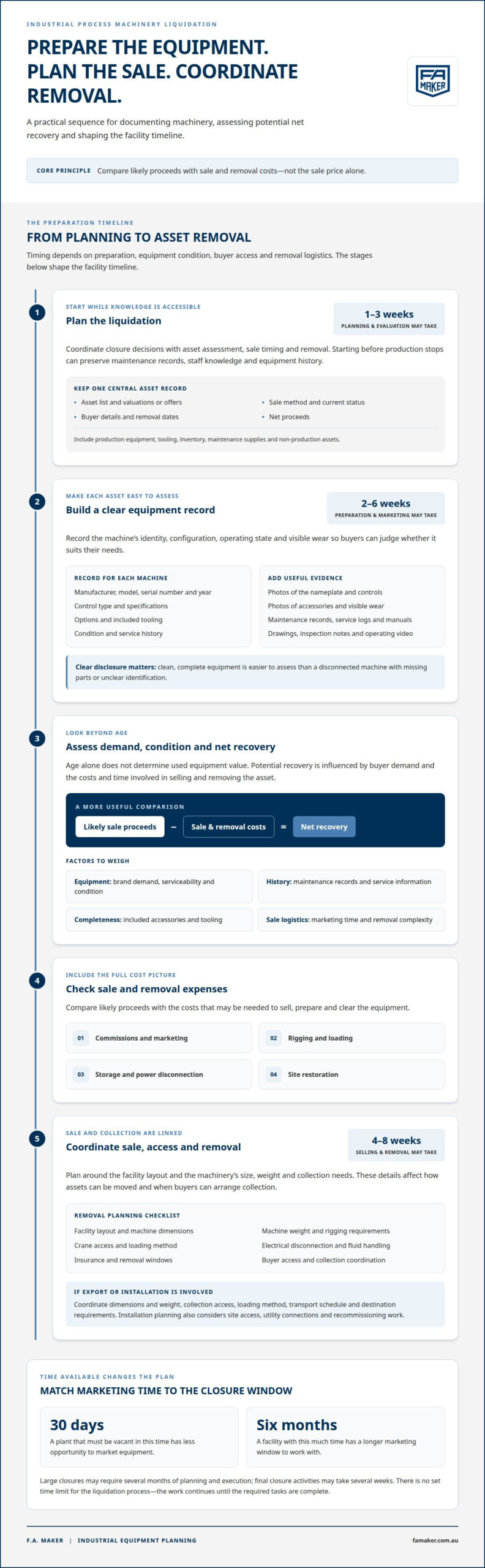
A well-planned industrial process machinery liquidation starts with clear asset records and realistic removal planning. Preparation and marketing may take 2 to 6 weeks, while selling assets and coordinating their removal may take 4 to 8 weeks. Both stages shape the facility timeline.
Condition records should identify a machine’s configuration, operating state and visible wear. Buyers need this information to assess whether the equipment suits their needs. Record the manufacturer, model, serial number, year, control type, specifications, options, tooling, condition and service history. Photographs of the nameplate, controls, accessories and visible wear make the record more useful.
Maintenance records, service logs, manuals, drawings and inspection notes add useful detail. A video showing the machinery operating under power can help buyers understand its function. Clean, complete equipment is easier to assess than a disconnected machine with missing parts or unclear identification.
Value assessment considers likely buyer demand and the net amount recovered after sale and removal costs. Age alone does not determine used equipment value. Brand demand, serviceability, condition, maintenance history, included accessories, marketing time and removal complexity all influence potential recovery.
Compare likely proceeds with commissions, marketing, rigging, loading, storage, power disconnection and site restoration costs. A machine with service records and standard controls may attract more interest than a similar asset with unknown maintenance or missing tooling. Net recovery is a more useful basis for comparing offers.
Before bidding, inspect the machine, nameplate, controls, accessories and visible wear, then compare your findings with the listing and available service records. Where possible, assess its operation under power and identify the included tooling. These checks help establish whether the machinery suits your intended production use.
Liquidation purchases can involve undisclosed wear, missing accessories, uncertain operating condition or difficult removal. Buyers should account for loading, transport and recommissioning, rather than treating the winning bid as the full acquisition cost.
For export, freight and installation, coordinate the machine’s dimensions and weight, collection access, loading method, transport schedule and destination requirements. Installation planning should also consider site access, utility connections and the work required to recommission the equipment.
Removal planning should account for facility layout, machine dimensions and weight, rigging, crane access, electrical disconnection, fluid handling, insurance and removal windows. These details affect how assets can be moved and when buyers can arrange collection.
In an industrial process machinery liquidation, available marketing time affects buyer access and sale planning. A plant that must be vacant in 30 days has less time to market equipment than a facility with six months. Large closures may require several months of planning and execution, while final closure activities may take several weeks.
Demand, asset condition and available marketing time influence potential recovery. Start planning when closure is being considered, while the operation, equipment knowledge and records remain accessible.
Liquidation planning coordinates the company’s closure decisions with asset assessment, sale timing and removal. A manufacturing liquidation planning and evaluation phase may take 1 to 3 weeks. Starting before production stops can preserve maintenance, staff knowledge and records, helping buyers understand machinery and its operating history.
Keep a central record of assets, valuations or offers, sale method, status, buyer details, removal dates and net proceeds. Include production equipment, tooling, inventory, maintenance supplies and non-production assets. A working plant may also be able to continue trading if a liquidator considers that to be in creditors’ best interests.
The Australian winding-up route affects who controls the company and its assets. Creditors’ voluntary liquidation is initiated by directors concerned that the company cannot pay its debts. Court liquidation begins with a court order, usually after a creditor’s application. Members’ voluntary liquidation allows a solvent company to close.
Choose the right professional for each responsibility. Company liquidation must be administered by an ASIC-registered liquidator, while machinery marketing and removal require suitable asset-sale coordination. Clarifying responsibilities helps align legal administration, buyer communication and site logistics.
Compare each proposed sale channel against asset demand, condition and removal constraints. A partner’s plan should account for buyer access, equipment ownership records, lender interests, landlord rights and sale proceeds. These details can affect the timing and execution of a manufacturing closure.
Company history can also affect the available process. Simplified liquidation is available only for a creditors’ voluntary winding up where the event triggering the winding up occurs on or after 1 January 2021. The company must be unable to pay its debts in full within 12 months, and must not have undergone restructuring or simplified liquidation during the preceding seven years.
Before adopting simplified liquidation, a liquidator must give members and creditors written notice at least 10 business days before adopting the process. Directors must provide a business affairs report and eligibility declaration within five business days after the day of the meeting at which the voluntary winding-up resolution was passed. These conditions make company records and history material to choosing the process.
Asset-sale planning should also distinguish machinery by buyer demand and operating use. For example, a production line with working mixers and bottle fillers may attract buyers seeking a coordinated operation, while a disconnected asset may suit a different channel. Reviewing industrial mixers and blenders can help readers assess how equipment categories fit their production requirements.
Sale channels determine how buyers are approached, how offers are made and how a closure timeline is managed. Direct sale, consignment and auction can each suit different assets within one facility.
A sale channel is the method used to market equipment and receive offers. Direct sale targets a buyer for a particular asset, while consignment assigns marketing and sale coordination to an intermediary. Auctions invite competing bids through a defined sale process. The best fit depends on equipment demand, condition, removal requirements and available time.
Combining channels can make sense for a facility with multiple assets. A specialised process machine may be marketed individually, while support equipment can be grouped. An auction can bring several assets to market together, while a negotiated sale can focus on machinery with a clearly identifiable buyer. Each route needs clear sale terms and removal planning.
A direct equipment sale is a negotiated transaction between a seller and an identified buyer. It can suit machinery with a specific application, such as a bottle filler sought by a packaging operation. The parties can discuss the machine’s condition, included components, collection arrangements and sale terms directly, keeping the transaction focused.
Direct selling depends on reaching suitable buyers and agreeing on terms. Consider offers alongside the asset’s condition, demand and net recovery after removal expenses. Keep a written record of offers, buyer details, agreed terms and collection dates. This makes each transaction easier to track during a wider closure.
Timeline affects the available options. A facility with six months to market specialised equipment has more selling choices than a plant that must be vacant in 30 days. A short deadline can narrow buyer access and constrain removal scheduling. In a mixed sale, use the longer marketing window for specialist assets where possible, while planning other lots around the facility’s access and closure dates.
Company circumstances also affect who can direct asset sales. In Australia, a company is insolvent if it cannot pay debts as they fall due, even if it holds assets that cannot be sold quickly. Directors who breach their duty not to incur debts while insolvent may be personally liable to compensate the company for those unpaid debts. The company’s financial position matters alongside machinery value.
Bankruptcy applies to individuals, not companies; company liquidation is a separate process. During liquidation, control of company assets and financial affairs passes to the liquidator, and directors cease to have authority over them. Asset sales must therefore follow the applicable control and approval arrangements. Identify who has authority before agreeing to a direct sale to help prevent conflicting instructions or delays.
For example, a plant with a sought-after process line and assorted support items could use a blended approach: negotiate for the specialist asset, group suitable equipment, and auction other lots. Match each channel to buyer demand, collection logistics and the closure schedule, then track offers and removal dates in the same asset record.
A sale strategy matches each machine to a transaction method, buyer group and removal plan. For a five-axis machining centre, individual marketing may suit its specialist demand better than bundling it with general inventory.
Auction and private-sale outcomes depend on buyer demand, asset condition, sale terms and competition. There is no fixed price relationship between an Australian liquidation auction, a private sale and a machinery dealer’s offer. An auction establishes a result through competing bids; a negotiated transaction depends on an agreed offer and its conditions.
Compare expected net recovery, not just the headline amount. Account for buyer premiums where applicable, commission, marketing, loading and removal. A dealer offer may simplify a transaction, while an auction may expose an asset to multiple bidders. Compare the proceeds after considering each channel’s costs and timing.
Buying rules are the sale conditions governing bids, payment, collection and transfer of an asset. In an Australian liquidation, the liquidator controls company assets and financial affairs after appointment, so machinery transactions must follow the authorised sale process.
Before bidding, read the lot conditions and confirm what the asset includes, how payment is handled and when collection must occur. Also assess equipment condition, access and removal requirements. These checks matter because a winning bid does not itself resolve rigging, transport or installation arrangements.
Sale terms should also identify the seller’s authority and the asset being transferred. For example, a production line may include several machines, guards and controls, while a single lot may exclude associated tooling. Clear lot descriptions and written transaction records reduce confusion about what the buyer has purchased.
A buyer’s total outlay includes the bid and any applicable buyer’s premium, GST treatment, freight, rigging and removal charges. The sale terms should explain the premium and how GST is treated. Compare those terms before bidding, since the winning bid alone does not show the full acquisition cost.
Transport planning starts with the machine’s dimensions, weight, collection access and required lifting equipment. A large vessel, for example, may need a different loading plan from a bottle filler. Buyers should align collection windows with freight and removal crews, and include power disconnection, fluid handling and site access in the plan.
Auction marketing can use a detailed catalogue, buyer inspections, digital channels, industry directories, trade events and direct outreach. These methods help buyers assess relevant assets before bidding. A catalogue should distinguish individual machines from grouped lots and describe visible condition, included components and collection arrangements.
Negotiated sales suit assets with a clear buyer or specialised application. The offer can address the machine, included tooling, payment, collection and removal responsibilities in one agreement. Record those terms alongside buyer details and the removal date, then compare the net result with other sale options.
A blended strategy can allocate premium machines to individual sale, group support systems and send obsolete material to scrap or salvage. For operations liquidating tooling or seeking to recover value from hardmetal components, specialized industrial scrap suppliers like Carbide Kings provide avenues for handling tungsten and carbide materials. One channel may not suit every asset. The decision should reflect buyer demand, production requirements, transaction terms and the facility’s removal schedule.
A suitable partner understands both the machinery and the responsibilities involved in a plant liquidation. The choice affects how assets are valued, marketed, sold and removed, so assess the proposed process as well as the expected sale outcome.
Australian liquidations are administered by specialist accountants who are registered liquidators with ASIC. A machinery sale partner may support asset valuation, buyer access, auction marketing and removal coordination, but these activities are distinct from administering the company’s liquidation. Establishing who controls each decision helps prevent conflicting instructions during a closure.
Ask how the proposed valuation will account for demand, serviceability, condition, maintenance history, accessories and removal complexity. A stainless steel tank with clear specifications presents different buyer considerations from an industrial mixer or bottle filler. The valuation approach should also explain whether assets will be offered individually, grouped, negotiated privately or placed in an auction.
Inspection and marketing plans should suit the equipment. A useful inspection process gives prospective buyers access to the relevant machine and its available records. For an operating asset, a demonstration may help buyers assess its function. Marketing can include a detailed catalogue, buyer inspections, digital channels, industry directories, trade events and direct outreach.
Industrial process machinery commonly sold in Australian liquidations includes stainless steel tanks, centrifuges, separators, mixers, blenders, pumps, valves, conveyors and processing equipment. The mix depends on the facility’s operation and the assets being sold. A specialist should explain how distinct equipment groups will be presented to relevant buyers.
Australian auction houses that handle industrial plant and machinery use specialist sale channels, including online auctions, sealed bids and negotiated transactions. The right fit depends on the asset mix, timeline and removal plan. Rather than treating an auction catalogue as the whole service, assess how inspection access, buyer communication, sale records and collection schedules will be coordinated.
For a company in liquidation, ownership and authority require particular attention. Resolve lender interests, landlord rights and any financing, leasing or lien issues before assets are marketed. Plant liquidation transactions can also require coordination of lien releases and shipment schedules. The partner’s process should make responsibilities and transaction records clear to the liquidator and relevant creditors.
Removal capability matters as much as sale capability. A large machine may need planned rigging, loading, electrical disconnection and suitable site access. Confirm that the proposed schedule accounts for equipment dimensions, removal windows and the facility layout. Gaps between sale dates and collection plans can complicate site closure.
Use the proposed plan to compare partners on valuation method, buyer reach, sale-channel choices, transaction tracking and removal coordination. For machinery that also needs relocation planning, discuss machinery relocation requirements alongside the sale and collection schedule.
F.A. Maker can help when a liquidation leaves a production operation needing suitable processing equipment. Its range includes Industrial Mixers and Blenders, Used Stainless Steel Tanks, Centrifuges and Separators, and Pumps and Valves.
For buyers replacing a machine or planning a new process line, matching equipment to the required application is a practical next step after assessing sale and removal options. F.A. Maker’s used industrial process equipment categories can help identify relevant machinery for that decision.
Contact F.A. Maker to discuss your industrial equipment requirements.
The next step is to turn your plant’s changing needs into a clear equipment plan. Whether you are preparing for closure, replacing a process line or sourcing machinery for continued production, a considered industrial process machinery liquidation can help determine what to sell and what equipment may suit another operation. For facilities modernizing operations beyond traditional machinery, companies such as EdNex Automation highlight how modern robotic systems and industrial automation can reshape production environments.
F.A. Maker offers Industrial Mixers and Blenders, Used Stainless Steel Tanks, and Centrifuges and Separators. These categories can be relevant when assessing processing equipment for a new or continuing operation. Matching machinery to the intended application remains central to making a sound purchasing decision.
To discuss your equipment requirements and liquidation needs, contact F.A. Maker. A practical conversation can help you identify a suitable next step for your machinery plans.
In Australia, company liquidation converts company assets into cash to repay as much debt as possible. The liquidator takes control of company assets and financial affairs, investigates the company’s position, realises assets and considers creditor claims. Section 556 of the Corporations Act sets the order of priorities for dividends, including liquidation costs, employee entitlements and unsecured creditors. There’s no set time limit; the process continues until required tasks are complete.
A liquidator investigates the company’s financial affairs, assets, liabilities and relevant transactions to understand its position and creditor outcomes. In a creditors’ voluntary winding up, directors provide a Report as to Affairs detailing assets and liabilities at the appointment date. In voluntary administration, the administrator issues an investigation report under section 75-225 of the Insolvency Practice Rules (Corporations) 2016. Ownership records and lender interests can also affect which assets are available for realisation.
Australian industrial machinery auctions may run online or by sealed bid, while negotiated sales can suit particular assets. The authorised seller sets the sale terms, and a catalogue identifies the available lots. Buyer inspections help bidders assess machinery before bidding. Successful bidders then follow the stated payment and collection conditions and arrange rigging, freight and removal. Review lot boundaries and included components, as production-line equipment may be divided into separate lots.