Used Industrial Valves and Fittings: A Practical Australian Sourcing Guide

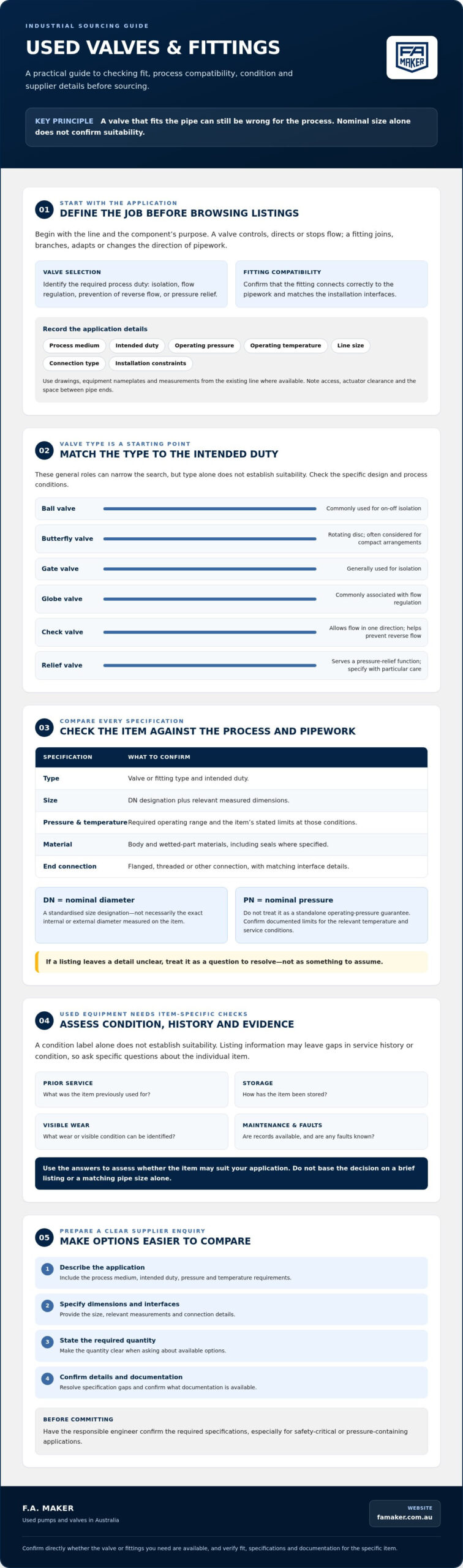
A valve that fits the pipe can still be wrong for the process. With used industrial valves and fittings, nominal size alone won’t confirm suitability. Pressure and temperature limits, process media, materials and connection details all matter. Listing information may also leave gaps in an item’s service history or condition.

Before committing to second-hand equipment, get clear specifications and identify what still needs checking. This guide explains how to define your requirements, check process compatibility and interfaces, and assess condition and documentation. It also shows what to include in a supplier enquiry so you can compare options more effectively. F.A. Maker supplies used pumps and valves in Australia. Confirm directly whether the valve or fittings you need are available.

Ask specific questions about prior service, storage, visible wear, maintenance records and known faults. The answers can help you assess whether an item may suit your application. The aim is a disciplined sourcing process, not a decision based on a brief listing or a matching pipe size.

Key Takeaways

  • Start with the application and line requirements to identify which used industrial valves and fittings may be suitable.
  • Compare valve type, size, pressure and temperature limits, material and end connection. Check how nominal dimensions relate to measured dimensions.
  • Assess used equipment using item-specific condition and history. A condition label alone doesn’t establish suitability.
  • Prepare a supplier enquiry with the application, dimensions, connection details and required quantity, then confirm specifications and documentation.
  • F.A. Maker supplies used pumps and valves in Australia. Confirm current valve stock and whether the fittings you need are available.

Used industrial valves and fittings: define the application before you source

Start with the line, not the listing. Whether you’re matching an existing installation or sourcing a replacement, identify what the component must do and how it connects to the pipework. Used industrial valves and fittings can appear suitable by type or size yet still be wrong for the process.

A valve controls, directs or stops flow through a system. A fitting joins, branches, adapts or changes the direction of pipework. Valve selection is about controlling process flow; fitting compatibility is about connecting the pipework correctly. For a foundational overview of industrial valves, including common types and their functions, see Wikipedia.

What information defines the application?

Record the process medium and intended duty, such as isolation, flow regulation or prevention of reverse flow. Note operating pressure and temperature, and whether the service involves a fluid or gas that could affect material selection. Capture the line size, connection type and any installation constraints, such as limited access, actuator clearance or the space between pipe ends.

Use drawings, equipment nameplates and measurements from the existing line where available. Don’t assume a stated nominal size guarantees a physical match. Ask the responsible engineer to confirm the required specifications before contacting suppliers, especially if the item will be used in a safety-critical or pressure-containing application.

Which valve types might suit different duties?

Valve type can narrow the search, but it doesn’t establish suitability. The general roles below are a starting point only. Actual selection depends on process conditions and the specific valve design.

  • Ball valves commonly provide on-off isolation through a rotating ball.
  • Butterfly valves use a rotating disc and are often considered where a compact arrangement is needed.
  • Gate valves are generally used for isolation, with a gate moving into or out of the flow path.
  • Globe valves are commonly associated with regulating flow.
  • Check valves allow flow in one direction and help prevent reverse flow.
  • Relief valves serve a pressure-relief function and require particular care in specification.

Before settling on a type, verify the required duty, operating limits, materials and connection details. A familiar valve category doesn’t prove that a particular used item will perform as required. The responsible engineer should check the specification against the process and installation before purchase.

Which specifications matter when selecting used industrial valves and fittings?

Compare candidate items against a written specification, not just a listing title. For used industrial valves and fittings, check each field against the process design and mating pipework. Treat any missing or unclear detail as a question to resolve before purchase, not as something to assume.

Matching nominal size alone does not establish compatibility. Pressure and temperature limits, materials and connection interfaces must also suit the application.

Specification What to confirm
Type Valve or fitting type and intended duty.
Size DN designation plus relevant measured dimensions.
Pressure and temperature Required operating range and the item’s stated limits at those conditions.
Material Body and wetted-part materials, including seals where specified.
End connection Flanged, threaded or other connection, with matching interface details.

DN means nominal diameter. It identifies a standardised size designation, not necessarily the exact internal or external diameter measured on the item. PN is a nominal pressure designation, but it should not be treated as a standalone operating-pressure guarantee. Confirm the item’s documented limits for the relevant temperature and service conditions. Compare measurements with drawings or the mating component rather than relying on DN or PN alone.

How do materials and process conditions affect selection?

Check that every wetted material is compatible with the process medium. Consider operating temperature and pressure, possible corrosion, and cleaning chemicals or procedures. These factors can affect the body, trim, seals and other components differently. Material suitability depends on the application, so have the responsible engineer check it against process requirements and available item documentation.

What should you check on fittings and connection interfaces?

Identify the connection type before comparing dimensions. Flanged ends need matching flange details; threaded ends need the correct thread form and dimensions. Other connection styles also require their own interface checks. For a valve, compare face-to-face length with the available pipe gap, and check actuator mounting and clearance where relevant. If the listing lacks detail, ask for measurements or drawings and compare them with the mating equipment.

Where a used item forms part of plant, Safe Work Australia’s guidance can help buyers assess condition and purchasing risk. F.A. Maker supplies used pumps and valves. Confirm current valve stock and ask separately whether the fittings you need are available. A clear specification brief can make the enquiry more useful. You can contact F.A. Maker about used valves.

Used versus new valves: how to assess condition and purchasing risk

A used valve may be a practical sourcing option when a suitable item is available. The trade-off is uncertainty: service history, storage conditions or maintenance records may be incomplete. A new valve may come with clearer product documentation, but neither its label nor its new status alone proves suitability for your process.

Condition descriptions such as “good”, “tested” or “unused” are starting points, not evidence. Ask what was inspected, how it was assessed and whether records are available. For used industrial valves and fittings, base your decision on item-specific details rather than a general description. A visual check can reveal obvious concerns, but it can’t confirm pressure integrity or internal condition.

What can a buyer inspect before committing?

Begin with external condition. Look for body corrosion, impact damage, deposits, damaged coatings, stem or handwheel issues, and signs of leakage around joints or seals. Request clear photographs of the nameplate, markings, both ends and any visible defects. These checks can reveal questions to resolve, but they don’t establish operational fitness.

Don’t dismantle, pressurise or operate equipment unless the work is within the competence of the people involved and suitable controls are in place. Pressure testing and other verification should be scoped and completed by qualified personnel where required. Ask for the method, results and limits of any reported test rather than treating “tested” as complete assurance.

What records and condition evidence should you request?

Ask for the manufacturer, model, serial number or other identifying marks where present. Request available maintenance, service, test and previous-duty records. Prior service matters: a valve used with a clean utility may have a different history from one exposed to corrosive media. Ask whether it was decontaminated and how it was stored, as age and storage can affect seals and other components.

Clarify exactly what has and hasn’t been inspected, tested or refurbished. If a record is unavailable, note the gap and consider what further assessment your application requires. Don’t infer compliance, certification or performance from appearance, a condition label or a seller’s brief description. Have the responsible engineer determine whether the available evidence is adequate for the intended service.
Used Industrial Valves and Fittings: A Practical Australian Sourcing Guide

A practical checklist for sourcing used industrial valves and fittings in Australia

A structured enquiry helps suppliers check what you need and helps you identify gaps before purchase. Follow these steps when sourcing used industrial valves and fittings, and keep the supplier’s answers with your purchasing records.

  1. Prepare the application brief. State the process duty and medium, operating pressure and temperature, required valve or fitting type, material and any actuator requirements. Note installation constraints that could affect fit.
  2. Record dimensions and interfaces. Provide the line size, relevant measured dimensions, connection type and details such as thread form, flange interface or face-to-face length. Include drawings or clear reference photographs if available.
  3. State the quantity. Specify the number of items required and whether each must match the same specification. If alternatives could work, identify which requirements are essential and which your engineer can review.
  4. Confirm current availability and item identity. Ask the supplier to confirm the specific item, identifying marks where present, quantity available and whether the requested fittings are in stock. Don’t assume a broad category listing confirms that a particular item is available.
  5. Request condition evidence and records. Ask what has been inspected, tested or refurbished, and what remains unverified. Request available photographs, maintenance history, prior-duty information and other relevant documentation.
  6. Arrange inspection and final checks. Clarify whether inspection is possible, what access is available and who is responsible for any additional assessment. Before proceeding, confirm the item specification, condition description, included components and agreed quantity in writing.
  7. Plan collection or delivery. Establish who arranges and pays for transport, how the equipment will be handled and packed, and whether the delivery vehicle can access the site. Check unloading equipment, site access restrictions and the receiving area before dispatch.

Make the enquiry specific

A useful supplier enquiry explains what the component must do, how it connects and what evidence you need to assess it. Ask which details are confirmed from the item itself and which are estimates or need further verification. This makes uncertainty visible early and gives your responsible engineer a clearer basis for review.

F.A. Maker supplies used industrial equipment, including pumps and valves. Confirm current valve stock, item-specific condition and documentation directly, and ask separately about fittings availability. If your project involves moving plant, F.A. Maker also offers machinery relocation services.

Have a specification brief ready? Enquire with F.A. Maker about used valves and provide the application, dimensions, connection details and required quantity.

Sourcing used valves through F.A. Maker: confirm fit, stock and next steps

F.A. Maker is an Australian, family-owned supplier of used industrial processing equipment, including pumps and valves. The Maker family business dates to the 1920s, and the company supplies used equipment nationally. Its confirmed range includes valves, but a particular valve may not be currently available, and fittings availability should be confirmed directly.

When sourcing used industrial valves and fittings, treat supplier contact as a specification check, not just a stock enquiry. Give the supplier enough detail to compare an item with your application, then verify the individual equipment’s identity, condition and documentation before deciding. If you need fittings as well as a valve, ask about their availability separately.

What should buyers confirm with F.A. Maker?

Ask whether an item matching the required type and specification is currently available. If a potential match is identified, confirm its identifying details, such as manufacturer, model or markings where present, along with the item-specific condition description and available records.

Be clear about the evidence you need. Ask what is known about prior service, what has been inspected and whether test or maintenance records exist. Clarify anything not established by the available information. Don’t assume inspection, testing, refurbishment or compliance status is included or guaranteed. Verify each point for the specific item.

How should you prepare a useful sourcing enquiry?

Keep the enquiry concise, but include enough technical detail for a meaningful response. Summarise the process application and duty, then separate essential requirements from preferences. Include the valve type, size, connection details, materials, operating limits, actuator needs and required quantity where known. If you’re seeking a fitting, describe its function and interface, then ask whether it is available.

Photographs or drawings can help explain an existing installation. Show the connection faces and surrounding space, and include measured dimensions where possible. Make clear which specifications your engineer has confirmed and which need checking against the equipment. This helps avoid treating an approximate match as a verified fit.

Contact F.A. Maker about its used pumps and valves. Share your application and specification brief, then confirm current stock, condition details and documentation directly before proceeding. For fittings, ask specifically whether the items you need are available.

Make your next sourcing decision with confidence

A sound purchase starts with a clear application brief. Confirm the process duty, operating limits, materials and connection interfaces, then compare those requirements with the specific item’s details. For used industrial valves and fittings, nominal size or a broad condition label isn’t enough to establish a match. Check available service history, inspection evidence and documentation before committing, and clarify any gaps with the supplier.

F.A. Maker is an Australian, family-owned supplier of used industrial equipment, including pumps and valves. The Maker family business dates to the 1920s. Confirm current valve stock and ask separately whether the fittings you need are available, along with item-specific condition information and records.

Prepare your specifications, quantity and any relevant drawings or photographs, then discuss your used industrial equipment requirements with F.A. Maker. A considered enquiry gives you a practical starting point for evaluating fit and next steps.

Frequently Asked Questions

Are used industrial valves safe to use?

They may be suitable, but safety depends on the specific valve, its condition, service history and intended application. Review available records, inspect visible condition and have a competent person determine whether further assessment or testing is needed. A seller’s condition label or a visual check alone can’t confirm pressure integrity or suitability. Before installation, the responsible person should assess the item against the process and site requirements.

How do I identify the right size and pressure rating for a used valve?

Check the existing line drawings, valve markings and measured interfaces, then confirm the selection with the responsible engineer. DN is a nominal diameter designation, not necessarily the exact diameter measured on the valve. PN is a nominal pressure designation, not a complete statement of operating limits. Verify the item’s documented pressure and temperature limits for the intended service, along with connection dimensions and valve type.

Can used valves be used in food, dairy or pharmaceutical processing?

Possibly, but suitability must be established for the specific process and site requirements. Check wetted materials, seals, prior service, cleaning compatibility, surface condition and available records. Ask whether the valve’s history and condition can be substantiated, and whether it meets your facility’s hygiene and quality requirements. Don’t assume stainless steel, an unused label or a general description makes a valve suitable. Have the responsible technical team assess the evidence.

What should I inspect before buying a used industrial valve?

Check the body for corrosion, impact damage, deposits and visible evidence of leakage. Look over the stem, handwheel or actuator interface, end connections, nameplate and markings. Request photographs that show these areas and any defects. Ask for identifying details, prior-duty information and available maintenance or test records. Visual inspection can reveal concerns, but it doesn’t verify internal condition or pressure integrity. Any dismantling or testing should be handled by competent personnel using appropriate controls.

What is the difference between a valve and a pipe fitting?

A valve controls, directs or stops flow through a system. A pipe fitting joins, adapts, branches or changes the direction of pipework. They serve different functions, even when installed in the same line. For example, a valve may isolate equipment for maintenance, while a fitting connects pipe sections or adapts an interface. A suitable valve still needs compatible end connections to fit the surrounding pipework.

How can I check whether a used valve is compatible with my pipework?

Compare the valve’s end connection and measured dimensions with the mating pipework or equipment. Check whether the ends are flanged, threaded or another type, and verify the relevant flange details or thread form. Confirm face-to-face length, available installation space and actuator clearance where applicable. Don’t rely on nominal size alone. Drawings, clear photographs and measurements can help, but have the responsible engineer confirm the match before purchase.

Does F.A. Maker sell used industrial fittings as well as valves?

F.A. Maker’s confirmed equipment offering includes used pumps and valves, but a dedicated fittings inventory isn’t confirmed. Ask directly whether the specific fitting you need is currently available. Provide its function, dimensions, connection details and required quantity, and confirm any item-specific condition information or records. Availability can vary, so don’t assume a fitting is in stock based on a general equipment category or a valve listing.

Buying a Used Industrial Centrifuge: A Practical Buyer’s Guide

The centrifuge with the most familiar name may still be the wrong machine for your process. When buying a used industrial centrifuge, suitability depends on more than the make or a clean exterior. Wear in critical components, gaps in the maintenance history and a mismatch between the machine’s capacity and your separation duty can all affect the decision.

A used centrifuge can be a practical option, but it needs to suit the material being processed, the required throughput and the way your plant operates. Check the machine type and configuration, review the available condition records and identify what an inspection should verify before you commit.

This guide explains how to shortlist centrifuges for your process and assess the evidence available about their condition. It also covers controls, utilities and site requirements, along with transport, installation and commissioning. For Australian buyers, imported machinery may involve additional safety and biosecurity checks. Plan for those requirements early to help avoid complications later.

Key Takeaways

  • Define the separation duty and document your feed characteristics before comparing machines.
  • When buying a used industrial centrifuge, assess machine type and capacity against your actual process, not nameplate figures alone.
  • Use maintenance records, visual inspection and operational evidence to investigate condition rather than relying on appearance.
  • Compare process fit and condition with refurbishment, spare parts, operator training and ongoing maintenance requirements.
  • Before committing, resolve open questions and plan transport, site readiness, installation and commissioning.

Start with the Process: What Must a Used Industrial Centrifuge Do?

Before comparing machines, define the separation task. Are you clarifying a liquid by removing suspended solids, concentrating solids from a slurry, separating two liquid phases or dewatering solids to achieve a drier cake? Each outcome places different demands on the centrifuge and leads to different requirements for the feed, throughput and discharge.

Process fit means aligning the feed, the separation goal and the plant’s operating requirements. A machine’s make or stated capacity can’t establish that fit on its own. The centrifuge configuration, product characteristics and required output all matter.

Translate the separation duty into equipment requirements

Record which phases need to be separated and the quality required from each outlet. For liquid-solid separation, specify the target clarity of the liquid and the expected dryness or concentration of the solids. For liquid-liquid separation, describe the phases and the required separation quality.

Document the feed composition, solids loading, particle size and characteristics, viscosity and operating temperature. Note expected feed variation, whether the process is batch or continuous, operating hours, cleaning needs and production constraints. If information is missing, ask your engineering team or equipment supplier what needs to be confirmed before selecting a machine.

Identify the centrifuge type before comparing machines

Decanter centrifuges are commonly used for continuous separation of solids from liquids and can suit concentration or dewatering duties, depending on the feed and required result. Disc stack centrifuges are used for duties such as liquid clarification or liquid-liquid separation. Suitability depends on the configuration and material. Basket centrifuges generally operate in batches, retaining solids in a rotating basket for separation or dewatering.

These are broad distinctions, not a substitute for reviewing the process. An overview of industrial centrifuge types can help explain the different operating principles, but the right choice depends on your specific feed and output requirements.

Before buying a used industrial centrifuge, prepare a process brief that covers:

  • Feed composition, solids loading and particle characteristics
  • Viscosity, temperature and likely feed variability
  • Separation objective and required output quality
  • Batch or continuous operation, operating hours and cleaning needs
  • Production constraints that affect installation or day-to-day operation

Use this information to rule out configurations that don’t match the duty, then confirm remaining options against the actual material and operating conditions. Don’t treat a familiar centrifuge type as a universal solution across industries.

Compare Centrifuge Types, Capacity, and Operating Requirements

Once the process duty is clear, compare configurations against the material and required output. A machine’s nameplate capacity is a starting point, not proof that it will meet your production target. Feed composition, solids loading, particle characteristics, viscosity, temperature and required separation quality can all affect actual throughput and performance.

Assess rated capacity against the specific feed and operating conditions, rather than treating it as a guaranteed production rate. Ask for documented operating parameters and establish how they relate to your planned duty. Confirm whether figures describe a particular material and operating setup or are general machine ratings.

Decanter, disc stack, and basket centrifuges: what changes?

These configurations separate material in different ways, so their typical duties and the questions to ask will differ. Use the table to shortlist options, then check the individual machine’s specifications and application limits.

Configuration Typical duty Feed considerations Confirm with the supplier
Decanter Continuous separation of solids from liquids, including concentration or dewatering Solids loading, particle characteristics, viscosity and expected feed variation Bowl and scroll configuration, solids discharge, operating parameters and suitability for the feed
Disc stack Liquid clarification or separation of liquid phases Required liquid quality, solids present and properties of the phases Bowl configuration, solids-handling method, discharge arrangement and applicable feed limits
Basket Batch separation, often retaining solids for removal after processing Solids behaviour, batch size, loading and the required solids condition Basket details, loading and discharge method, operating cycle and feed suitability

These are broad process roles. Actual operating limits and suitability depend on the specific machine configuration and application.

Check capacity, materials, controls, and utilities

Review the complete machine, not just its name and rated throughput. Confirm bowl or basket details, motor and drive information, control system, wetted materials and which ancillary equipment is included. Ask for documented operating parameters and clarify what testing or application evidence supports them.

Check site requirements with the relevant plant personnel before making a selection. Depending on the machine, these may include:

  • Electrical supply and control system connections
  • Water, compressed air and drainage
  • Floor space, access, service clearances and handling needs

When buying a used industrial centrifuge, resolve discrepancies between the machine documentation and your site or process requirements before proceeding. For a shortlist of available used centrifuges and separators, ask the supplier to confirm each machine’s configuration, documentation and availability.

Inspect a Used Industrial Centrifuge and Verify Its Condition

A clean exterior doesn’t show whether a used centrifuge is mechanically sound. Internal wear, undocumented repairs or missing components may not be apparent during a basic walk-around. When buying a used industrial centrifuge, base your assessment on records, a structured inspection and relevant test evidence. Each can reduce uncertainty, but none guarantees future performance.

Use a staged inspection sequence

  • 1. Review the documents. Request available service records, operating history, manuals, drawings, component records and details of prior repairs. Confirm the make, model, identification details and configuration, then check that the documents match the machine offered. Record missing or inconsistent information as an open due diligence item.
  • 2. Arrange a visual inspection. Have a qualified inspector examine the machine for visible wear, corrosion, damage, leaks and missing parts. The assessment should include the bowl or basket, bearings, seals, drive and safety systems. Ask the inspector to document observations and identify areas that need further examination.
  • 3. Define operational testing. If a demonstration or test is appropriate, agree on the conditions beforehand. Establish what will be operated, what measurements or observations will be recorded, and whether the test uses your material or another agreed basis. Keep the results with the machine’s records.

Review records and machine history

Compare the machine’s identification plate and installed components with its manuals and drawings. Ask whether its configuration has changed, what operating history is known and which maintenance tasks or repairs are documented. If service records are incomplete, don’t assume that unrecorded work was done or that the machine operated within particular limits. Treat gaps as questions to resolve with the supplier or engineering team.

Examine wear, damage, and test evidence

Have a qualified technician familiar with the equipment assess safety critical components and rotating assemblies. The technician can advise which inspection or testing is appropriate for the specific machine and identify evidence that may need specialist examination. A visual check alone may not reveal internal condition or remaining component life.

Ask for any available test reports and note their date, scope and conditions. A successful demonstration can show how the machine operated during that test, but it doesn’t establish how it will perform with your feed or under different conditions. Record defects, missing items and proposed remediation in writing, then confirm what remains unresolved before committing to the purchase.

Buying a Used Industrial Centrifuge: A Practical Buyer’s Guide

Assess Purchase Risk, Ownership Requirements, and Australian Site Readiness

Assess a machine’s condition, process fit, documentation and site requirements together. A centrifuge that looks suitable on paper may still need work to meet the planned duty or fit the site. When buying a used industrial centrifuge, identify unresolved issues early and establish who will confirm them before purchase, delivery and start-up.

Build a total ownership assessment without relying on assumptions

Look beyond the purchase itself to the work needed to bring the machine into operation and maintain it. Request machine-specific information and clarify in writing what is included, excluded, tested or still to be confirmed. Consider:

  • Inspection findings and any refurbishment required before use
  • Installation and commissioning responsibilities, including any specialist support needed
  • Availability of spare parts and relevant technical documentation
  • Operator training requirements and ongoing maintenance tasks

Ask who is responsible for each open item and what evidence will close it. Keep estimates tied to the specific machine and proposed scope rather than relying on generic cost ranges. Missing manuals, unconfirmed component condition or unclear commissioning arrangements should remain visible in your decision record.

Confirm transport, installation, and operating readiness

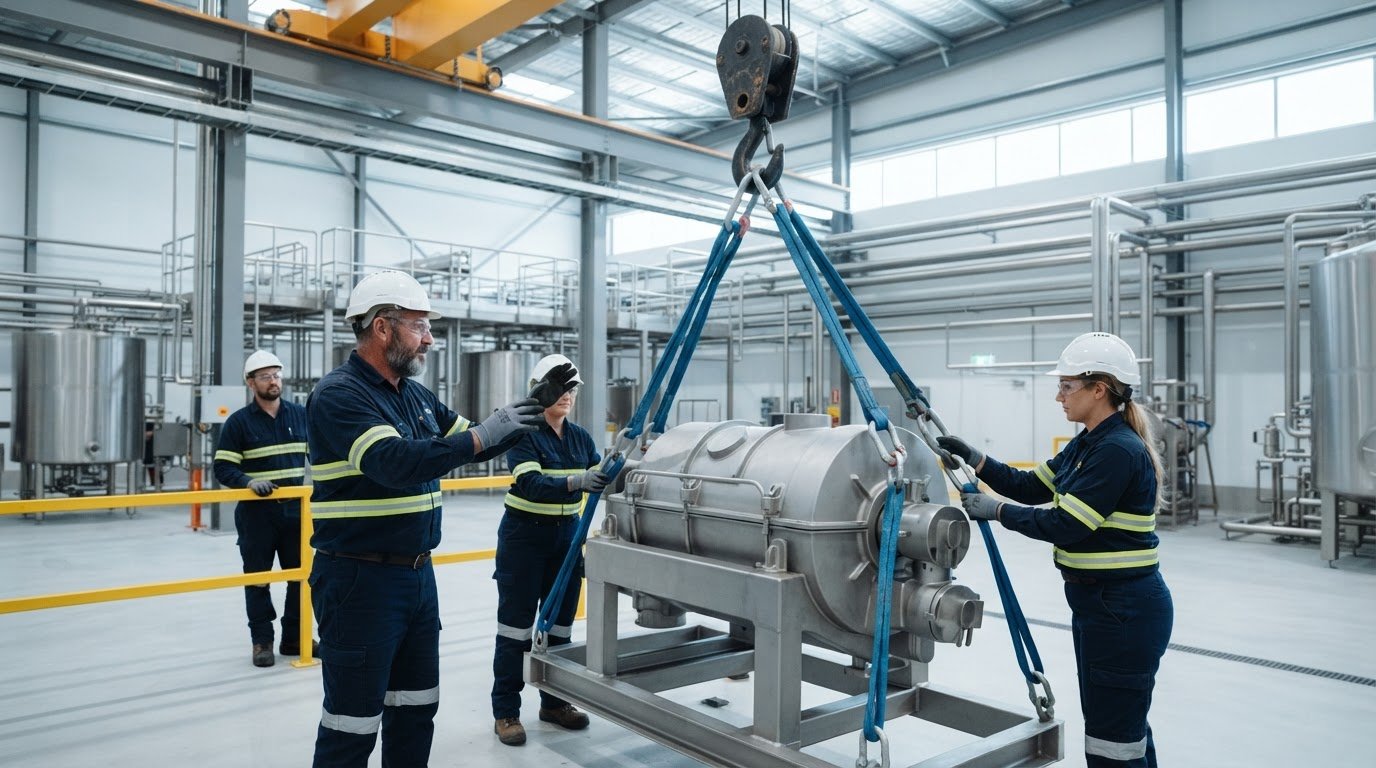
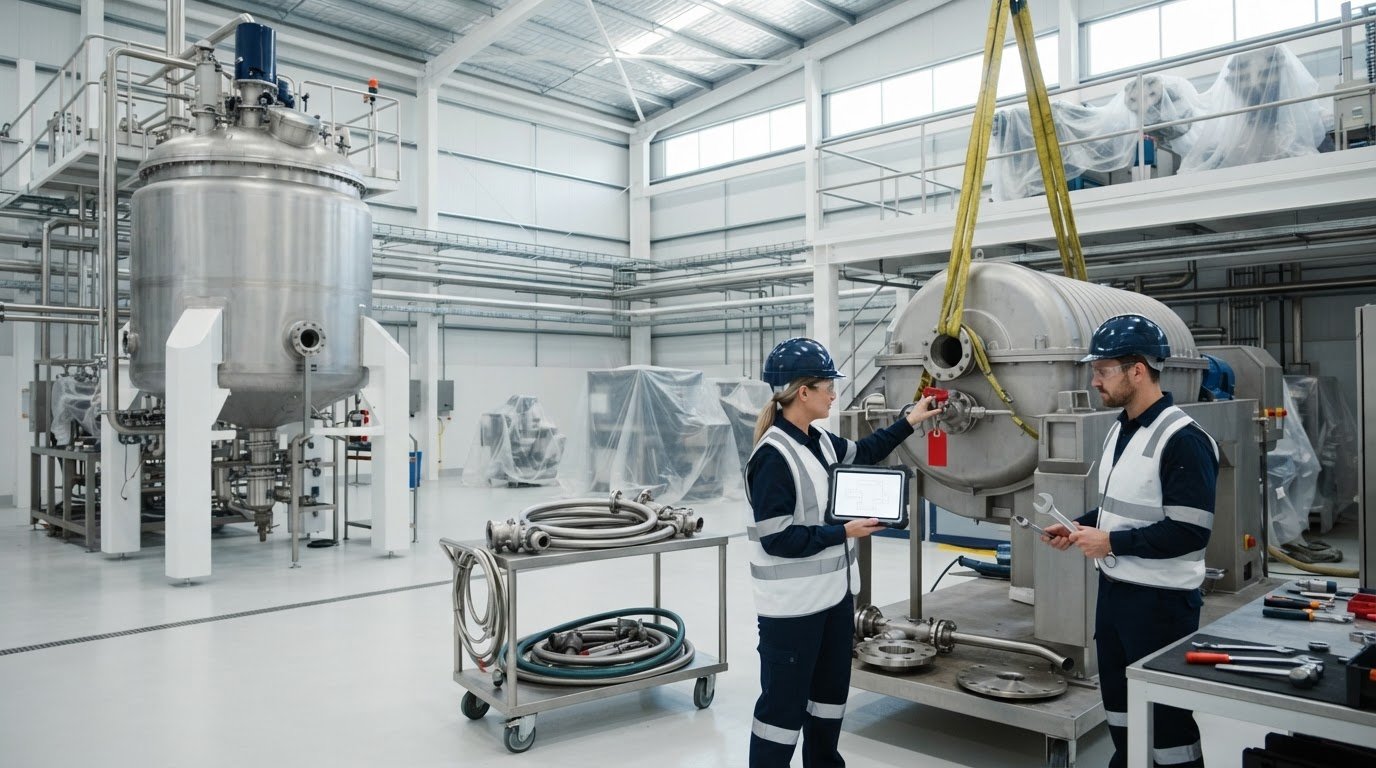
Involve qualified site and equipment specialists before arranging transport. Check the route into the plant, including doorways, turning space, lifting access and restrictions along the delivery path. Confirm the machine’s dimensions and weight using reliable documentation, then have appropriate specialists assess lifting arrangements, floor loading, foundation conditions and installation clearances.

Have your site’s technical team confirm utility connections and responsibilities. Depending on the configuration, this may include electrical supply, water, compressed air, drainage and control interfaces. Ask the relevant professionals which Australian state, site, electrical, workplace safety and transport requirements apply to the project. Requirements and responsibilities can depend on the machine and its intended installation, so don’t assume an assessment from another site will apply.

Include commissioning and operator readiness in the installation plan. Confirm what checks must be completed before operation, who will perform them and what maintenance instructions operators will need. F.A. Maker offers machinery relocation services, which may be relevant when planning equipment movement. Confirm the scope and availability for your circumstances.

Use your findings to make a balanced decision. Proceed only when the machine’s condition and process suitability align with the documentation, ownership requirements and site plan. To discuss your centrifuge requirements and equipment movement considerations, contact F.A. Maker about your project.

Complete Due Diligence and Source a Used Industrial Centrifuge

A sound purchase decision follows a clear sequence: confirm process fit, review evidence of the machine’s condition, resolve outstanding questions, then plan transport and installation. Apply the same criteria to each candidate so you can compare suitability and risk consistently. This is a practical way to approach buying a used industrial centrifuge with fewer unanswered questions.

For broader context on equipment categories and supplier selection, read this industrial centrifuge and separator supplier guide. Use it alongside your process requirements, not as a substitute for confirming the details of a specific machine.

Prepare a clear equipment enquiry

A focused enquiry gives a supplier useful information to assess potential matches. Include the separation duty, feed characteristics, required throughput and output quality, operating conditions, expected schedule, and preferred configuration if known. Note the site location, available utilities, access or lifting constraints, and expected project timing.

Ask which machine records, inspection or test evidence, manuals, drawings and components are available for review. Request confirmation of the specific machine’s make, model, configuration, condition and availability. If a detail is unknown, identify it as a question rather than treating an assumption as confirmed.

Make the decision and plan the next stage

Compare each candidate against the same process, condition, documentation and site readiness criteria. Before agreeing to purchase or transport arrangements, get material uncertainties clarified in writing. Confirm any required follow-up checks, responsibilities and installation considerations with the relevant technical specialists.

Equipment movement also needs a plan. Review the practical considerations in this guide to industrial machinery relocation services, then confirm the scope and availability of any relocation service for your project.

F.A. Maker supplies used centrifuges and separators and offers machinery relocation services. Share your process and site requirements to discuss suitable equipment or review the information available for a particular machine. Discuss your centrifuge requirements with F.A. Maker.

Make Your Next Centrifuge Decision with Confidence

Buying a used industrial centrifuge is a process and engineering decision, not simply a comparison of machine names or rated capacity. Start with the separation duty and feed, then assess whether the configuration suits the required output. Review available records and inspection evidence, and treat gaps or unverified claims as questions to resolve before committing.

Bring site readiness into the same decision. Confirm utilities, access, lifting and installation needs with the relevant technical specialists, and plan for commissioning and ongoing maintenance. A suitable machine is one whose process fit, condition evidence and operating requirements align with your plant.

F.A. Maker is a family-owned Australian supplier of used centrifuges and separators, operated across several generations of the Maker family and established in the 1920s. The company also offers machinery relocation services. Confirm machine-specific condition, documentation and availability as part of your enquiry.

Share your process duty, feed details and site constraints to discuss your centrifuge requirements with F.A. Maker. A clear brief is a practical next step towards finding equipment that fits your operation.

Frequently Asked Questions

Is buying a used industrial centrifuge a good idea?

Buying a used industrial centrifuge can be a practical choice if its configuration suits your process and evidence supports its condition. Assess the feed, separation objective, operating requirements and available maintenance history before comparing candidates. Include inspection, any refurbishment, installation and ongoing maintenance in your decision. A lower purchase price alone doesn’t establish value if the machine needs substantial work or can’t meet the required duty.

What should I inspect when buying a used industrial centrifuge?

Inspect records, visible condition and relevant operational evidence. Confirm the machine’s identity and configuration, then review available service history, manuals, drawings and repair records. Ask a qualified technician to assess the bowl or basket, bearings, seals, drive and safety systems. If a demonstration is suitable, agree on test conditions beforehand. Record missing parts and observed defects. Inspection reduces uncertainty, but can’t guarantee future performance.

How do I choose the right type of industrial centrifuge?

Choose a centrifuge type based on the separation duty and feed, not the industry label alone. Decanters are commonly used for continuous solids-liquid separation; disc stack machines may suit liquid clarification or liquid-liquid separation; basket centrifuges often handle batch duties. These are general roles, not a selection rule. Compare feed properties, solids handling, discharge method, required output and operating conditions with the specific machine configuration.

How much does a used industrial centrifuge cost?

There isn’t one reliable price for a used industrial centrifuge. The asking price depends on factors such as machine type, capacity, configuration, condition, documentation and included components. Inspection, refurbishment, transport, installation and commissioning can also affect the overall purchase decision. Request machine-specific details and written clarification of what is included or still to be confirmed, then assess the complete ownership requirements rather than the purchase price alone.

Can a used centrifuge handle food or dairy processing?

A used centrifuge may be suitable for food or dairy processing only if its materials, configuration, condition and cleaning requirements fit the product and process. Confirm wetted materials, the machine’s previous use, available documentation and any cleaning or hygiene requirements with your engineering and quality teams. Don’t assume suitability from appearance or a general description. Verify the specific machine and applicable requirements for your operation before purchase.

What documents should I request before buying a used centrifuge?

Request available service and maintenance records, operating history, manuals, drawings, component details and records of previous repairs or modifications. Check that the documents match the machine’s make, model and configuration. Ask for any inspection reports or test evidence, noting their scope and conditions. If records are unavailable or inconsistent, list those gaps as unresolved questions and clarify them with the supplier before making a commitment.

What should I check before installing a used industrial centrifuge?

Before installation, confirm the machine’s dimensions, weight, access route, lifting arrangements, floor loading, foundation and required clearances with qualified specialists. Have your site’s technical team verify the electrical supply and any applicable water, compressed air, drainage or control connections. Plan transport, commissioning and operator readiness as well. For an Australian site, check relevant state, workplace safety, electrical and transport requirements with the appropriate professionals before the machine arrives.

Used Industrial Centrifuge Buyer Guide: How to Assess Fit, Condition and Risk

The lowest-priced centrifuge may be the wrong machine for your process. A sound purchase starts with the feed and separation requirements, then checks whether the equipment’s capacity, condition and history can support them. This used industrial centrifuge buyer guide gives you a practical way to assess fit before committing to a shortlist.

Age, visible wear and asking price matter, but they don’t establish whether a centrifuge can handle your feed, integrate with your plant or has enough documentation to assess its operating history. Installation, utilities, transport and commissioning plans can also affect the decision.

Use this process-led checklist to define your requirements, compare centrifuge types and capacity, and identify condition or documentation issues that need clarification or inspection. It also covers relocation and site readiness, so you can weigh the scope of a purchase rather than the machine alone. With your requirements clear, you can ask sourcing contacts, including F.A. Maker, more informed questions about specific equipment.

Key Takeaways

  • Define the separation duty and document feed characteristics before comparing machines, so your shortlist reflects actual process requirements.
  • Use this used industrial centrifuge buyer guide to distinguish stated capacity from realistic throughput and check the basis for performance claims.
  • Review available records and arrange an appropriate inspection. A clean exterior alone can’t confirm internal condition or suitability for service.
  • List unresolved technical, condition and documentation questions before deciding whether a machine is a practical purchase.
  • Check site access, dimensions, lifting and transport requirements early. Prepare an enquiry brief to support an informed sourcing discussion.

Used Industrial Centrifuge Buyer Guide: Start with the Separation Duty

Before comparing used machines, define what the process needs to separate and what each output must achieve. Is the duty to clarify a liquid, separate two liquid phases, dewater solids or recover solids from a suspension? The answer shapes the equipment shortlist. A machine that handled a different feed may not deliver the required result, even if its nameplate capacity appears sufficient.

Centrifuge process fit is the match between a buyer’s stated separation duty, feed characteristics, operating requirements and required output quality. Use that definition to keep supplier discussions focused on your process, rather than on general machine descriptions.

Which process data should buyers gather first?

Build the duty description from representative operating data, not a single convenient sample. Record feed density, viscosity and temperature, along with solids concentration, particle characteristics and expected variability. Note whether the feed changes across products, shifts or operating conditions. Ask process and production teams to confirm the figures and identify unusual operating cases the machine may need to handle.

  • State the separation objective and the required quality of each output stream.
  • Record batch or continuous operation, target throughput range and operating schedule.
  • Describe acceptable product losses, including solids carried into liquid or liquid retained with recovered solids.

These details give suppliers a usable basis for assessing a machine. They also help separate process requirements from sales descriptions. Treat stated capacity as a figure to verify. Nameplate capacity alone doesn’t establish suitability for a different feed, separation duty or output target.

How does the separation objective narrow the shortlist?

Equipment categories perform different separation tasks. Decanter centrifuges are commonly considered for continuous separation of solids from liquids, including dewatering. Disc-stack centrifuges are used in applications requiring liquid clarification or separation of liquid phases. Basket centrifuges use a perforated basket and filter medium to separate solids from liquid, often in batch duties. These are starting points, not a substitute for checking process conditions and required results.

For a broad overview of industrial scale centrifuges and their applications, see the foundational reference. Then compare candidate types against your documented duty. Don’t assume equipment in the same category is interchangeable. Feed behaviour, operating mode and product quality targets all matter.

For broader supplier and selection context, consult the industrial centrifuge and separator sourcing guide. Once the duty is clear, use it to screen candidates and ask for the basis behind claimed capacity or application suitability. This makes a used industrial centrifuge buyer guide useful from the first sourcing conversation.

Match Centrifuge Type and Capacity to Your Process Requirements

With the separation duty defined, compare each candidate’s configuration and documented operating limits with your feed and required output. Decanter, disc-stack and basket centrifuges have different general roles, but the precise application depends on machine configuration and process conditions. A broad capacity claim cannot establish suitability. Ask a process specialist to assess the actual feed and separation target before treating a candidate as a fit.

Capacity figures need context. Ask whether a stated rate refers to feed volume, solids handling or another basis, and what feed properties and operating conditions support it. Compare that figure with expected process throughput across the operating range, not just a peak or nominal value. A machine’s previous duty may differ materially from yours.

Compare candidate types and outstanding questions

Type General process fit Key data gap Follow-up question
Decanter Often considered for continuous solids-liquid separation and dewatering. Feed basis for stated throughput and operating limits. What feed and conditions support the quoted rate?
Disc-stack Often considered for liquid clarification or liquid-liquid separation. Configuration and target product quality. What separation duty was this configuration designed for?
Basket Often considered for solids separation using a filtering basket, commonly in batch duties. Basket arrangement, operating mode and acceptable product losses. How does the machine handle this feed and solids load?

Use the table to expose unanswered questions, not to select equipment by category alone. In this used industrial centrifuge buyer guide, type is a screening step. Documented performance and process review determine whether a candidate deserves further assessment.

Confirm operating and integration details

Request machine records for the motor, drive, operating speed and controls. Confirm that the available speed range and control arrangement suit the intended duty, and clarify which specifications are documented and which remain unverified. Check electrical supply, footprint and connection requirements against the site. Have relevant specialists verify applicable Australian installation requirements for the proposed equipment and location.

Assess the whole line, too. Upstream feed equipment must supply the required flow and consistency, while downstream equipment must accept the separated streams at the proposed operating rate. A centrifuge that meets an isolated capacity figure may still constrain the process if adjacent equipment can’t keep pace.

Record each candidate’s specification, evidence source and open questions in one comparison sheet. Once your requirements are defined, F.A. Maker’s used centrifuges and separators may be a relevant starting point for sourcing. Confirm current availability and machine-specific details directly.

How to Assess the Condition of a Used Industrial Centrifuge

Assess condition in stages, starting with records and identification before moving to a physical inspection and any operational checks. A clean exterior or recent coat of paint can’t confirm the state of internal components, prove operating performance or establish suitability for your process. Treat missing records, undocumented modifications and components that can’t be inspected as unresolved questions, not as evidence that the machine is sound.

Use a staged inspection sequence

  1. Review the records. Request available manufacturer details, manuals, maintenance and service history, operating history, and records of repairs or modifications. Note missing documents and ask for clarification where possible.
  2. Confirm machine identity. Compare the serial identification and details on the machine’s plates with its documents. Check that the physical configuration appears consistent with the records and ask about any differences.
  3. Arrange a physical inspection. Have a qualified technician assess the rotating assemblies, bearings, seals, bowl condition and wear points. Check visible guards, fasteners, corrosion, leaks and damage, while recognising that external observations reveal only what can be seen.
  4. Resolve access and inspection limits. Ask whether dismantling or further examination is permitted, which components will remain inaccessible and who is responsible for arranging or conducting each inspection.
  5. Clarify operational verification. If an operational check is proposed, establish whether it is permitted, who will conduct it, what conditions can be tested and what records will be supplied. Don’t treat a demonstration under unspecified conditions as proof that the centrifuge will meet your process duty.

Separate evidence from claims

Record findings in a simple evidence log. Distinguish direct observations from supporting documents, seller statements and items that remain unverified. For example, “corrosion visible near a connection” is an observation. “Recently serviced” is a seller statement until supported by a service record. This distinction makes information gaps clear and helps you decide what further assessment is needed before proceeding.

Inspection checklist summary: Record what you observed, identify the document or inspection that supports each conclusion, label seller statements as statements, and list unverified claims or inaccessible components as open questions.

This evidence-led approach is central to a practical used industrial centrifuge buyer guide. If records conflict with the machine’s identification or physical configuration, pause the assessment and seek clarification from the seller or a suitably qualified specialist. An inspection can inform the purchase decision, but it doesn’t replace confirmation that the machine matches the intended duty.

Used Industrial Centrifuge Buyer Guide: How to Assess Fit, Condition and Risk

Evaluate Purchase Risk, Site Readiness and Relocation Before Committing

A centrifuge can match the process on paper and still create avoidable risk if key questions remain open or the plant isn’t ready to receive it. Before weighing the purchase, gather unresolved technical, condition and documentation issues in one register. Separate verified facts from seller-provided statements, and assign each outstanding check to someone responsible for resolving it.

Is the plant ready to receive the centrifuge?

Check the proposed installation position against verified machine dimensions and weight. Confirm floor area, doorways and access routes, lifting points, overhead clearance, and any constraints on vehicle access or unloading. Have relevant site, lifting and transport specialists assess the movement plan rather than relying on photographs or estimated measurements.

Site readiness also depends on what the machine needs to operate and connect. Compare verified electrical and control details, utilities and process connections with site conditions. Identify any foundation work, connection changes or integration with upstream and downstream equipment. Clarify who is responsible for installation, commissioning, operator training and confirming that the completed setup is ready for operation. Don’t assume there’s a standard installation scope.

For planning the movement itself, the industrial machinery relocation services guide outlines considerations to review. Include transport constraints and the intended route from collection point to final position in the project plan.

How should buyers manage uncertainty before purchase?

Keep a written register with three clear categories: verified facts, seller statements and outstanding checks. Include unresolved items such as missing machine records, unclear specifications, unconfirmed inspection access, site modifications or transport limitations. Agree with relevant parties what documentation will be supplied, what further inspection is permitted and what acceptance conditions apply before committing.

Assess the complete project scope, not only the machine. A used option may require site preparation, connection work or attention to known condition issues. Compare those requirements with the alternative of new equipment without assuming either route will be simpler or less costly. The used versus new industrial equipment comparison can help structure that evaluation.

This step turns the used industrial centrifuge buyer guide into a practical decision process: unresolved items are visible, responsibilities are assigned and site constraints are considered before purchase. Once your process requirements and verification questions are clear, discuss centrifuge sourcing and machinery relocation with F.A. Maker. Confirm current equipment availability and machine-specific details directly.

Source a Used Industrial Centrifuge with a Verifiable Buying Process

A disciplined sourcing process keeps the machine under consideration tied to the requirements already defined. Work through the steps in order: define the separation duty, shortlist suitable centrifuge types, verify machine specifications, assess condition and documentation, then plan delivery and site readiness. Ask for information about the specific machine, not only a general description of its category or typical applications.

What information makes a centrifuge sourcing enquiry useful?

Prepare a short enquiry brief that gives suppliers enough context to respond to your actual process. Include:

  • Process duty: the separation objective, feed composition and variability, solids characteristics, and relevant liquid properties.
  • Operating needs: expected throughput range, batch or continuous operation, operating schedule and required output quality.
  • Equipment preference: preferred centrifuge type, if known, and the reason for that preference.
  • Site constraints: Australian site location, available floor space, access limitations, utilities and process connections.
  • Verification needs: records required, such as available manuals, identification details, service history, specification information and details of modifications.

Ask which machine-specific details are currently available for review. Clarify whether inspection access is possible and what operational verification, if any, can be documented. A useful enquiry also identifies which requirements are fixed and where a process specialist can assess alternatives.

When should buyers involve a machinery supplier or relocation specialist?

Involve a potential sourcing contact when the machine’s configuration, history or specifications need to be checked against your duty. Bring in appropriate technical personnel when process suitability, condition or installation requirements need independent assessment. Plan relocation input early if dimensions, lifting, access routes, transport or the final installation position may constrain the project. Early coordination helps identify unanswered logistics questions before they affect delivery planning.

F.A. Maker supplies used industrial centrifuges and separators, but inventory and machine-specific condition and documentation should be confirmed directly. The business also offers machinery relocation services, which may be relevant when planning equipment movement. Use this used industrial centrifuge buyer guide to make the sourcing conversation specific: share your process requirements, verification questions and site constraints, then assess any proposed machine against them.

To discuss your requirements and relocation considerations, Discuss your used centrifuge requirements with F.A. Maker. Start with the duty and ask for details that can be checked, rather than shortlisting by nameplate or category alone.

Make Your Next Centrifuge Purchase a Defined Process

A sound used-equipment decision begins with a clear separation duty, then tests candidate type and capacity against the process. Verify machine-specific records and condition rather than relying on appearance or broad claims. Before committing, resolve open questions and plan for site access, utilities, transport and installation requirements.

This used industrial centrifuge buyer guide sets out a practical sequence for those checks. A concise enquiry brief, with feed data, throughput targets, required records and site constraints, can make sourcing discussions more focused.

F.A. Maker supplies used industrial centrifuges and separators and offers machinery relocation services. The family-owned business was founded in the 1920s. Confirm current availability and the specific machine’s condition and documentation as part of your assessment.

When your process requirements are ready, Discuss your used centrifuge requirements with F.A. Maker, including any relocation considerations. With the key questions documented, you can approach the next step with a clearer basis for comparison.

Frequently Asked Questions

What type of industrial centrifuge do I need for my process?

Choose a centrifuge type by matching the separation objective, feed behaviour and required output, not by capacity alone. A decanter may be considered for continuous solids-liquid separation, a disc-stack for liquid clarification or liquid-liquid separation, and a basket for solids separation using a filter medium. Configurations vary, so treat these as starting points. A used industrial centrifuge buyer guide should begin with your process duty, with a process specialist confirming suitability.

How do I inspect a used industrial centrifuge before buying?

Start with records, then arrange a physical inspection by a qualified technician and clarify whether operational verification is possible. Request the machine’s identification, manuals, operating and service history, and details of repairs or modifications. Compare those records with identification plates and the machine’s configuration. Have relevant rotating assemblies, bearings, seals, bowl condition and wear points assessed. Record observations separately from seller statements, and resolve missing information or inaccessible components before deciding.

What information should I request from a used centrifuge supplier?

Request machine-specific details, including manufacturer and serial identification, available manuals, specifications, maintenance and operating history, and records of repairs or modifications. Ask for the basis of any stated capacity and whether it relates to feed and operating conditions comparable to yours. Confirm motor, drive, speed, controls, dimensions, weight, connections and available inspection opportunities. Note which claims are documented, which are seller statements and which remain unverified.

Can a used centrifuge handle a different product or feed?

Possibly, but suitability needs to be assessed against the new feed and separation target. Compare its composition, solids concentration, particle characteristics, density, viscosity, temperature and variability with the machine’s documented operating information. Also confirm throughput range and required output quality. Don’t assume a machine will perform as required because it handled another product or has a suitable nameplate capacity. Ask a process specialist to review the actual duty and identify unresolved risks.

What should I check before installing a used industrial centrifuge in Australia?

Confirm the machine’s verified dimensions, weight, electrical and control details, utilities and process connections against your site conditions. Check floor space, access openings, lifting requirements, transport route and installation position with relevant specialists. Identify any foundation or integration work, and agree who is responsible for installation, commissioning and operator training. Have competent professionals verify applicable Australian installation requirements for the equipment and location. Don’t assume the machine can connect directly to existing services.

How much does a used industrial centrifuge cost?

The price depends on the specific machine and its condition, configuration, documentation and suitability for the intended duty. Transport, site preparation, integration and other project requirements may also affect the purchasing decision, so compare the full scope rather than the asking price alone. Request a current, machine-specific quotation and clarify what is included or excluded. Confirm availability, condition and records directly with the supplier, as these details vary between machines.

Is machinery relocation part of buying a used centrifuge?

Not necessarily. Equipment sourcing and relocation are separate considerations, so confirm whether movement is included in any proposed arrangement and who is responsible for each step. F.A. Maker supplies used industrial centrifuges and separators and offers machinery relocation services. Discuss dimensions, weight, access, lifting and transport needs early, particularly if the route or installation position is constrained. Confirm the scope and responsibilities for your equipment and site before planning delivery.

Calculating ROI on Used Capital Equipment: A Practical Guide

What if the lower purchase price of a used machine is offset by installation, relocation, maintenance or lost production? When calculating roi on used capital equipment, the purchase price is only one part of the investment. Uncertain condition and remaining service life can make the other costs and returns harder to estimate.

A sound assessment compares the equipment’s full lifecycle costs with measurable operating benefits, then weighs the result against a suitable alternative on consistent terms. This guide explains how to build a transparent calculation that finance and operations teams can review, using assumptions based on the machine’s condition, expected service life and role in your process.

You’ll learn what to include in the installed investment, how to quantify production gains or operating savings, and which checks to complete before committing capital. For example, a used stainless steel tank needs the capacity and condition to suit the process, while any required relocation should be included in the investment estimate. The aim is a practical, defensible view of value, not a decision based on purchase price alone.

Key Takeaways

  • Define the evaluation period and operating baseline before estimating returns, so the calculation reflects a clear comparison.
  • When calculating roi on used capital equipment, distinguish ROI from payback period and net present value, as each answers a different investment question.
  • Compare used and new options using the same capacity, duty, operating assumptions and evaluation period.
  • Separate verified facts from supplier information and buyer estimates, then test conservative, expected and favourable operating scenarios.
  • Turn the results into a sourcing brief, and confirm specifications, condition, availability and logistics before relying on projected returns.

What Does ROI on Used Capital Equipment Actually Measure?

Return on investment (ROI) measures the net financial benefit generated over a defined period in relation to the investment required. For used capital equipment, the calculation is useful only when it captures both the value the machine is expected to produce and the costs of putting it to work. The general Return on Investment (ROI) formula provides a starting point, but the inputs must reflect the equipment’s intended duty and a realistic operating plan.

Before entering figures, set a consistent evaluation period and baseline. The baseline might be current production using existing equipment or a comparable new machine. Compare the same output, operating hours and production requirements across the options. Projections depend on the quality of the inputs, so treat an ROI estimate as a planning tool rather than a guaranteed outcome.

The basic ROI formula and its limits

ROI = (total benefits minus total costs) ÷ total costs × 100. Define the period first, such as the time span your organisation uses to assess capital investments. Benefits could include additional saleable output or reduced operating expenses. Costs may include purchase, installation, commissioning, operating and maintenance expenses included in your model. Use the same cost and benefit categories throughout the comparison.

A positive ROI indicates that estimated benefits exceed the costs counted during that period. It doesn’t show when cash benefits arrive, how sensitive the result is to downtime, or whether the machine will remain suitable for the full period. A used stainless steel tank, for example, may have the required capacity, but its condition and fit with the process affect assumptions about its projected contribution.

ROI, payback period, and net present value

These measures answer different investment questions. ROI expresses net benefit relative to total costs over the chosen period. Payback period estimates how long cumulative cash benefits take to recover the initial investment. It highlights recovery timing, but doesn’t show the full value generated after payback.

Net present value (NPV) discounts future cash flows to account for the time value of money, then subtracts the initial investment. A positive NPV means projected discounted inflows exceed that initial outlay under the model’s assumptions. The discount rate and cash flow forecasts therefore matter.

When calculating roi on used capital equipment, review these measures together. ROI summarises the return, payback shows recovery speed, and NPV tests value over time. A consistent baseline and period make the results easier for finance and operations teams to review. Verified inputs help them judge how much confidence to place in each projection.

How to Calculate Used Capital Equipment ROI Step by Step

A useful calculation follows a clear sequence: define what the machine will replace or improve, estimate the costs and returns, then check whether the projected result holds up. This practical approach to calculating return on investment keeps assumptions visible and the comparison consistent.

  1. Set the baseline and evaluation period. Record current output, operating costs and production constraints. Choose a defined period for the analysis, and use it for both the used-equipment option and its comparator.
  2. Choose consistent operating units. Model performance in units that match the process, such as batches, operating hours or tonnes processed. Apply the same capacity, duty and utilisation assumptions to each option.
  3. Build the full installed investment. Include the acquisition and all costs required to inspect, transport, relocate, install, commission and modify the equipment for its intended use. Include only relevant items, and distinguish these one-off costs from recurring expenses.
  4. Estimate costs and benefits over the period. Add expected maintenance, parts, utilities and downtime costs. Quantify benefits only where there’s evidence, such as incremental saleable throughput, reduced outsourcing, labour changes or an avoided replacement. Avoid counting the same benefit twice.
  5. Calculate net benefit and ROI. Compare total measurable benefits with all relevant costs using the formula below.
  6. Review the inputs and result. Check the source of each figure and test whether changes in utilisation, downtime or maintenance alter the investment case.

For a used stainless steel tank, confirm its capacity, material, condition and suitability for the process before projecting output. A tank that doesn’t meet process requirements could undermine the assumed throughput, even if its purchase cost appears favourable.

Estimate benefits and calculate the result

Let A represent acquisition and other one-off installed costs, O represent recurring costs over the evaluation period, and B represent total evidenced benefits for that same period.

  • Total costs: A + O
  • Net benefit: B − (A + O)
  • ROI: [B − (A + O)] ÷ (A + O) × 100

For example, enter your documented acquisition, freight, installation, operating and maintenance figures, then compare them with evidenced production or cost benefits. The formula shows how the result is derived without treating unverified estimates as facts. Label assumptions clearly, and confirm current specifications, condition and availability before relying on the projection. Once your requirements are defined, review used industrial process equipment as a potential sourcing step.

How Do Used Equipment ROI and New Equipment ROI Compare?

A fair comparison starts with the production requirement, not the equipment’s age or purchase price. Model used and new options against the same capacity, duty, evaluation period and operating assumptions. A lower acquisition outlay doesn’t automatically produce stronger ROI if the used machine needs more commissioning, maintenance or downtime allowance, or has less useful life remaining. For a broader decision framework, see this used versus new equipment comparison.

Compare equivalent production requirements

Define the required process output and operating conditions first. Then check each option’s specifications against the duty and compatibility with the existing production line. For tank applications, assess capacity, material and process suitability. The used stainless steel tank sourcing guide outlines considerations for evaluating a suitable tank.

Comparison factor Used equipment New equipment
Total installed investment Acquisition plus inspection, freight, relocation, installation, commissioning and required modifications Acquisition plus freight, installation, commissioning and required modifications
Expected output Estimate against verified specifications, condition and planned utilisation Estimate against documented specifications and the same utilisation plan
Maintenance and downtime Allow for inspection findings, expected maintenance and site-specific downtime Use evidence and assumptions appropriate to the proposed equipment
Commissioning Include the work and time required to integrate the machine Include the work and time required to install and integrate it
Remaining useful life State as an assumption and seek technical validation Estimate over the same evaluation period using stated assumptions

Account for condition, downtime, and useful life

For a used machine, review available inspection findings and service history. Identify critical components whose condition could affect output or maintenance requirements. Check parts availability rather than assuming replacements can be sourced when needed. Model commissioning delays and downtime using evidence from your site or project plan, not a generic allowance.

Remaining useful life is an estimate, not a guarantee. Record its basis and have the machine’s condition and suitability technically assessed before relying on it in the ROI model. Apply equivalent scrutiny to new equipment, including installation requirements and expected commissioning time.

When calculating roi on used capital equipment, keep comparison assumptions visible. If one option appears preferable only because it has been assessed over a shorter period, at a lower duty or against a different output target, revise the model before drawing a conclusion.

Calculating ROI on Used Capital Equipment: A Practical Guide

How to Test ROI Assumptions Before Approving the Investment

An ROI model is only as reliable as its inputs. Before approval, label each figure so reviewers can distinguish evidence from estimates. This makes uncertainty visible and helps identify which assumptions need confirmation before the decision is made.

  • Verified facts: documented measurements, inspection findings, operating records or confirmed site requirements.
  • Supplier information: specifications or other details provided by the equipment supplier, recorded with their source and any conditions.
  • Buyer estimates: forecasts for utilisation, output, commissioning time, energy use, maintenance or downtime that still need validation.

When calculating roi on used capital equipment, test uncertain inputs rather than presenting a single projection as certain. Change one variable at a time to see how it affects the result, then identify the assumption that most influences whether the investment meets your organisation’s criteria.

Run sensitivity analysis on the variables that matter

Build conservative, expected and favourable cases using your own operating evidence. Keep the evaluation period and calculation method consistent in each case. The examples below are a framework, not industry benchmarks. Enter documented figures or clearly labelled buyer assumptions for each scenario.

  • Conservative: lower utilisation or throughput, longer commissioning, and higher maintenance or energy use.
  • Expected: the most supportable estimates based on current site plans, records and available equipment information.
  • Favourable: stronger utilisation or throughput and lower downtime or maintenance, only where there’s a defensible basis.

Calculate the break-even operating level from your own figures: the utilisation or throughput at which measurable benefits equal the costs included in the model. If a small change in commissioning time or maintenance shifts the result below that point, flag the input for closer review. Avoid false precision. State which assumptions are estimates and how they were chosen.

Check tax, accounting, and compliance inputs

Keep depreciation, tax treatment and financing assumptions separate from operating performance. Their treatment depends on your organisation and circumstances, so ask an Australian accountant to confirm the current tax and accounting inputs before relying on them in a capital decision.

Also have qualified advisers review the equipment against applicable site, process and safety requirements. Technical reviewers can assess condition and suitability, operations staff can test assumptions about integration and use, and finance can check the model’s costs, benefits and decision criteria. Record unresolved items and their effect on the scenarios before seeking approval.

Once your requirements and assumptions are documented, explore used industrial process equipment as a potential sourcing option. Confirm relevant specifications, condition and availability before updating your model.

Turn a Used Equipment ROI Calculation Into a Sourcing Decision

A positive result in a spreadsheet is only useful if it can be matched to a machine that fits the process and site. Convert the model into a requirements brief before approaching suppliers. State the required capacity and duty, acceptable condition, installation needs, evaluation period and minimum operating case that makes the investment viable.

Prepare a practical equipment investment brief

Describe required throughput, process conditions and interfaces with the existing production line. Include site constraints such as access, available space and connection requirements, along with the target commissioning window. List the inspection evidence you need and any open technical questions. Set out the evaluation period and the conservative operating case your organisation would accept, so candidate equipment can be assessed against the same criteria.

Confirm sourcing and relocation details

Before relying on projected returns, verify the specific machine’s current availability, specifications and condition directly. Confirm what is included in the supply, what inspection information is available, and which details still require technical validation. Clarify transport, site access, installation and commissioning responsibilities, then update the model with the relevant costs and timing. If relocation is required, include it in the plan and investment calculation rather than treating it as an assumed inclusion.

F.A. Maker supplies used industrial process equipment and provides machinery relocation services. These may be relevant options when they align with your documented requirements. Confirm the particular equipment and logistics details before making a decision. Your brief can cover used stainless steel tanks, mixers, mills, pumps and other process equipment, but let the required specifications guide the search.

Use a final review to close any gaps before approval:

  • Match confirmed specifications to process requirements and site constraints.
  • Record unresolved condition, logistics or commissioning questions and their effect on the ROI model.
  • Ask qualified technical, finance or safety advisers to review assumptions that remain uncertain.

With requirements documented and key inputs checked, your ROI calculation can guide a focused sourcing discussion rather than stand alone as a projection. Discuss your used equipment requirements.

Make Your Next Equipment Decision With Clearer Numbers

A defensible ROI case goes beyond the machine’s purchase price. It accounts for the full installed investment, measures benefits over a stated period and compares used and new options against the same operating requirements. Sensitivity testing shows whether the result still holds when utilisation, downtime or maintenance assumptions change.

That process makes calculating roi on used capital equipment more useful to both finance and operations teams: assumptions are visible, uncertainties can be checked, and the sourcing brief reflects actual process and site needs. Confirm equipment specifications, condition, availability and logistics before treating projected returns as a basis for commitment.

F.A. Maker supplies used industrial process equipment and offers machinery relocation services. Founded in the 1920s, the family-owned business has operated across generations. If you’ve defined your requirements and are ready to discuss sourcing options, discuss your used equipment requirements. A measured, well-supported decision is a strong foundation for your next capital investment.

Frequently Asked Questions

How do you calculate ROI on used capital equipment?

Use a defined evaluation period, total the measurable benefits and relevant costs, then calculate: ROI = (total benefits − total costs) ÷ total costs × 100. When calculating roi on used capital equipment, include the installed investment, not just the purchase amount. State the period and assumptions, and separate verified figures from estimates. If maintenance or production forecasts are uncertain, test them as scenarios rather than presenting them as established outcomes.

What costs should be included when calculating equipment ROI?

Include relevant acquisition, inspection, freight, relocation, installation, commissioning and modification costs, plus maintenance, parts, utilities and downtime across the evaluation period. Keep one-off costs separate from recurring costs so reviewers can see how the total is built. Financing or disposal assumptions may also be relevant, depending on the organisation’s chosen method. Use the same cost categories and evaluation period when comparing used equipment with a new machine or another operational alternative.

Is buying used equipment always a better investment than buying new?

No. A lower acquisition outlay may reduce the initial investment, but it doesn’t establish which option will deliver the stronger return. Condition, remaining useful life, installation requirements, maintenance, downtime and process suitability also affect the model. Compare used and new equipment against the same production requirement and evaluation period. Base the decision on verified specifications and condition evidence, rather than assuming that either used or new equipment is always the more economical choice.

How do you account for downtime in an equipment ROI calculation?

Estimate downtime from installation, commissioning, planned maintenance and possible unplanned stoppages using site records where available. Convert lost production into a financial impact only if your organisation can support that estimate. For example, use production records to assess the effect of a commissioning delay on expected output. Test more than one downtime scenario if machine condition or installation needs are uncertain, and record the source of each assumption so reviewers can check or update it.

What is the difference between ROI and payback period?

ROI expresses net benefit relative to investment over a defined period, usually as a percentage. Payback period estimates how long cumulative benefits take to recover the initial investment. Payback helps decision-makers assess recovery timing, but it doesn’t show the full value generated after that point. Reviewing both measures gives a more balanced view of an equipment proposal: ROI summarises the return over the chosen period, while payback focuses on how quickly the initial outlay is recovered.

How can you estimate the useful life of used industrial equipment?

There’s no reliable universal estimate based on equipment age alone. Consider condition, service history, operating duty, inspection findings, critical components, parts availability and the proposed maintenance plan. Have suitably qualified technical personnel assess the machine and identify uncertainties. In the ROI model, state the assumed remaining service life and test how the result changes if the equipment operates for less time than expected. Treat the estimate as an assumption to validate, not a guaranteed lifespan.

Should tax depreciation be included when calculating used equipment ROI in Australia?

Tax and accounting treatment depends on the asset, the business’s circumstances and current rules. Don’t rely on a generic depreciation assumption or treat tax effects as the equipment’s operating return. Ask an Australian accountant to confirm the appropriate treatment for the specific purchase and financial model. Keep tax assumptions separate and clearly labelled so operational benefits remain visible and finance reviewers can distinguish projected process performance from any tax-related effects.

Calculating Industrial Mixer Horsepower: A Practical Engineering Guide

A larger motor doesn’t automatically make an industrial mixer more capable. Calculating industrial mixer horsepower starts with the process load, not the motor nameplate. Material viscosity, batch conditions, impeller design and operating speed all affect the power required at the shaft. A general formula can provide a useful estimate, but it may not represent the actual mixing duty.

It’s understandable to look for a single calculation to settle motor size. The important distinction is that power transferred to the fluid, power available at the mixer shaft and the motor’s rated horsepower are not interchangeable. Torque also matters, particularly when mixing viscous materials or starting a loaded vessel. Confusing these factors can lead to an unsuitable selection, inefficient operation or added mechanical strain.

This guide explains the main equations and the assumptions behind them, including how flow regime affects the calculation. It also covers the process and equipment details needed for a meaningful estimate, how to account for drive losses and start-up loads, and when to confirm the result with the mixer manufacturer or a qualified engineer. Treat horsepower first as an estimate of process load, then as one consideration in motor selection.

Key Takeaways

  • Start with the mixing duty and material properties. Gather vessel, impeller and speed data before choosing a calculation method.
  • When calculating industrial mixer horsepower, check that the chosen equation suits the flow regime and the process data available.
  • Use torque-based estimates, power-number methods and manufacturer data for different purposes, and record each method’s assumptions and limitations.
  • Build a reusable worksheet that records duty, material, vessel, impeller, speed, drive and the source of each input.
  • When assessing a mixer, compare its configuration and operating record with the process requirements. Horsepower alone cannot confirm suitability or condition.

What industrial mixer horsepower measures, and why the number matters

Horsepower is a unit of power, or the rate at which work is done. For an industrial mixer, it describes the rate of mechanical energy transfer needed to move and mix the contents. However, a motor’s rated horsepower is not necessarily the power the process absorbs. The mixing duty creates a load at the impeller, while the drive transmits power from the motor to the mixer shaft and incurs losses along the way.

Motor horsepower is the motor’s rated output capacity; process power is the power absorbed by the mixing duty under stated operating conditions. Keeping these terms separate is central to calculating industrial mixer horsepower. A nameplate identifies the motor, but it does not show whether the mixer will achieve the required blend, circulation or dispersion in a particular material.

Horsepower, kilowatts, torque, and rotational speed

In the mechanical horsepower convention, 1 hp is approximately 0.7457 kW. Kilowatts are the SI unit commonly used to express power, while horsepower may appear on equipment nameplates and in technical records.

Torque is the turning force applied to the shaft. Rotational speed, measured in revolutions per minute (rpm), describes how quickly the shaft turns. Together, torque and speed determine power. In imperial units, the relationship is:

hp = torque (lb-ft) × rpm ÷ 5,252

This equation assumes torque is expressed in pound-feet and speed in revolutions per minute. It shows why horsepower alone doesn’t describe a mixer’s ability to handle a load: the same power can come from different combinations of torque and speed. For mixer calculations, the dimensionless Power Number (Np) is also relevant because it relates impeller geometry and operating conditions to power draw.

Why mixer horsepower cannot be chosen from tank size alone

Vessel capacity describes volume, not the resistance the contents present to the impeller. The load depends on interacting factors, including material density and viscosity, the presence of solids, impeller type and diameter, rotational speed, and the required mixing result. Operating conditions matter too: starting a settled or thick batch can impose a different load from running at steady speed.

Consider two vessels with similar working volumes. One may contain a low-viscosity liquid that circulates readily; the other may hold a viscous mixture or a solids-bearing batch that requires greater torque or a different impeller arrangement. Their horsepower requirements can differ even though their capacities are comparable.

That’s why a horsepower-per-volume rule without a defined application is unreliable. Treat vessel size as one input, not the answer. A sound estimate begins with the material and duty, then checks the impeller, speed and drive before comparing estimated process demand with the motor rating.

How to estimate industrial mixer power from process and impeller data

A useful estimate follows a defined sequence. Start with the process duty and finish by checking the result against the mixer and drive, rather than choosing a motor rating from vessel size alone.

  1. Define the duty. Record whether operation is batch or continuous, what the mixer must achieve, and whether the calculation should represent steady running, start-up or another demanding condition.
  2. Collect the inputs. Note fluid density and viscosity, batch volume, impeller type, number and diameter, rotational speed, impeller clearance, and whether the vessel has baffles. Identify the source and operating conditions for each value.
  3. Select a valid method. Choose an equation or manufacturer data suited to the impeller and flow regime. State its assumptions before calculating.
  4. Calculate process power. Keep units consistent and record the result as an estimate of power absorbed by the mixing duty, not as a motor selection.
  5. Verify the selection. Account for drive losses and operating loads, then check the proposed motor and mixer configuration with the manufacturer or a qualified engineer.

Collect the inputs before choosing an equation

Do not fill gaps with assumptions without labelling them. Viscosity can vary with temperature, concentration or shear, while batch volume and solids content may change between operating conditions. Confirm impeller dimensions and speed from equipment records or direct measurement where possible. When assessing used equipment, compare the intended duty with available nameplate, gearbox and configuration details.

Use the power-number relationship only when its assumptions fit

For applicable impeller-flow conditions, the standard relationship is P = Np × ρ × N³ × D⁵. Here, P is power in watts, Np is the dimensionless power number, ρ is fluid density in kg/m³, N is rotational speed in revolutions per second, and D is impeller diameter in metres. Convert rpm to revolutions per second by dividing by 60 before substituting it.

The power number depends on impeller geometry and flow regime, so use a value that matches the configuration and document its source. This relationship applies to turbulent flow, typically at Reynolds numbers above 10,000. At Reynolds numbers below 10, flow is laminar and power depends on viscosity rather than density, so the turbulent equation is not appropriate. Transitional conditions also require care. An equation is only as reliable as its process inputs.

The calculated value is a preliminary estimate of process power, not the motor rating. Account for gearbox losses and higher start-up or upset loads during final selection. When assessing equipment, confirm these details before comparing the estimate with a nameplate. F.A. Maker’s used process-equipment inventory includes industrial mixers and blenders.

Which calculation method fits your mixer, and what can make it misleading?

No single method suits every mixer duty. Choose according to the available data and the operating conditions the calculation is meant to represent. Torque measurements can provide a direct estimate at a known operating point. A power-number calculation estimates impeller demand from geometry and fluid conditions. Manufacturer data can help when the process or equipment falls outside those methods’ assumptions.

Method Required inputs Suitable use Key limitations
Torque-based Shaft torque and rotational speed at the relevant condition Estimating shaft power when reliable operating measurements are available Measurements may not represent other speeds, batch states or start-up loads
Power-number Power number for the impeller, fluid density, impeller diameter and rotational speed Estimating power draw when impeller data and flow-regime assumptions are defensible Can mislead if geometry, flow regime or fluid behaviour differs from the data source
Manufacturer or engineering data Mixer configuration, process properties and required operating duty Checking applications beyond a simplified equation’s scope Results depend on the accuracy and completeness of the supplied process information

Match the calculation to the operating condition

For a torque measurement, shaft power is calculated as P = T × ω, where torque is in newton-metres and angular speed is in radians per second. Use readings from the relevant operating condition. A steady-state measurement may not represent the load needed to start a settled batch.

Power-number estimates require a suitable value for the impeller and an appropriate flow-regime assumption. They can be unreliable for non-Newtonian materials, whose apparent viscosity changes with shear, or when viscosity, temperature, solids content or batch volume varies during operation. If those conditions are not adequately represented, seek manufacturer or qualified engineering guidance instead of forcing the equation to fit.

Trace power through the drive

Calculated fluid power is not automatically the motor nameplate requirement. The process load is transferred through the mixer shaft, coupling and gearbox, with losses in the drive components. Motor selection must allow for the required shaft output under the specified duty, including relevant start-up or upset loads.

A gearbox changes the relationship between speed and torque: reducing output speed increases available torque according to the ratio, subject to losses. It does not remove the need to check gearbox, coupling, shaft and motor ratings. Avoid applying a universal service factor or margin. Confirm the selection against the equipment manufacturer’s guidance and actual process conditions. This distinction is central to calculating industrial mixer horsepower without mistaking a process estimate for a final motor specification.

Calculating Industrial Mixer Horsepower: A Practical Engineering Guide

A practical checklist for calculating and checking mixer horsepower

Before calculating industrial mixer horsepower, organise the process and equipment information in one worksheet. Record the source for each value and flag anything unknown rather than silently substituting an estimate.

  • Duty: Batch or continuous operation, required mixing outcome, and relevant steady-state or start-up condition.
  • Material: Density, viscosity, temperature, solids content and any known non-Newtonian behaviour.
  • Vessel: Working volume, dimensions, baffles and operating fill level.
  • Impeller: Type, number, diameter, clearance and configuration.
  • Speed: Shaft speed at the impeller, with units and source.
  • Drive: Motor nameplate rating, gearbox ratio and available efficiency or manufacturer data.
  • Source data: Nameplate, drawings, manuals, measurements or process records, including any uncertainty.

Work through a transparent illustrative estimate

Educational example only, not a design specification. Assume a single impeller in a baffled vessel mixes a Newtonian, water-like liquid at steady speed. For illustration, take density as 1,000 kg/m³, viscosity as 0.001 Pa·s, impeller diameter as 0.50 m, speed as 180 rpm, and an assumed power number of 5 for the stated impeller geometry. Assume fully turbulent flow and no solids. The power number is hypothetical and would need to be verified for a real mixer.

Convert speed to revolutions per second: 180 rpm ÷ 60 = 3 s⁻¹. Check the flow-regime assumption using Reynolds number: Re = ρND²/μ = 1,000 × 3 × 0.50² ÷ 0.001 = 750,000. This supports a turbulent-flow assumption for this simplified example.

Using P = Np × ρ × N³ × D⁵: P = 5 × 1,000 × 3³ × 0.50⁵ = 4,218.75 W, or approximately 4.22 kW of estimated power transferred to the fluid. This result does not specify the motor rating. It excludes drive losses and does not establish suitability for another impeller, material, batch condition or mixing duty.

Check the estimate against the actual machine

Compare the estimate with the motor nameplate, gearbox documentation, shaft speed and available manufacturer records. Confirm that the recorded configuration matches the equipment being assessed. For a used mixer, review its condition and configuration with appropriate technical support before relying on its ratings. If key inputs are missing, the flow regime is uncertain or the result conflicts with machine records, pause and verify it with the manufacturer or a qualified engineer.

For equipment assessment, F.A. Maker’s industrial mixers and blenders can be considered alongside the duty and machine details you’ve recorded.

Applying a horsepower estimate when assessing an industrial mixer

A horsepower estimate is a screening tool, not a complete equipment assessment. Use it to compare expected process load with the mixer’s documented capability, then check whether the machine’s configuration and operating history support that comparison. A suitable power figure by itself cannot confirm that a mixer will achieve the required blend, meet throughput needs or suit the material.

Start by identifying what the stated rating describes. A nameplate may give the motor’s rated output, while other records may refer to gearbox output or power at the mixer shaft. These values are not interchangeable. Trace the drive arrangement and confirm the rated speed and gearbox ratio before comparing a calculation with the machine.

Questions to resolve before accepting a mixer rating

Check that the proposed duty matches the mixer’s actual arrangement. Impeller type, diameter, number and position affect how it interacts with the vessel and contents. Vessel geometry, baffles, operating fill level, material properties and the required outcome also matter. A mixer that performed reliably on one product may not suit a different viscosity, solids content or batch condition.

Request supporting information where available, including motor and gearbox nameplates, operating records, drawings and manufacturer documentation. Compare reported shaft speed with the intended process speed. If records are incomplete or the rating’s basis is unclear, note the uncertainty and seek technical verification instead of treating an assumed value as confirmed.

Operating history can add context, but it does not prove present condition. Look for records describing the material, batch size, operating speed and any recurring issues. Mechanical condition, such as shaft alignment, bearing wear or seal leakage, requires its own assessment. Horsepower calculations do not diagnose these faults.

From calculation to sourcing and installation planning

Use the estimate alongside process requirements, configuration, machine condition and site constraints. A used mixer may have the required nominal power yet still need changes to suit the duty, or may not fit the available layout. Confirm dimensions, connections, access, electrical supply and installation requirements separately. Relocation and installation planning are distinct from determining horsepower suitability.

For Australian operations, base the assessment on the actual process and installation rather than a generic rating comparison. If the application falls outside the calculation method’s assumptions, or the records do not establish the machine’s output and condition, involve the manufacturer or a qualified engineer before making a selection.

F.A. Maker supplies used process equipment, including industrial mixers and blenders. Compare available equipment information with the documented duty, drive and site requirements when assessing a potential fit.

Turn your estimate into a sound equipment decision

Calculating industrial mixer horsepower is most useful when it starts with the actual process duty. Material properties, impeller arrangement and operating conditions shape the estimated power, while the motor nameplate describes the motor’s rating. Keep those figures distinct, check that the calculation method fits the flow regime, and verify the drive and machine details before treating an estimate as a specification.

For an equipment assessment, horsepower is only one part of the decision. Confirm that the mixer’s configuration, operating record and condition suit the intended material and outcome. Where key data is missing or uncertain, seek confirmation from the manufacturer or a qualified engineer.

F.A. Maker supplies industrial mixers and blenders and is a family-owned business operated across several generations, founded in the 1920s. If you’re considering equipment for a defined process, explore F.A. Maker’s industrial mixers and blenders and compare the available information with your requirements.

Frequently Asked Questions

How do you calculate industrial mixer horsepower?

Start by defining the mixing duty and collecting the material, vessel, impeller and speed data. To calculate industrial mixer horsepower, choose a method that fits the known operating conditions, such as a torque calculation using reliable shaft measurements or an applicable power-number relationship. Convert units consistently and document assumptions. Treat the result as an estimate, then check it against the mixer configuration, drive information and manufacturer documentation before using it to guide equipment selection.

What is the formula for mixer horsepower?

There isn’t one formula that suits every mixer duty. If torque is measured in pound-feet and speed in revolutions per minute, horsepower equals torque multiplied by rpm, divided by 5,252. For some impellers and flow conditions, engineers use a power-number relationship to estimate power draw. The power number, impeller geometry and flow-regime assumptions must be appropriate for the application. Check the inputs and limitations before applying either method.

How do I convert mixer motor kW to horsepower?

For mechanical horsepower, divide kilowatts by approximately 0.7457 to obtain horsepower. To convert horsepower to kilowatts, multiply by approximately 0.7457. Check which horsepower convention a source or equipment record uses, and keep units consistent when comparing specifications. Also distinguish the motor’s rated output from power absorbed at the mixer shaft. Drive components introduce losses, and the process load may not equal the motor rating.

Does a larger mixing tank always need more horsepower?

No. Tank volume is only one factor in mixer power. The load also depends on material density and viscosity, impeller design and diameter, rotational speed, vessel geometry and the required mixing result. For example, two vessels with similar working volumes may contain materials with very different flow resistance. Their mixers may therefore need different power and torque. Base an estimate on actual process conditions rather than applying a general horsepower-per-volume rule.

What information do I need to calculate mixer horsepower?

The inputs depend on the method, but typically include material density and viscosity, batch volume, impeller type and diameter, rotational speed, vessel dimensions and baffle arrangement. For an existing mixer, gather the motor nameplate, gearbox details and shaft speed, then establish whether a rating refers to motor output, gearbox output or mixer shaft power. Record where each value came from. Mark unknown or uncertain data clearly instead of filling gaps with unsupported assumptions.

Is motor nameplate horsepower the same as mixer power?

No. A motor nameplate states the motor’s rating, while a process calculation estimates the power required for a mixing duty under specified conditions. Power at the motor, gearbox and mixer shaft can differ because the drive has losses and each component has operating limits. Before judging suitability, confirm what point the stated rating applies to and compare it with the mixer configuration, process requirements and available manufacturer information.

Can I use a horsepower calculation to choose a used industrial mixer?

A calculation can help screen a mixer against a defined process duty, but it cannot establish suitability on its own. Check the machine’s impeller arrangement, operating speed, motor and gearbox details, condition and available records. Confirm that the calculation assumptions match the intended material and vessel. If key process inputs or equipment documentation are missing, record the uncertainty and seek guidance from the mixer manufacturer or a qualified engineer before relying on the estimate.

Buying Used Food Processing Equipment: 2026 Guide

The lowest purchase price doesn’t necessarily make a used machine the right investment. Equipment can appear sound yet fail to match your product, throughput or site requirements. This buying used food processing equipment guide starts with process fit, then explains how to assess condition, maintenance history and operating records before you commit.

It’s reasonable to be cautious when a machine’s wear, performance and service history aren’t fully clear. Food-contact surfaces, cleaning access and the requirements that apply to your Australian operation also need careful review. Previous use alone won’t tell you whether equipment can be safely and effectively integrated into your process.

Use this guide to compare specifications with production needs, inspect key components and request relevant documentation. It also covers food-contact materials, cleaning considerations, facility compatibility and delivery planning, including relocation. The aim is to help you make a considered decision based on a machine’s condition and suitability, not just its asking price.

Key Takeaways

  • Use this buying used food processing equipment guide to turn production needs into clear machine-selection criteria.
  • Compare required, preferred and confirmed specifications, and check rated capacity against your product and operating conditions.
  • Assess visible condition, maintenance records and functional test results separately to identify issues before purchase.
  • Check food-safety, compliance and site-readiness requirements for your equipment, product and Australian jurisdiction with competent advisers and relevant authorities.
  • Plan removal, transport, installation and commissioning in advance, and confirm responsibilities for each step in writing.

Buying used food processing equipment starts with defining the job

Specify the process before comparing machines. A mixer, tank, centrifuge or mill is only a possible fit once you know what material it must handle, what result it needs to achieve and how it will operate within your production line. This buying used food processing equipment guide starts with those requirements, not with a machine listing.

Product characteristics drive equipment selection. Liquids, pastes, powders and solids may need different handling. Viscosity, temperature, pressure and target particle size can also affect performance. Batch size and hourly throughput matter, too. A machine’s stated capacity may not reflect its performance in your process if the material or operating conditions differ from those behind its rating. For background on the range of unit operations involved, see Food processing.

Which process requirements should you define first?

Write down the product and material properties, the process stage and the result the equipment must deliver. Record your target batch size, throughput range and expected operating hours. Include relevant conditions such as temperature, pressure, viscosity or particle size. Separate fixed requirements from preferences. A preference can help compare options, while a critical operating limit can rule out an unsuitable machine.

How do you map equipment into the production line?

Identify the machine’s role between upstream and downstream steps. Note how material enters and exits, what the machine connects to, and whether the line depends on its uninterrupted operation. A production-critical machine can constrain the whole line if it can’t meet the required duty. Auxiliary equipment may allow more flexibility, but still needs to suit the process and available services.

Check the proposed location for floor space, utility access, operator needs and the route for moving equipment into position. Record essential specifications separately from features you can assess later, such as preferred controls or configuration.

Before contacting suppliers, prepare a short requirements brief:

  • Define the job: Record the material, product characteristics and intended process outcome.
  • Set the duty: State the batch size, target throughput, operating hours and required capacity range.
  • Map interfaces: Document feed and discharge arrangements, connected equipment and utility needs.
  • Check the site: Measure the installation area and access route, and note operator requirements.
  • Rank specifications: Mark each item as essential or preferred so you can compare it with confirmed machine details.

This brief gives suppliers a practical basis for discussing suitability and helps you screen options consistently, whether you’re considering a tank, mixer, separator or another machine. Define the job first, then compare available equipment with the process it must perform.

Match used food processing machinery to product, capacity and construction

Compare machines with your process brief, not just category names or a seller’s headline capacity. A mixer, centrifuge, mill or conveyor performs a different role, and equipment in the same category can vary in working range, construction and connections. Make those differences clear and verifiable before you shortlist a machine.

Build a simple comparison table with three columns: required, preferred and confirmed. Put each specification on its own row. The first two columns describe your needs; the third records what the seller has verified for that particular machine. Mark unknowns as unconfirmed rather than treating them as a match.

Which specifications matter for your process?

Compare working capacity and operating range with the product and duty you defined. Check materials, inlet and outlet connections, motor and drive details, controls and utility requirements against your process and proposed installation. Nameplate ratings are a starting point, not proof of performance under your conditions. Ask what material, operating settings and duty cycle the stated capacity refers to, and whether supporting records or a functional demonstration are available.

Nominal capacity can be misleading if it describes a different product or operating condition. For example, a machine rated for a free-flowing material may not deliver the same throughput with a product that behaves differently. Confirm the basis of the rating before deciding whether the machine can meet your target.

How should construction and food-contact suitability be assessed?

Identify the materials that contact the product and inspect their condition, along with seals, joints and accessible surfaces. Ask for construction records where available, and request information about cleaning and maintenance history. A clean appearance alone doesn’t establish suitability. Verify the hygiene and food-contact requirements for your product, machine and Australian jurisdiction with competent advisers or relevant authorities.

Keep the comparison focused on the machine’s role. A tank’s volume, connections and construction may be central to one process, while a conveyor’s transfer arrangement and integration points may matter more in another. For tank-specific selection considerations, refer to the used stainless steel tanks sourcing guide.

Before shortlisting, check that essential specifications are supported by information about the actual machine. Preferences can help distinguish otherwise suitable options, but shouldn’t outweigh a mismatch in capacity, construction or installation requirements. F.A. Maker’s range includes used stainless steel tanks, mixers and blenders, mills, centrifuges and separators, among other equipment categories. Confirm current availability and machine details directly. You can review used process equipment once you have defined your criteria.

Inspect condition, maintenance history and operating evidence before purchase

Inspection reduces uncertainty, but it can’t guarantee future performance. Assess the machine in three separate ways: examine its physical condition, review available records and agree on functional tests. Each check answers a different question. A machine may look presentable but have limited service documentation, or run during a demonstration without proving it can handle your product and duty.

What should a physical inspection cover?

Look for corrosion, leaks, deformation, damaged guards and signs of unauthorised modification. Check product-contact areas for visible damage or hard-to-clean surfaces, and inspect seals, bearings and wear components relevant to the machine. Record what you observe, including the location of defects, and photograph findings where permitted. If a check requires specialist knowledge, disassembly or safe access to restricted areas, use a suitably qualified technician rather than relying on a visual assessment alone.

For tank-specific inspection questions, refer to the existing used-tank inspection article. Checks vary by equipment type, so focus on components and failure points associated with the machine under review.

Which records and tests should you request?

Request available manuals, nameplate details, service records and modification history. Compare the documents with the machine, and note missing, incomplete or inconsistent information. Ask what maintenance has been completed and whether known faults or replaced components are recorded. A missing record isn’t proof of a defect, but it does leave a question to resolve.

Agree in advance which functional tests can be demonstrated, who will conduct them and what conditions they represent. A test using no load, a different material or a short run may provide useful evidence, but won’t establish performance under every production condition. Record the test setup and observed results so you can compare them with your process requirements.

Use a written inspection record to separate findings from assumptions:

  • Visual inspection: Note defects, wear, modifications and areas that couldn’t be accessed.
  • Document review: Record what was supplied, what was confirmed and what information is still missing.
  • Functional testing: Document agreed test conditions, observed operation and limits to what was demonstrated.

List unanswered questions and make acceptance criteria explicit before committing. Identify which specifications must be confirmed, which defects need further assessment and which test results are necessary for your decision. Support condition claims with inspection findings, available records and documented test evidence. This won’t remove all uncertainty, but it gives you a clearer basis for assessing risk and deciding what needs to be resolved before purchase.

Buying Used Food Processing Equipment: 2026 Guide

Check food-safety, compliance and site-readiness requirements in Australia

A machine that suits the process still needs to meet your facility’s hygiene, safety and installation requirements. These depend on the equipment, product, intended use, site and relevant Australian jurisdiction. Don’t assume a machine is suitable because it was previously used in food production or because a seller describes it as compliant. Confirm what applies to your operation with competent advisers and relevant authorities before purchase.

How can you verify hygiene and compliance needs?

Compare product-contact areas, cleaning method, drainage and operator access with your site’s hygiene plan. Consider whether the equipment can be inspected and cleaned as required in its intended position, including around joints, seals and hard-to-reach surfaces. Check applicable Food Standards Australia New Zealand (FSANZ) requirements and local obligations with qualified advisers. Ask what records are available to support your intended use, but don’t assume certification or compliance without evidence and appropriate verification.

Is the equipment ready to fit your Australian facility?

Confirm installation details before committing. Check electrical supply and other required services, connection points, footprint, floor loading, operating clearances and access for maintenance. Verify the machine’s lifting points and whether the transport route, doorways and handling arrangements can accommodate it. Review guarding and other safety considerations for the intended installation and operation with a competent person.

Use a site-readiness checklist to identify gaps early:

  • Services: Confirm electrical and other utility requirements against available connections.
  • Installation area: Check footprint, floor capacity, clearances, drainage and cleaning access.
  • Movement and handling: Verify access routes, lifting points and planned handling arrangements.
  • Safe operation: Have guarding and installation requirements reviewed for the specific machine and site.
  • Evidence: Record the documents received and the questions that still need confirmation.

If you’re weighing procurement routes, compare the practical trade-offs in your used-versus-new equipment assessment. Include the work needed to make the machine fit your facility, not only its process specifications. Resolve uncertainties about hygiene, site compatibility or applicable obligations before finalising the purchase.

Once your requirements and site checks are clear, you can discuss used equipment sourcing with F.A. Maker. Confirm current availability, specifications and documentation directly, and establish which relocation arrangements, if needed, are included for the particular purchase.

Plan delivery, installation and commissioning before you commit

A machine can meet your process requirements and pass inspection, yet still be a poor purchase if it can’t be removed, transported or installed as planned. Include removal, transport, installation and commissioning in your decision before committing. Finish your assessment with a practical handover plan, not just agreement on the machine itself.

Write down who is responsible for disconnection, dismantling, lifting, loading, transport, unloading, reconnection and testing. Don’t leave responsibilities implied. Clear assignments help identify gaps between the seller’s site, the transport arrangement and your facility, where assumptions about timing or equipment handling can otherwise cause problems.

What should the delivery plan confirm?

Confirm the machine’s dimensions and weight, lifting points, dismantling requirements and access constraints at both ends. Check doorways, internal routes, floor capacity and the space needed for handling equipment. Coordinate transport timing with site readiness and any planned production shutdown. Where permits or approvals may be relevant to the route or work, establish who will check and arrange them. Confirm in writing who manages removal, loading, delivery and unloading before finalising arrangements.

How should installation and supplier discussions conclude?

Agree what installation and commissioning include, who will reconnect services and who will conduct tests. Set out acceptance checks, required documentation and unresolved technical questions. Define test conditions so everyone understands what has and hasn’t been demonstrated. For broader planning considerations, consult the industrial machinery relocation guide.

  • Before removal: Confirm disconnection, dismantling and lifting responsibilities.
  • During transport: Clarify loading, transport, delivery timing and unloading arrangements.
  • At installation: Assign reconnection, commissioning, testing and documentation tasks.
  • Before acceptance: Record agreed checks and outstanding items in writing.

Match your requirements to confirmed equipment categories rather than assuming a particular machine is available. F.A. Maker’s range includes used stainless steel tanks, centrifuges and separators, industrial mixers and blenders, mills, pumps, valves, shredders and conveyors. Confirm current stock, specifications, condition and documentation directly. Relocation support is also available to discuss, but confirm the scope for the specific purchase rather than assuming it covers every stage of the move.

Once your process, inspection criteria and delivery responsibilities are defined, discuss used processing equipment with F.A. Maker, including any relocation requirements that need clarification.

Make your next equipment decision with a clear plan

A sound purchase starts with a defined process requirement, then tests each machine against capacity, construction and actual operating conditions. Inspection, records and agreed functional checks help clarify what’s known and what still needs verification. Before committing, confirm that hygiene and site requirements have been checked for your product, facility and Australian jurisdiction, and put delivery and commissioning responsibilities in writing.

This buying used food processing equipment guide gives you a structure for comparing options without relying on appearance or nominal capacity alone. Use your requirements and unanswered questions to guide supplier discussions, and confirm current stock, specifications, condition and documentation directly.

F.A. Maker is an Australian, family-owned supplier of used industrial process equipment, with a business history dating to the 1920s. The business also offers machinery relocation services, with scope to be confirmed for each purchase. Discuss your used processing equipment requirements with F.A. Maker when you’re ready to explore suitable options.

Frequently Asked Questions

Is buying used food processing equipment a practical option?

It can be, provided you assess process fit, current condition, documentation and installation needs before purchase. This buying used food processing equipment guide offers a structured way to compare a machine with written requirements for your product and operating duty. Age or appearance alone can’t establish suitability. Inspect the equipment, review available records, clarify unanswered questions and identify work required before it can be integrated into your operation.

What should I check before buying used food processing equipment?

Start with the machine’s specifications and the task it must perform. Compare capacity, operating range, construction and connections with your process, then review visible wear, product-contact areas, service records, modifications, controls and safety features. Arrange an appropriate functional assessment where possible, with a qualified person if specialist knowledge is needed. Before committing, confirm site services, transport access, installation responsibilities and any applicable food-safety or local requirements.

How do I know whether used processing equipment will suit my product?

Compare the product’s form and characteristics with the machine’s operating range, working capacity, construction and configuration. Ask what material and duty conditions support any stated capacity or performance, and request specifications or test evidence where available. A machine previously used with a different product may need further technical assessment. If key details remain uncertain, consult a process engineer or another suitably qualified adviser before deciding whether the equipment is a fit.

Can used food processing equipment meet food-safety requirements in Australia?

It may be suitable, but previous food-industry use or stainless steel construction alone doesn’t establish that it meets your needs. Assess product-contact surfaces, seals, drainage and cleaning access against the intended use and your site’s hygiene plan. Check applicable FSANZ requirements and local obligations with competent advisers or relevant authorities. Requirements depend on the product, equipment and site, so seek project-specific confirmation rather than treating a general checklist as a compliance decision.

What documents should I request when sourcing used food processing machinery?

Request available nameplate details, manuals, service and maintenance records, modification history, relevant drawings and inspection or test evidence. Check that records relate to the machine being considered, and ask for clarification if information is missing or inconsistent. Note the operating conditions behind any performance claims. Documentation varies by machine and should support, not replace, a physical inspection and technical assessment of process fit and current condition.

What should I plan for when moving used processing equipment?

Confirm dimensions, weight, lifting points, dismantling needs, access routes and required site services before arranging transport. Put responsibilities for disconnection, removal, lifting, loading, delivery, unloading, reconnection and testing in writing. Coordinate the move with site readiness and commissioning plans. For complex moves, consider suitably experienced machinery relocation specialists and agree on scope, acceptance checks and responsibilities in advance. F.A. Maker offers machinery relocation services. Confirm the scope for the specific purchase directly.

Duties of a Machinery Rigger: Roles, Safety and Skills

A machinery lift is only as controlled as the planning and communication behind it. The duties of a machinery rigger include preparing equipment for a lift, checking rigging gear and coordinating with the lift team. Exact responsibilities depend on the work and each person’s assigned role.

Before heavy equipment is moved, it helps to know who is responsible for each task. A rigger, dogger and crane operator have different functions, and assuming one person covers everything can leave important details unconfirmed. The rigger helps carry out the agreed lift plan and raises concerns if conditions change.

This article explains the typical sequence of machinery rigging before, during and after a lift. It covers load information, lifting points, equipment checks and communication, as well as how the rigger’s role differs from other team members. Before work begins, confirm responsibilities with your employer, site supervisor or relocation contractor.

Key Takeaways

  • The duties of a machinery rigger depend on the lift plan, site conditions, equipment and assigned competencies.
  • Follow the agreed sequence from plan review and equipment checks to confirming the load is stable. Raise concerns if conditions change.
  • Riggers, doggers and crane operators have distinct functions. Confirm who is responsible for each task before the lift begins.
  • Load awareness, rigging gear inspections, clear communication and site procedures are central to safe work.
  • Before an industrial relocation, confirm equipment details, site constraints, applicable licences and who is responsible for each stage.

What Are the Duties of a Machinery Rigger?

A machinery rigger prepares and handles loads for controlled lifting and positioning. The duties of a machinery rigger depend on the lift plan, site conditions, equipment and competencies assigned to each worker. This is a practical overview, not a universal legal duty list. Responsibilities and job titles can vary between projects.

Rigging is distinct from general equipment operation. A rigger works with the load and lifting arrangement, while operating a crane or other lifting equipment is a separate function unless a worker has also been assigned and is competent to perform that task. An industrial rigger may use lifting gear and related tools to prepare and control a load. The method must suit the planned lift.

What equipment and loads might a machinery rigger handle?

Industrial work may involve pumps, tanks, motors and processing machinery such as mixers or conveyors. The equipment type alone does not determine the rigging method. The load’s weight and dimensions, its centre of gravity, and the location and capacity of suitable lifting points all affect how it can be supported and handled.

A tall tank and a compact motor, for example, have different shapes and balance considerations. A rigger’s assigned work may cover particular equipment or lifting arrangements, not every machinery type or method. If reliable information about the load or its lifting points is missing, the team should resolve that uncertainty before proceeding.

How does a rigger fit into a lifting team?

A lift may involve a rigger, dogger, crane operator and site supervisor, each assigned a defined part of the work. Depending on the task, a dogger may attach the load and communicate directions to the crane operator. The operator controls the crane, while the supervisor oversees site coordination. These are typical distinctions, not a fixed allocation for every Australian worksite.

Before lifting starts, confirm who selects and connects the rigging, who gives signals, who operates the lifting equipment and who can pause or escalate the work. Responsibilities and terminology can vary by task and jurisdiction, so do not rely on job titles alone. Clear assignments help prevent gaps, such as assuming the rigger operates the crane or directs every part of the lift.

For a machinery relocation, these roles sit within a wider move that may also involve access planning, disconnection, transport and placement. Establish where the rigger’s assigned work begins and ends so facility teams can coordinate the lift with others responsible for the move.

Machinery Rigger Duties Before, During and After a Lift

The work follows a sequence: understand the agreed lift, prepare and check the rigging, help control the load during movement, then confirm it is safely landed and report any issues. The duties of a machinery rigger are tied to the approved plan and assigned role. If site conditions or the load differ from what the team planned for, stop and raise the discrepancy with the person responsible.

Preparation, lift planning and rigging equipment checks

Before the lift, the rigger reviews the task and available load information, including weight, dimensions, lifting points and the intended travel path. The team should also confirm access, ground conditions, overhead or nearby obstructions, and how the exclusion area will be maintained. A change to the route or setup may affect the lift, so assess it rather than improvising.

Rigging gear needs to suit the load and planned arrangement. Under site procedures, check that equipment is identifiable, appropriate for the task and free from visible damage. OSHA’s rigging equipment standards provide a US reference for equipment inspection and use. Australian workplaces must follow the WHS requirements and procedures that apply to their jurisdiction and task.

Controlling the lift and confirming equipment placement

Before movement begins, the lift team agrees who communicates with the operator, which signals or communication method to use, and what to do if communication is lost. Do not assume hand signals will be used. Everyone involved needs to understand the agreed method and know who can call for a pause.

During the lift, the rigger performs their assigned role and monitors the load’s balance, clearance and stability. If the load shifts unexpectedly, catches on an obstruction or cannot follow the planned path, the team should pause and reassess. Do not compensate for changed conditions by introducing an unplanned method.

At the destination, the team positions and lands the equipment as planned, then confirms it is stable before releasing the rigging. Report any gear found damaged or unsuitable during or after the move, and manage it under site procedures rather than returning it to use without assessment.

Load control, clear communication and the agreed lift plan work together. If one changes, pause and confirm the next safe step. For facilities coordinating a wider equipment move, F.A. Maker’s machinery relocation services may be relevant. Confirm the service scope and who is responsible for each lift-related task.

Rigger, Dogger or Crane Operator: Who Is Responsible for What?

A machinery lift is a team task, but that does not mean every person has the same responsibilities. The duties of a machinery rigger are not automatically the duties of a dogger, crane operator or lift supervisor. Site assignments can differ, so agree on who handles each task and how instructions will be communicated before lifting begins.

Role Typical function What to confirm
Machinery rigger Prepares or handles the load and rigging within the assigned scope. Which rigging tasks and checks are allocated to them?
Dogger May select or attach lifting gear and communicate directions to the crane operator, depending on the task and work allocation. Who is authorised to sling the load and direct the lift?
Crane operator Operates the crane and follows the agreed signals or communication method. Who is the nominated signal person, and what method will they use?
Supervisor or lift lead Coordinates site controls, responsibilities and the agreed lift arrangements. Who can pause the work if conditions change?

How machinery rigger duties differ from dogger duties

In practice, a rigger may prepare or position rigging, while a dogger may be responsible for slinging the load and directing the crane operator. These descriptions are general. Tasks can overlap according to workers’ competencies, applicable requirements and work allocation. Do not treat an informal job title as proof of legal authorisation. Check current high-risk work licensing requirements with the relevant state or territory regulator, since requirements depend on the task and jurisdiction.

What the crane operator and supervisor contribute

Operating the crane is a separate function unless the worker is also authorised and assigned to operate it. The supervisor or lift lead coordinates site controls and ensures responsibilities and communication arrangements are understood. The operator, rigger and dogger each need to follow the agreed lift plan and report concerns through the established process.

If an instruction is unclear, a signal is missed or conditions differ from the plan, pause and clarify before continuing. Do not assume a rigger directs every lift or that the crane operator determines how the load is rigged. Clear role boundaries help the team identify who makes each decision and who needs to be informed when circumstances change.

The OSHA rigging equipment standards are a United States reference, not Australian law. For Australian work, confirm applicable requirements with the relevant state or territory regulator and the site’s procedures.

Duties of a Machinery Rigger: Roles, Safety and Skills

What Skills, Training and Safety Checks Does a Machinery Rigger Need?

A machinery rigger needs practical judgement as well as task-specific knowledge. They must understand how a load may balance, recognise whether rigging equipment is suitable and in serviceable condition, communicate clearly with the lift team, and follow the agreed plan and site procedures. Experience with one type of equipment or lift does not automatically demonstrate competence for another.

Australian WHS requirements and high-risk work licensing depend on the task and jurisdiction. Employers and workers should check current guidance from Safe Work Australia and the relevant state or territory regulator. Confirm what applies to the actual work rather than relying on a job title or a general claim of experience.

Which competencies should employers and workers confirm?

Check that the worker’s training and practical experience match the machinery, rigging arrangement and responsibilities they will be assigned. Use current jurisdictional guidance to confirm required licences or other authorisations, and whether supervision is needed. Before work starts, the worker should also understand the lift plan, site induction, communication process and emergency arrangements.

What should be checked before rigging work starts?

Use a pre-work review to confirm the information and controls needed for the planned lift. The person coordinating the work should ensure the team can resolve any gaps before lifting begins.

  • Load and setup: Confirm load details, lifting points and the planned rigging arrangement.
  • Movement and placement: Check the travel route, access, obstructions and landing area.
  • Communication: Agree who communicates with the operator and which signals or method the team will use.
  • Equipment: Check that gear is suitable and in serviceable condition, following site procedures and manufacturer information.
  • Site controls: Confirm relevant work area controls, supervision and emergency arrangements.

If the plan, equipment or conditions do not match, pause and ask the supervisor or lift lead to clarify the next step. Do not substitute different gear or change the method without the appropriate review. These checks connect the duties of a machinery rigger to the specific risks and arrangements of each job, rather than treating competence as a generic qualification.

For facilities planning an industrial equipment move, discuss machinery relocation with F.A. Maker and confirm the service scope and responsibilities, including who will arrange any rigging labour.

Machinery Riggers in Industrial Relocation: Planning the Next Step

Rigging is one stage of an industrial machinery move, not the entire relocation. A project may involve planning access, coordinating shutdown and disconnection, lifting and securing the equipment for transport, then placing it at the new location. The duties of a machinery rigger relate to the assigned lifting work. They do not automatically cover transport, utility work or every other part of the move. Establish who is responsible for each stage to prevent gaps between the lift and the wider relocation plan.

Before requesting support, facility managers can assemble core equipment and site information. Details such as the machine’s dimensions, approximate weight, centre of gravity and available lifting information help the relevant parties assess what needs to be planned. Record access restrictions, floor conditions, overhead clearances and shutdown requirements as well. These factors can affect how the equipment reaches the lift area and where it can be placed.

Information to assemble before an industrial machinery move

Prepare a concise move brief with the information available, and flag anything that still needs confirmation. Identify who will provide the lift plan, rigging crew, crane and transport arrangements. Do not assume one provider is responsible for all of them. For further preparation, consult F.A. Maker’s industrial machinery relocation services technical guide.

  • Equipment dimensions, approximate weight, centre of gravity and documented lifting points.
  • Access routes, floor conditions, overhead clearances, obstructions and the intended landing area.
  • Shutdown timing and coordination required with production or site operations.
  • Named responsibilities for planning, rigging, lifting, transport and final placement.

This information supports a clearer discussion about scope. If weight, lifting points or access details are unknown, record that uncertainty rather than treating an estimate as confirmed.

When to involve a machinery relocation specialist

Early coordination can help when equipment is heavy, access is restricted or the move must fit around production sequencing. Ask prospective providers what their service includes, what information they need and which site responsibilities remain with your facility or other contractors. Confirm who arranges the lift plan, rigging crew, crane and transport before work is scheduled.

F.A. Maker offers machinery relocation services for industrial equipment. If you are planning a move, discuss your machinery relocation requirements with F.A. Maker and confirm the service scope and responsibilities for the specific project. This establishes the next planning steps without assuming that rigging labour or other lift arrangements are included.

Plan Your Machinery Move with Clear Responsibilities

Understanding the duties of a machinery rigger helps everyone involved know where rigging work begins and ends. The rigger’s tasks depend on the agreed lift plan, site conditions and assigned competencies. They are distinct from crane operation and other team responsibilities, so confirm who handles each function before work starts.

A controlled move also relies on preparation, suitable equipment checks and an agreed communication process. If the load, rigging setup or site conditions differ from the plan, pause and seek clarification. Before engaging support, gather equipment details, access constraints and shutdown requirements, then establish who is responsible for planning, lifting, transport and placement. Check relevant Australian WHS and licensing requirements for the task and jurisdiction.

F.A. Maker’s machinery relocation services complement its industrial equipment expertise. As a family-owned business operating across several generations, it may be a useful contact for facilities planning an equipment move. Confirm the service scope and who will arrange rigging labour and other lift requirements for your project.

Discuss your industrial machinery relocation requirements and take the next planning step with a clearer view of the work involved.

Frequently Asked Questions

What are the main duties of a machinery rigger?

A machinery rigger prepares and handles loads for controlled lifting and positioning within the agreed lift plan and their assigned competencies. Typical tasks may include reviewing load information, helping select and connect suitable rigging gear, checking equipment and monitoring the load during movement. They may also help confirm the equipment is stable after landing. The exact duties of a machinery rigger depend on the machinery, site conditions, task and team responsibilities.

What is the difference between a machinery rigger and a dogger?

A machinery rigger’s work generally centres on preparing or handling the load and rigging arrangement, while a dogger may sling the load and direct the crane operator. These are typical functions, not fixed descriptions for every site. Tasks can overlap depending on work allocation, competencies and applicable requirements. Confirm who is authorised and responsible for each task before the lift. A job title alone does not establish a person’s legal authorisation.

Does a machinery rigger operate the crane?

Not automatically. Crane operation is a separate function, and a machinery rigger should only operate a crane if they are appropriately authorised and assigned to do so. The lift team should establish who operates the crane, who attaches or handles the load, and who communicates signals or instructions. Follow the lift plan and agreed communication process. If roles or instructions are unclear, pause and clarify them with the supervisor or lift lead.

Does a machinery rigger need a licence in Australia?

It depends on the task and applicable state or territory requirements. Some lifting work may involve high-risk work licensing, but the title “machinery rigger” alone does not determine whether a licence is required. Employers and workers should confirm the specific work, authorisations and supervision requirements using current guidance from Safe Work Australia and the relevant state or territory regulator. Do not assume training or experience replaces a licence where one is required.

What equipment does a machinery rigger use?

Equipment varies with the load and planned lift. A rigger may work with lifting gear such as slings, shackles or other load-connection equipment when these suit the approved arrangement. The load’s weight, dimensions, centre of gravity and lifting points inform equipment selection. Gear must be suitable for the task and checked under site procedures and manufacturer information. A rigger will not necessarily use every type of rigging equipment or lifting method.

What safety checks should happen before machinery is lifted?

Before lifting, confirm the load information, lifting points, rigging arrangement, travel path and landing area. Check the condition and suitability of the rigging gear, site access, ground conditions, obstructions and exclusion controls. The team should also agree who communicates with the crane operator and how. If information is missing, equipment is unsuitable or conditions differ from the plan, pause and raise the issue before proceeding. Follow site procedures and applicable Australian WHS requirements.

When should a business engage a machinery relocation specialist?

Consider specialist coordination when machinery is heavy, access is restricted, shutdown timing is complex or the move must fit around production. Before engaging support, provide equipment dimensions, approximate weight, lifting information, access constraints and timing requirements. Ask what the service covers and who arranges the lift plan, rigging crew, crane, transport and placement. F.A. Maker offers machinery relocation services for industrial equipment. Confirm the scope and responsibilities for your specific move.

Designing a Powder Mixing Process: A Practical 2026 Guide

The mixer should not be the first decision in a powder blending project. Start by defining what the finished blend must do, then build a process that can meet that specification consistently. When designing a powder mixing process, it is understandable to focus on equipment early, especially when a laboratory blend still needs to translate to production scale.

A more reliable starting point is a measurable blend specification and a test method. Together, these help you compare mixing approaches, identify process variables to control and assess whether trial results are repeatable before committing to a production setup.

This practical 2026 guide covers the key steps: characterising powder properties, setting blend requirements, comparing mixer types and establishing operating parameters. It also explains how to plan validation and account for segregation, dust and batch-to-batch variation. With process requirements defined first, you can assess industrial mixers and blenders, including ribbon blenders, against the work they need to perform instead of relying on equipment choice alone.

Key Takeaways

  • When designing a powder mixing process, define the required composition, batch size, downstream use and acceptable blend variation before selecting equipment.
  • Compare ribbon, paddle and high-shear mixers against powder behaviour, batch scale, material sensitivity and cleanability.
  • Use a controlled trial sequence and record ingredient order, loading pattern and operating conditions to help identify sources of variation.
  • Plan representative sampling, a suitable test method and clear acceptance criteria so validation reflects both mixing and discharge.
  • Turn validated process needs into a written equipment specification, then check capacity, construction, condition, controls and cleanability before sourcing.

Start designing a powder mixing process with a measurable blend specification

When designing a powder mixing process, define the result before choosing the mixer. Powder mixing distributes two or more components through a batch to meet specified product requirements. Those requirements should describe the finished blend, not simply the equipment or mixing time used to make it.

Blend uniformity is the consistency of component distribution across representative portions of a batch; acceptance criteria depend on the product’s composition, intended use and quality requirements. Set those criteria with the production and quality teams, then use them to assess trials and subsequent production batches.

Distinguish mixing from other powder operations. Mixing aims to distribute ingredients, while particle size reduction changes particle dimensions, dispersion breaks up or distributes agglomerates, and chemical or physical transformation changes the material itself. A process may combine these operations, but each has a different purpose and should have its own requirements.

The mixing process engineering overview describes mixing mechanisms and equipment types. This context helps clarify why the required product result, rather than a general idea of “thorough mixing”, should guide process design.

Which product and blend requirements should be specified first?

Record ingredient proportions and target batch size, along with critical product attributes such as composition, appearance or moisture limits where relevant. Specify how the blend will be used next. For example, consider whether it must flow from a hopper, discharge cleanly, dissolve at a defined stage or feed consistently into another process. These downstream needs can affect both the blend specification and how it should be assessed.

Agree on measurable acceptance criteria before trials begin. Define the test method and what results count as acceptable, so operators and quality staff assess the same outcome. Where measured component distribution is required, do not rely on visual appearance alone.

How do powder properties affect blendability?

Characterise each ingredient using properties relevant to handling and mixing, including particle size distribution, shape, density, moisture and flow behaviour. Differences between components can affect how readily they distribute, move through a mixer and remain uniform after blending. Record information for the actual materials being processed rather than assuming a supplier description captures every batch.

Flag cohesive, electrostatic, fragile or segregation-prone ingredients for closer evaluation during trials. Also document expected variation between suppliers or material batches. This record helps set realistic process limits and identify when a change in incoming powder could affect the finished blend.

  • Composition and scale: ingredient proportions and target batch size.
  • Product performance: required downstream flow, discharge, dissolution or feed behaviour.
  • Material behaviour: powder characteristics and known batch-to-batch variation.
  • Quality decision: test method and measurable acceptance criteria.

With these requirements documented, mixer comparisons and operating trials can focus on whether the process produces the specified blend, rather than whether the equipment simply moves powder.

Characterise the powders and choose a mixing mechanism

Powder characteristics help narrow the mixer options, but they do not determine suitability on their own. Particle size distribution, shape, density, cohesion, fragility and flow behaviour can all affect how ingredients move and combine. When designing a powder mixing process, use these properties to form a shortlist, then assess candidate equipment with representative materials and the required batch size.

Mixer names describe broad mechanisms, not guaranteed results. A ribbon mixer, for example, can behave differently depending on its configuration, fill level, operating conditions and the powders being processed.

How do ribbon, paddle and high-shear mixers differ?

Use this comparison as a starting point, not a final selection. Actual performance depends on the machine design and material response.

Mixer type General action Consider for
Ribbon Inner and outer helical blades move material through the vessel in different directions. Batch blending where bulk material movement is needed. Confirm that the action suits the powder’s cohesion and fragility.
Paddle Angled paddles lift and move powder through the vessel. Applications where the required movement and handling are compatible with the material and batch.
High-shear Intensive mechanical action applies greater shear to the material. Processes that need stronger deagglomeration or dispersion, provided the material can tolerate the action.

Consider whether the ingredients are cohesive or fragile, whether agglomerates need to be broken up, and whether the batch requires gentle redistribution or more intensive action. Establish the right balance through trials. A mechanism that disperses one formulation effectively may damage another or fail to prevent segregation.

What should a mixer comparison include?

Compare each candidate against the written process requirements, not just its nominal mixer category. Check working capacity for the intended batch and assess contact materials, discharge arrangement and access for cleaning. Confirm that the machine can accommodate the actual powders and any permitted liquid additions. Review controls, maintenance access and how the equipment would connect with the surrounding production line.

Include cleanability and discharge in the assessment. Residual material or uneven emptying may affect product changeovers or the composition of material collected at different points in discharge. Where possible, validate these factors with a representative trial.

Once process needs and trial results are documented, an equipment search can be more focused. F.A. Maker supplies industrial mixers and blenders, including ribbon blenders. Assess used machinery against the application, its condition and its specific equipment details. For an initial look at industrial mixers and blenders, treat equipment categories as options to evaluate, not proof of suitability.

Set mixing order, loading and operating conditions to limit variability

Once the mixer mechanism has been shortlisted, establish how materials will be handled through each batch. A repeatable sequence makes it easier to identify whether variation comes from ingredient preparation, charging, mixing or discharge. When designing a powder mixing process, treat each trial as a controlled test: change one condition at a time where practical, record the result and compare it with the agreed blend criteria.

Establish operating limits using representative material and documented trials. Do not assume a standard speed, fill level or mixing time will suit every formulation, even when the equipment type is familiar.

How should ingredients be added and mixed?

Begin with verified ingredient weights and a consistent preparation method. Sieving may be appropriate where the process specification calls for it, but confirm that it does not alter a material in a way that affects the blend. Charge ingredients in a controlled order and record the amount and timing of each addition. Keep the loading pattern consistent between trials so the results can be compared.

Low-dose ingredients can be difficult to distribute directly through a larger batch. Assess whether premixing a minor ingredient with a compatible carrier improves its distribution, and document the method if adopted. The carrier and premixing step must suit the product requirements. The approved batch record should give operators a clear sequence for preparation, charging, mixing, sampling, discharge and assessment.

How can process conditions contribute to segregation?

Differences in particle size, density or shape can cause components to separate as material moves. Segregation may arise during mixing, but it can also occur during transfer or discharge. For example, a blend that meets criteria inside the mixer may become less uniform if it is handled roughly or discharged in a way that separates particles.

Assess fill level, mixing duration and speed through documented trials. A low or high fill level can change how material moves through the vessel. Longer mixing is not automatically better if it increases segregation or damages fragile particles. Check the blend at relevant stages, including after discharge, and record transfer steps such as conveying or drops between equipment.

  • Prepare: verify weights and apply any defined material preparation.
  • Charge: follow the approved ingredient order and loading pattern.
  • Mix: test defined combinations of fill level, speed and duration.
  • Sample and discharge: assess blend quality at representative points and observe how the batch empties.
  • Review: compare results with acceptance criteria and record conditions for repeatable batches.

Keep trial records precise enough to reproduce a successful batch and investigate a failure. Note material batch details, addition timing, operating settings, sample locations and discharge observations. These records provide a basis for setting process ranges and identifying which variables need routine control.

Designing a Powder Mixing Process: A Practical 2026 Guide

Validate the powder mixing process through sampling and scale-up

Validation checks whether the defined process produces an acceptable blend consistently, not just in a single successful trial. When designing a powder mixing process, agree on the sampling plan, analytical method and acceptance criteria with the relevant quality personnel before assessing results. Visual appearance can reveal obvious problems, but it cannot establish component distribution on its own.

How should a powder blend be sampled and tested?

Choose sampling points and timing to reflect the mixer and the way material is discharged. Samples taken from only one convenient location may miss variation elsewhere in the batch. Depending on the equipment and process, the plan might include samples from different mixer regions or portions collected at different stages of discharge. Define the approach before testing so results can be compared consistently.

Agree on how samples will be collected, handled and analysed. A suitable test method must measure the product attributes that matter, and sample handling should avoid introducing changes or bias before analysis. Record results against the acceptance criteria, along with any deviations from the approved method or operating conditions.

  • Sampling plan: locations, timing and collection method.
  • Test method: analysis suited to the blend specification.
  • Decision criteria: defined limits for accepting or rejecting results.
  • Trial record: results, deviations and evidence of repeatability.

Review the pattern of results, not just whether an average meets the target. Differences between sample locations or points in the discharge sequence can reveal localised variation. Repeatability across documented trials provides stronger evidence for approving routine operation.

What changes when scaling up a mixing process?

A laboratory result is a useful starting point, but production equipment can change how powder moves. Compare mixer geometry, working volume, power and mixing action, then consider material movement through charging and discharge. A larger vessel may create different flow paths, while production transfers can introduce handling steps that were not present in the smaller trial.

Do not transfer laboratory mixing time directly as a production setting. Plan staged trials at relevant scales and evaluate the blend against the same product criteria at each stage. Document changes and results so the approved production process is based on evidence from the equipment and batch conditions it will actually use.

Once validation establishes the required capacity and process conditions, use those findings to guide equipment comparisons. F.A. Maker supplies industrial mixers and blenders. Check any used equipment’s condition and specifications against the validated requirements. Review industrial mixers and blenders as part of that equipment search.

Turn the validated process into an equipment and operating decision

Use trial results and acceptance criteria to prepare a written equipment specification before sourcing machinery. This keeps the decision tied to demonstrated process needs rather than a mixer’s general description. Include the required working capacity and batch range, mixing action, materials of construction, discharge arrangement, controls and cleaning access.

Check the machine against the Australian facility where it will operate. Confirm that installation space, site access, utilities, maintenance clearance and material transfer arrangements suit the equipment and production line. Allow for how ingredients enter the mixer and how the finished blend moves to the next step. A machine that meets capacity needs on paper may still be impractical if it cannot be installed, cleaned or integrated as required.

What should buyers verify before selecting a used mixer?

Request available machine details and compare them with the documented process conditions. Inspect relevant wear points, drive components, seals, discharge components and accessible internal surfaces. Check that the condition and configuration support the intended materials, working capacity and cleaning requirements. A used mixer’s suitability depends on the application, so verify its current specifications and condition before making a decision.

How can the process move from trial to routine production?

Translate the approved trial into an operating procedure that records the recipe, ingredient sequence, loading pattern, operating limits, sampling plan and batch records. Train operators to follow the method, recognise deviations and escalate results that fall outside acceptance criteria. Reassess the process after a change to formulation, supplier, batch size or equipment, since each may affect blend performance.

A practical equipment specification can include:

  • Capacity and operation: required working volume, batch range and validated operating conditions.
  • Construction and cleaning: contact materials, internal access and cleaning requirements.
  • Machine condition: inspection findings for wear points, drives, seals and discharge.
  • Site fit: installation access, utilities, maintenance clearance and material handling.

Keep the specification, approved operating procedure and validation records together. This gives purchasing and production teams a shared reference for assessing equipment and managing future changes. F.A. Maker supplies industrial mixers and blenders in Australia. Once process requirements are defined, review industrial mixers and blenders as potential equipment options, checking current inventory and each machine’s details against your specification.

Move from a tested process to a confident equipment decision

A dependable powder blend starts with a clear specification, not a guess at mixer type. Define the product requirements, understand how the powders behave, then use documented trials and representative sampling to establish repeatable operating conditions. This keeps designing a powder mixing process focused on measurable results before equipment selection.

Once the process is validated, turn its capacity, construction, cleaning and operating needs into a written equipment specification. Check each candidate against those requirements, including its condition and fit with your facility. This provides a practical basis for moving from trials to routine production.

F.A. Maker supplies industrial mixers and blenders. Explore F.A. Maker’s industrial mixers and blenders as part of your equipment search, and verify current inventory and machine details against your process needs.

Frequently Asked Questions

What is the first step in designing a powder mixing process?

Start by defining the required blend composition, batch size and measurable quality criteria. Then characterise the powders, including particle size, density, moisture and flow behaviour, to inform the mixing mechanism and test plan. For example, differences in density or particle size may influence how ingredients move and whether segregation needs particular attention. Setting these requirements before choosing equipment makes mixer comparisons more relevant and helps focus trials on measurable product outcomes.

How do you choose a mixer for powder blending?

Match the mixer’s action to material behaviour, batch requirements and product sensitivity. Compare ribbon, paddle and high-shear options by how they move material, along with cleanability, discharge and operating needs. A mixer type can help form a shortlist, but its name alone cannot confirm suitability for a particular formulation. Assess the candidate using representative materials and agreed blend criteria, then consider how the blend must perform in the next production step.

How long should powder be mixed?

There is no universal mixing time for every powder, mixer and batch. Establish an appropriate range through controlled trials using representative materials, consistent loading and a defined sampling method. Record the duration alongside other operating conditions, then assess samples against the blend criteria. More mixing does not necessarily improve uniformity; depending on the materials and process, excessive mixing may contribute to separation or damage. Use trial results to set a repeatable operating range rather than adopting a default time.

How can you prevent segregation in a powder blend?

Identify ingredient differences in particle size, density, shape and flow behaviour, as these can affect separation during processing. Review ingredient order and loading, then consider transfers and discharge, where material movement may alter the blend. Use a consistent sampling plan to check for variation at relevant points, and document the results of process changes. Visual appearance alone cannot establish that a blend meets its specification, so assess it using the agreed test method.

How do you scale up a powder mixing process?

Reassess material movement in the larger equipment rather than copying laboratory settings directly. Mixer geometry, working volume, mixing action, power and discharge behaviour can all differ at production scale. Plan staged trials using representative material and the same product acceptance criteria, then compare documented sampling results across scales. Record deviations and adjust operating conditions based on evidence. Approve routine production conditions only after the larger process demonstrates repeatable results against the specified blend requirements.

Can a used industrial mixer be suitable for a new powder process?

Yes, a used industrial mixer may be suitable if its capacity, configuration, materials, condition and operating characteristics match the process specification. Request available machine details and check relevant wear points, drive components, seals and discharge arrangements. Consider whether cleaning access and installation fit your facility’s needs. Suitability is process-specific, so verify the individual machine’s details and assess it against trial requirements. Confirm current inventory and specifications with the equipment supplier.

Decommissioning Industrial Equipment Checklist: A Practical Engineering Guide

Decommissioning is not the messy prologue to demolition; it is a precision engineering discipline. Treating an equipment retirement as a blunt teardown routinely destroys viable machinery, exposes personnel to hazardous energy, and generates costly compliance breaches. Deploying a structured decommissioning industrial equipment checklist is the only reliable way to maintain operational control, satisfy Safe Work Australia requirements, and protect plant capital from day one.

Every plant engineer understands the stakes. Unplanned shutdown delays, fluid contamination, and hasty rigging can wipe out the secondary value of high-grade processing assets in a matter of seconds. You shouldn’t have to sacrifice personnel safety or asset equity to hit an aggressive facility handover target.

This technical guide details how to safely isolate, decontaminate, dismantle, and recover maximum capital from retired processing equipment without incident. We will walk through every mechanical stage, covering certified zero-energy lockout, chemical line purging, heavy extraction techniques, and asset liquidation pathways.

Key Takeaways

  • Baseline your plant asset register and original engineering drawings before initiating any mechanical intervention on site.
  • Eliminate stored operational energy across electrical, hydraulic, and pneumatic lines by executing a verified decommissioning industrial equipment checklist.
  • Purge, neutralise, and certify chemical residues in process vessels and pipework to ensure compliance with Australian environmental regulations.
  • Preserve secondary machinery value by deploying systematic match-marking, protective blanking, and engineered rigging over destructive demolition.
  • Differentiate high-demand processing equipment from structural scrap to unlock significant capital recovery through secondary industrial resale channels.

Pre-Decommissioning Planning: Audit and Engineering Scope Checklist

A successful plant shutdown starts months before the first mechanical flange is unbolted. Many facilities treat retirement as a general demolition exercise, but skipping preliminary engineering discovery introduces severe safety risks and destroys equipment value. As part of an engineered decommissioning process, plant managers must systematically review piping and instrumentation diagrams (P&IDs), original schematics, and manufacturer service logs. Establishing clear project boundaries on a master decommissioning industrial equipment checklist prevents accidental disruption to operational plant areas and sets clear mechanical scopes from day one.

Compiling the Mechanical and Electrical Asset Inventory

Asset recovery and safe isolation depend on a line-item asset register that captures operational state and mechanical configuration. Instead of just logging parent units, catalogue every integrated component across your processing lines:

  • Nameplate specifications and compliance tags: Document equipment serial numbers, design temperatures, operating pressures, and verification stamps on registered pressure vessels to verify compliance against AS 1210 standards.
  • Ancillary assets and drive systems: Detail all variable speed drives, positive displacement pumps, reduction gearboxes, and local control panels directly tied to the main machinery.
  • Operating provenance: Compile lifetime run hours, maintenance logs, recent overhaul records, and original manuals. Having complete documentation preserves secondary market resale value when the equipment is retired.

Engineering Risk Assessments and Permitting Requirements

Compliance prevents stop-work orders and site incidents. Plant teams must draft comprehensive Safe Work Method Statements (SWMS) for high-risk work, referencing Safe Work Australia codes of practice for managing electrical, chemical, and plant hazards.

Structural validation must occur before unbolting any heavy processing skid. Verify floor slab load ratings, overhead crane tolerances, and physical doorway clearances along all egress routes. At the same time, coordinate site discharge permits and waste consignments with your state environmental protection authority to ensure legal handling of all industrial effluents before stripping down pipework.

Utility Isolation and De-energisation Checklist (LOTO Protocols)

Uncontrolled energy releases represent the most severe operational threat during plant decommissioning. Broad facility cut-offs are insufficient because individual machine trains contain trapped mechanical, electrical, thermal, and fluid forces. A practical decommissioning industrial equipment checklist mandates rigorous zero-energy verification before any tradesperson touches a mechanical coupling or junction box. While global frameworks like the OSHA Lockout/Tagout Standard outline core isolation principles, Australian sites must adhere strictly to AS/NZS 4836 and state workplace health and safety legislation.

Primary Electrical Disconnection and Arc Flash Protocols

Licensed electrical contractors must isolate equipment at the primary switchboard or motor control centre (MCC) rather than relying on local field isolators or emergency stops:

  • Isolate and lock out: Rack out circuit breakers, open main disconnect switches, and secure physical hasps with individual trade padlocks and danger tags.
  • Test before touch: Prove test instruments against a known live source, test supply terminals to verify zero voltage phase-to-phase and phase-to-earth, and re-test the instrument immediately afterwards.
  • Discharge stored electrical energy: Bleed and ground power factor correction capacitors, dynamic braking units, and large variable frequency drive (VFD) DC bus banks.
  • Air-gap and label: Disconnect field cables from terminal strips, air-gap conductors, insulate bare copper ends, and label every core for downstream reinstallation or scrap clearance.

Fluid, Gas, and Pressure System Mechanical Isolation

Piping systems connected to processing vessels, blenders, and heat exchangers frequently conceal trapped hydrostatic or pneumatic pressure. Simply shutting manual ball or butterfly valves is unacceptable due to the risk of seat bypass.

Depressurise all steam jackets, compressed air accumulator tanks, and hydraulic systems by venting them through calibrated drain ports until gauges confirm zero head pressure. Once drained, insert physical slip blinds or spectacle blanks rated to line operating pressure directly downstream of the isolation valves. Mechanically lock these isolation points, tag them, and vent the spool piece between the valve and the blank to guarantee atmospheric pressure across internal cavities.

Managing intricate plant decouplings requires careful coordination. Partnering with seasoned specialists in machinery relocation services helps site teams manage complex utility disconnections smoothly without disrupting adjacent operational plant lines.

Decontamination, Cleaning, and Environmental Clearance Checklist

Mechanical disconnection cannot proceed while process materials linger inside pipework or vessels. Surface wiping is never enough for processing equipment; industrial machinery requires chemical neutralisation, thorough rinsing, and formal testing before any dismantling begins. Skipping this stage creates severe toxic exposure risks for rigging personnel and invites heavy environmental fines under Australian state EPA regulations. Integrating complete decontamination protocols directly into your decommissioning industrial equipment checklist protects site labour and keeps the asset clean for immediate downstream transport or resale.

Vessel Purging and Chemical Neutralisation Protocols

Process equipment handling dairy, food, pharmaceutical, or chemical products must follow product-specific washout pathways governed by relevant Safety Data Sheets (SDS):

  • Clean-in-place (CIP) execution: Run existing CIP systems to cycle targeted caustic and acidic wash cycles through stainless steel tanks, ribbon blenders, homogenisers, and centrifugal separators.
  • Chemical buffering: Flush piping manifolds and pumps using approved buffering solutions to return internal surface pH levels to a neutral 6.5 to 8.5 range.
  • Atmospheric testing: Deploy calibrated photoionisation detectors (PIDs) and multigas sniffers across vessel manways and low-point drains to confirm zero volatile organic compounds (VOCs) and safe oxygen levels.

Waste Containment and Disposal Compliance

All wash effluents, cleaning chemicals, and residual raw materials must be treated as controlled trade waste. Never direct flush water into general stormwater drains or standard council sewer connections without explicit trade waste discharge agreements.

Position bunded spill containment trays underneath all low-point drain valves, pump casings, and flange breaks before opening mechanical lines. Vacuum extraction trucks must pump contaminated rinsate directly into registered mobile tankers for off-site treatment. Maintain complete waste transport certificates and chain-of-custody documentation with licensed liquid waste handlers, matching national and state environmental requirements. Mechanical disassembly should commence only after the site Environmental Health and Safety (EHS) officer issues a signed Clean Plant Clearance certificate, verifying that the mechanical train is chemically inert and fully cleared for hot work or rigging.

Decommissioning Industrial Equipment Checklist: A Practical Engineering Guide

Machinery Disassembly, Match-Marking, and Rigging Checklist

Demolition contractors often approach machinery extraction with excavators and cutting torches. That approach destroys salvageable plant assets and turns valuable stainless steel process equipment into low-grade scrap metal. A rigorous decommissioning industrial equipment checklist treats machinery extraction as precision reverse-assembly. By taking equipment apart deliberately, you protect critical components, prevent site accidents, and preserve resale or reinstallation equity.

Systematic Match-Marking and Preservation Procedures

Reassembling or reselling a processing line is impossible if components arrive as a jumble of unlabelled parts. Technical disassembly requires systematic identification and preservation protocols:

  • Coordinate match-marking: Stamp or attach stainless steel identity tags to all mating flanges, multi-pin electrical harness plugs, and pneumatic manifold banks. Cross-reference every marking directly onto mechanical layout drawings.
  • Protect machined interfaces: Wrap sanitary triclamp ferrules, raised-face flanges, and precision pump shafts with protective timber covers or heavy rubber blanking plates. Apply corrosion-inhibiting wax coatings to unpainted carbon steel shafts and keyed couplings.
  • Lock rotating components: Internal mixing ribbons, centrifuge bowls, and agitator shafts can rotate freely during transit, destroying bearing journals. Install mechanical transit brackets to lock all rotating assemblies securely before rigging.

Safe Lifting, Rigging, and Heavy Equipment Relocation

Processing assets rarely feature symmetrical weight profiles. A jacketed stainless steel reactor vessel or a horizontal ribbon blender carries most of its mass near top-mounted drive motors, heavy reduction gearboxes, and bottom discharge valves. Rigging crews must calculate the true centre of gravity before selecting pick points.

Inspect all lifting lugs, pad eyes, and trunnions using non-destructive visual checks for stress fractures or weld fatigue. Certified spreader beams and synthetic roundslings should always be used around sanitary shells to avoid crushing internal dimple jackets or gouging polished walls.

Heavy extraction demands experienced hands who know how to extract complex assets safely from constrained plant layouts. You can coordinate your load plans and transport requirements with turnkey industrial machinery relocation services. If your site is preparing to pull heavy production units, contact F.A. Maker to plan your machinery extraction and protect your mechanical assets.

Asset Valuation: Scrap Metal Recycling vs. Secondary Market Sale

Plant closures often result in hasty financial decisions. Many site managers simply send entire processing lines to scrap recycling yards, trading precision machinery for basic commodity weight rates. This approach forfeits substantial capital. A thorough decommissioning industrial equipment checklist separates structural demolition scrap from functional, high-value processing machinery, allowing operators to offset total project expenses through secondary market asset recovery.

Evaluating High-Value Process Equipment Categories

Process equipment retains strong demand on the secondary market due to lengthy original equipment manufacturer (OEM) lead times for new fabrications. When conducting your end-of-life audit, categorise your inventory by mechanical viability rather than pure scrap weight:

  • Sanitary storage and process vessels: Demand remains consistent for certified used stainless steel tanks for sale across Australian food, beverage, and chemical manufacturing sectors, particularly jacketed or agitated pressure vessels built from 304 or 316 stainless steel.
  • High-shear separation and mixing: Centrifuges, decanters, ribbon blenders, and emulsifiers hold premium equity when rotor assemblies, gearboxes, and bowls remain undamaged.
  • Size reduction machinery: Pin mills, hammer mills, and industrial shredders can be refurbished and redeployed across parallel industrial processing sectors.

Understanding the operational trade-offs outlined in our review of buying used vs new industrial equipment helps plant engineers appreciate what secondary buyers look for in used machinery assets.

Choosing Direct Asset Sale vs. Scrap Consignment

Plant handover deadlines dictate disposition strategies. Consignment models and uncurated public auctions carry real risk; equipment can sit unsold for months while site lease penalties accrue. Meanwhile, basic scrap recovery yields minimal returns for specialised alloys once cutting, cartage, and processing charges are deducted.

Direct asset liquidation through an established industrial equipment merchant eliminates lingering storage overheads and shortens facility exit timelines. By engaging a specialist dealer during the planning stage of your decommissioning industrial equipment checklist, your site team receives firm purchase offers prior to mechanical removal. This direct capital injection helps fund clean-down, electrical isolation, and specialist rigging contracts while guaranteeing your facility achieves vacant possession on schedule.

Executing a Controlled, Value-Driven Plant Decommissioning

Plant retirement doesn’t have to be a costly, high-risk liability. Approaching mechanical removal through a structured decommissioning industrial equipment checklist protects your workforce through verified zero-energy isolation, thorough decontamination, and strict Safe Work Australia compliance. Crucially, systematic match-marking and engineered rigging keep salvageable processing machinery intact, preventing viable stainless steel assets from being liquidated at bulk scrap rates.

F.A. Maker has supported Australian manufacturing facilities with machinery relocation and asset solutions since the 1920s. As active buyers and experienced valuation specialists for used processing equipment, we provide turnkey heavy extraction, rigging, and transport capabilities that simplify site transitions. By identifying resale potential early, you can offset site clearance expenses and hand over your facility on schedule. When your team is ready to retire operational equipment safely while recovering maximum capital, speak with our machinery relocation and asset valuation specialists to begin your project with confidence.

Frequently Asked Questions

What is the difference between industrial plant decommissioning and plant demolition?

Industrial plant decommissioning is the methodical, safe de-energisation, decontamination, and systematic dismantling of equipment to preserve its operational integrity or site safety. Plant demolition is the destructive razing of physical structures and machines down to bulk rubble and scrap. Incorporating a comprehensive decommissioning industrial equipment checklist ensures high-value mechanical assets like stainless steel tanks, blenders, and centrifuges remain viable for secondary resale or relocation rather than being crushed into scrap.

How do I ensure LOTO compliance during industrial equipment decommissioning?

Ensure compliance by isolating all energy sources at primary control points, such as motor control centres and main breakers, rather than relying on local machine switches. Following AS/NZS 4836 and Safe Work Australia standards, tradespeople must lock hasps with individual padlocks, tag isolation points, and bleed stored pneumatic, hydraulic, and thermal energy. Always conduct a formal test before touch using calibrated testing instruments to prove zero energy before starting mechanical work.

Can industrial equipment with residual chemicals be transported offsite?

No, transporting processing machinery containing chemical residues violates Australian dangerous goods transport laws and environmental protection regulations. All vessels, pumps, and interconnected lines must undergo thorough clean-in-place flushing, chemical neutralisation, and physical draining before transit. The site environmental officer must issue a formal clean-plant clearance certificate, and any hazardous flush water collected must be handled through licensed liquid waste disposal contractors with compliant transport documentation.

What environmental permits are required before decommissioning industrial machinery in Australia?

Requirements vary by state, but facilities typically require trade waste discharge agreements from local water authorities before disposing of wash-down effluent. If the process machinery contained hazardous materials, solvents, or scheduled poisons, approvals from your state Environmental Protection Authority (such as EPA Victoria or NSW EPA) and waste transport certificates are mandatory. Sites with ozone-depleting refrigerants or controlled synthetic gases also require certified technician sign-offs under national environmental protection legislation.

How much value can typically be recovered from used processing machinery?

Net capital recovery varies depending on machine age, brand pedigree, running hours, and current secondary market demand. Intact sanitary stainless steel processing equipment, including ribbon blenders, decanters, centrifuges, and storage vessels, consistently yields significantly higher net returns when sold as operational machinery compared to basic scrap weight. Factoring equipment recovery into your decommissioning industrial equipment checklist helps recover substantial capital that can directly offset broader shutdown and site remediation expenses.

Why is match-marking critical during the mechanical disassembly phase?

Match-marking provides a clear engineering trail for future reassembly. When taking apart complex processing trains, stamping or tagging mating flanges, pipe spool runs, mechanical couplings, and electrical terminations eliminates guesswork during installation at a new facility. Without systematic match-marking linked to mechanical layout drawings, reassembly labour costs escalate dramatically, and prospective secondary buyers will heavily discount or reject unlabelled, disorganized machinery components.

What factors determine whether an asset should be sold complete or scrapped?

The decision hinges on physical condition, market obsolescence, dismantling costs, and facility handover deadlines. Assets fabricated from standard carbon steel with obsolete mechanical controls or heavy corrosion typically default to scrap metal recycling. Conversely, certified stainless steel vessels, pumps, homogenisers, and separators in sound operational condition should be sold complete to an industrial equipment specialist, as their functional utility value far exceeds raw commodity scrap pricing.

Custom Stainless Steel Tank Fabrication Alternatives: Technical Guide

Commissioning a virgin vessel from the ground up isn’t the only dependable path to expanding your processing capacity. When facility expansions demand immediate output, waiting twenty to forty weeks for bespoke drafting and fabrication isn’t just inconvenient; it actively stalls commercial momentum. For plant engineers balancing urgent production deadlines against escalating metal surcharges, evaluating custom stainless steel tank fabrication alternatives has evolved from a contingency plan into a pragmatic procurement strategy.

You already understand that production targets won’t wait for workshop queues, yet cutting corners on vessel integrity or safety documentation is never an option. This technical guide outlines viable pathways to deploy certified, high-grade vessels in weeks rather than quarters, preserving vital capital for your upstream and downstream infrastructure. Below, we examine the practical methods for sourcing, inspecting, and reconfiguring existing industrial vessels while ensuring strict compliance with Australian Standards, including AS 1210 and AS 1692.

Key Takeaways

  • Bypass lengthy 16 to 36-week fabrication backlogs and reduce drafting overhead by utilizing structurally verified secondary vessels.
  • Explore practical custom stainless steel tank fabrication alternatives that secure immediate capacity without compromising sanitary standards or structural integrity.
  • Evaluate critical performance differences between stainless steel and non-metallic materials regarding pressure thresholds, thermal resilience, and clean-in-place compatibility.
  • Implement systematic non-destructive testing, wall thickness verification, and targeted nozzle modifications to adapt existing shells to your precise piping layout.
  • Ensure full compliance with Australian Standards, including AS 1210 and AS 1692, through rigorous physical inspection and qualified equipment sourcing.

Why Process Plants Seek Alternatives to Custom Stainless Steel Fabrication

Specifying a custom-built stainless vessel has long been treated as the default engineering route. However, procurement realities tell a different story. Facilities face lead times that regularly stretch from 16 to 36 weeks for bespoke builds, while volatile alloy surcharges and structural nickel pricing create budget uncertainty. Production schedules cannot wait two to three quarters for specialized manufacturing slots, which is why engineering teams increasingly evaluate viable custom stainless steel tank fabrication alternatives to maintain operational throughput.

The True Cost of Fabrication Lead Times and Delays

Vessel delays cause immediate operational bottlenecks. Floor space set aside for upstream extraction or downstream bottling sits unproductive while secondary pipework stands dormant. Missing a seasonal production window or delaying an expansion contract weakens competitive market share. In many chemical, pharmaceutical, and beverage plants, temporary modular vessels and intermediate bulk containers (IBCs) serve as interim stopgaps, but they cannot replace stationary processing capacity indefinitely. Extended backlogs in sourcing certified dished ends, specialty 316L plate, and coded welding labor continually push project commissioning dates back.

  • Floor Space Inefficiency: Unfilled production footprints accrue facility overhead without generating product output.
  • Contract Penalties: Late product releases jeopardize supply agreements with wholesale distribution networks.
  • Material Bottlenecks: Mill delays for sanitary-grade plate cascade through fabrication and delivery schedules.

Engineering Overhead and Specification Creep

Every bespoke tank requires dedicated design cycles. Draft iterations between internal teams, equipment builders, and third-party certifiers inflate design costs rapidly. Specification creep often occurs when process engineers over-tailor auxiliary port configurations, agitation baffles, or custom jackets that standard vessel geometry handles equally well. This design complexity adds considerable time to regulatory approval cycles under Australian pressure vessel design codes like AS 1210 and storage standards like AS 1692.

Standardizing expansions around existing, proven vessel footprints removes repetitive drafting cycles and eliminates layout errors. Adopting dependable custom stainless steel tank fabrication alternatives lets plants bypass drafting backlogs entirely, shifting resources toward process automation, instrumentation, and line commissioning.

Evaluating Primary Alternatives to Custom Stainless Steel Tanks

Process engineers navigating capital project timelines are rarely constrained to an all-or-nothing choice between high-cost bespoke builds and light-duty storage. Several practical custom stainless steel tank fabrication alternatives deliver immediate operational capacity while preserving processing compliance. Determining the right route requires evaluating material compatibility, operating pressures, and hygienic washdown cycles.

Sourcing High-Spec Used and Refurbished Stainless Steel Tanks

Procuring pre-owned industrial vessels provides immediate access to heavy-gauge 304 and 316-grade austenitic stainless steel. High-spec vessels manufactured for dairy, chemical, or pharmaceutical service possess structural lifespans easily surpassing thirty years. Recommissioning an existing shell bypasses mill lead times entirely while retaining high thermal stability and full Clean-In-Place (CIP) capability. Plant engineers can consult our technical guide to sourcing used stainless steel tanks to establish systematic structural and passivation verification protocols before purchase.

Non-Metallic Alternatives: HDPE, Polypropylene, and FRP

Engineered thermoplastics like high-density polyethylene (HDPE), cross-linked polyethylene (XLPE), and fiberglass-reinforced plastic (FRP) provide strong corrosion resistance against aggressive chlorides, inorganic acids, and brine solutions. Where food contact is required, polymer formulations must satisfy FDA regulations for food-contact materials under 21 CFR Part 177.

Despite their chemical resilience at ambient temperatures, non-metallic materials exhibit hard technical limitations:

  • Thermal Degradation: Continuous exposure to steam sterilization cycles causes polymer embrittlement and environmental stress cracking.
  • Pressure Constraints: Thermoplastics are fundamentally unsuitable for rated positive-pressure processing or full internal vacuum operation.
  • Mechanical Vulnerability: Composites and rotational moldings offer low impact resistance compared to stainless shells in high-traffic production zones.

Standard Pre-Engineered Stock Vessels

Catalogue-ordered stock tanks supply another route, offering standardized cylindrical geometries with predictable dimensions. However, fixed port sizes, non-negotiable manway orientations, and uniform wall gauges often necessitate secondary piping retrofits. If your line demands tailored heat transfer dimple jackets or top-mounted heavy agitation bridges, catalog models rarely deliver the necessary structural reinforcement out of the box.

For operations needing heavy-duty pressure ratings and complete sanitary validation without factory lead times, reviewing current industrial availability at famaker.com.au allows facilities to align immediate vessel deliveries with upcoming production milestones.

Comparing Custom Fabrication, Used Stainless, and Non-Metallic Options

Selecting an equipment procurement strategy requires balancing capital expenditure against technical risk. While custom fabrication guarantees exact nozzle layouts from day one, it incurs substantial time penalties. Non-metallic vessels offer fast delivery for low-stress duties, but they lack mechanical robustness. Evaluating custom stainless steel tank fabrication alternatives requires measuring these three paths against structural integrity, sanitary validation, and regulatory compliance under AS 1210 and AS 1692.

Evaluation Metric Custom Stainless Build Used Stainless Vessel Non-Metallic (HDPE / FRP)
Lead Time Horizon 16 to 36 weeks 1 to 2 weeks 3 to 8 weeks
Capital Outlay Baseline maximum Substantially reduced Moderate to low
Pressure & Vacuum Rating Full engineering range Certified nameplate rating Atmospheric / low hydrostatic only
Clean-In-Place (CIP) / SIP Full steam & caustic tolerance Full steam & caustic tolerance Severely restricted thermal limits
Depreciation & Resale Steep initial depreciation Stable residual asset value Minimal secondary market demand

Deployment Timeline and Procurement Velocity

When unexpected equipment failures halt continuous lines, multi-month build schedules are impractical. Sourcing certified used vessels reduces dispatch to one or two weeks, allowing swift integration into operating loops. This velocity protects operational cash flow during unscheduled shutdowns or rapid market entries. For a comprehensive operational breakdown between brand-new manufacturing and existing equipment, review our analysis on buying used vs new industrial equipment.

Sanitary Performance and Clean-in-Place Compatibility

Food, dairy, and active pharmaceutical manufacturing enforce rigorous surface boundary limits. Sanitary stainless steel provides Ra finishes below 0.8 microns, preventing bacterial colonization and product entrapment. Both 304 and 316 alloys align with FDA GRAS standards, allowing repeated high-temperature clean-in-place cycles at 85 degrees Celsius and steam-in-place sterilization above 121 degrees Celsius.

Thermoplastics struggle under these processing regimes. Repeated caustic washes combined with steam cycling cause thermal deformation, surface leaching, and micro-fissuring in polymer liners. For operations that cannot compromise on sanitary compliance or pressure ratings, verified stainless shells remain the most durable custom stainless steel tank fabrication alternatives available.

Custom Stainless Steel Tank Fabrication Alternatives: Technical Guide

Adapting and Retrofitting Used Stainless Vessels to Your Process

Adapting an existing vessel shell is a routine mechanical task when handled with qualified engineering methods. Plant teams don’t have to accept pre-owned equipment in an as-is configuration. Strategic modification allows facilities to adjust nozzle orientations, add heating surfaces, and mount agitation gear to match specific processing recipes. When evaluated among practical custom stainless steel tank fabrication alternatives, targeted retrofitting delivers the exact operational configuration you need without the lengthy manufacturing queue.

Structural Verification and NDT Testing Procedures

Re-engineering starts with validating base metal integrity. Ultrasonic thickness testing (UTM) maps the shell, cone, and dished ends to confirm residual wall gauge against original factory specifications. Non-destructive testing protocols include:

  • Dye Penetrant Inspection: Liquid penetrant testing highlights surface-breaking defects along circumferential and longitudinal weld seams.
  • Hydrostatic Pressure Testing: Proves vessel strength at 1.5 times the maximum allowable working pressure (MAWP).
  • Passivation Verification: Chemical swabs assess free iron removal, verifying the chromium-oxide barrier resists pitting corrosion.

Customizing Ports, Manways, and Thermal Jackets

Modifying nozzle schedules rarely disrupts structural integrity if executed by coded welders. Repositioning or adding sanitary tri-clamp ferrules, ANSI flanges, or BSP threaded bosses aligns the vessel directly to your pipe rack. Existing heat transfer jackets can be flushed, pressure-tested, and recertified for steam or glycol service. When reconfiguring discharge ports, process teams frequently integrate compatible used industrial pumps and valves to ensure precise flow regulation and drainability.

Retrofitting Mixing Mechanisms and Agitators

Static storage tanks can readily transition into dynamic reaction vessels. Engineers install structural top bridges to distribute dynamic torque loads from high-shear emulsifiers, ribbon impellers, or gear-driven props. Sanitary anti-vortex baffles are welded to interior walls to eliminate vortexing and promote top-to-bottom product turnover. Calculating radial thrust and resonance frequencies ensures the retrofitted tank foundation remains stable during full-volume batch runs.

If your facility requires rapid vessel deployment tailored to custom line requirements, contact the engineering team at famaker.com.au to inspect our available tanks and discuss specific line retrofits.

Sourcing High-Capacity Process Vessels from F.A. Maker

Procuring pre-owned industrial process equipment shifts from a speculative venture to a reliable procurement method when backed by thorough technical evaluation. Rather than absorbing extended manufacturing delays, operating plants leverage existing inventories to secure certified capacity immediately. As one of the most effective custom stainless steel tank fabrication alternatives, sourcing ready-to-ship vessels allows facilities across Australia to commission functional lines months ahead of bespoke fabrication schedules.

Comprehensive Industrial Vessel Inventory in Australia

Operating continuously since the 1920s, F.A. Maker maintains an extensive physical stock of industrial process tanks across food, pharmaceutical, dairy, beverage, and chemical classifications. Vessels range from compact batch reactors to large-scale bulk storage silos, ready for deployment in genuine AISI 304 and 316 marine-grade stainless steel. Standard stock profiles include:

  • Jacketed and Insulated Vessels: Featuring dimple, limpet, or half-pipe thermal jackets rated for steam, chilled water, or glycol circulation.
  • Agitated Mixing Tanks: Equipped with heavy-duty bridge mounts, anchor impellers, paddle agitators, and high-shear disperse heads.
  • Sanitary Silos and Receivers: Configured in vertical and horizontal orientations with dished, conical, or sloped bases for rapid drainage.

Sourcing directly from verified yard stock insulates projects from raw alloy market swings and fabrication yard backlogs. Every vessel undergoes systematic dimensional verification, visual weld checks, and baseline mechanical inspections before being catalogued, ensuring engineering teams receive accurate structural data prior to site arrival.

Turnkey Logistics and Equipment Integration Support

Integrating heavy process vessels into existing industrial facilities presents distinct transport challenges. Oversized tanks, top-heavy reactors, and jacketed vessels demand specialized rigging and route planning to avoid transit distortion or nozzle stress. F.A. Maker supports plant installations through dedicated industrial machinery relocation services, overseeing heavy lifting, transport logistics, and site positioning nationwide.

Beyond standalone vessels, plant engineers can concurrently source complementary upstream and downstream machinery from stock. Pairing storage tanks with matching centrifugal separators, ribbon blenders, heat exchangers, or sanitary positive displacement pumps simplifies procurement into a unified delivery schedule. Plant managers assessing practical custom stainless steel tank fabrication alternatives can consult directly with experienced technical staff to match exact capacity requirements, verify design plate details, and coordinate swift delivery.

Accelerate Plant Deployment Without Fabrication Backlogs

Expanding your facility’s processing output doesn’t require accepting extensive workshop delays or unhedged material surcharges. Practical custom stainless steel tank fabrication alternatives offer an immediate route to secure certified, heavy-gauge processing capacity. By acquiring structurally verified 304 and 316-grade shells and applying precision nozzle or agitation retrofits, operations satisfy sanitary demands and Australian Standards like AS 1210 without waiting months for drawing approvals.

Operating since the 1920s, F.A. Maker backs every project with multi-generational engineering authority and Australia’s most extensive inventory of immediately dispatchable process vessels. Our end-to-end machinery relocation and transport capabilities ensure seamless, safe delivery directly to your facility floor, keeping your line expansion on schedule and within budget. Explore In-Stock Used Stainless Steel Tanks at F.A. Maker and deploy your next operational vessel with complete confidence.

Frequently Asked Questions

Why consider used stainless steel tanks instead of custom fabrication?

Sourcing used stainless tanks bypasses multi-month fabrication backlogs and removes heavy engineering drafting expenses. High-grade 304 and 316 stainless steel retains its metallurgical integrity across decades of continuous service. As one of the most reliable custom stainless steel tank fabrication alternatives, pre-owned vessels deliver immediate structural availability and sanitary cleanability while preserving essential capital for upstream processing equipment, pumps, and facility automation.

Can an existing stainless steel tank be reconfigured to match specific pipework?

Yes, existing stainless vessels are easily modified by qualified welders to match facility pipe layouts. Standard ports can be blanked, repositioned, or upgraded to sanitary tri-clamp ferrules, ANSI flanges, or BSP threaded bosses. Adding or relocating sight glasses, level-sensor wells, and bottom-drain outlets allows an existing shell to integrate into an established production line without compromising original wall thickness or structural vessel integrity.

Are non-metallic tanks viable replacements for stainless steel process vessels?

Non-metallic vessels like HDPE or FRP suit ambient, low-pressure storage of corrosive chemicals, but they cannot replace stainless steel across high-demand processing environments. Thermoplastics degrade under steam sterilization temperatures above 100 degrees Celsius and fail to support positive pressure or vacuum cycles. For food, beverage, or pharmaceutical lines requiring strict clean-in-place protocols, stainless steel remains mandatory for hygiene and mechanical longevity.

How do you inspect a used stainless steel tank for sanitary process suitability?

Sanitary inspection begins with ultrasonic thickness gauging across the shell and dished ends to confirm original wall gauge. Inspectors use dye penetrant testing to verify circumferential welds are free of micro-fissures or cracks. Borescope surface checks verify an internal roughness average below 0.8 microns, while chemical swab tests detect residual free iron to ensure the surface chromium-oxide passivated layer remains intact.

Do repurposed stainless steel tanks comply with Australian Standards like AS 1210?

Repurposed vessels comply with Australian Standards provided their original design registration and manufacturer data plates remain legible. Pressure vessels subject to AS 1210 require verification of maximum allowable working pressure through hydrostatic pressure testing and wall thickness verification. Non-pressurized atmospheric storage vessels are assessed against AS 1692 standards to confirm structural stability, venting adequacy, and nozzle reinforcement before commissioning into local processing operations.

What lead time advantage does sourcing used vessels provide over custom builds?

Sourcing in-stock used vessels reduces deployment schedules from quarters to weeks. Bespoke fabrication typically demands 16 to 36 weeks due to plate procurement, workshop queues, and engineering sign-offs. In contrast, existing tanks ship from inventory within days, arriving on site for modification or immediate tie-in. This procurement speed prevents expensive line downtime and keeps commercial expansion targets strictly on schedule.

Can thermal jackets be retrofitted or tested on second-hand stainless vessels?

Existing thermal jackets can be tested, recertified, and adapted, while external dimple jackets can be added to unjacketed shells. Before commissioning, technicians flush the jacket cavity and run hydrostatic pressure tests to identify leaks or internal channel blockages. If heating or cooling capacity must be upgraded, external stainless dimple sheets or half-pipe coils are welded directly to the vessel wall to accommodate steam, chilled water, or glycol media.

Common Mistakes Buying Used Industrial Equipment: An Engineering Procurement Guide

According to lifecycle benchmarks from SpecLens, the initial invoice price of industrial machinery accounts for just 20% to 40% of its total lifecycle cost. The remaining expense accumulates in dismantling, heavy transport, structural retrofits, and electrical integration. Understanding the common mistakes buying used industrial equipment is often what separates an astute capital expenditure from an idle asset that drains your operational budget.

It’s understandable why procurement teams target the second-hand market; avoiding long OEM lead times while preserving capital makes solid commercial sense. Yet, taking an asset spec sheet at face value frequently leads to serious plant-floor complications, from compliance failures under Australian Standards to hairline metallurgical fatigue discovered only after delivery. This guide provides a pragmatic framework to identify mechanical defects early, calculate true landed relocation costs, and eliminate hidden refurbishment expenses before committing capital. You’ll gain a methodical engineering checklist designed to integrate acquired process machinery straight into your line without unexpected downtime.

Key Takeaways

  • Calculate total landed costs early to ensure decommissioning, transport, and site modifications do not erase your initial procurement margin.
  • Use non-destructive testing and positive material identification to detect subsurface fatigue and verify alloy specifications beneath fresh cosmetic paint.
  • Audit electrical panels, voltage ratings, and legacy control architectures before purchase to prevent expensive integration delays on your production floor.
  • Verify plant design registrations and Australian Standards compliance to avoid the common mistakes buying used industrial equipment that lead to immediate operational red-tagging.
  • Engage engineered rigging and specialized transport capabilities early to preserve machine bed alignment and structural tolerances during relocation.

Mistake 1: Evaluating Machinery by Nameplate Price Instead of Landed Operational Cost

Evaluating fixed process plant assets solely on invoice cost is among the most frequent, expensive errors in engineering procurement. Unlike mobile earthmoving plant that rolls directly off a flatbed trailer, heavy processing equipment requires intricate site integration before turning a single shaft. When procurement teams look only at upfront asset pricing, they risk underestimating the capital needed to commission that hardware on their plant floor.

To avoid the common mistakes buying used industrial equipment, engineering teams must evaluate acquisitions using a comprehensive total cost of ownership model. A low initial purchase price quickly turns negative when mechanical overhauls, missing parts, and logistical roadblocks surface during handover. Rigorously analyzing buying used vs new industrial equipment reveals that initial savings only hold if site integration expenses are accurately forecasted upfront.

The Hidden Line Items in Second-Hand Equipment Procurement

Relocating complex process hardware introduces several immediate technical expenses that rarely appear on an auction manifest:

  • Hygienic Passivation: Stainless vessels used in food, beverage, or pharmaceutical manufacturing demand aggressive chemical pickling and passivation to re-establish passive chromium oxide layers.
  • Vendor-Site Isolation: Machinery rarely comes neatly disconnected. Budget for trade-certified match-marking, fluid draining, and safe electrical isolation at the seller’s facility.
  • Civil and Foundation Modifications: Dynamic machinery like centrifuges, hammer mills, and industrial blenders impose specific vibrational loads. Anchoring patterns, plinth depths, and floor loading capabilities must be re-engineered to match the asset’s structural footprint.

Calculating the Total Cost of Ownership (TCO) Framework

A rigorous TCO calculation accounts for operational integration long after commissioning. High-wear assets require an immediate audit of consumable wear parts; custom gaskets, mechanical seals, and drive belts for older machines can have extended procurement lead times. Motor efficiency must also be measured against modern standards, as running legacy drives continuously across multiple shifts adds substantial ongoing power expenses.

Finally, factor in automation interoperability. Integrating a legacy machine into a facility’s existing SCADA or distributed control system frequently demands complete control panel overhauls, updated PLC modules, and modern field wiring. Omitting these engineering realities from your initial assessment is one of the most common mistakes buying used industrial equipment, turning an apparent capital saving into an unexpected operational liability.

Mistake 2: Overlooking Metallurgical Integrity, Material Grades, and Wear Patterns

A fresh coat of industrial enamel easily conceals critical structural defects. Superficial cosmetic inspections fail to reveal hairline fatigue cracks, localized wall thinning, or pitting corrosion that compromise equipment under full operational load. Assuming an asset is production-ready based on visual cleanliness alone is one of the most common mistakes buying used industrial equipment, particularly when processing corrosive slurries, acids, or sanitary consumables.

High-stress rotating assemblies and pressurized shells require non-destructive testing (NDT) before issuing purchase orders. Reviewing our technical guide to sourcing used stainless steel tanks details how ultrasonic thickness gauges establish remaining shell life against design minimums. Ensuring mechanical integrity also means confirming that drive guards and nip points comply with safety benchmarks, such as OSHA machine guarding requirements and harmonized local standards.

Alloy Verification and Stainless Steel Grade Mismatches

Process equipment frequently changes service duties over its lifespan, creating severe material mismatch risks:

  • Alloy Confirmation: Grade 304 and 316 stainless steels look identical to the naked eye. Positive material identification (PMI) using handheld XRF analysis confirms molybdenum content, preventing premature pitting when handling chlorides.
  • Heat-Affected Weld Zones: Inspect seam welds for sensitization and carbide precipitation, which leave boundaries vulnerable to aggressive intergranular chemical attack.
  • Sanitary Surface Finishes: Dairy and pharmaceutical duties require specific internal surface roughness (Ra) values. Deep pitting, chemical etching, or coarse repairs prevent effective CIP sanitation and ruin cleanroom compliance.

Inspecting High-Wear Rotating and Dynamic Components

Dynamic assemblies demand rigorous physical tolerance checks. On industrial centrifuges and decanters, measure shaft runout with dial indicators, inspect bearing journals, and confirm dynamic bowl balance. An out-of-balance rotor operating at high RPM will quickly destroy bearing housings and drive couplings.

For ribbon blenders and screw feeders, measure the clearance between flight edges and vessel troughs. Excessive play creates dead zones, unmixed materials, and localized friction that strains gearboxes. Similar diligence applies to impellers, mechanical packing, and casing wear plates when sourcing used industrial pumps and valves. To eliminate these technical uncertainties, working alongside an established technical partner like F.A. Maker provides certified workshop inspections that verify mechanical tolerances before equipment reaches your factory floor.

Mistake 3: Skipping Electrical, Drive System, and Utility Compatibility Checks

A process machine can feature flawless steel fabrication and clean mechanical bearings, yet still fail during site commissioning due to electrical and utility mismatches. Production managers often discover too late that an acquired asset cannot interface with their plant’s power reticulation or control systems. In manufacturing environments, utility integration requires as much scrutiny as mechanical condition.

Reviewing incoming plant balance prevents the common mistakes buying used industrial equipment that stall factory production lines. Beyond raw electrical hookups, process machinery demands balanced pneumatic pressure, clean cooling water circuits, and adequate steam headers. If line pressures or flow capacities fall short of the machine nameplate, operational throughput plummets immediately.

Motor Specifications, Voltage Compatibility, and Grid Frequency

Imported processing plant regularly creates severe electrical head-scratching during installation:

  • Frequency and Voltage Discrepancies: Assets built for 460V/60Hz North American grids run hot and 20% slower when connected to Australia’s standard 415V/50Hz supply without proper engineering adjustments or step-down transformers.
  • Inverter-Duty Insulation: Modern automation relies on variable frequency drives (VFDs) for process regulation. Older electric motors lack Class F or H inverter-grade wire insulation, causing voltage spikes to burn out windings within weeks.
  • Substation Fault Currents: Check your facility motor control center (MCC) capacity. Installing high-draw hammer mills, shredders, or heavy decanters without calculating starting currents and upstream busbar ratings risks tripping upstream breakers.

Automation Architecture and Obsolete Control Systems

Control systems age faster than structural steel. Inspecting the electrical enclosure must extend beyond checking for tidy trunking; engineering teams need to verify programmable logic controller (PLC) lifecycle support. Sourcing legacy spares for obsolete platforms is exceptionally difficult, and finding programmers capable of modifying ladder logic on 25-year-old controllers can quickly inflate operational budgets.

Proprietary OEM circuit boards present another critical risk. Without machine source code, administrative passwords, and backup schematics, any logic card fault renders the entire line useless. Safety circuitry demands identical attention; the safety relays, emergency stops, and interlocks must wire directly into your site-wide category safety architecture. When handling and positioning these sensitive, pre-wired control enclosures during plant modifications, strict adherence to rigging equipment safety standards prevents shock loading that loosens terminal blocks or cracks delicate circuit board solders.

Thoroughly inspecting these electrical and operational interfaces before issuing a purchase order ensures that your hardware lands ready to connect, test, and run. Ignoring utility compatibility remains one of the most common mistakes buying used industrial equipment, turning a rapid capacity upgrade into an extended engineering overhaul.

Common Mistakes Buying Used Industrial Equipment: An Engineering Procurement Guide

Mistake 4: Disregarding Regulatory Compliance, Plant Registration, and Safety Standards

Operating an uncertified pressure vessel or non-compliant processing line directly violates statutory Work Health and Safety (WHS) regulations. Australian workplace health and safety inspectors issue immediate prohibition notices when equipment lacks documented design verification or safe access protocols. Overlooking statutory plant registration is one of the most hazardous common mistakes buying used industrial equipment, exposing facility owners to heavy penalties, operational shutdowns, and personal liability.

Compliance cannot be retrofitted as an afterthought. Second-hand process hardware must satisfy state-based jurisdictional requirements before energisation, regardless of whether it ran successfully in another facility or jurisdiction.

Australian Standards (AS1210) and Pressure Equipment Registration

Pressure vessels, including shell-and-tube heat exchangers, jacketed mixing tanks, and continuous reactors, must comply strictly with AS1210. Before committing capital, verify that the asset has a traceable design registration number and an original Manufacturer’s Data Report (MDR). This documentation proves the vessel was engineered to acceptable pressure thresholds and weld efficiencies.

Procuring unregistered grey-market equipment creates a regulatory nightmare. Proving compliance after the fact requires costly non-destructive testing, acoustic emission profiling, and third-party engineering calculations. Without verified hydrostatic test logs and ultrasonic thickness records, you cannot establish whether internal corrosion has compromised the vessel’s Minimum Allowable Working Pressure (MAWP).

Machinery Guarding, Interlocks, and Hazardous Area Classifications

Physical safeguarding and emergency stop architectures must satisfy Australian Standard AS4024. Second-hand machinery frequently arrives with interlocks bypassed, physical guards modified, or light curtains missing entirely. Rectifying these gaps on-site requires structural fabrication and dual-channel safety relay rewiring.

Processing combustible powders or volatile solvents introduces further regulatory complexity. Milling, screening, and blending equipment operating in explosive atmospheres must feature certified IECEx components. European ATEX certifications don’t automatically grant operating approval in Australia without formal engineering sign-off. To eliminate legal exposure and operational delays, partner with F.A. Maker to source fully vetted, compliant process plant that aligns with Australian design and safety regulations.

Mistake 5: Neglecting Transport Logistics, Rigging, and Safe Relocation Planning

Procuring an asset is only half the battle. Extracting a five-tonne ribbon blender or an eight-metre stainless vessel from an operational mezzanine often presents greater technical hurdles than the commercial transaction itself. Treating process machinery relocation like standard pallet freight is among the most costly common mistakes buying used industrial equipment. General transport carriers lack the heavy-duty skates, spreader beams, and load-monitoring gear needed to extract precision hardware without twisting baseplates or cracking structural welds.

Engineering teams must evaluate the entire transit corridor well before signing release paperwork. Understanding how to manage industrial machinery relocation services ensures that mechanical tolerances and vessel geometries survive de-installation, lifting, transport, and final site positioning.

Extraction Obstacles, Internal Plant Rigging, and Craneage

Process plant extractions rarely offer straightforward roll-out paths. A proper engineering rigging plan accounts for three distinct mechanical bottlenecks:

  • Floor and Trench Loadings: Confirm that internal concrete slabs, suspended mezzanines, and trench covers can handle the concentrated point loads of hydraulic jacks, machinery skates, and mobile gantries.
  • Overhead Crane Hook Heights: Lifting vertical tanks or agitated columns upright demands substantial clearance. Insufficient ceiling heights require specialized tandem pick manoeuvres, horizontal tilting frames, or removing roof cladding.
  • Permits and Engineered Lifts: Coordinate municipal road closures, traffic management plans, and certified lifting calculations weeks before mobilization to avoid project delays.

Transit Bracing, Securing Stainless Tanks, and Shaft Protection

Road transit subjects equipment to continuous multi-axis vibration. Thin-walled stainless steel tanks easily buckle under ratchet tie-downs if secured without custom timber or curved steel saddles. Large tanks also require internal spiders or cross-bracing to preserve circular shell geometry during heavy cornering and braking.

Dynamic assets face subtle, destructive transport hazards. Heavy rotor shafts inside centrifuges, decanters, and large electric motors must be mechanically locked to prevent rotation and axial shifting. Unlocked shafts cause false brinelling, where continuous road vibration hammers bearing rollers into their race tracks, guaranteeing rapid bearing failure upon start-up.

Avoiding these transport hazards requires coordination with experienced industrial providers who manage end-to-end de-installation and transit. Drawing on decades of heavy industrial experience across Australia, turnkey specialists like F.A. Maker deliver dedicated heavy rigging, specialized transport configurations, and secure workshop staging to ensure your acquired assets land on-site in production-ready condition.

Securing Reliable Plant Assets for Long-Term Production Uptime

Procurement success hinges on looking far beyond initial machinery sticker prices. By auditing electrical interfaces, demanding non-destructive metallurgical verification, and planning transport routes early, plant managers prevent the common mistakes buying used industrial equipment that stall production schedules. Factoring in true landed integration costs ensures your capital investment delivers dependable operating performance from day one.

Serving Australian process industries with dependable used machinery since the 1920s, F.A. Maker helps manufacturers sidestep these engineering hurdles. We maintain an extensive stock of inspected stainless steel tanks, centrifuges, blenders, and process systems, backed by in-house capabilities for complete machinery de-installation, heavy rigging, and interstate relocation across Australia.

Consult the technical team at F.A. Maker to inspect and source reliable process machinery for your next project. With a methodical engineering approach, you can expand plant capacity rapidly, ensure regulatory compliance under Australian Standards, and secure exceptional return on capital.

Frequently Asked Questions

How do I verify the operating history of used process machinery?

Request maintenance logbooks, clean-in-place (CIP) wash records, and engineering histories from the previous operating facility. Inspect the machine’s programmable logic controller (PLC) runtime counters, as physical hour meters can easily be swapped or disconnected. Reviewing historical fluid chemistries, process pressures, and operating cycles reveals whether the equipment ran continuously under severe thermal stress or handled standard production loads.

Can I install a used industrial pressure vessel without original registration papers?

No, installing an unregistered pressure vessel breaches workplace health and safety laws across all Australian jurisdictions. Without an original Manufacturer’s Data Report (MDR) or state plant registration, the asset requires retrospective engineering verification. This involves comprehensive ultrasonic thickness testing, hydrostatic testing, and formal design verification by a certified engineer to establish operating pressure limits before regulatory sign-off, adding substantial expense.

What is positive material identification (PMI) and why is it essential?

Positive material identification is a non-destructive testing method using handheld XRF analysers to confirm exact metallurgical chemistry. It prevents common mistakes buying used industrial equipment where Grade 304 stainless steel is mistakenly accepted in place of Grade 316 or specialized duplex alloys. Verifying molybdenum and nickel percentages ensures the vessel won’t suffer stress-corrosion cracking or localized pitting when exposed to harsh industrial cleaning chemicals.

How do I check if spare parts are still manufactured for older machinery?

Contact the original equipment manufacturer (OEM) with the exact serial number, model designation, and year stamped on the asset nameplate. Inquire directly about the lead time and commercial availability of critical castings, proprietary mechanical seals, and shaft couplings. If the OEM has discontinued the line, confirm whether third-party engineering workshops can reliably machine drop-in replacements before you commit capital.

What are the main risks of buying used industrial machinery from overseas?

The biggest risks involve grid frequency mismatches, non-compliant electrical panels, and unexpected logistics charges. Overseas hardware configured for 60Hz systems overheats on Australia’s 50Hz grid unless re-engineered with step-down transformers or variable speed drives. Falling into these common mistakes buying used industrial equipment abroad also leaves buyers vulnerable to customs biosecurity cleaning hold-ups, port demurrage fees, and unenforceable offshore supplier warranties.

Is an on-site physical inspection always necessary before purchasing?

Yes, a hands-on technical inspection is vital when investing in high-wear process machinery. A workshop inspection lets engineers check shaft runout with dial gauges, inspect internal fluid pathways for cavitation, and listen to bearing assemblies during test rotations. If your internal team can’t attend, partnering with an established supplier capable of conducting physical workshop overhauls provides the assurance needed before issuing payment.

What insurance coverage is required when moving heavy processing equipment?

Transporting heavy machinery demands dedicated Marine Cargo or Goods in Transit insurance covering de-installation, lifting, transit, and offloading. Standard carrier freight terms carry strict financial liability limits that don’t cover the full replacement value of sensitive process plant. Confirm the policy explicitly includes “hook risk” and rigging liability to protect against shock loading, tipping, or drop damage during crane operations.

Used Machinery Commissioning Checklist: 2026 Guide

Industry data indicates that 60% to 70% of early-stage failures in relocated machinery aren’t caused by component age, but by improper installation. Relying on a robust commissioning checklist for used machinery is the only way to mitigate risks like poor mechanical alignment or unverified electrical utility quality. Bringing a piece of legacy equipment back into a production line is a high-stakes investment that requires more than just a standard power-on test.

You’re likely familiar with the frustration of missing OEM manuals or the lingering worry about hidden wear from a previous owner’s repairs. It’s a valid concern, especially when you’re responsible for ensuring a risk-free startup and full compliance with AS/NZS safety standards. This guide provides a forensic framework for the 2026 regulatory environment. By following these steps, you’ll ensure your assets meet the latest NFPA 70E-2027 safety requirements while protecting your operational longevity.

We’ll walk through the essential phases of pre-power-on diagnostics, utility integration, and the documented proof of performance needed for modern insurance and regulatory compliance. This methodical process turns a potentially volatile transition into a stable, predictable integration for your facility.

Key Takeaways

  • Learn how to conduct a forensic structural audit to identify non-OEM modifications that could compromise the safety of used stainless steel tanks or process equipment.
  • Discover the methodical approach to utility integration, including electrical tagging and pressure testing for legacy hydraulic and pneumatic systems.
  • Master the two-step dynamic run process to verify mechanical performance and thermal stability before introducing raw materials into the production line.
  • Implement a robust commissioning checklist for used machinery to generate the documented proof of performance essential for insurance and regulatory compliance.
  • Ensure long-term operational success by compiling a Final Commissioning Report that captures the specific technical nuances and maintenance requirements of legacy assets.

Defining Commissioning for Used Industrial Machinery

Commissioning is the systematic process of ensuring all systems and components of an industrial asset are designed, installed, tested, and operated according to the operational requirements of the owner. In the context of second-hand procurement, this process becomes a forensic evaluation. You aren’t just verifying factory specs; you’re auditing a machine’s entire service history and any undocumented repairs. This differs significantly from new OEM installs where you start with a clean slate and a manufacturer guarantee.

It’s helpful to view the industrial project commissioning process as a series of specific gates. Pre-commissioning involves static checks like motor insulation testing and structural inspections. The Pre-Startup Safety Review (PSSR) serves as the final safety gate before energy is introduced. Finally, full operational startup validates the machine under load. For used equipment, each gate requires a “guilty until proven innocent” mindset to ensure safety and performance validation.

The Three Pillars of Used Gear Validation

Mechanical integrity is the first priority. We look for metal fatigue, bearing wear, or structural stress in used stainless steel tanks and pressure vessels that might not be visible to the untrained eye. Operational performance follows; we verify if a ribbon blender or centrifuge can still achieve its rated throughput. Finally, compliance ensures the machine aligns with 2026 Australian safety standards, such as AS/NZS 4024.1. These requirements often change throughout a machine’s lifespan, making it essential to audit legacy hardware against current regulations rather than original build specs.

Why a Standardized Checklist is Non-Negotiable

Using a comprehensive commissioning checklist for used machinery eliminates the guesswork that often leads to catastrophic failure during the first run. It creates a standardized method for your team to follow, whether they’re installing a hammer mill or a complex conveyor system. Consistency is key when dealing with varied equipment types from different eras.

Beyond immediate safety, this commissioning checklist for used machinery provides documented proof of performance. This paper trail is vital for insurance coverage and WorkSafe Australia audits. It proves you’ve exercised due diligence in integrating legacy hardware into a modern facility. A clear record of static and dynamic testing protects your business from liability while ensuring your investment delivers the expected operational longevity.

Forensic Pre-Commissioning: Inspecting Legacy Integrity

A critical first step in any commissioning checklist for used machinery is the verification of nameplate data against the physical configuration. Don’t assume the stamped specifications are still accurate. Over decades of service, industrial assets often undergo modifications that aren’t recorded in the original documentation. We frequently find used stainless steel tanks with altered port configurations or ribbon blenders with upgraded drive motors that no longer match the factory plate. This audit ensures you’re designing your utility inputs for the machine’s actual requirements rather than its 1995 specifications.

Identifying non-OEM modifications is essential for both safety and hygiene. Previous owners might have added structural supports or internal baffles that create “dead zones” for bacteria or introduce stress points in the vessel wall. These changes must be audited against HSE refurbished and modified machinery guidelines to ensure they don’t compromise structural integrity or introduce new hazards. If a modification appears substandard, it must be remediated before the asset enters your production line.

Mechanical and Material Assessment

Specific attention must be paid to material fatigue. Dye penetrant testing on critical welds in used stainless steel tanks reveals hairline fractures or stress corrosion cracking that a visual inspection will miss. For rotary equipment like hammer mills or centrifuges, we prioritize a full inspection of the drive-train and bearings. Listen for irregular harmonics and check for excessive play in the shafts. For those in the early stages of procurement, referencing a Guide to Sourcing Used Stainless Steel Tanks provides a baseline for what constitutes acceptable material quality before the commissioning checklist for used machinery is even applied.

The ‘Missing Manual’ Strategy

Documentation for legacy brands like Alfa Laval or Westfalia can be difficult to source. When manuals are absent, you must reverse-engineer operational parameters. This involves calculating flow rates, pressure limits, and thermal capacities based on physical measurements and material grades. Documenting this “as-is” state versus your facility’s “required” state is a mandatory step for compliance. It allows your engineering team to establish safe operating envelopes without relying on guesswork.

This forensic audit transforms a second-hand purchase into a verified asset. By identifying seal degradation and structural weaknesses early, you avoid the high costs of mid-production failures. Partnering with a supplier that understands these technical nuances, such as the team at F.A. Maker, ensures you start with a foundation of reliable hardware that is ready for rigorous testing and long-term service.

Utility Integration and Static Testing

Static testing is the bridge between structural inspection and dynamic operation. It’s the phase where we verify that the physical connections between the facility and the machine are secure before any dynamic motion occurs. A robust commissioning checklist for used machinery must prioritize these static verifications to prevent energized failures during the first power-on. This involves more than just connecting cables; it requires a systematic validation of electrical, pneumatic, and hydraulic interfaces to ensure they can handle the operational loads of a modern production environment.

Electrical and Control System Alignment

The most common failure point in legacy equipment is the electrical system. We start by inspecting motor insulation resistance on older used industrial pumps and mixers using a Megger tester to identify winding degradation. Verifying compatibility between old equipment and modern PLC systems is also vital, as legacy hardware often uses analog signals that don’t communicate natively with newer plant networks. Upgrading legacy e-stops and guarding to meet current AS/NZS 4024.1 standards is mandatory for 2026 compliance. For technical details on selecting the right auxiliary components for these upgrades, refer to our guide on Sourcing Used Industrial Pumps and Valves.

Fluid and Process Utility Checks

For process equipment like used mixers or blenders, pneumatic and hydraulic system pressure testing is essential to find leaks before they cause a shutdown. We conduct hydrostatic testing of used jacketed vessels to ensure thermal integrity and leak-free performance under pressure. This stage also confirms that the plant’s utility supply, such as steam pressure or compressed air flow rates, matches the machine’s requirements without causing utility starvation elsewhere in the facility. Checking for cross-contamination risks in used food-grade equipment is the final step, ensuring that legacy seals are compatible with modern cleaning chemicals.

Aligning your process with OSHA Pre-Startup Safety Review requirements ensures that all hazardous energy sources are identified and isolated before the introduction of materials. We also focus on the mechanical seals of used pumps and valves, as these components often degrade during storage. Replacing them during the static phase is far more cost-effective than dealing with a high-pressure leak during production. Calibration of legacy sensors, gauges, and flow meters completes this phase, providing a baseline of accuracy that is required for the commissioning checklist for used machinery to move into dynamic testing.

Used Machinery Commissioning Checklist: 2026 Guide

The Pre-Startup Safety Review (PSSR) and Dynamic Run

After static checks are complete, the transition to energized testing begins with the Pre-Startup Safety Review (PSSR). This is a high-stakes phase where the theoretical integrity of the machine is tested against physical reality. A comprehensive commissioning checklist for used machinery ensures that no detail, from a loose mounting bolt to a faulty interlock, is overlooked before the motor starts. This review serves as the final gateway, ensuring the asset is safe for both the operators and the facility infrastructure.

The process starts with a final walk-through to ensure all “punch list” items identified during pre-commissioning are closed. Once verified, a dry run is conducted. Operating the machine without product allows you to monitor for excessive vibration or heat build-up in bearings and drive assemblies. This is followed by the wet run or load test, where process materials are introduced under controlled conditions. Finally, performance validation measures the actual output against your required KPIs to confirm the asset meets production goals.

Executing the Safety Walk-Through

The safety walk-through is a methodical verification of the machine’s physical state. You must confirm all guards are secured and every safety interlock is functional, aligning with the 2026 standards discussed in previous sections. Lubrication levels in high-speed components, such as centrifuges or separators, require precise checking; dry bearings are a primary cause of catastrophic failure during initial startup. It’s also vital to confirm that the industrial machinery relocation process didn’t cause subtle alignment issues or frame twisting that could lead to premature wear.

Dynamic Load Testing and Troubleshooting

Once the machine is running under load, troubleshooting becomes a matter of monitoring technical signatures. We use thermographic imaging to look for abnormal thermal signatures in second-hand ribbon blenders, which often indicate motor strain or friction in the shaft seals. For those integrating used hammer mills, assessing particle size consistency is the definitive test of internal screen integrity and rotor balance. Documenting these vibration profiles creates a baseline for future predictive maintenance, turning the commissioning checklist for used machinery into a long-term reliability tool.

If you’re ready to add verified, high-performance assets to your facility, view our current inventory of tested industrial equipment to find machinery that meets these rigorous standards.

Handover and Long-Term Operational Documentation

The completion of physical testing leads to the most critical administrative phase: the formal handover. This step ensures that the technical insights gained while executing the commissioning checklist for used machinery aren’t lost when the engineering team leaves the factory floor. For used assets, documentation must be more exhaustive than for new equipment because it serves as the new “baseline” for the machine’s life in your facility. Proper handover bridges the gap between a successful startup and long-term reliability.

The Final Commissioning Report (FCR)

The FCR is the consolidated record of the machine’s readiness. It should include all static and dynamic test results, calibration certificates for legacy sensors, and red-lined engineering drawings that reflect any modifications made during installation. This report is a living document. We recommend creating a “Legacy Logbook” to track performance trends, such as thermal signatures or vibration profiles, over time. This data is invaluable for verifying the long-term ROI of buying used vs new industrial equipment, as it proves that a well-commissioned second-hand asset can match the reliability of a new alternative at a fraction of the capital cost.

Training and Knowledge Transfer

Training personnel on the specific quirks of legacy hardware is a safety requirement. Unlike modern equipment with standardized touchscreens, older used gear often features manual control interfaces or unique startup sequences that operators must master. For high-risk machinery like shredders, hammer mills, or large centrifuges, safety protocols must be specific to that unit’s history. Establishing clear “Stop Work” triggers based on the vibrations or temperatures observed during commissioning ensures that operators can identify trouble before it leads to failure.

Establishing a maintenance schedule based on actual condition rather than arbitrary age is the final step in the process. This approach respects the machine’s service history while accounting for its new operational environment. F.A. Maker supports this transition by providing high-quality used gear and the technical relocation expertise needed to get it on-site correctly. By integrating the results of your commissioning checklist for used machinery into your facility’s maintenance management system, you ensure the asset’s operational longevity for years to come.

Establishing Operational Stability for Legacy Assets

Successfully integrating second-hand equipment into a modern production line requires more than a standard startup. It demands a forensic approach that validates structural integrity and aligns legacy hardware with current Australian safety standards. Implementing a systematic commissioning checklist for used machinery allows your team to identify hidden wear and undocumented modifications before they impact your facility’s output. This disciplined process turns potential risks into documented proof of performance, ensuring your investment is both safe and compliant.

F.A. Maker is Australia’s leading supplier of used process equipment, offering a century of expertise in machinery relocation and technical setup. We maintain an extensive inventory of high-quality stainless steel tanks, centrifuges, and mills designed for long-term utility. Our team provides the expert support necessary to move from procurement to full-scale production with quiet confidence, helping you navigate the complexities of legacy hardware integration.

Browse our inventory of high-quality used industrial machinery at F.A. Maker and secure a reliable foundation for your next facility transition. We’re ready to help you achieve a risk-free startup and lasting operational success.

Frequently Asked Questions

What is the difference between commissioning and pre-commissioning for used machinery?

Pre-commissioning involves static activities such as structural inspections, internal cleaning, and electrical tagging while the machine is de-energized. Commissioning is the subsequent phase where energy is introduced to verify dynamic performance and safety interlocks under load. For those using a commissioning checklist for used machinery, pre-commissioning acts as the final verification that the asset is safe to power on, while commissioning confirms it can meet production KPIs.

Do I need the original OEM manual to commission a second-hand machine?

While an original OEM manual is highly beneficial, it isn’t strictly mandatory for commissioning second-hand assets. In cases where documentation is missing, engineers must reverse-engineer operational parameters based on physical measurements and material specifications. This forensic approach involves calculating safe operating envelopes for pressure, temperature, and speed. F.A. Maker often assists clients in navigating these missing-data scenarios by leveraging decades of experience with legacy brands like Alfa Laval.

How long does the commissioning process typically take for used industrial equipment?

The duration of the commissioning process varies based on the complexity of the equipment and the quality of the installation. A standalone ribbon blender might be commissioned in two to three days, whereas a complex centrifuge system integrated into a multi-stage production line could take several weeks. Factors such as the results of initial static tests and the availability of utilities at the new site significantly influence the final timeline.

Are used machines required to meet 2026 Australian safety standards?

Yes, all used machinery must meet current Australian safety standards, specifically AS/NZS 4024.1, regardless of its original manufacture date. This requirement often necessitates upgrading legacy e-stops, light curtains, and physical guarding to ensure the machine is safe for modern workplace environments. Failing to align second-hand hardware with these 2026 regulations can lead to significant legal liability and potential WorkSafe intervention during audits or incidents.

What happens if a used machine fails its commissioning performance test?

If a used machine fails to meet its performance KPIs during commissioning, the engineering team must conduct a root-cause analysis to identify the bottleneck. This often involves checking for mechanical issues like worn bearings or electrical issues such as faulty sensors. Once identified, the asset may require refurbishment, component replacement, or in some cases, a derating of its operational capacity to ensure it runs safely within its actual physical limits.

Who is legally responsible for the safety of a commissioned used machine?

The legal responsibility for the safety of a commissioned used machine rests with the owner or operator of the facility where it’s installed. Under Australian Work Health and Safety laws, the duty holder must ensure that the equipment is fit for purpose and safe for use. This is why following a rigorous commissioning checklist for used machinery is vital; it provides the documented evidence of due diligence required to protect the business from liability.

Can I use digital commissioning tools for older, non-digital equipment?

You can certainly use digital commissioning tools, such as cloud-based PSSR platforms and data loggers, on older non-digital equipment. These tools are used to record manual measurements, vibration profiles, and thermographic signatures during testing. Digitizing the results from a legacy asset allows you to establish a modern maintenance baseline and ensures that the Final Commissioning Report is easily accessible for future audits or insurance reviews.

What are the most common points of failure when commissioning used stainless steel tanks?

The most common failure points when commissioning used stainless steel tanks include hairline fractures in welds and degradation of mechanical seals. Stress corrosion cracking is also a frequent issue in legacy vessels that have handled corrosive materials. Additionally, jacketed tanks often show signs of thermal integrity failure due to internal scaling or previous over-pressurization. A thorough hydrostatic test during the static phase is essential to identify these leaks before production begins.