

A machine’s book value is not necessarily its fair market value. In Australia, determining fair market value for used machinery means estimating the price informed, willing parties would agree on in an open market, with neither party under pressure to transact. The estimate typically starts with comparable machinery sales, then accounts for condition, age, demand and remaining useful life.
It’s reasonable to expect a clear figure, but the result depends on what value is being assessed and the assumptions behind it. A negotiated sale, an insurance assessment and a forced sale can produce different values for the same machine.
This article explains how the market, cost and income approaches work, when replacement cost is useful, and how fair value differs from other valuation bases. It also outlines the assumptions that shape an estimate, so you can understand how machinery value is determined and which factors matter most in your situation.
A plant, machinery and equipment valuation estimates an asset’s value for a defined purpose and under specific market conditions. The chosen approach affects the result, so it should suit the machine, the available evidence and the decision you need to make.
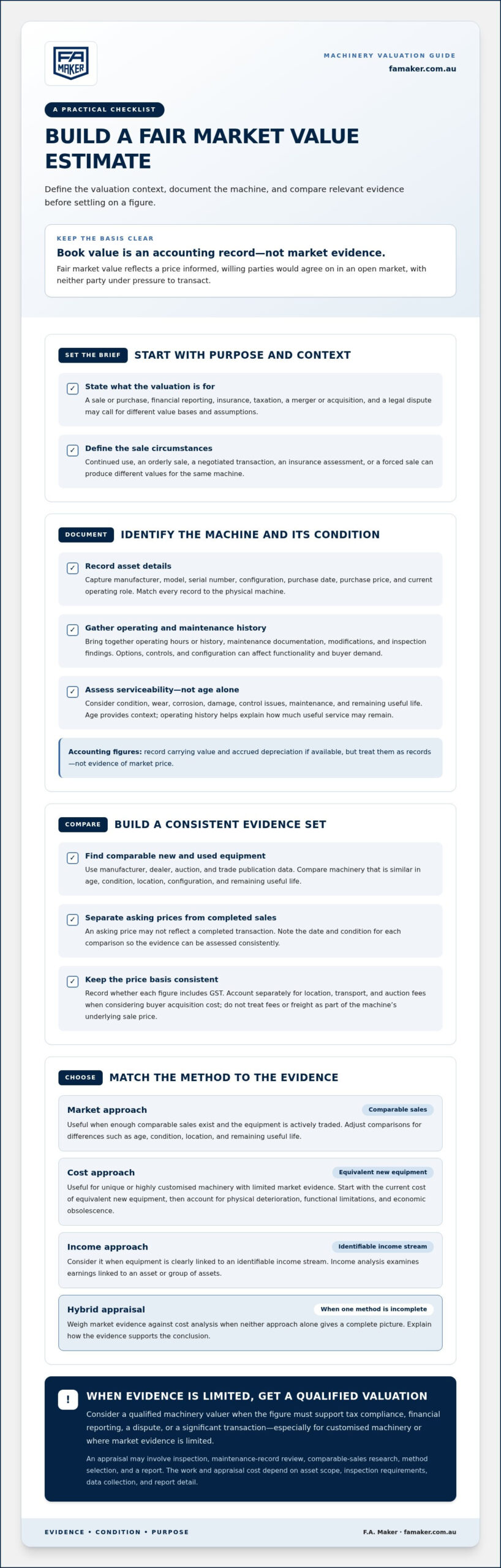
A valuation approach provides a framework for estimating value from market evidence, replacement cost or expected income. The market approach compares similar machinery sales. The cost approach starts with equivalent new equipment and adjusts for depreciation and obsolescence. The income approach analyses earnings linked to an asset or group of assets. A hybrid appraisal can weigh market evidence against cost analysis when neither alone gives a complete picture.
For example, comparable sales may anchor the estimate for a standard pump, while replacement cost can help assess a customised processing line. Income analysis is more relevant when equipment is clearly linked to an identifiable income stream. Combining approaches shows how the evidence supports the conclusion, rather than presenting a single figure without context.
Plant, machinery and equipment valuation provides an independent estimate for a specific business or financial decision. It can support sales and purchases, financial reporting, insurance, taxation, mergers and acquisitions, and legal disputes. The purpose matters because the required value basis and assumptions can differ between a negotiated sale and an insurance assessment.
A valuation can also inform liquidation, sales negotiations and investment analysis. For Australian tax compliance, the methodology should suit industry practice, available data and market circumstances. A professional appraisal may involve inspecting equipment, reviewing maintenance records, gathering comparable sales data, selecting a method and preparing a report. Each step ties the estimate to the asset’s condition and intended use.
The market approach is generally useful when comparable machinery sales provide enough evidence to assess demand and likely transaction prices. It suits equipment that is actively traded. Comparisons should account for differences in age, condition, location and remaining useful life, because an asking price may not reflect a completed sale.
The cost approach is more useful for unique or highly customised machinery with limited market evidence. It starts with the current cost of equivalent new equipment, then accounts for physical deterioration, functional limitations and economic obsolescence. When market data is scarce, an appraiser can compare the cost-based result with available sales evidence and explain the weighting. The valuation’s purpose also guides the choice.
A preliminary DIY assessment can help organise evidence before a sale or purchase discussion. Record the machine’s make, model, age, configuration, operating history, condition, maintenance documentation and modifications. Then compare similar new and used equipment using manufacturer, dealer, auction and trade publication data. Distinguish asking prices from completed sales, and note the date and condition of each comparison.
For comparable prices, keep the basis consistent. Record whether each figure includes GST, then account separately for location, transport and auction fees when assessing the buyer’s total acquisition cost. Don’t treat fees or freight as part of the machine’s underlying sale price.
Engage a qualified machinery valuer when the figure must support tax compliance, financial reporting, a dispute or a significant transaction, especially if the machinery is customised or market evidence is limited. Appraisal costs depend on the asset scope, inspection requirements, data collection and report detail; a quote should reflect that work.
Start by identifying the asset, its condition and the intended sale context, then compare relevant evidence. Fair market value reflects a price agreed by informed, willing parties who aren’t under pressure to transact.
Asset identification records what the machine is and which characteristics distinguish it from comparable equipment. Capture its manufacturer, model, serial number, configuration, purchase date, purchase price and current operating role. Include the balance-sheet carrying value and accrued depreciation if available, but treat accounting figures as records, not market evidence.
Match each record to the physical machine before valuing it. A model designation alone may miss options, control systems or modifications that affect functionality and buyer demand. When determining fair market value for used machinery, organise maintenance records and operating history alongside inspection findings. This provides a consistent basis for comparison.
Age provides context, but operating history and condition indicate how much useful service may remain. A lightly used standby generator can have a lower effective age than a newer machine with intensive operating hours. Inspect for wear, corrosion, damage, control issues and signs of maintenance. Missing records make it harder to distinguish a well-maintained machine from one with hidden deterioration.
Functionality and demand also influence saleability. Equipment that performs its intended process efficiently may attract more buyers than a machine requiring substantial modification. Technological obsolescence can reduce value even when equipment still operates, particularly if replacement parts or compatible controls are difficult to source. Compare the machine with assets of similar capacity and configuration, not just similar age.
The income approach estimates value from future earnings, but those earnings can be difficult to isolate for an individual machine. A production line’s output may depend on several machines, labour, materials, maintenance and sales conditions. Assigning a precise share of business income to one asset can therefore produce an unsupported estimate.
For an individual asset, the market approach is generally more useful when comparable sale evidence exists. It tests the machine against actual market demand and similar transactions. Income analysis may be more relevant when equipment is clearly linked to a distinct income stream, but projected business revenue is not a direct measure of standalone equipment value.
Liens, undisclosed defects and obsolete parts can distort an estimate if their effect on transferability, condition or buyer costs is overlooked. A lien may affect the seller’s ability to transfer an asset free of an encumbrance. Mechanical defects can reduce performance, while unavailable parts can increase downtime or repair requirements.
Check inspection findings against maintenance records and the machine’s stated configuration. Compare asking prices cautiously: listings may differ from completed transactions, and asking prices can be 10-15% higher than final prices. Record whether each comparison is an asking or sale price, and account separately for transport, location, GST and auction fees. For equipment purchases involving a move, planning machinery requirements can help connect valuation assumptions with operational needs.
The cost approach estimates machinery value from the cost of equivalent new equipment, adjusted for depreciation and obsolescence. It is especially useful when comparable sales are scarce, as with unique or highly customised assets.
Replacement cost new is the current cost of buying a new asset that performs the same function as the existing machine. It need not be an identical model; the replacement must provide equivalent utility. This distinction matters when manufacturers have changed designs or discontinued older machinery.
Reproduction cost new instead estimates the current cost of constructing a duplicate. The distinction matters for specialised equipment: a functional equivalent may be easier to source than an exact replica. For reporting or transactions, the selected basis should match the valuation purpose and clearly state what is being replaced.
The cost approach adjusts the relevant new-equipment cost for physical deterioration, functional obsolescence and economic obsolescence. Physical deterioration reflects wear and damage. Functional obsolescence arises when design limits performance or efficiency. Economic obsolescence reflects external conditions that reduce the asset’s usefulness or demand. Each adjustment accounts for a different reason the used machine may be worth less than new equipment.
In a cost-based valuation, depreciation represents lost utility, not simply an accounting charge. The estimate considers age, condition, maintenance, remaining useful life and obsolescence. A machine with wear concentrated in replaceable components may retain more utility than one with outdated controls or structural deterioration.
Actual cash value is replacement cost new minus depreciation based on the equipment’s remaining useful life. This measure can be relevant to insurance, although a policy may instead use replacement cost new or reproduction cost new. The applicable basis depends on the policy wording, so the report should identify the chosen definition rather than treat these terms as interchangeable.
Useful-life assessment should reflect the machine’s operating role and condition, not age alone. Maintenance records, inspection findings and known limitations help explain depreciation adjustments. If the machine has been upgraded, assess whether the upgrades restore function or merely postpone deterioration. This ties the estimate to current utility instead of assuming every year of age causes the same loss.
For a unique asset with little market evidence, the cost method offers a structured basis for analysis, but replacement cost is not automatically its sale price. Buyers may discount equipment that needs installation, has limited demand or cannot meet current production requirements. A sound valuation explains the replacement basis, each depreciation adjustment and the assumptions behind the result.
Equipment value depends on the valuation basis, intended use and transaction assumptions. Fair market value, market value and accounting fair value are related concepts, but they aren’t interchangeable. Naming the required basis helps buyers, sellers and finance teams understand what a reported figure represents.
Fair market value estimates the price an asset would bring between informed, willing parties, neither under compulsion. Market value similarly assumes a competitive, open market, with prudent parties acting knowledgeably and without undue pressure. These assumptions describe a reasonable transaction, not necessarily the amount achieved in a rushed sale or a negotiation involving unusual conditions.
Under IFRS 13, fair value is the price received to sell an asset, or paid to transfer a liability, in an orderly transaction between market participants at the measurement date. For non-financial assets, IFRS 13 requires fair value to reflect the asset’s highest and best use from market participants’ perspective. This basis is relevant to financial reporting, mergers and acquisitions, and impairment-loss assessments.
Other definitions can change the calculation. Fair market value installed includes the equipment’s fair market value plus installation and assembly costs needed to make it operational. Orderly liquidation value assumes reasonable time to find a buyer, while forced liquidation value estimates gross proceeds from an immediate auction. These bases reflect different sale conditions, so they shouldn’t replace ordinary market value without a clear reason.
For Australian income tax purposes, the ordinary meaning of market value applies unless a statutory provision specially defines or qualifies it. Subsection 995-1(1) of the Income Tax Assessment Act 1997 doesn’t define market value for every context. Specific examples include former Subdivision F of Division 13A of the Income Tax Assessment Act 1936 for employee share schemes, and subsection 10(1) of the Superannuation Industry (Supervision) Act 1993 for superannuation. The applicable context therefore matters.
For Australian tax valuations, the method should fit industry standards and practice, available evidence and market circumstances. According to the ATO, APES 225 Valuation Services and RICS Valuation – Global Standards are references relevant to valuation standards. A sufficiently qualified and experienced plant and machinery valuer should select the relevant methodology. In financial reporting, document the measurement date, asset condition, market assumptions and selected value definition. That record helps readers understand how the estimate was calculated and whether it answers the decision at hand.
A valuation is shaped by its assumed transaction, market participants and asset use. For machinery, a fair value estimate can change when the purpose shifts from continued manufacturing use to liquidation. State these assumptions before comparing figures, or a buyer and seller may interpret the same estimate differently.
Market value assumes a willing buyer and seller are well-informed, act prudently and face no undue pressure. Fair value also assumes a hypothetical transaction between willing parties, neither compelled to act. These assumptions remove unusual urgency or personal attachment from the analysis. They don’t mean every buyer will pay the estimate; they define the conditions used to develop it.
Asking prices need a separate assumption. Used machinery listings may be 10-15% higher than final transaction prices, so an asking figure is not equivalent to evidence of a completed sale. Compare like with like: note whether the price relates to an actual transaction, and assess the machine’s condition, configuration and market demand before drawing a conclusion.
Continued-use assumptions matter in manufacturing. Fair market value in continued use includes installed fair market value, plus any adjustment for the equipment’s income-generating potential. A machine installed in a functioning production line may have a different use context from the same asset removed and offered separately. Identify whether installation and operational contribution belong in the valuation basis.
Liquidation changes the assumed sale conditions. Orderly liquidation value allows reasonable time to find a purchaser, while forced liquidation value reflects an immediate auction. Estimates describe orderly liquidation value as usually 10-20% below fair market value, and forced liquidation value as 30-50% below. These are distinct bases, not automatic discounts to apply to every purchase or sale.
For financial reporting, IFRS fair value focuses on an orderly transaction between market participants at the measurement date. The valuation technique should maximise observable inputs and minimise unobservable inputs. In practice, this means giving more weight to reliable comparable sales than unsupported forecasts, then documenting adjustments for the asset’s condition, location and use.
The practical takeaway is to write down the assumed buyer, seller, sale conditions, measurement date and intended use before selecting a figure. For a purchase involving a used bottle filler, compare bottle fillers with your production requirements and keep the operating assumptions explicit.
F.A. Maker can help buyers assess used stainless steel tanks against their process requirements and valuation assumptions. Its range also includes centrifuges and separators, industrial mixers and blenders, and pumps and valves. These equipment categories serve different production functions, so compare capacity, configuration, condition and intended use rather than relying on broad category prices.
Turn to F.A. Maker when your valuation research has clarified the type of equipment you need and you’re assessing suitable used machinery for purchase. Matching a machine’s role to your operating requirements helps keep the decision grounded in practical fit as well as value.
To discuss used process equipment, contact F.A. Maker or visit famaker.com.au.
A useful valuation should inform a decision, not sit apart from it. Before committing to a sale or purchase, turn the assumptions into a brief: identify the machine’s role, the condition you’re prepared to accept and the operational requirements it must meet. This connects determining fair market value for used machinery with the equipment’s actual place in your production process.
If you’re sourcing process equipment, F.A. Maker offers used stainless steel tanks, centrifuges and separators, and industrial mixers and blenders. Compare these categories with your requirements to focus your search on machinery that fits the intended application, rather than on a valuation figure alone.
For a discussion about machinery valuation and relevant equipment, contact F.A. Maker about machinery valuation. A clear brief gives the conversation a practical starting point and helps you move forward with greater confidence.
Professionals define the valuation’s purpose, inspect the equipment and analyse relevant evidence. They may review maintenance records, operating information, specifications and comparable transactions, then choose a method suited to the asset and available data. For example, a customised production machine may require cost analysis alongside limited market evidence. The report should explain its assumptions and measurement date so readers can interpret the estimate correctly.
For machinery owners considering a sale, F.A. Maker offers an appraisal as part of its equipment-selling options. Provide clear asset identification and available records, such as the make, model, configuration and maintenance history. F.A. Maker also sells used industrial equipment, including stainless steel tanks, centrifuges and separators, and industrial mixers and blenders. This connects a seller’s valuation question with a practical equipment transaction.
Market value estimates the price an asset could achieve in a competitive, open market under fair-sale conditions. The assumed buyer and seller are informed, prudent and not under undue pressure. For a used machine, the estimate should reflect its actual configuration and sale context. A listing price alone doesn’t establish market value, since it may differ from the price agreed in a completed transaction.
In Australia, fair market value for used machinery generally reflects the amount informed, willing parties would agree on, with neither compelled to transact. The applicable definition can depend on the purpose and any relevant statutory provision. For income tax, the ordinary market-value meaning applies unless a particular provision defines or qualifies it. State the valuation purpose and measurement date so the estimate is interpreted in context.
Common methods are the market, cost and income approaches, sometimes considered together when evidence is incomplete. The market approach suits machinery with useful comparable sales; the cost approach can help assess specialised assets without an active market. Income analysis is more relevant when earnings can be clearly linked to an asset or group of assets. The selected method should suit the valuation purpose and evidence available in Australia.
Useful evidence may come from completed auction results, machinery dealers, manufacturers and trade publications. Focus on actual sale prices where available, rather than treating advertised prices as confirmed transaction evidence. Record each comparison’s model, configuration, condition, location and sale circumstances. For a specialised machine, broaden the search to equipment performing the same function, then explain adjustments for material differences instead of relying on a single listing.
Age is only one indicator of wear. Operating hours, workload, maintenance quality and inspection findings help show the machine’s effective condition and remaining service potential. A high-hour machine with consistent servicing may compare differently from one with fewer hours but neglected maintenance. Records also help substantiate repairs and component changes. Buyers may discount uncertain condition because unresolved faults or missing history make future operating costs harder to assess.
Fair market value assumes a normal transaction between willing, informed parties. Orderly liquidation value estimates gross proceeds where there is reasonable time to find a purchaser; it is usually 10-20% below fair market value. Forced liquidation value reflects the circumstances of an immediate sale rather than a normal transaction. These are distinct valuation bases, not automatic discounts. Choose the one matching the sale conditions being assessed.