

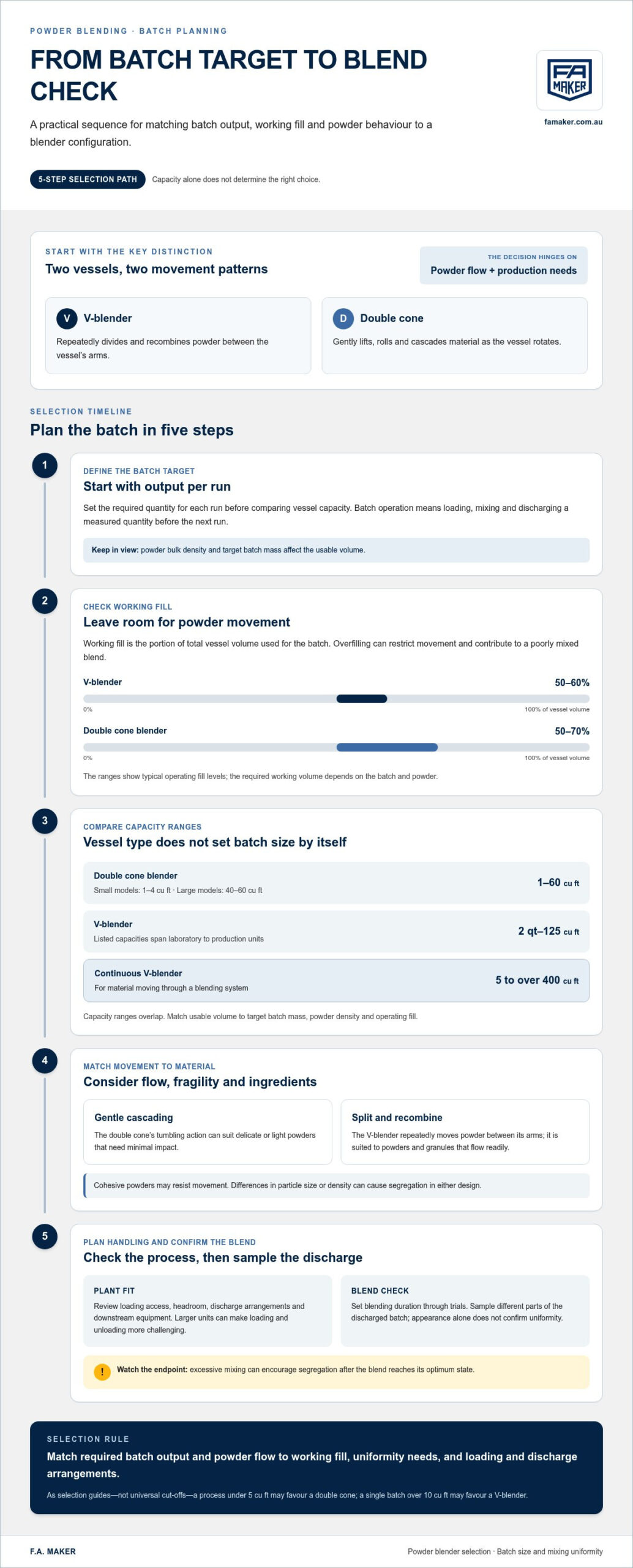
The more complex-looking blender isn’t automatically the better choice. In the double cone blender vs V-blender comparison, the deciding factor is how each vessel moves the powder: a V-blender repeatedly separates and recombines material, while a double cone blender gently lifts and cascades it. A V-blender is typically filled to 50-60% of its total volume, compared with 50%-70% for a double cone blender.
Both designs use tumbling motion, but their differences go beyond the shape of the machine. Material flow, batch size, required uniformity, and loading and discharge arrangements all matter when choosing equipment for an Australian processing operation. This comparison explains how each design works, how its mixing action affects powder behaviour, and what to consider when assessing blending time and handling. Use it to decide which configuration better suits your material and production requirements.
Vessel capacity and working batch size are different measures. A V-blender is generally operated at a fill level of 50-60% of total vessel volume, leaving space for powder to move between its arms. Overfilling can restrict that movement and produce a poorly mixed blend. A double cone blender is usually filled to 50%-70% of its volume, allowing the material to tumble as the vessel rotates.
Typical double cone blender capacities range from 1 to 60 cubic feet. Small models commonly hold 1-4 cubic feet, while large models typically hold 40-60 cubic feet. V-blenders span laboratory models to production units, with listed capacities from 2 qt to 125 cu ft. Those ranges overlap, so vessel type alone doesn’t determine batch size. Powder density, target batch mass and the required operating fill all affect the usable volume.
Uniformity depends on movement, not capacity alone. A V-blender repeatedly divides and recombines flowing powder, while a double cone blender lifts and cascades it. Both actions can produce a homogeneous mixture when ingredients flow freely. Differences in particle size or density can still lead to segregation in either design. For a new formulation, sample different parts of the discharged batch rather than judging uniformity by appearance alone.
Batch operation suits production that needs a measured quantity of ingredients loaded, mixed and discharged before the next run. Continuous V-blender configurations are also described, with capacities from 5 cubic feet to over 400 cubic feet. Continuous equipment serves a different process requirement: material moves through the blending system rather than being handled as one discrete batch. Match the operating mode to the production flow and downstream equipment.
Custom batch sizing starts with the required output per run, then accounts for the blender’s working fill and the powder’s bulk density. For example, a small-batch process under 5 cubic feet may favour a double cone blender, while a single batch over 10 cubic feet may favour a V-blender. These are selection guides, not universal cut-offs. A V-blender may be less practical at very small or very large batch sizes, and larger units can make loading and unloading more challenging.
| Option | Typical capacity | Working fill | Batch considerations |
|---|---|---|---|
| Double cone blender | 1-60 cubic feet | 50%-70% | Broad batch range; straightforward loading and unloading |
| V-blender | 2 qt-125 cu ft | 50-60% | Allow space for powder movement; large units may be harder to handle |
| Continuous V-blender | 5 to over 400 cubic feet | Process-dependent | Consider for continuous material flow |
Choose a blender by matching the required batch output and powder flow with the working fill, uniformity requirements, and loading and discharge arrangements.
In Australia, assess industrial powder blenders against workplace safety controls and process hygiene requirements, including guarding, dust management, and cleanability. Uneven flow, differences in particle size or density, or excessive mixing can lead to poor blending or segregation.
A double cone blender has two cone-shaped chambers joined at their wide ends and rotates around a central shaft. As the vessel turns, powders roll, drop, and move between the cones. This tumbling action relies on gravity, rather than the V-blender’s repeated split-and-recombine movement. The open cone geometry provides gentle mixing, which can suit fragile materials that need minimal impact during operation.
A V-blender uses two cylindrical sections joined at an angle to form a V-shaped vessel. During rotation, the vessel divides powders between its arms, then brings them together again. This repeated separation and recombination creates a different movement pattern from the double cone’s cascading action. The V-shaped chamber uses gravity without internal agitators, making it suited to powders and granules that flow readily.
The key difference is how material travels through each vessel. A double cone lifts and cascades the mixture, providing gentle tumbling for delicate or light powders. A V-blender repeatedly divides and recombines ingredients, promoting movement between its arms. Both designs can handle fragile substances, but material behaviour matters: free-flowing particles move more readily, while cohesive powders can resist uniform movement. Match the vessel’s action to the product’s fragility and flow characteristics.
Neither vessel shape prevents segregation on its own. Powders with different particle sizes or densities may separate during mixing or after discharge, even when the initial blend looks homogeneous. In a V-blender, cohesive material may not move effectively between the arms; in either design, poor flow can leave parts of the mixture unevenly blended. Assess ingredient characteristics and sample the finished blend to evaluate uniformity. Excessive mixing can also increase segregation after the blend reaches its optimum state.
For Australian processing operations comparing vessel designs, review industrial mixing equipment alongside the material’s movement and handling requirements.
A double cone blender has two cone-shaped sections joined at their wide ends, forming a chamber that rotates on a central shaft. Its tapered ends guide powder towards the centre and back as the vessel turns. This compact arrangement supports gentle handling, and the interior has few corners or tight spaces. That geometry can simplify cleaning compared with a V-shaped chamber, where powder may collect at the arm junctions.
A V-blender consists of two cylindrical shells connected at an angle. Each arm has an access cover for loading, inspection, and cleaning. During operation, rotation carries the ingredients through the arms, with gravity driving their movement. The angled junction creates a distinct flow path, but also needs attention during cleaning. The design requires more headroom than a double cone blender, which can affect placement in a processing room.
Both designs suit free-flowing powders and granules. A V-blender can be efficient when repeated separation and recombination help distribute ingredients. A double cone blender is a practical option when gentle tumbling is a priority, including for fragile material. The better fit depends on flowability, sensitivity to handling, required uniformity, and batch size. Pharmaceutical powders, for example, can be processed in either design, depending on formulation needs.
Material behaviour helps distinguish the options beyond vessel geometry. V-blenders work effectively with free-flowing powders, but cohesion can hinder movement between the arms. They may also be less suitable when ingredients have substantial particle-size differences. Double cone blenders can handle free-flowing powders and materials with varying particle sizes; their tumbling action also suits delicate products. Sticky or wet materials can adhere to a double cone’s inner walls and mix poorly, so compatibility with dry materials remains a key selection point.
Plan operation around access and cleaning as well as the mixing cycle. A V-blender’s separate arm covers provide access for inspection and cleaning, though its junctions need careful attention. A double cone blender’s single access cover provides a straightforward entry point, and its smooth interior can reduce hard-to-reach areas. Confirm that the blender’s position allows safe loading, inspection, and discharge within the plant layout. For a pharmaceutical formulation, assess powder flow and fragility before choosing a vessel, then evaluate the resulting blend for uniformity.
In practical terms, choose a V-blender when free-flowing ingredients benefit from movement between two arms. Choose a double cone blender when gentle tumbling, accessible cleaning, or varied particle sizes matter more. The vessel should suit both the material and the way operators will load, inspect, and clean it.
Both designs use rotation to move powder, but their operating times vary with material and batch size. V-blender batches can take from 5 minutes to over an hour; a typical V-Cone batch reaches target homogeneity in 5 to 15 minutes. Double cone mixing can take several minutes to over an hour. Uniformity depends on the formulation and mixing conditions, not simply the machine’s rotation time.
Load ingredients in their required proportions before starting either machine. A double cone blender is usually filled to 50%-70% of total volume, while a V-blender’s optimal fill is 50-60%. These working levels leave room for powder movement. Overfilling a V-blender can prevent material from travelling between its arms, impairing the blend. During loading, an even distribution of ingredients supports the intended mixing action.
Rotation speed and blending time can be adjusted to achieve the required homogeneity. V-blender speeds vary from 5 to 40 RPM, depending on the application. Use the material’s flow behaviour and blend uniformity as process considerations, rather than assuming that a longer cycle improves results. Excessive mixing can increase segregation after the powder reaches its optimum blend state. Establish the cycle through testing and assess samples at discharge.
Blending-stage descriptions distinguish the designs: V-blenders use a single blending stage, while double cone blenders use two. After blending, material exits from the bottom of the vessel. V-blenders have bottom discharge valves, and double cone blenders also discharge through a bottom outlet. Plan the receiving container or downstream equipment around the outlet position, especially when the mixture feeds a chemical process or bottle-filling line.
Cleaning and changeover involve different access points. A double cone blender has one access cover, and its interior has few corners or tight spots. This shape can make inspection and cleaning more straightforward. Each V-blender arm has its own access cover for loading, inspection, and cleaning. Powder can collect where the arms join, so pay particular attention to that junction during cleaning to reduce residue and contamination between applications.
For a controlled changeover, discharge the batch fully, inspect accessible surfaces, then clean the vessel and outlet before loading the next ingredients. Pay particular attention to the V-blender’s junction and discharge valves; the double cone’s cover and bottom outlet are key inspection points. Record the selected speed, cycle duration, and discharge sampling results for each formulation. These operating records help reproduce a uniform mixture in later batches.
A double cone blender gently cascades material through its rotating vessel; a V-blender repeatedly divides and recombines it. This difference in motion affects powder flow, the handling of delicate ingredients, and how operators assess a formulation.
As a double cone rotates, powder lifts along the vessel wall before falling towards its centre. Each turn shifts material between the two conical ends, creating gentle tumbling rather than a sharp split between separate arms. This movement can suit fragile products that need limited impact. For example, delicate granules may benefit from gradual cascading rather than repeated division and recombination.
A V-blender’s two arms repeatedly separate and recombine the powder as the vessel rotates. This creates intersecting movement paths through the ingredients, supporting distribution when particles flow freely. V-blender agitator speeds vary from 5 to 40 RPM, depending on the application. Unlike the double cone’s cascading path, the V shape makes the split-and-combine action central to its mixing operation.
Neither motion guarantees a consistent blend for every formulation. Particle size, density, and flow behaviour influence how ingredients travel through the vessel. Free-flowing powder can move between V-blender arms, while cohesive material may resist that movement. In a double cone, powder must cascade readily to circulate between the ends. Material that moves poorly can leave uneven concentrations in either machine.
Mixing intensity also matters for fragile materials. A double cone’s gentle tumbling can help limit impact on delicate granules, while a V-blender’s repeated division creates a different pattern of particle movement. Both designs are used in pharmaceutical, chemical, and nutraceutical industries. To assess a formulation, compare samples from different discharge points and check whether the mixture achieves the required uniformity. Excessive mixing can encourage segregation after the optimum blend state.
The practical takeaway is to match motion to material: choose cascading for gentle handling, or split-and-recombine movement for free-flowing ingredients. The V-blender’s movement pattern is not automatically more efficient; flow characteristics determine whether it can distribute each ingredient consistently. To compare equipment suited to your process, review industrial mixers and blenders.
A V-blender uses two connected cylinders to divide and recombine particle movement during blending. Its connected form defines the route that material follows, while the double cone uses a different path: materials cascade between its cones as the central shaft rotates. These features distinguish the vessels by how they direct movement, rather than treating their mixing actions as identical.
Both double cone blenders and V-blenders split their contents each time the vessel is inverted. Their rotation speed can be adjusted so contents slide towards the lower part of the vessel during rotation. Considering vessel shape alongside this adjustable movement helps clarify which blending action suits a material.
F.A. Maker supplies industrial mixers and blenders for processing operations comparing double cone and V-blender designs. The choice depends on powder flow, fragility, batch requirements, and how the equipment fits the wider production line. Consider the blender alongside related process equipment, such as stainless steel tanks for storage or pumps and valves for material transfer. F.A. Maker also offers centrifuges and separators for other separation stages in processing.
Turn to F.A. Maker when sourcing used stainless steel tanks or industrial processing equipment to support your operation. The range can help you assess equipment needs across connected process stages, without treating the blender as an isolated purchase. Visit famaker.com.au to discuss your equipment requirements.
Use the double cone blender vs V-blender comparison as a starting point for a broader process review. Define the product-handling requirements, production workflow, and equipment connections that will shape your purchase decision. A blender must fit its place in the line, from ingredient preparation through to storage and separation.
F.A. Maker offers Industrial Mixers and Blenders, Used Stainless Steel Tanks, and Centrifuges and Separators. Consider these equipment categories alongside your blending requirements when planning or updating a processing operation. The next step is to outline the material and workflow needs for your application.
Contact F.A. Maker about your blending needs and take the next step with a clear equipment plan.
A V-blender’s repeated division and recombination can distribute free-flowing ingredients effectively. Its gravity-driven action uses no internal agitators, keeping the mixing mechanism straightforward. This can suit dry formulations that need repeated redistribution through the vessel. For example, a process combining several free-flowing powder components can benefit from movement through both arms. Performance still depends on how readily each ingredient flows.
V-blenders can struggle when cohesive powders do not move readily between the arms. Differences in particle size or density can also contribute to segregation, even after blending. An unsuitable fill level can restrict the movement needed for mixing. The arm junction may need extra attention during cleaning, and larger machines can be more challenging to load and unload. Consider these constraints when assessing a formulation and its production workflow.
The main performance difference is powder movement: a double cone tumbles and cascades material, while a V-blender repeatedly separates and recombines it. The best fit depends on how the formulation responds to each motion. Compare trial blends using samples from several discharge points, then assess ingredient distribution. This practical test helps determine whether the selected machine achieves consistent results for the powder combination.
Double cone blender capacities are listed from 2 qt to 100 cu ft, with typical models ranging from 1 to 60 cubic feet. V-blender capacities range from 2 qt bench-top configurations to 125 cu ft. These are vessel capacity ranges, not guaranteed working batch volumes. Account for the required fill level and powder bulk density when translating vessel volume into a production batch quantity.
Both designs are used in pharmaceutical and food production, with selection guided by formulation flow, fragility, and batch needs. A double cone’s gentle tumbling can suit delicate powders, while a V-blender’s movement can work well with free-flowing ingredients. Cohesive material may move poorly in a V-blender; wet or sticky material can adhere inside a double cone. Assess product handling and cleanability for each process.