

Higher throughput does not have to mean a wider particle-size distribution. The right equipment for scaling up production helps control the variables that affect particle size, including screen configuration, impeller design, tip speed, feed rate, and material characteristics. Assess these together, then validate the process as it moves from laboratory or pilot scale to production.
Choosing a larger machine based on capacity alone can overlook how the material responds to changes in mixing, milling, and flow. Consistency depends on the whole process: how equipment works together and whether the site can support the required layout and operation.
This article explains how to assess production systems and resources before expansion, compare equipment and mixer options, and evaluate flow components and space requirements. Use this framework to identify constraints, preserve process knowledge, and plan a scale-up that meets your throughput target and product requirements.
Start by mapping the process from incoming materials to finished product. Record each operation, its current constraints, and where particle size is measured. For example, a milling line may meet its target until the feed rate rises, then produce a wider distribution. This baseline helps locate the constraint: in the mill, material feed, or a later process.
Consider scalability during concept development and manage it through new product introduction. For an existing line, compare current demand with realistic forecasts, then assess whether equipment, labour, materials, storage, and logistics can support the required production scale. Moving from laboratory or pilot scale to commercial production requires validation at each stage, not just a larger machine.
What production equipment is best for small and medium-sized Australian manufacturers? There is no single best machine. The right choice depends on the product, process, required output, and particle-size target. Match equipment to those conditions, then assess how it fits existing operations and available space.
Optimise the process before adding capacity. Review changeover time, cleaning, scheduling, material handling, and recurring bottlenecks. If a mixer sits idle while staff wait for material transfer, improving the transfer sequence may free capacity without replacing the mixer. Document standard operating procedures so each shift follows the same sequence and settings, helping maintain product quality as output increases.
Managing resources means planning people and supply alongside machinery. Identify which operators need training, whether maintenance tasks compete with production time, and whether suppliers can support higher material volumes. Material requirements planning, economic order quantity, and just-in-time inventory are approaches for managing stock; the suitable method depends on demand patterns and supply reliability. Keep at least 3-6 months of working capital to absorb increased operational costs when preparing to scale.
What Australian safety standards and regulations apply to production equipment? Requirements depend on the equipment hazards, workplace, and state or territory. Assess risks such as moving parts, cleaning access, and isolation during maintenance, then apply the relevant workplace safety requirements to the installation.
What permits, electrical requirements, or workplace approvals are needed to install production equipment in Australia? Before installation, assess the site’s electrical capacity, equipment connections, floor loading, access, and any effect on the building layout. Planning or building approvals and electrical work requirements depend on the site and proposed changes.
What are the installation, maintenance, training, and operating costs of production equipment? Build an estimate that includes installation work, utilities, consumables, planned maintenance, operator training, and downtime. Key cost drivers include equipment complexity, site modifications, operating hours, and the maintenance regime.
What risks should I consider when automating or expanding production? Poor planning can divert resources from other lines, delay deliveries, increase cash burn, or affect quality. Also assess staff training, supply-chain capacity, and the risk of producing stock that demand cannot absorb.
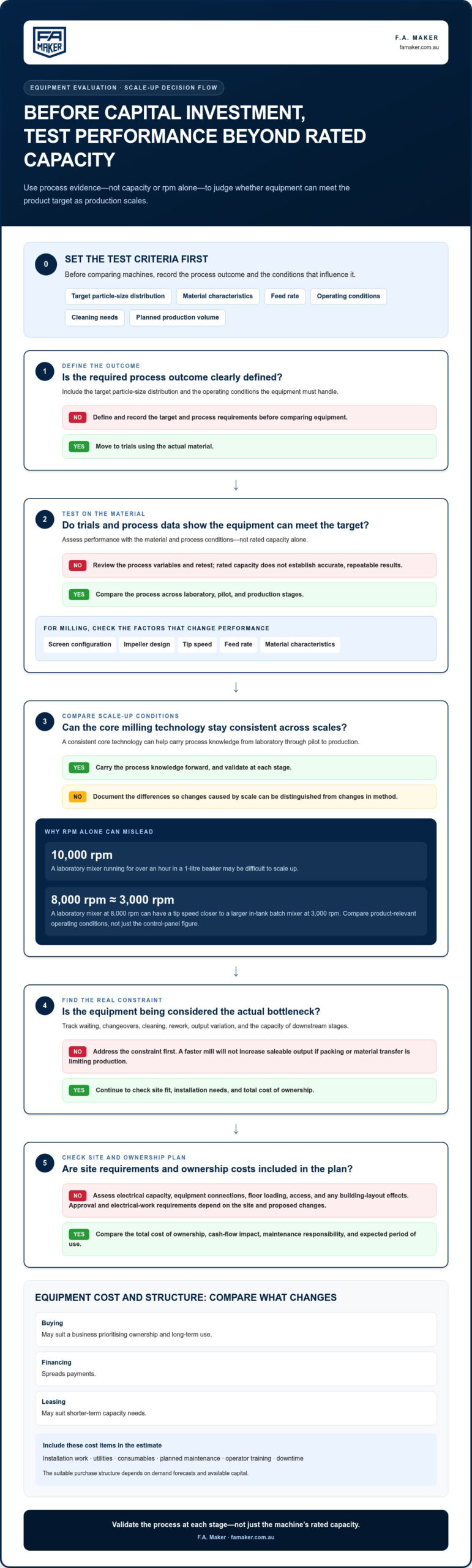
Before committing capital, define the process outcome the equipment must achieve. Record the target particle-size distribution, material characteristics, feed rate, operating conditions, cleaning needs, and planned production volume. Compare those requirements with equipment performance at laboratory, pilot, and production stages. Rated capacity alone does not show whether a machine can deliver accurate, repeatable results.
Use trials and process data to test how equipment handles the actual material. Milling performance can change with screen configuration, impeller design, tip speed, feed rate, and material characteristics. Where practical, keep the core milling technology consistent from laboratory through pilot and production stages. This helps teams carry process knowledge forward and identify differences caused by scale rather than a changed method.
A laboratory mixer running at 10,000 rpm for over an hour in a 1-litre beaker may be difficult to scale up. Rotational speed alone can mislead: a laboratory mixer running at 8,000 rpm can have a tip speed closer to a larger in-tank batch mixer running at 3,000 rpm. Compare the operating conditions that affect the product, not just the figures displayed on the control panel.
Should I buy, lease, or finance production equipment in Australia? Compare the total cost of ownership, cash-flow impact, maintenance responsibility, and expected period of use. Buying suits businesses that prioritise ownership and long-term use; financing spreads payments, while leasing may suit shorter-term capacity needs. The right structure depends on demand forecasts and available capital.
How do I identify production bottlenecks before buying equipment? Track each production stage, including waiting, changeovers, cleaning, rework, and output variation. Compare the time required at each stage with downstream capacity. A faster mill will not increase saleable output if packing or material transfer remains the constraint. Record particle-size results alongside operating conditions to locate quality losses.
Before upgrading machinery, prepare a process plan, timeline, budget, and obstacle register. Include installation work, staff training, maintenance access, utilities, and production interruptions. Research the machinery and identify safety hazards, including moving parts and cleaning access. These checks help uncover costs and risks beyond the purchase decision.
What Australian grants or tax incentives are available for manufacturing equipment investment? Eligibility depends on current Australian, state, or territory programs and their rules for business size, equipment use, and project purpose. Assess eligible support separately from the investment case, and base the production decision on demand, operating requirements, and product quality.
For process-specific planning, compare equipment requirements with the product and production method; for example, dairy processing equipment must fit the intended process and throughput.
A production line can lose consistency between its main machine and supporting equipment. Trace the material path from the source vessel through each hose, pipe, pump, and receiving vessel. Mark every transfer, change of direction, hold point, and return line. This map can reveal where material may settle, separate, warm, cool, or remain trapped.
Start with the vessel’s role in the process. A feed vessel must supply the machine steadily, while a receiving vessel must accept the batch without interrupting discharge. Compare usable volume with batch size, headspace needs, agitation requirements, and transfer timing. For example, if the receiving vessel is still occupied at the next discharge, the line may have to pause even when the main machine has spare capacity.
Choose pumps based on the material and transfer duty. Review viscosity, solids content, sensitivity to shear, required flow, suction conditions, and discharge pressure. A pump that handles a thin liquid may not suit a viscous mixture or particle-containing slurry. Excessive shear may alter a sensitive product, while inadequate flow can lengthen transfer and disrupt the next operation. Match the pump to the full duty, not just the connection size.
Hoses and pipes also affect how reliably a line handles increased volumes. Check internal diameter, length, bends, elevation changes, connection points, and the route operators use for cleaning or changeovers. A narrow or sharply routed section can restrict flow, while a long line can increase retained product and cleaning demands. Keep connections accessible, support pipework appropriately, and avoid unnecessary branches where material can collect.
Set a transfer sequence operators can repeat. Document which vessel feeds each machine, the pump settings for the material, and the order for opening and closing valves. Include checks for leaks, blockages, unusual vibration, and incomplete drainage in routine inspections. Records of transfer time and batch variation can help distinguish a pump problem from inconsistent upstream mixing.
For a line handling multiple products, assess compatibility and changeover requirements. A hose suited to one product may need different cleaning or handling for another. Identify dedicated and shared lines, then specify how operators will prevent mix-ups. Confirm that every vessel, valve, and pump can be isolated for maintenance without creating an uncontrolled product route.
Finally, test the complete transfer path under representative operating conditions. Observe machine feed and discharge, check whether material remains at low points, and compare product samples before and after transfer. This system-level assessment helps determine whether additional pumps and valves or revised pipework will support the intended throughput and particle-size consistency.
An in-tank mixer works inside a vessel, while an in-line mixer processes material as it passes through a pipe. The choice affects batch handling, production flow, cleaning, and operator control. Compare both arrangements with the process sequence, not just the mixer’s rated capacity.
For batch production, an in-tank mixer can suit processes that require a defined mixing period before discharge. Vessel geometry, fill level, impeller design, and material properties all influence circulation and mixing. For example, a partly filled vessel may not develop the same flow pattern as a full production batch. Document the working volume and mixing sequence for each product.
An in-line mixer can suit a continuous process or a line that feeds material directly between operations. It can reduce reliance on a separate mixing stage, but needs a suitable feed and stable flow through the mixing head. Review pump performance, pipework, pressure, and downstream capacity together. If flow varies, the mixer’s operating conditions can vary too.
Particle-size consistency depends on how the material responds to mixing. Agitation, shear, temperature, viscosity, and addition order can affect dispersion or agglomeration. Establish a repeatable test using the same material, feed conditions, mixing sequence, and particle-size measurement method. Compare samples taken at consistent process points, such as after mixing and after transfer.
For a scale-up, record impeller type, rotational speed, tip speed, vessel geometry, batch volume, and processing time. Most larger in-tank batch mixers run at a standard speed of 3,000 rpm. That figure alone doesn’t establish equivalent performance: impeller design, material behaviour, and vessel conditions also matter. Use pilot trials to identify which operating conditions must remain controlled as volume increases.
Use this decision sequence to narrow the configuration:
Cleaning and changeovers matter too. An in-tank configuration may require vessel access, while an in-line arrangement requires cleaning the mixer head and connected pipework. Consider product residues, inspection access, and the changeover sequence. For example, a line making several formulations needs a clear method to prevent carryover between batches.
Choose industrial mixers and blenders by matching the arrangement to material behaviour, process flow, and the consistency target. The right configuration must support both the required throughput and repeatable product quality.
To scale up, plan the entire production route, not just the main machine. List each operation from material receipt through processing, holding, packing, and dispatch. Include vessels, mixers, pumps, conveyors, controls, and cleaning access where relevant. A line may have enough processing capacity yet remain constrained by storage, transfer, or packing space.
What equipment is needed to scale up production? It depends on the process and target output, but typically includes the core processing machine, suitable feed and receiving vessels, pumps, controls, and downstream handling equipment. Add components only to remove a verified constraint or meet a defined production requirement.
Calculate required throughput from the saleable output needed during available production time. Account for batch preparation, processing, discharge, cleaning, changeovers, and planned maintenance. Then compare each operation’s usable capacity with that requirement. If a mill feeds a packaging line, for example, the line’s sustainable rate must accommodate the mill’s output without creating a queue or disrupting product handling.
For a batch process, calculate working volume and cycle sequence, including loading and discharge. For continuous production, map material flow through each stage and identify where it waits. Compare required output with demonstrated operating performance, then investigate the bottleneck before adding equipment. Name the constraint clearly, such as insufficient holding capacity or a slow transfer step.
What equipment is needed also depends on product and process. A 100 mL flask and a 100 L reactor represent different scales in a small-molecule scale-up example; the larger vessel doesn’t automatically reproduce the same conditions. Likewise, doubling production may require double the equipment, space, and trained staff. Treat that as a planning possibility, then assess the actual process, layout, and operating model.
Mark proposed equipment footprints on the site plan, including operator access, material routes, maintenance clearance, and cleaning areas. Check doorways and travel paths for delivery and installation. Allow space for connected vessels and pipework, not just the machine frame. In an Australian facility, also assess how the proposed layout affects existing operations and safe access.
Protect consistency as the production footprint grows. Keep raw materials, work in progress, finished product, and waste routes distinct in the layout. Identify where operators sample material and record results, then preserve those control points in the expanded line. If the new equipment changes transfer distance or storage time, include those changes in process validation.
For a filling-line capacity requirement, review bottle filler options alongside the upstream process and available floor space. A layout strategy that accounts for the filler, feed supply, access, and product flow supports a more practical scale-up plan.
F.A. Maker supplies used stainless steel tanks for manufacturers assessing additional process or holding capacity during expansion. Turn to F.A. Maker when your process plan identifies a need for another vessel or supporting equipment alongside the main production machine.
The range also includes industrial mixers and blenders, centrifuges and separators, and pumps and valves. These categories support different production stages, from mixing and separation to material transfer. Match the equipment’s function to your process, product, and layout before selecting a machine.
Contact F.A. Maker to discuss your production equipment requirements and how a tank or other listed equipment could support your expansion.
Next, turn your production targets into a practical equipment brief. Define product requirements, intended operating conditions, and the constraints the proposed setup must address. This gives your team a clear basis for comparing options and planning the transition, without treating higher throughput as the only measure of success.
For Australian manufacturers reviewing process equipment, F.A. Maker offers used stainless steel tanks, centrifuges and separators, and industrial mixers and blenders. These can suit different stages of a production line, depending on the process and each machine’s role. The right equipment for scaling up production should fit the wider system, not just one operation.
Share your process requirements and equipment priorities with F.A. Maker as you develop the next stage of your plan. Contact F.A. Maker to discuss your needs and take a considered next step towards greater production capacity.
Increase throughput in controlled stages, comparing particle-size results with a defined product specification. Take representative samples at consistent points, such as before and after milling, and record operating conditions for each batch. When selecting equipment for scaling up production, account for feed characteristics and the effects of changes to feed rate, screen configuration, and mill settings. Investigate variation before increasing output further.
Scaling up in manufacturing means transferring a process from laboratory or pilot scale to a larger pilot or production scale while aiming to maintain the required output and quality. The larger system can change how material moves, mixes, heats, or cools. For example, a process instruction that works for a small trial may need revised feed sequencing or monitoring at production scale. Scale-up is a process change, not simply buying a larger machine.
Where practical, use the same core milling technology from laboratory through pilot and production stages, then validate it with representative material. Hammer mills and pin mills are equipment options; the right choice depends on the product and desired particle-size distribution. Compare screen configuration, feed method, and operating conditions between stages. Pilot validation helps operators establish a workable process before commercial production, without assuming similarly named mills produce identical results.
Size reduction is challenging to scale because a larger machine changes the interaction between material, moving components, and process conditions. Material feed, screen configuration, impeller design, and tip speed can all affect particle-size distribution. A laboratory setup may also handle material differently from a production line with continuous feed and longer transfers. Comparing test results across stages helps identify which process variables need adjustment before production runs begin.
Map the production process and material path, then check the new equipment’s operating requirements, transfer points, utilities, layout, and fit with existing operations. Document standard procedures, and use an ERP system to connect inventory, production scheduling, financials, and purchasing.