

Finding reliable used machinery dealers means looking beyond the listing to the machine’s service and repair history, the seller’s track record, and the support available after purchase. Used equipment can pass through previous owners, dealers or online platforms before inspection, sale and transport to your site. A sound purchase depends on understanding each handover and confirming the machine’s condition and sale terms in writing.
A low asking price or polished listing can’t show how consistently a machine was maintained, whether its parts are practical to source, or what happens if delivery is delayed. Assess the equipment and the seller together, then compare the full purchase terms rather than relying on a single claim.
This guide explains how to review service records, assess sellers and online platforms, and compare parts availability and ongoing support. It also covers inspections, delivery arrangements and the details to document before you commit, helping you judge whether a used machine fits your operation.
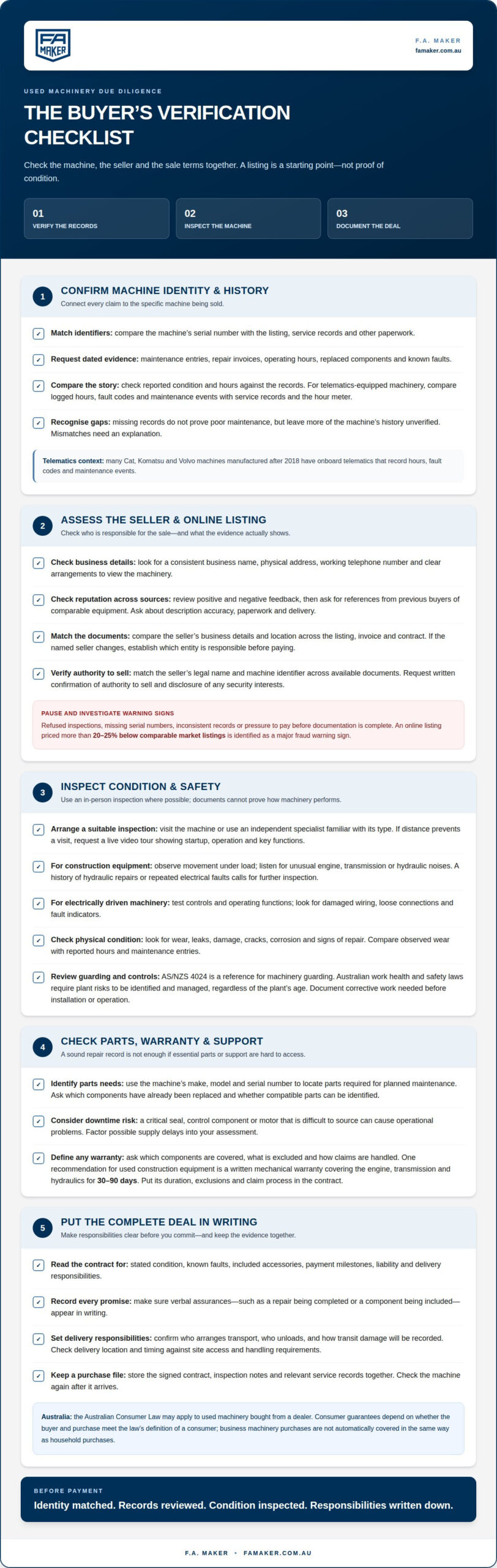
Start with the machine’s service and repair history, then test whether the seller’s claims match its records. Ask for dated maintenance entries, repair invoices, operating hours and details of replaced components. Compare the serial number on the machine with the number on its records. For construction equipment, a history of hydraulic repairs or repeated electrical faults can signal further inspection is needed. Missing records don’t prove poor maintenance, but they leave more of the machine’s past unverified.
Assess the dealer as carefully as the equipment. Look for a consistent business name, physical address, working telephone number and clear arrangements for viewing machinery. Check the dealer’s reputation across multiple sources, including both positive and negative feedback. Ask for references from previous buyers of comparable equipment, then ask about the accuracy of the description, paperwork and delivery. Specific examples are more useful than general praise.
Confirm that the seller’s business details and location make sense for the sale. A seller offering a machine for inspection should be able to explain where it is held and how access is arranged. Compare the business details on the listing, invoice and contract. If the named seller changes between documents, pause and establish which entity is responsible for the sale before paying.
For used machinery bought from a dealer in Australia, the Australian Consumer Law may apply. Consumer guarantees depend on whether the buyer and purchase meet the law’s definition of a consumer, so business machinery purchases aren’t automatically covered in the same way as household purchases.
Check replacement-parts availability by identifying the machine’s make, model and serial number, then locating the parts needed for planned maintenance. Ask which components have already been replaced and whether the seller can identify compatible parts. A machine with a sound repair record may still cause operational problems if a critical seal, control component or motor is difficult to source. Include likely supply delays in your assessment of downtime risk.
Before signing, read the contract for the stated condition, known faults, included accessories, payment milestones, liability and delivery responsibilities. Make sure any verbal promise, such as a listed repair or included component, appears in writing. Confirm who arranges transport, who is responsible for unloading and how transit damage will be recorded. Compare the agreed delivery location and timing with your site’s access and handling requirements. Keep the signed contract, inspection notes and relevant service records together as the purchase file.
Online listings are a starting point, not an inspection. Ask the supplier for records that connect the machine’s identity, condition and maintenance history. Useful documents include the make, model, year, serial number, operating hours, service entries, repair invoices, known faults, included accessories and any inspection report. Check that the serial number on the machine matches the paperwork and listing.
For machines with telematics, ask for a report showing logged hours, fault codes and maintenance events. Many Cat, Komatsu and Volvo machines manufactured after 2018 have onboard telematics that record this information. Compare the report with service records and the hour meter. A mismatch needs an explanation before you assess condition or value.
Ask whether a warranty applies, what components it covers and how claims are handled. For used construction equipment, one recommendation is to request a written mechanical warranty covering the engine, transmission and hydraulics for 30–90 days. Put the duration, exclusions and claim process in the contract. A verbal assurance doesn’t define what the seller must address.
Documents alone can’t show how machinery performs. Arrange an on-site inspection, or use an independent specialist familiar with the machine type. If distance prevents a visit, request a live video tour showing startup, operation and close views of key functions. Ask the operator to show the controls, guards, connections and areas identified in the inspection records.
Tailor the inspection to the equipment. For construction equipment, observe movement under load and listen for unusual engine, transmission or hydraulic noises. For electrically driven machinery, test the controls and operating functions, and look for damaged wiring, loose connections or fault indicators. Check structural areas for cracks, corrosion, leaks and signs of repair. Match observed wear with reported hours and maintenance entries.
For Australian safety checks, the AS/NZS 4024 series is a reference for reviewing machinery guarding. Australian work health and safety laws require risks from plant to be identified and managed regardless of the plant’s age. Check guarding and operating controls against the machine’s intended use, then document any corrective work needed before installation or operation.
To check ownership and possible liens, match the seller’s legal name and machine identifier across the listing, invoice and ownership documents. Request written confirmation of authority to sell and disclosure of any security interests, then use the serial number or vehicle identifier to search the relevant Australian register before payment. For recalls, ask the manufacturer to check the serial number against its recall records.
Red flags include refused inspections, missing serial numbers, inconsistent records or pressure to pay before documentation is complete. An online listing priced more than 20–25% below comparable market listings is a major fraud warning sign. Pause the transaction and resolve discrepancies before proceeding.
A B2B platform is a discovery channel, not necessarily the machinery seller. Before relying on a listing, identify the legal business offering the equipment and the platform’s role in the transaction. For example, a marketplace may host an advertisement while the seller controls the inspection, contract, payment and transport. Confirm which party receives payment and appears as the seller on the invoice.
Compare how each platform presents equipment details. A useful listing should distinguish the machine’s make, model, configuration and condition, rather than relying on broad labels such as “production equipment”. Check whether photographs show the complete machine and its important components. If the listing omits practical information, use the platform’s messaging tools to obtain it in writing before deciding.
Alibaba and 1688 may display prices that aren’t the actual price. Treat a displayed figure as an initial listing detail, not a final offer. Ask the seller to provide a written quotation in Australian dollars and itemise what it covers, such as the machine, accessories, transport and any platform charges. Compare the written offer with the listing so differences are visible before you proceed.
Review the platform’s transaction terms before using its payment process. Find out whether payment is held, transferred directly to the seller or handled through another arrangement. Read the rules on cancellations, disputes and refunds, then save the relevant terms with your quotation. A platform’s dispute process and the seller’s contract are separate documents, so understand which governs each part of the purchase.
Check how seller profiles are verified and what their history actually demonstrates. A profile badge or long presence on a platform isn’t proof that a specific machine is suitable. Compare the seller’s business name across its profile, quotation and contract. Review feedback for patterns, such as repeated concerns about descriptions or delivery, rather than relying on a single positive rating.
Finally, assess whether a platform supports the practical needs of an Australian operation. Confirm the seller’s location, the machine’s current location and the proposed delivery destination. For machinery sourced interstate or overseas, clarify who arranges freight, loading, insurance and unloading, and record those responsibilities in the contract. A platform can help locate a suitable listing, but a clear seller identity, written terms and workable delivery plan make the transaction easier to assess.
delivery plan. Because large B2B platforms such as Alibaba and 1688 may display prices that are not the actual price, rely on a seller’s itemised written quotation and confirmed delivery responsibilities when comparing offers.
Before the purchase, define what support means for the specific machine. Separate technical guidance, warranty claims, replacement components and transport damage into distinct processes. For a bottle filler, for example, identify the components most likely to interrupt production, such as filling valves or product-contact seals. Record the correct part references and the person responsible for each support request.
Use the seller’s written warranty terms as the starting point for a claim procedure. Note how to report a fault, what evidence to provide and whether the machine must remain available for inspection. Keep dated photographs, operating logs and maintenance entries together. If a fault appears after installation, document the symptoms before adjustments change the machine’s condition.
Build a spare-parts plan around the machine’s actual operating role. List components whose failure would stop the line, then record their part numbers, compatible alternatives and storage requirements. A seal kit may be a sensible stock item for one machine, while a drive component may need a different plan. Confirm part compatibility against the machine’s configuration, not just its brand.
Delivery timing matters because unavailable parts can extend downtime. For each critical component, establish the supply route, dispatch location and any ordering conditions. Compare those details with your production schedule and maintenance capacity. If a component is difficult to source, consider whether a different machine design or a local stock arrangement better suits the operation.
Prepare the installation site before the machine arrives. Compare its footprint, access route, service connections and operating sequence with the intended production layout. Assign someone to record the installed configuration, including replaced parts and settings. This baseline helps maintenance staff distinguish later changes from the machine’s condition at handover.
After commissioning, maintain a single support file for the machine. Include the purchase contract, warranty terms, manuals, parts references, inspection records and service notes. Record each fault with its date, operating conditions, observed symptoms and corrective action. A consistent log gives technicians a useful history and helps identify recurring issues before they interrupt production.
For transport, arrange transit insurance and inspect the machinery on arrival before signing acceptance documents. Photograph or video any visible damage, including affected panels, controls or connections. Record the damage with the carrier and seller, then retain the delivery paperwork with the machine’s support file. These steps preserve a clear account of its condition at handover.
Set the machine’s job requirements before comparing listings. Write down the required throughput, material characteristics, available floor space and connection requirements. For example, a packaging line designed for a particular bottle format has different needs from a general-purpose filler. This specification gives you a consistent basis for comparing machines and prevents a low purchase price from outweighing basic suitability.
Buying privately can mean dealing directly with an owner, while a dealer sale usually involves a business and formal sale documents. A private seller may provide less structured service history or post-sale support, so clarify responsibilities and record the agreed condition in writing. With either seller, don’t assume a warranty or refund policy applies; check the actual terms before paying.
Compare the machine’s asking price with a new model and assess the difference against condition, included accessories and remaining useful life. Also consider whether a documented rebuild or recent component replacement supports the asking price. For auction machinery, account for the “as-is, where-is” basis and the usual absence of a warranty. Read the auction terms and inspect the machine before bidding.
Check operating hours alongside wear on components that experience regular movement or contact with product. A low hour reading doesn’t establish condition by itself, and a high reading doesn’t prove the machine is unsuitable. Compare hours with maintenance entries, physical wear and the production task. Ask which parts have been replaced and whether replacement parts are available through a practical supply route.
Before purchasing, match the make, model and serial number across the machine, listing and contract. Test the machine’s functions, listen for unusual noise and look for rust, structural damage, leaks, worn components and electrical issues. Request a written list of known faults, included accessories and any repair work represented as complete. Record any difference between the description and inspection findings before signing.
Plan transport and payment as carefully as the equipment assessment. Compare delivery costs and timing, confirm loading and unloading responsibilities, and consider collection if it suits your operation. Use a business account for payment and avoid large direct transfers to individuals. Arrange transit insurance, photograph damage on arrival and inspect the machinery before signing delivery acceptance.
A trade-in may reduce the purchase cost if your existing machine retains market value. Assess its condition and market value separately, then ensure the contract records the trade-in amount and how it affects the transaction. For help sourcing used industrial machinery, review available machinery options against your operating requirements.
F.A. Maker supplies used stainless steel tanks for Australian businesses assessing pre-owned process equipment. They may suit operations that need a tank to fit an existing production setup, where capacity, connections and condition must match the process. F.A. Maker also supplies centrifuges and separators, industrial mixers and blenders, and pumps and valves. These equipment categories support different processing stages, so compare the machine’s role with your production requirements before choosing.
Use the checks in this guide to assess records, physical condition, parts availability and purchase terms for the equipment you’re considering. Contact F.A. Maker to discuss used stainless steel tanks or other listed processing machinery.
A used machine should support the production system you plan to run, not just fill an immediate equipment gap. Consider how it will fit your workflow, maintenance capacity and future production needs. A machine that integrates well with the wider line can be more practical than one selected on its own.
Finding reliable used machinery dealers is one part of the decision; choosing equipment that fits your operation is another. Bring production, maintenance and site-planning staff into the discussion. Their combined perspective can reveal constraints that aren’t obvious from a listing and help you assess whether the machine suits your process.
A disciplined approach to finding reliable used machinery dealers also means comparing each option against your operating priorities. For used process machinery, F.A. Maker is a relevant next step. Contact F.A. Maker to discuss your equipment requirements and the machinery you’re considering.
With clear priorities and a considered purchase, you can move forward with confidence.
Used machinery generally moves from an owner or operator to a dealer, broker or auction, then to a buyer and operating site. A marketplace may advertise equipment without owning it, so identify who controls the sale and who is responsible for each handover. For a clear transaction trail, retain the listing, seller’s invoice, sale contract, transport documents and arrival record together.
Start by identifying the business behind the listing, rather than treating the platform profile as the seller. Compare the business name, contact details and machine description across its website, marketplace profile and written quotation. Check whether the supplier lists comparable equipment and explains its sale process. If key details differ between channels, clarify them before relying on the listing to make a purchase decision.
Look for a chronological record that separates scheduled maintenance from repairs and component replacements. A service log showing routine lubrication, for example, tells a different story from repeated entries for the same fault. Compare recorded work with the machine’s present condition and intended duty. Use any gaps to identify maintenance tasks that may be due soon, then include those tasks in your operating plan.
Read feedback across more than one review platform and look for recurring details, not just star ratings. Repeated comments about inaccurate descriptions, unresolved disputes or delivery problems deserve attention. Ask for references from buyers who purchased comparable machinery, then discuss how the sale and handover matched expectations. Check that the business named in those reviews is the same legal entity shown on your quotation and contract.
The price depends on the machine and project, and is provided after a quote request. Financing costs depend on the lender’s terms and the buyer’s circumstances; delivery costs vary with distance, loading, insurance and site access. Installation may require rigging, electrical connections, commissioning or site preparation, depending on the equipment. Request an itemised estimate so these separate costs can be assessed alongside the purchase terms.