

What if the centrifuge with the highest capacity is the wrong choice for your process? Nameplate specifications alone don’t show whether a machine can handle your material, separation duty or operating conditions. This guide explains how to select a used centrifuge by establishing process fit first, then assessing equipment condition and integration requirements.
It’s understandable to focus on capacity and purchase condition, but both need to be considered alongside the material being processed, the required separation result and the machine’s operating history. Wear, incomplete maintenance records or a mismatch with site utilities can affect whether an apparently suitable unit is practical for your plant.
You’ll learn how to identify a suitable centrifuge configuration, review condition and documentation using a repeatable inspection framework, and plan for transport, installation and integration at an Australian site. We’ll also cover practical constraints that can shape a purchase, from access and utilities to fitting the equipment into your existing process. F.A. Maker supplies used centrifuges and separators, and offers machinery relocation services for equipment moves and site transitions.
A centrifuge separates process materials using centrifugal force. For an industrial application, selection starts with the separation duty, not the machine listing. Define what needs to be separated, such as suspended solids from a liquid, two liquid phases, or liquid from a solids cake. Then specify the required output: the target liquid clarity, solids dryness, recovery of valuable material, or a combination of these.
Record feed conditions and production patterns before comparing machines. Include density, viscosity, solids content and temperature, along with how these properties vary during operation. Estimate the required throughput over a normal production period, noting whether the plant runs continuously or in batches and how many operating hours are available. Document product-quality limits and downstream requirements, too. A separation result that looks acceptable at the centrifuge may still create problems for filtration, drying, recirculation or product handling.
These details form the process brief for how to select a used centrifuge. Keep it practical: state the feed range, desired separation result, throughput, operating pattern and cleaning needs. A clear brief makes it easier to assess whether a candidate’s configuration and documented performance are relevant to your duty.
Configuration depends on the separation task. A decanter centrifuge is generally used for continuous separation of solids from liquid. A disc-stack design is commonly applied to liquid-liquid separation or liquid clarification where fine solids may also be present. A basket centrifuge is often used for batch duties that separate liquid from solids, such as dewatering a solids load. These are broad distinctions, not guarantees of suitability. For an overview of operating principles and classifications, see Understanding Centrifuge Principles and Types.
Feed properties influence separation performance and equipment requirements. Particle size and solids loading affect the separation duty, while density and viscosity shape how phases behave under centrifugal force. Temperature, corrosiveness and abrasiveness can influence material compatibility and wear. Record variability in feed composition and flow, too. A unit assessed against an average feed may not suit regular peaks or changes in solids content.
Include cleaning and product handling in the brief. A process with frequent product changes may have different cleaning requirements from a steady, single-product duty. Consider whether residue can remain in the machine between runs, how separated solids will be discharged, and where each output goes next. These practical details can distinguish configurations that look similar in a basic equipment description.
Before reviewing used centrifuges, summarise the requirement in one sentence. For example: “Separate suspended solids from a variable-viscosity liquid at the required production rate, while meeting the downstream liquid-clarity and solids-handling needs.” Replace the general terms with your process values and acceptance criteria. This gives the assessment a firm starting point and helps keep capacity or appearance from outweighing process fit.
Once the process duty is defined, test each candidate against the production target and the site where it will operate. A centrifuge’s stated capacity is useful only when you know the feed properties, operating conditions and separation result behind the figure. A machine rated for a high maximum throughput may not meet your required output if that rating assumes a different feed or a less demanding separation specification.
Distinguish a catalogue or nameplate rating from demonstrated performance. Ask what feed, operating conditions and product specification underpin the stated capacity. Compare that evidence with your target throughput and required output quality. If capacity is unverified or based on materially different conditions, record it as an open question, not a confirmed production figure. This is a key step in how to select a used centrifuge without treating a maximum rating as a guarantee.
Assess the full operating duty, not just peak flow. Consider whether the machine can sustain the required rate across the planned operating period and whether its documented separation results match your acceptance criteria. Where evidence is incomplete, record the performance gap and identify what information or evaluation would resolve it before you decide.
Check physical and service interfaces alongside performance. Record the machine footprint, access dimensions, foundation requirements and connection locations, then compare them with the proposed installation area. Map the electrical supply, controls, cooling, drainage and other connected services against plant capabilities. Trace the process connections from upstream feed equipment through the centrifuge to downstream collection or handling equipment, too.
| Review area | Plant requirement | Machine evidence | Unresolved question |
|---|---|---|---|
| Process duty | Target throughput and separation specification | Documented capacity and operating conditions | Does evidence reflect comparable feed? |
| Utilities | Available electrical supply, cooling and drainage | Recorded service and connection requirements | Are adaptations or additional services needed? |
| Site fit | Available footprint, access route and foundation | Dimensions and connection locations | Can the machine reach and fit its operating position? |
| Integration | Upstream feed and downstream collection interfaces | Configuration and included components | What connection or control gaps remain? |
Use the comparison to separate established facts from assumptions. A blank or uncertain cell identifies an item for engineering review, not a reason to guess. Confirm the proposed configuration and interfaces against site drawings and the process layout before planning installation. This matters when equipment is moving between Australian sites, where access, transport and installation conditions can differ.
F.A. Maker supplies used centrifuges and separators for industrial process applications. Comparing candidates against a documented duty and site checklist helps keep capacity, utilities and integration in view together.
Assess condition through evidence, not appearance or age alone. A clean exterior can’t establish the state of internal assemblies, and visible wear needs to be understood in context. When deciding how to select a used centrifuge, build a traceable picture of the machine’s history, current condition and inspection limits before making a purchase decision.
Review available operating hours, maintenance logs, service reports, repair records and component replacement history. Check that documents identify the machine and, where possible, its configuration and major assemblies. Compare dates and descriptions across records to identify gaps or changes. Keep documented facts separate from seller statements and unverified estimates. Note missing information rather than treating it as evidence of either good or poor condition.
Useful records may include:
Inspect accessible areas for corrosion, cracks, evidence of leakage, unusual wear and signs of unauthorised modification. Review the frame, drive, bowl or rotor assembly, guards, interlocks and other accessible safety provisions. An external inspection can identify concerns, but it can’t establish the condition of concealed or internal components. Don’t bypass safeguards or inspect moving parts while equipment is operating.
Use a consistent inspection record so observations can be reviewed alongside the available documents. Note the exact location of each issue and distinguish a visible finding from a suspected fault. For example, record staining as evidence of leakage rather than concluding what caused it. Take photographs where permitted and identify areas that couldn’t be inspected, such as components behind guards or inaccessible assemblies.
Visible findings should lead to technical review, not improvised repairs or assumptions. Arrange an appropriate inspection by a competent person and controlled testing before final acceptance, with the test scope suited to the machine and the site’s safety procedures. Record what was tested, under what conditions, and any observations or outstanding issues. If testing isn’t possible, document that limitation and account for the remaining uncertainty in the decision.
Bring the records and inspection notes together. A clear assessment separates established facts, observed condition and unresolved questions, giving the next decision stage a sound basis. This is more useful than relying on a listing description or a general condition label.
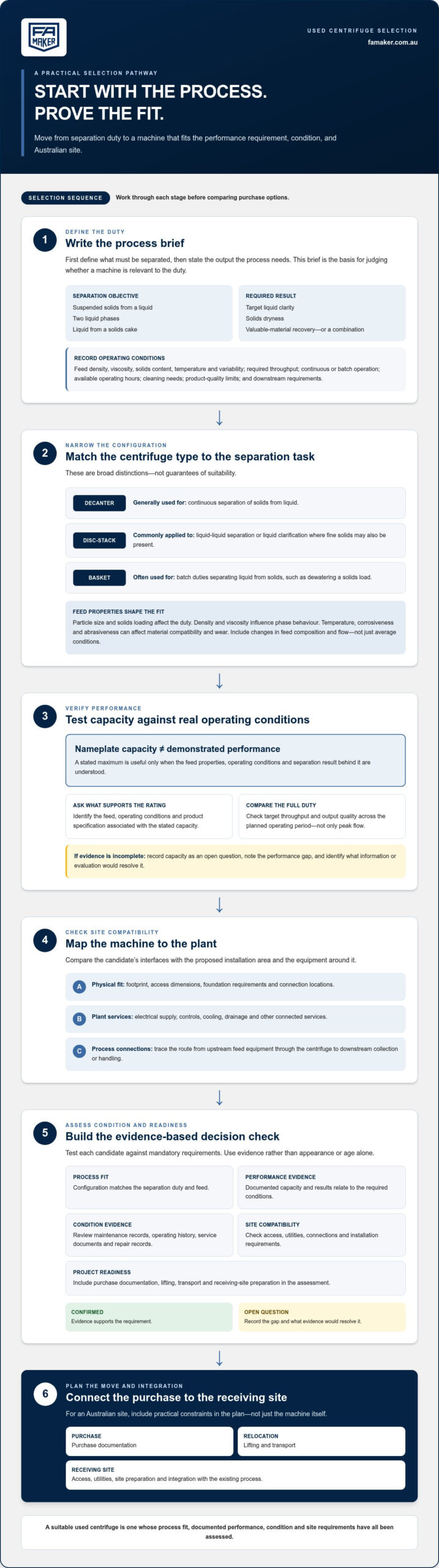
A consistent decision process helps engineering, procurement and operations assess candidates against the same requirements. Use sequential decision gates rather than letting a strong score in one area compensate for a failure in another. A machine that can’t meet an essential process or safety requirement shouldn’t progress simply because it looks favourable against other criteria.
Create a side-by-side matrix for each candidate. Include configuration, process duty, capacity evidence, condition, documentation, site interfaces and project readiness. Mark each criterion as evidenced, unresolved or unacceptable, and add a short note identifying the supporting record or open question. This makes the comparison auditable and shows where a decision relies on an assumption.
Apply pass-or-fail thresholds to mandatory requirements first, including essential process fit and acceptable safety provisions. Only candidates that pass those gates should be scored against preferences such as control features or ease of integration. Keep the scoring method simple and consistent across all options. For example, don’t award a candidate full credit for capacity when the available evidence doesn’t relate to comparable operating conditions.
Record assumptions and decisions as the assessment progresses. If operations and engineering interpret an unresolved item differently, assign it for review rather than averaging the disagreement into a score. Broader context on evaluating equipment and sourcing considerations is available in this industrial centrifuge and separator sourcing guide.
Compare candidates against the project’s full requirements and readiness, not purchase price alone. A used machine may suit a project when its process capability, condition and interfaces align with the duty and the remaining work is manageable. Include inspection, any required modifications, commissioning, transport and site preparation in the assessment. The used versus new industrial equipment comparison can help frame broader lifecycle trade-offs.
Before selecting a preferred candidate, summarise its status across the decision gates:
This framework gives a practical answer to how to select a used centrifuge: advance only candidates that meet mandatory needs, then compare preferences and remaining project work. To discuss used centrifuge and separator options for an industrial application, explore F.A. Maker’s equipment range.
A suitable machine still needs a defined path from purchase to production. Before dispatch, document what is being supplied, how it will be moved and what must be ready at the receiving site. These steps turn the selection decision into a manageable project and help prevent avoidable delays caused by missing components, access issues or an incomplete handover.
Use verified records to document the machine’s configuration, dimensions, weight, lifting points and any dismantling requirements. Confirm which components and accessories are included, and write the agreed acceptance criteria into the purchase documentation. Coordinate collection and transport planning with the project team, then check the route from the unloading point to the installation area. A machinery relocation planning guide can help structure the move.
Prepare the receiving site before the centrifuge leaves its current location. Confirm that access routes, floor or foundation preparation, lifting arrangements and available services align with the documented machine requirements. Allow space to unload and manoeuvre the equipment, not just for its final footprint. F.A. Maker offers machinery relocation services to support equipment moves between sites.
Collect available operating, maintenance, assembly and control-system documentation as part of the handover. Have qualified personnel review installation requirements, guarding, utilities and commissioning needs against the machine configuration and site conditions. Define acceptance checks before production use, including the process measures the equipment must meet. This keeps commissioning focused on the intended duty, not just a basic start-up.
For a clear handover, assign responsibility for outstanding project items and record how each will be closed. For example, note whether a document is pending, a connection needs engineering review or an acceptance check remains to be completed. Keep the agreed criteria consistent with the process brief and avoid informal assumptions about what constitutes satisfactory operation. This final planning stage completes the practical sequence for how to select a used centrifuge.
F.A. Maker’s relocation support can form part of planning an equipment move. Installation and commissioning arrangements should reflect the requirements of the specific machine and receiving site. Explore used centrifuges and separators as you assess options for your process.
Turn your evaluation into a working brief for your engineering, operations and procurement teams. Record the intended duty, essential acceptance criteria, unresolved technical questions and site responsibilities in one place. This gives the purchase decision a clear basis and helps the team prepare for handover and installation without relying on assumptions.
The brief also helps keep the decision grounded as project details develop. If a machine configuration or site requirement changes, revisit the relevant criteria before proceeding. A disciplined approach to how to select a used centrifuge supports a decision based on your process needs and the practical demands of bringing equipment into service.
F.A. Maker is a family-owned and operated business with a history of supplying industrial equipment since the 1920s. Explore its used centrifuges and separators as you consider the right fit for your application. With a defined process brief and a practical plan, you can move forward with greater clarity.
RPM measures how many times the rotor turns per minute; RCF describes the resulting acceleration relative to gravity. RCF depends on both rotational speed and the distance from the rotation axis to the sample or material. As a result, two machines operating at the same RPM can produce different RCF values if their rotor geometry differs. Compare the relevant operating values, not RPM alone, when reviewing process requirements.
Possibly, if the configuration and operating range suit each product and changeovers can be managed appropriately. Assess each feed separately, including its physical properties, required separation result and compatibility with wetted materials. For example, a machine that handles one liquid-solid duty may not suit a product with a different viscosity or solids load. Consider cleaning procedures, residue risks and any need to prevent cross-contamination before assigning multiple products to one unit.
Request the records available for the specific machine, such as its identification details, operating and maintenance history, service and repair reports, assembly information, control-system documentation and records for replaced components. Drawings, manuals and parts information can help the site team plan installation and future servicing. Match documents to the machine’s actual configuration and note any gaps. A generic manual may explain the equipment family but won’t confirm the installed options or modifications.
A suitable inspection and test can provide useful evidence before purchase, but the scope should reflect the equipment and intended duty. A basic run may show that the drive operates, but won’t necessarily demonstrate separation performance on your material. Agree on checks in advance, including what will be observed and recorded. Use appropriately qualified personnel and safe test conditions. If process testing isn’t practical, document the resulting performance uncertainty in the purchase assessment.
Assess suitability against the product, cleaning method and plant requirements, rather than relying on appearance or a general description. Review documentation for product-contact materials, surface condition, seals and any modifications. Consider whether the design allows effective cleaning and whether residues could remain in difficult-to-access areas. Your site’s quality and engineering teams should determine applicable requirements for the specific product and process. Include cleaning and changeover needs in the decision before purchase.
Plan around the machine’s verified dimensions, weight, lifting points and any dismantling needs. Check the full route from collection to its final position, including doorways, headroom, turning space and unloading access. Protect and secure components appropriately for transport, and coordinate the move with site personnel responsible for lifting, installation and utilities. F.A. Maker offers machinery relocation services for industrial equipment moves and site transitions. Explore F.A. Maker’s equipment range to discuss used centrifuges, separators and relocation support for your project.