

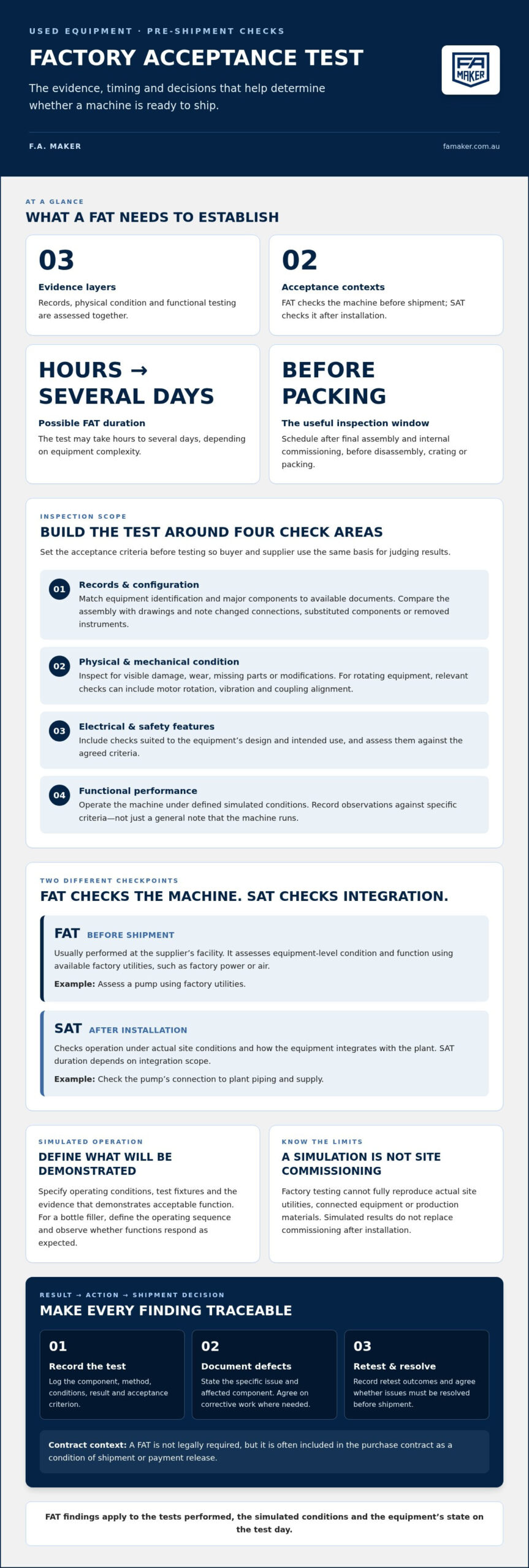
A factory acceptance test for used equipment should be planned before shipment and cover records, physical condition, safety features and operation against agreed acceptance criteria. It is usually carried out before the machine is disassembled or packed, giving the buyer a chance to identify issues before transport. A FAT isn’t legally required, but it is often included in the purchase contract as a condition of shipment or payment release.
A run test alone cannot show whether the equipment is complete, whether its condition matches the available records or whether important safety and functional checks have been missed. A clear plan helps the buyer and supplier agree on what to inspect, how to assess each test and what must be resolved before dispatch.
This guide explains how to set acceptance criteria, organise the test, review documentation and assess mechanical, electrical, safety and functional performance. It also covers how to record defects and decide whether the equipment is ready to ship or needs further work.
Before shipment, a factory acceptance test for used equipment checks whether the machine meets agreed requirements through document review, physical inspection and functional testing. In Australia, the cost depends on equipment type, test scope, preparation and whether testing is remote or on site. The price is provided after a quote request.
Keep pre-shipment acceptance testing separate from checks performed after installation. A FAT examines the equipment before it leaves the supplier, usually at the supplier’s facility. A site acceptance test, or SAT, checks operation after installation under actual site conditions. For example, a FAT can assess a pump using factory utilities, while a SAT checks its connection to the plant’s piping and supply.
Use the FAT to find equipment-level issues and the SAT to assess integration. A FAT may take hours to several days, depending on complexity; SAT duration depends on the integration scope.
Specify the operating conditions the supplier must reproduce and the evidence that will demonstrate acceptable function. Use available test fixtures, factory power or air to operate controls and simulate the intended process. For a bottle filler, define the operating sequence and observe whether its functions respond as expected.
Record the limits of each simulation. Factory testing cannot fully reproduce actual site utilities, connected equipment or production materials, so simulated results do not replace commissioning after installation.
Compare the machine’s physical condition with its available records and the agreed test criteria. Match its identification and major components to the documentation, then inspect for visible damage, wear, missing parts or modifications. During operation, record observations against defined criteria rather than relying on a general statement that the machine runs.
For rotating equipment, include relevant checks such as motor rotation, vibration and coupling alignment. Link each result to the component tested, the test conditions and any observed defect.
For remote testing, agree how the supplier will show the machine, test readings and results. Identify which inspections require direct physical access, since a camera view cannot establish every aspect of the equipment’s condition.
If a test fails, record the result, defect and required corrective action. Agree whether the supplier must rectify the issue and repeat the test before shipment. FAT findings are limited to the tests performed, the simulated conditions and the equipment’s state on the test day. They cannot establish how the machine will perform in every future production scenario.
Organise records around the equipment’s identity, history and agreed test scope. A well-ordered file lets the buyer compare the machine’s actual configuration with its drawings and recorded test results.
Assemble the test file before the FAT, using customer specifications, drawings, data sheets, an inspection test plan, applicable codes, procedures and required calibration certificates. Arrange the documents by test sequence so the buyer and supplier can find the relevant acceptance criterion during each check.
Identify who records results, who reviews them and who signs each test record. Include space for failed tests, corrective actions and retest outcomes. Avoid leaving acceptance decisions to informal verbal agreement.
Match the equipment’s identification details to its general arrangement, electrical drawings and piping and instrumentation diagrams. Compare the physical assembly with the drawings, then record differences such as changed connections, substituted components or removed instruments. This helps distinguish an approved configuration change from an unexplained discrepancy.
Gather available materials and component records relevant to the machine’s design and operation. For example, file component data sheets with the relevant equipment documents rather than separately without an identifier. Use revision details to verify that reviewers are assessing the correct drawings.
For each test, record what was tested, the method, the result and whether it met the stated acceptance criterion. Include raw test data where required, along with the test instrument’s identification and calibration status. A signed record should identify the reviewer and show whether the result passed, failed or needs follow-up.
Record defects as specific findings, not broad comments. Identify the affected component and observed issue, then document corrective work and retest results. Keep failed and repeated tests in the record so the final handover reflects the complete test history.
Compare listed maintenance tasks with the equipment manuals and available service documents. Record gaps or inconsistencies for resolution, and clearly distinguish historical records from work completed during the current FAT.
Before shipment, check that the file is complete, legible and correctly identified. Store the signed records with the equipment documentation, and provide the operations and maintenance team with relevant manuals and drawings for installation and ongoing use.
A used equipment FAT checklist should cover drawings, physical condition, electrical connections, safety features and operation. Set each check against the equipment’s specifications and record whether the result meets the expected function.
Compare the assembled machine with its technical drawings and specified design. Check dimensions, component locations, connections and modifications against the current drawings, and note discrepancies for review. Confirm that inputs and outputs connect as shown and that the arrangement follows the manufacturer’s specifications. Do not accept an undocumented change as a match simply because the equipment operates.
Inspect the equipment’s physical condition before operation, then examine moving parts during testing. Look for visible damage, loose or missing components, sharp edges, pinch points and signs of leakage. For rotating equipment, check motor rotation, vibration and shaft or coupling alignment. Record observations against the checklist and expected operating behaviour.
For machinery with control software, verify that the installed version is compatible with the specified configuration. Test inputs and outputs according to the drawings, and document the response to each relevant command. A control test should show what was activated and how the machine responded, rather than simply recording that it passed.
Record any safety concern as a specific finding, including its location and observed effect. An accessible emergency stop does not prove that the full shutdown function works; test the response and record the result.
Keep the checklist tied to the machine’s actual configuration and intended use. Separate visual findings, mechanical observations, electrical checks and functional results so reviewers can identify the source of any failure and assess whether corrective work is needed.
Keep the FAT, commissioning and pre-shipment inspection distinct by objective and timing. For an Australian FAT, identify the applicable state or territory WHS requirements and any equipment-specific standards in the contract. Do not assume one standard covers every used machine.
Keep the records distinct. A successful FAT does not prove that the machine has been installed correctly, and a visual inspection alone does not demonstrate operating performance.
Plan isolation and lockout/tagout steps before maintenance or close inspection. Identify the relevant energy sources and isolation points, and make sure the test team understands when the machine must remain stopped.
For an industrial machine with moving parts, check that guards are present and securely fitted before functional testing. Do not remove a guard to improve visibility while the machine is operating; arrange a safe inspection while it is stopped.
Document each outstanding item, its location and the agreed resolution. Clear the FAT punch list before the equipment is moved or shipped, and retain records of corrective work and any required retesting.
For machinery relocation, coordinate the handover between pre-shipment checks and site commissioning. This helps distinguish a transport or installation issue from a fault observed during the original factory acceptance test.
Apply the WHS requirements of the relevant state or territory and the equipment-specific standards agreed in the contract. No single standard is assumed to cover every used machine. The FAT plan should also address test-area hazards and set out isolation and lockout/tagout steps before maintenance or close inspection.
Build the test plan around the purchase requirements, the equipment’s current configuration and the evidence needed for acceptance. Clear criteria make each test result actionable, rather than leaving the buyer and supplier to interpret “working” differently.
Assign responsibility for each task: who conducts the test, who records readings and who approves results. Specify required witnesses and deliverables in the contract, alongside any relationship between acceptance, shipment and payment.
Avoid criteria such as “runs satisfactorily” without a defined observation. Use a specific, observable response, measurement or documented inspection result, and state how deviations will be recorded and assessed.
Check that test instruments are within their required calibration dates before taking readings. Record the instrument identification alongside each result, so another reviewer can understand how the measurement was obtained.
Separate factory criteria from site acceptance test criteria. The FAT assesses what can be demonstrated before dispatch, while site acceptance addresses integration with site utilities, connected systems and production conditions.
Keep the plan controlled as manufacturing information and equipment configuration change. ISO 9001 provides a quality management framework for supplier testing and documentation practices, but it doesn’t prescribe a specific FAT procedure. Tailor the test sequence to the machine and agreed requirements.
For buyers assessing bottle filling equipment, explore bottle fillers alongside the specifications your test plan needs to address.
F.A. Maker supplies used stainless steel tanks for Australian industrial processing. After defining your acceptance criteria, use them to assess whether a tank’s documented condition and function suit your process.
F.A. Maker also offers centrifuges and separators, industrial mixers and blenders, and pumps and valves. These equipment categories can support different stages of a processing line, so consider the machine’s role, connection requirements and intended operating conditions when planning your purchase evaluation.
For a used equipment decision, compare the equipment’s specifications and available records with the needs in your test plan. Visit famaker.com.au to explore the equipment range or contact F.A. Maker with your requirements.
Use your FAT findings as a practical decision record, not just a pass-or-fail document. The observations and criteria you establish can guide discussions about equipment suitability, required corrective work and checks after installation. For a factory acceptance test for used equipment, keep the purchase requirements tied to the machine’s intended role and the evidence gathered during evaluation.
F.A. Maker offers used stainless steel tanks, centrifuges and separators, and industrial mixers and blenders. These categories serve different process requirements, so define the equipment’s intended duty and key specifications before comparing options. A well-defined requirement keeps the next step focused on operational fit rather than a general search for machinery.
If you’re assessing used process equipment for a project, contact F.A. Maker about used equipment. Bring your process requirements and evaluation priorities into the discussion, then move forward with a clearer basis for your decision.
Skipping or rushing a FAT can leave faults undiscovered until the equipment reaches the buyer’s facility. A control fault might appear only during a particular operating sequence, while transport can make later inspection and correction more difficult. A limited test also gives the buyer less evidence for resolving disagreements about condition or performance. Match test time to equipment complexity and document any checks that could not be completed.
Include people who can assess the equipment technically and those who will operate or maintain it. The buyer’s project manager can track requirements, an engineer can review technical results, and an operator can assess practical controls and access. The supplier’s technical team should explain the test setup and respond to findings. For specialised machinery, an independent inspector can witness relevant checks on the buyer’s behalf.
A factory acceptance test for used equipment is a pre-shipment examination of its records, physical condition and operation against agreed purchase requirements. It helps the buyer assess the specific machine being purchased, rather than relying only on a description or previous operating history. The test can combine inspection, document review and functional checks. Its scope should reflect the machine’s current configuration and intended duty.
The buyer’s designated technical representative should witness the checks they need to assess, with the supplier’s representative present to explain the equipment and record outcomes. The contract or test plan should name who can approve results and accept outstanding actions. Sign-off should identify the tested machine and the records reviewed. A witness confirms what they observed; that alone does not mean every requirement has passed.
Request records that identify the specific machine, such as available manuals, drawings, service history, component information and current test results. Each record should be traceable to the equipment’s identification details and show its revision or date where applicable. For example, a maintenance entry should identify the component and work performed. Ask for readings and outcomes from tests, including recorded failures and retests, not just a pass statement.
A FAT assesses the machine before dispatch, while a site acceptance test checks it after installation in its operating environment. The site test can reveal issues that factory testing cannot, such as a mismatch with connected equipment, site utilities or production materials. For example, a machine may operate on a factory test setup but need further adjustment once connected to the buyer’s process line.
Set out the test scope, measurable pass criteria, responsible parties, required records and who can approve acceptance. Specify how defects will be logged, who determines corrective work, how retesting will be recorded and how unresolved items affect shipment or payment. Identify tests excluded from the FAT and distinguish them from later site checks. Clear wording gives both parties a shared basis for resolving test findings.