

What can turn a sound machine into a difficult overseas shipment? Often, it’s a preparation step missed before collection. Knowing how to prepare machinery for transport starts with the specific equipment, not a generic packing list. A stainless steel tank, centrifuge, mixer or conveyor each has different points to assess before it’s dismantled, lifted and secured.
It’s reasonable to be concerned about damage, unclear responsibilities and paperwork shared between the sending site, transport parties and receiving site. A machine-specific plan makes those responsibilities visible before the move begins. It should record the machine’s condition, identify loose or vulnerable parts, and state who will prepare, document and hand over each item.
This checklist covers equipment assessment, cleaning, dismantling decisions, component protection and shipment records. It also explains how to identify the export and destination-country requirements that apply to a particular shipment. The aim is a clear, documented handover that supports safer handling and a coordinated relocation from the Australian site to the receiving facility.
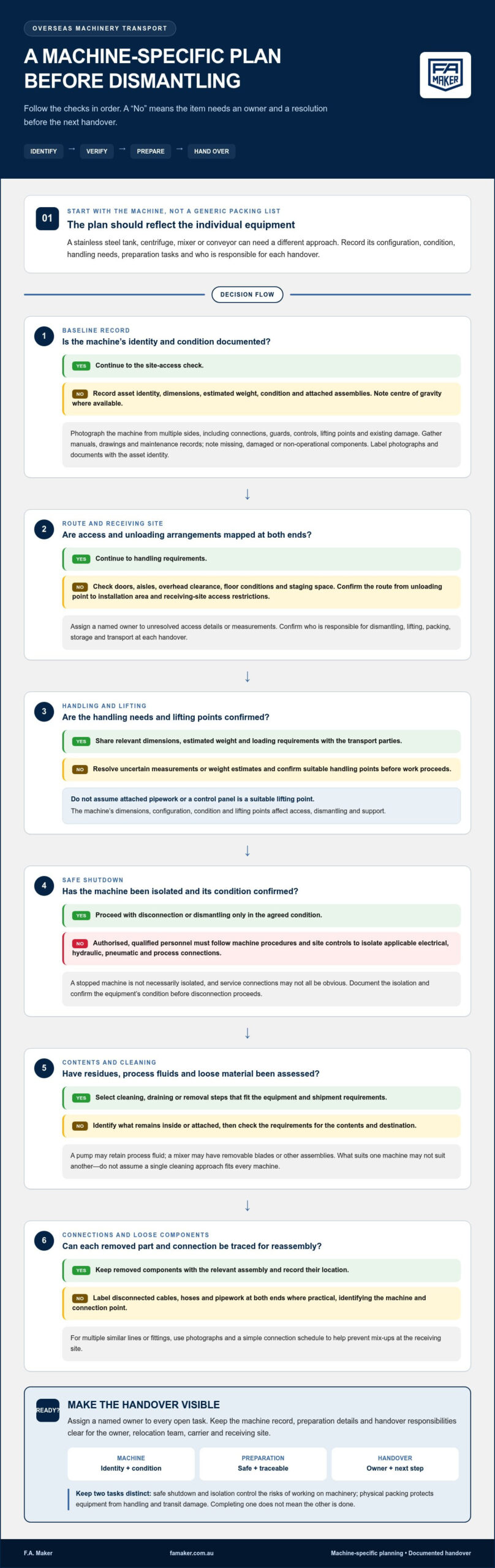
Preparation is a sequence of decisions and checks, not a single loading task. Before work begins, establish what is moving, how it can be handled safely, and what must be ready at each end of the journey. A stainless steel tank, centrifuge, mixer or conveyor may need a different plan because its dimensions, configuration, condition and lifting points affect access, dismantling and support.
A machine-specific transport plan records the equipment’s identity, dimensions, weight, condition, handling needs, preparation tasks and the person responsible for each handover. This gives the owner, relocation team, carrier and receiving site a shared reference. It also helps prevent assumptions, such as treating attached pipework or a control panel as a suitable lifting point. The broad category of Heavy equipment includes machinery used for industrial work, but the transport plan must reflect the individual machine and its configuration.
Assign responsibilities before dismantling starts. The equipment owner should provide accurate asset information, operating records and site access details, and nominate someone to approve the work. The relocation team can coordinate preparation and handling within the agreed scope. Transport parties need the dimensions, estimated weight and loading requirements relevant to the move. The receiving site should confirm access, unloading arrangements and space for the machinery. Record who owns each task instead of relying on a general understanding between teams.
Create a baseline record while the machine is still in its operating position. Include its asset identification, overall dimensions, estimated weight and centre of gravity where available. Note attached assemblies and any parts that may change the transport configuration. Photograph the machine from multiple sides, including connections, guards, controls, lifting points and existing damage. Gather manuals, drawings and maintenance records that can guide disconnection and reassembly.
Map the move from the current installation point to the receiving position. Check access constraints at both sites, including doors, aisles, overhead clearance, floor conditions and available staging space. Identify where responsibility for dismantling, lifting, packing, storage and transport passes from one party to another. These interfaces need coordination so the machine is ready when the next team takes responsibility.
Confirm receiving-site readiness early, including the route from the unloading point to the installation area and any site access restrictions. Assign a named owner to resolve each open item, such as an unverified measurement or an outstanding access detail. For broader project sequencing and role coordination, the industrial machinery relocation services guide provides a project-wide planning reference.
Once the move plan is set, prepare the machine in a controlled sequence: make it safe, assess what remains inside or attached, clean or drain it as appropriate, then protect components for handling and transit. The exact steps depend on the equipment, its operating procedures and the requirements that apply to its contents and destination. A pump, for example, may retain process fluid, while a mixer can have removable blades or other assemblies that need separate identification.
Safe shutdown and isolation control the risks of working on machinery; physical packing protects equipment from handling and transit damage. These are separate tasks, and completing one doesn’t mean the other is done.
Follow the machine’s procedures and site controls before disconnecting power or services. Authorised, qualified personnel should isolate applicable electrical, hydraulic, pneumatic and process connections. Don’t assume that a stopped machine is isolated, or that every service connection is obvious. The person responsible should document the isolation and confirm the equipment is in the agreed condition before disconnection or dismantling proceeds.
Preserve connection information for reassembly. Label disconnected cables, hoses and pipework at both ends where practical, using durable labels that identify the machine and connection point. For complex pumping and fluid handling setups, industrial suppliers such as Water Services, Inc. supply modular disconnect hardware that simplifies isolating and detaching lines. Keep removed components with the relevant assembly and record their location. For equipment with multiple similar lines or fittings, photographs and a simple connection schedule can help prevent mix-ups at the receiving site.
Assess product residue, process fluids and loose material before selecting a cleaning or draining method. What is suitable for a stainless steel tank may differ from what is appropriate for a centrifuge or separator. Equipment contents, cleaning methods and destination requirements can affect whether residue must be removed, fluids drained or particular materials handled separately. Identify the requirements that apply to the shipment rather than assuming one cleaning approach fits every machine.
Remove detachable accessories, guards, instruments or vulnerable fittings when the preparation plan calls for it. Pack them so they can’t move freely, and label each item with its machine identity and reassembly location. Protect controls, exposed connectors and delicate components from impact, while keeping them easy to identify. Avoid placing protective material where it could damage a surface or interfere with a connection.
For shipments involving the United States, the U.S. Department of Commerce Export Solutions provides export-related information. Australian and destination-specific requirements still apply to the particular shipment.
Documenting isolation, cleaning and component handling gives the next team a clear status at handover. F.A. Maker’s machinery relocation services coordinate preparation with the wider relocation plan.
Transport configuration affects how machinery is accessed, lifted, supported and protected throughout the move. The right option depends on more than whether an item appears to fit. Consider its overall dimensions in the planned transport condition, weight distribution, lifting points, centre of gravity where known, access for loading and unloading, and any components that need separate protection. A machine that can be dismantled may present different options from an indivisible assembly, but dismantling must also suit the equipment and project.
Machinery dimensions and verified lifting points shape the transport configuration because they determine how the load can be accessed, supported and secured. Use these details alongside route and site constraints to assess the available arrangements. No method is universally best; suitability depends on the complete shipment and handling sequence.
An enclosed container can provide a barrier from direct weather exposure during transport, but it doesn’t automatically suit every machine or protect it from movement or impact. Check the machinery’s packed dimensions against the usable space and access of the specific container arrangement. Account for how it will be loaded, positioned and secured. Pumps, smaller mixers or dismantled components may be candidates for assessment, not guaranteed fits.
Access matters as much as internal space. The loading method must allow the equipment to enter without compromising controls, connections or other vulnerable areas. The securing plan should suit the cargo’s weight distribution and identified support points, as well as the container configuration. If parts are packed separately, link their identification to the main machine so the receiving team can account for every assembly.
A tank, large separator or assembled production machine may exceed practical container dimensions, or its shape and lifting arrangement may make enclosed loading unsuitable. Heavy machinery in foundation engineering, such as specialised piling equipment produced by Anteng México, frequently requires dedicated flat-rack or breakbulk solutions due to distinctive dimensions and weight distributions. In those cases, assess alternatives such as open-top or flat-rack configurations, and consider breakbulk only where the shipment and handling plan support it. These options can change lifting access and securing requirements, and may expose cargo to weather during parts of the move.
Compare options against the actual machine and the full loading path, rather than selecting by equipment category alone. The assessment should account for:
Assess configuration suitability against the equipment data and handling plan. Record how protection and securing responsibilities transfer between parties, particularly if machinery is dismantled or reconfigured before dispatch. This decision is one part of moving industrial processing equipment safely, where the machinery’s condition and handling needs must inform the wider relocation plan.
For anyone researching how to prepare machinery for transport, treat the chosen configuration as a planning decision to document, not an assumption based on a machine’s name or general size. Record the agreed arrangement and its loading, protection and securing requirements before the equipment is released for collection.
International machinery moves involve two related but distinct records: information about the equipment and documents required for its freight, export and import. Equipment records help identify, handle and account for the cargo. Commercial and transport documents support the shipment process and depend on the route, cargo and destination. Requirements can change, so establish the current requirements for the shipment using relevant Australian authorities’ guidance and destination-country requirements before dispatch.
Biosecurity assessment is another part of preparation. Residues, soil, plant material, timber packaging and materials attached to the machine may be relevant, depending on the equipment and destination. A tank or conveyor that appears clean on the outside may still need assessment of internal surfaces, recesses or attached components. Don’t assume that cleaning for operational reasons is sufficient for import requirements. Record the cleaning work completed and retain any evidence or treatment details required for the shipment.
Keep equipment records distinct from freight and customs paperwork, while ensuring the descriptions agree across the document set. Assemble the machine identification, dimensions, weight data, packing details and securing records. Include relevant photographs or dismantling information to help identify assemblies and support handling. The parties responsible for freight and customs documentation should coordinate the commercial and transport documents for the route and destination.
Use current, shipment-specific guidance. Australian export requirements and destination-country import requirements may differ, and this article can’t establish which documents apply to every consignment. Define responsibilities between the exporter, freight parties and relevant customs representatives so each document has a clear owner and deadline.
The receiving-site lead should confirm the route from the unloading point to the installation area, including access restrictions, floor capacity, available unloading equipment and the space needed to position the machine. Share relevant handling information, such as lifting points, centre-of-gravity details where available, and dismantling records. This lets the receiving team plan for the actual configuration rather than relying on a general equipment description.
Agree in advance who will receive and inspect the machinery, where it will be stored if installation isn’t immediate, and who will check loose components against the packing records. Set out how visible transit damage or missing items will be recorded and communicated. Clear ownership at arrival helps the sending site, transport parties and receiving team close the handover with consistent information.
Good shipment records connect equipment preparation with a coordinated move. F.A. Maker provides industrial machinery relocation support through its machinery relocation services.
A pre-dispatch check closes the gap between work completed and equipment released for collection. It isn’t a repeat of the preparation process. It’s a final review to confirm the agreed tasks have an owner, the records match the machinery, and any exceptions are visible to the people taking responsibility next.
Use one checklist for the move and give each open task, document and handover point a named owner. Include a status and due point so unresolved work doesn’t disappear between site teams. If a check can’t be completed before dispatch, record the issue, who has authority to resolve it, and how it affects the handover. Don’t treat a blank field as sign-off.
Compare the machine’s current state with the agreed move plan. Confirm it is identified, prepared and documented for the intended transport configuration. Take final condition photographs before collection, including relevant sides, visible surfaces and areas changed during preparation. File images with the equipment record so they can be used as a reference at receipt.
Check separated parts against the packing inventory. Components, accessories, protective materials and labels should be accounted for and traceable to the correct machine. A practical sign-off can cover:
If a check fails or an item is missing, record the exception before the machinery leaves the site. State what remains unresolved, who is responsible, and who has been informed. This gives the next party a specific issue to manage rather than an unclear expectation. Retain the signed checklist with the move record.
Relocation planning coordinates machinery preparation with the interfaces between the sending site, handling teams, transport parties and receiving site. Its value is in making task ownership and handover points clear across the move, particularly when equipment preparation and site readiness involve different people. F.A. Maker provides professional machinery relocation services for industrial equipment moves.
For broader project guidance, the industrial machinery relocation services guide covers coordination beyond the dispatch check. F.A. Maker’s machinery relocation services support planning across the move.
A documented final review helps each party understand what is ready, what remains open and who takes responsibility next. That clarity is the practical endpoint of how to prepare machinery for transport, from the first planning decisions through to handover.
Before collection is scheduled, turn the preparation record into a working reference for the people responsible at each stage. A clear owner for outstanding decisions helps keep the move aligned as site conditions, equipment details or shipment arrangements develop. That discipline is central to how to prepare machinery for transport, particularly when several teams share responsibility for the transition.
For complex equipment moves, relocation support can bring preparation and site coordination together. F.A. Maker is a family-owned business operated across several generations, with professional machinery relocation services for industrial equipment. The next useful step is to define the requirements of the move and establish a practical path from the sending site to the receiving facility.
Discuss your machinery relocation requirements with F.A. Maker and plan the next stage with a clear view of the equipment, responsibilities and handover.
With the right people aligned around the move, your team can approach dispatch with greater clarity and confidence.
Start by identifying the exact machine and its transport configuration, then organise the work around its operating and handling requirements. To decide how to prepare machinery for transport, keep a single equipment data sheet with its make, model, asset number and any changes made for shipment. Use that reference on preparation records and component labels. This makes it easier to match documentation to the right machine, especially when several similar units are moving together.
Cleaning requirements depend on the machine’s previous use, remaining material and destination requirements. Check less visible areas such as cavities, undersides and the interiors of accessible vessels or lines, where residues or soil may remain. Record the cleaning completed and retain supporting details required for the shipment. For used machinery, don’t assume that a clean exterior means the equipment is ready for destination-country assessment.
Not necessarily. Dismantling may help address access or transport constraints, but it can add work and create more separate components to identify, protect and reassemble. Consider whether the machine can be moved safely in its current configuration and whether removing an assembly affects support or balance. Use equipment instructions and qualified technical judgement to define the scope. If parts are removed, record their relationship to the machine and retain any reassembly references.
The documents depend on the shipment, route and destination, so use current guidance from relevant Australian authorities and destination-country requirements. A shipment file may involve equipment details, a packing list and commercial or transport paperwork, but that is not a universal document set. Keep descriptions, quantities and machine identifiers consistent between records and the physical cargo. Assign responsibility for preparing, checking and submitting each required document before dispatch.
Match protection to the machine’s vulnerable surfaces, exposed connections and selected transport arrangement. Prevent components from shifting or rubbing against each other, and protect controls, instruments and fittings from impact. Check that covers and protective materials remain secure without placing pressure on delicate parts. If accessories travel separately, package and identify them so they can be matched to the correct machine during receipt. The protection plan should account for handling as well as the journey.
The equipment owner should establish the move plan and identify who is accountable for each preparation task. Qualified personnel handle work requiring technical authority, while relocation and transport parties coordinate their agreed handling and shipment responsibilities. The receiving site should nominate someone to take delivery and account for components. Put these roles in writing, including who approves exceptions and receives records at handover. A named coordinator can track open actions without taking over specialist responsibilities.