

The best defence against cross-contamination is a mixer designed for thorough cleaning, paired with a validated cleaning process between production runs. To understand how to prevent cross-contamination in mixers, focus on smooth food-contact surfaces, accessible mixing areas and removable components that allow residues to be reached and removed.
This matters particularly when products contain allergens such as gluten or nuts. Residue can remain in seals, attachments, joints and other hard-to-reach areas, then transfer into the next batch. An enclosed mixing vessel can help limit exposure to airborne contaminants and foreign objects, but equipment design alone does not replace effective cleaning and sanitising.
This article explains which industrial mixer features can reduce areas where material collects and how cleaning between runs helps manage carryover risks. It also covers how to match cleaning instructions to the equipment and how suitable design can make access, inspection and changeovers more practical for production teams.
Cleaning removes product residue; sanitising then reduces microorganisms on food-contact surfaces. The mixer design, previous product and next batch all affect the cleaning approach.
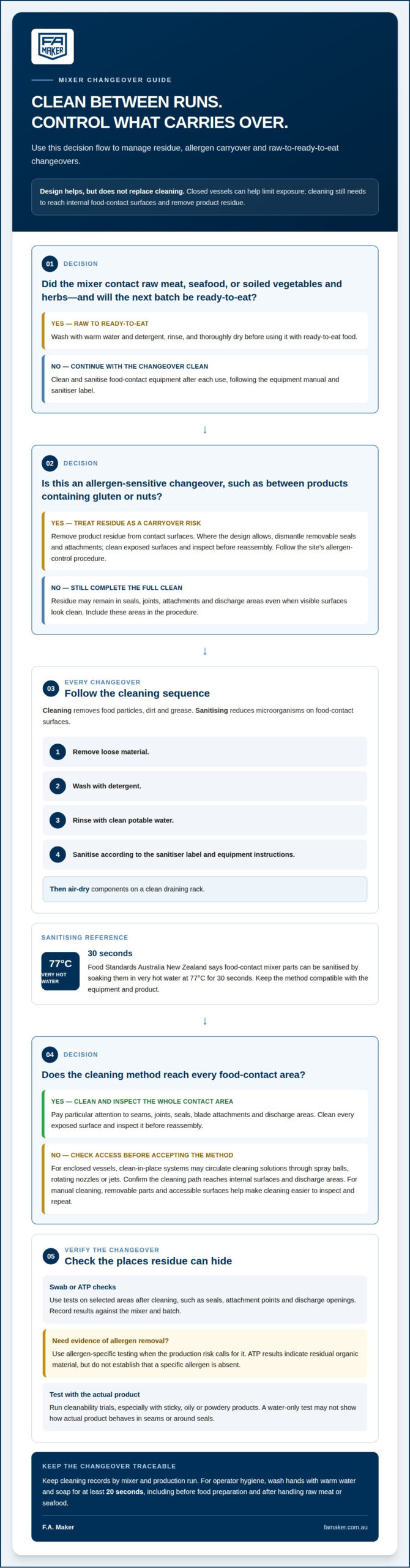
In Australia, equipment that has contacted raw meat, seafood, or soiled vegetables and herbs should be washed with warm water and detergent, rinsed, and thoroughly dried before use with ready-to-eat food. Clean and sanitise food-contact equipment after each use, following the equipment manual and sanitiser label.
Use a sequence that separates each stage: remove loose material, wash with detergent, rinse with clean potable water, then sanitise. Let components air-dry on a clean draining rack. Keep cleaning records by mixer and production run to track completed changeovers.
Seams, joints, seals, blade attachments and discharge areas can be hard to reach and may collect product. Residue can remain there even when visible surfaces look clean, creating a contamination risk in the next run. Where the mixer design allows, dismantle removable seals and attachments. Clean every exposed surface, then inspect it before reassembly.
Cleaning removes food particles, dirt and grease; sanitising reduces microorganisms on surfaces that contact product. Wash mixer parts with hot water and detergent, rinse with potable water, then apply sanitiser according to its label. Food Standards Australia New Zealand says food-contact mixer parts can be sanitised by soaking them in very hot water at 77°C for 30 sec. Keep the sanitising method compatible with the equipment and product.
Swab and ATP tests can check selected areas after cleaning. Sample hard-to-reach locations such as seals, attachment points and discharge openings, and record results against the mixer and batch. ATP results indicate residual organic material, but do not establish that a specific allergen is absent. Use allergen-specific testing when the production risk calls for evidence of allergen removal.
Run cleanability trials with the actual product, especially if it is sticky, oily or powdery. Process the product through the mixer, apply the proposed cleaning sequence, then inspect likely residue points and assess the results. A water-only test may not show how the actual product behaves in seams or around seals.
For a mixer with an enclosed vessel, clean-in-place systems can circulate cleaning solutions through spray balls, rotating nozzles or jets. Confirm that the cleaning path reaches internal surfaces and discharge areas. When manual cleaning is needed, removable parts and accessible surfaces make the process easier to inspect and repeat.
No mixer eliminates every contamination risk. A closed continuous mixer with accessible, smooth food-contact surfaces can help limit exposure and support effective cleaning.
For allergen changeovers, remove product residue from contact surfaces and clean the mixer before the next batch. To reduce raw-food carryover into ready-to-eat products, use separate equipment where practical. Otherwise, wash, rinse and thoroughly dry equipment after contact with raw food.
Allergen cross-contact occurs when residue from one product transfers to another through shared equipment. Gluten or nut particles can remain in blenders and food processors after routine cleaning, so a visually clean bowl does not prove that allergens have been removed. For a sensitive changeover, dismantle accessible attachments, clean contact areas thoroughly and follow the site’s allergen-control procedure before starting the next product.
Continuous mixers use closed, sealed vessels that help prevent contaminants from entering the mixing process. This configuration can suit production where material moves through a contained mixing path, including food processing. Its effectiveness depends on cleaning access: a sealed vessel still needs a method that reaches internal contact surfaces and removes product residue.
Biofilm can form on food-contact surfaces, particularly around seals and blade attachments, and may resist cleaning. Pay close attention to these areas during inspection and cleaning, especially after processing sticky or powdery products. Include seals, connection points and discharge areas in the cleaning procedure, not just the main vessel.
Smooth food-contact surfaces have fewer rough areas where particles can lodge and accumulate. Food-grade stainless steel can be polished to remove surface irregularities that may encourage bacterial growth. A mixer with accessible surfaces and fewer crevices makes residue easier to remove, but its design still needs to suit the product and the site’s cleaning process.
Raw and ready-to-eat production needs clear separation. If a mixer contacts raw meat, seafood, or soiled vegetables and herbs, clean it before using it for ready-to-eat food. Dedicated equipment can reduce reliance on changeover cleaning; otherwise, include the required washing, rinsing and drying sequence in the production plan.
Food safety also depends on how the mixer is handled and supervised. Operators should wash their hands with warm water and soap for at least twenty seconds, including before food preparation and after handling raw meat or seafood. HACCP principles can help food facilities identify and monitor contamination risks at process points such as mixing and changeovers.
For production planning, reviewing mixer configurations can help align containment, cleaning access and product changeovers with the process.
For allergen-sensitive production, prioritise a mixer that limits retained material and gives operators access to product-contact components. The suitable design depends on the ingredients, production sequence and cleaning method. To prevent cross-contamination in mixers, assess these factors together rather than relying on a single equipment feature.
Dedicated equipment for allergen-free products avoids sharing a mixing path with allergen-containing batches. Separate appliances can help prevent allergen cross-contact, including during food preparation—where smaller dedicated blending units from retailers such as craftcart.us can keep sensitive ingredients isolated. In a production facility, a dedicated mixer reduces reliance on changeover cleaning between allergen and non-allergen runs, while still requiring routine cleaning and hygienic handling.
Ribbon blender geometry shows how design details affect residue retention. The outer ribbon typically sits 1/8 to 3/16 inches from the trough, so a small amount of material may remain after discharge. Radiused welds on interior stainless-steel surfaces help prevent material buildup. For sensitive applications, a removable ribbon agitator can improve access to the mixing surfaces between batches.
A flat-flange clamshell coupling allows operators to lift the ribbon agitator out without moving the end shafts, bearings or seals. This can make thorough cleaning and inspection more practical. It also allows operators to inspect areas where residue could remain instead of relying only on cleaning the visible trough.
Material choice also affects hygienic design. Stainless steel and borosilicate glass have non-porous surfaces and resist chemical leaching, making them preferred materials for suitable food-contact applications. Consider surface finish, joins and removable components together. A smooth vessel alone will not address limited access around seals or connections.
For precise dispensing, a disposable static mixer provides a fresh mixing path for each application when replaced after use. Bayonet and bell-mount connections allow attachment and removal without exposing internal surfaces. This avoids cleaning, flushing or solvent use between applications and can simplify traceability. It suits tasks such as food-processing assembly or sanitary sealant dispensing, rather than replacing a production-scale batch mixer.
Hygiene-critical applications require equipment design and operating controls to work together. A closed vessel can limit airborne contamination, while accessible parts support cleaning. Operators still need a defined changeover procedure, a suitable sanitising method and clear batch records. To prevent cross-contamination in mixers, choose between dedicated equipment, removable components and disposable mixing paths according to the allergen, production sequence and cleaning requirements.
Optimised disposable mixer geometries can reduce the material retained inside the mixer after dispensing. Using a new disposable mixer for each dispense can simplify traceability and reduce the need for complex cleaning-validation procedures.
Cross-contamination in commercial mixers occurs when bacteria, allergens or other residue transfers between batches through equipment or handling. Joints, seals, attachments and poorly cleaned contact surfaces can retain material that enters the next product.
Traditional mixer designs can have crevices and dead spots where food residue collects. A mixer may look clean while particles remain around a seal, beneath an attachment or near the discharge. If cleaning misses these areas, microorganisms can grow; biofilms on surfaces such as seals and blade attachments can also resist removal. Consistent access and inspection are therefore important.
Shared equipment presents a particular challenge for allergen control. Gluten or nut residue can remain in blenders and food processors after routine cleaning, then transfer into a later batch. Treat changeovers as a defined process rather than assuming a quick rinse removes allergens. The product’s texture and contact with mixer components determine which areas need focused attention.
Hand contact can also transfer bacteria to food or mixer controls. Australian food handlers should wash their hands thoroughly with warm water and soap for at least twenty seconds, including before food preparation and after handling raw meat or seafood. This supports hygienic handling, but does not replace cleaning food-contact parts or keeping raw products separate from ready-to-eat batches.
Treat raw meat, poultry and seafood as contaminated when planning production. If a mixer contacts these foods, wash it with warm water and detergent, rinse it and dry it thoroughly before ready-to-eat use. Apply the same separation principle to soiled vegetables and herbs. Scheduling raw and ready-to-eat batches separately reduces reliance on operators remembering an informal changeover.
Dental and medical-adjacent applications illustrate a different way to manage shared mixing paths. Single-use static mixers help prevent patient-to-patient cross-contamination in dental settings because operators replace them between applications. The used component is discarded, so it does not require sterilising or chemical cleaning before reuse. This approach is for compatible dispensing tasks, not a substitute for cleaning reusable industrial mixer vessels.
For reusable equipment, written methods help operators apply the same checks across shifts and batches. Procedures can identify product-contact components, areas where residue tends to remain, and the cleaning method for each product changeover. Supervision can confirm that attachments are handled correctly and records match the production sequence. Clear handovers also reduce the chance of a batch starting before its mixer is ready.
Contamination can enter a mixer through food residue, cleaning chemicals, foreign objects or allergens carried between batches. Identifying each route helps production teams match controls to the hazard.
Biological contamination occurs when bacteria or viruses transfer from contaminated food or surfaces to other food. Salmonella, E. coli and Campylobacter can spread this way. Ready-to-eat food is especially exposed because it receives no further cooking before consumption. Cleaning-chemical residue presents a different concern: use detergent and sanitiser according to the product label, and rinse when the cleaning procedure requires it.
Inadequate cleaning can leave food particles and moisture on mixer surfaces, supporting microbial growth or biofilm formation. Wash away visible material before sanitising, and focus on seals, joints and attachments. Two-component mixing systems have an additional process risk: residue left in the mixing path can interact with a new batch and affect its mix ratio, curing behaviour or product quality.
Physical contamination occurs when foreign objects enter the product; allergen contamination occurs when allergen residue transfers into another batch. Open or partly open mixers can expose ingredients to airborne contaminants, insects and foreign objects from nearby activity. A closed mixing path can reduce that exposure, while changeovers need controls for residue such as gluten or nuts.
Treat raw foods as contaminated and keep them separate from ready-to-eat products. Hands, utensils, dirty preparation surfaces and containers can transfer bacteria or viruses, so contamination control must extend beyond the mixer. In Australian food handling, storing raw meat, poultry or seafood in a rigid, leak-proof container or at the bottom of the fridge helps prevent contact with ready-to-eat food.
Controls work best when each hazard has a corresponding measure. Production teams can identify likely sources during ingredient receipt, preparation, mixing, discharge and cleaning. For example, a damaged attachment could introduce physical fragments, while an incompletely rinsed surface could leave cleaning-agent residue. Recording the product sequence and changeover status helps operators link an issue to the relevant batch.
HACCP principles help food facilities monitor contamination risks across process stages. Apply them to the mixing operation: consider whether the vessel is open, whether products share contact components, and how cleaning solutions are removed. Controls differ by hazard. Cleaning removes food waste, sanitising reduces bacteria, and equipment inspection helps identify damage or foreign material.
For equipment planning, review mixer options for your process alongside the hazards present during production and changeovers.
F.A. Maker offers Industrial Mixers and Blenders for processors assessing equipment for production and changeover needs. When selecting a mixer, consider the materials being processed, the batch sequence and how operators will access product-contact parts for cleaning. These factors connect equipment choice with the contamination controls outlined above.
F.A. Maker also offers Used Stainless Steel Tanks, Centrifuges and Separators, and Pumps and Valves for processing operations. These categories may be relevant when reviewing a production line, while the mixer remains central to managing residue in the mixing path and allergen carryover.
Contact F.A. Maker to discuss Industrial Mixers and Blenders for your processing requirements.
Before changing equipment, document the production sequence and cleaning requirements for each changeover. This gives operations and procurement teams a shared basis for assessing how to prevent cross-contamination in mixers, grounded in actual products, batch transitions and line constraints.
Use that assessment to identify the design requirements that matter most, then consider how a mixer will integrate with the rest of the process. A clear specification helps align equipment selection with day-to-day production and the controls your team needs to maintain.
For a discussion about industrial processing equipment, contact F.A. Maker.
A considered equipment decision can support a more consistent and manageable approach to production.
Remove remaining product, wash food-contact areas with detergent, rinse with clean potable water, then sanitise according to the sanitiser label. When changing from raw meat or seafood to ready-to-eat food, wash the mixer with warm water and detergent, rinse and dry thoroughly before reuse. Follow the equipment manual to ensure the method suits the mixer. Record the product changeover and completed cleaning steps to support consistent handovers between operators.
Where the mixer design allows, disassemble removable parts that can retain product. These commonly include seals, blades, attachments and other removable food-contact components. Also focus on joints, discharge areas and connection points where residue may be hard to see. The equipment manual explains the correct disassembly method. Inspect parts for wear or damage; replace deteriorated components that cannot be cleaned and sanitised effectively.
Use detergent and sanitiser compatible with the mixer materials, and apply each product according to its label. There is no single safe concentration for every chemical or machine; the label specifies the required dilution and contact conditions. Check the equipment manual before choosing a cleaning method, as unsuitable chemicals or procedures may damage components. Rinse with clean potable water when required by the procedure, and do not mix cleaning products unless their instructions allow it.
Clean and sanitise food-contact mixer equipment after each use, including between production runs when the next batch differs. A change from an allergen-containing product to an allergen-sensitive one requires attention to the shared mixing path, not just the vessel. If a mixer contacts raw meat, seafood or soiled vegetables and herbs, clean it before using it for ready-to-eat food. The product sequence and equipment manual determine the specific cleaning procedure.
Seals, attachments and joints can hold residue that transfers to a later batch, including trace allergens or microorganisms. Biofilms may form on surfaces such as seals and blade attachments, making contamination harder to remove through routine cleaning. In two-component mixing systems, retained material can also interact with the next batch and affect its mix ratio, curing behaviour or quality. Include these areas in cleaning inspections and replace parts that can no longer be cleaned effectively.