

Tank capacity alone is a poor basis for choosing an agitator system. The right industrial agitator tank for sale needs to suit the material, mixing objective and operating conditions, not just fit the available space. Listings can be difficult to compare because two tanks with similar volumes may have different agitators, fittings and process capabilities.
It’s worth reviewing the specifications and condition closely, particularly when considering used equipment. This guide explains how to define your process requirements, compare tank-and-agitator configurations, and assess a used unit’s condition and available records. It also covers the choice between a complete system and separate components, plus equipment sourcing and relocation planning in Australia. F.A. Maker supplies used stainless steel tanks and industrial mixers, and provides machinery relocation services. The aim is to help you compare options against your process, rather than make a decision on tank volume alone.
Define the process duty before comparing equipment listings. A tank’s stated capacity won’t tell you whether its agitator can blend your product, keep solids suspended or handle changes in viscosity during a batch. Assess the vessel and mixing performance as connected requirements when considering an industrial agitator tank for sale, rather than treating the mixer as an accessory to choose later.
An industrial agitator tank is a vessel paired with a mechanical mixing assembly, typically comprising a drive, shaft and impeller, selected to achieve a defined process result. The vessel holds the material, while the agitator’s configuration and operation determine how it moves. General information about agitator types and components is available in Industrial Agitator on Wikipedia.
Describe the material and the job the mixer must perform. “Mix a liquid” is too broad to support a useful comparison. Specify whether the aim is blending, dispersing ingredients or maintaining a solid suspension, then record the operating conditions that affect the task.
Separate essential requirements from preferences. A process-critical temperature range or batch volume is a selection constraint. A preferred drive arrangement may be flexible if another configuration meets the duty. This distinction helps narrow listings without ruling out suitable equipment over a non-essential feature.
A complete package makes sense when you’re sourcing both vessel and mixer. Reviewing them together lets you assess whether the agitator mounting, shaft reach and impeller position suit the tank’s geometry and working volume. It also brings access and installation clearance into the comparison, rather than leaving those questions until after the components are selected.
If you already have a tank, first determine whether its dimensions, mounting arrangement and available clearance can accommodate a mixer that meets the process duty. A mixer must suit the vessel in practice, not just appear suitable based on capacity. This used stainless steel tank sourcing guide covers tank criteria to consider alongside the mixing requirement.
Write a short process brief before searching: material, batch volume, viscosity, temperature, mixing result, constraints and essential features. Use it to compare complete systems with a mixer intended for an existing tank.
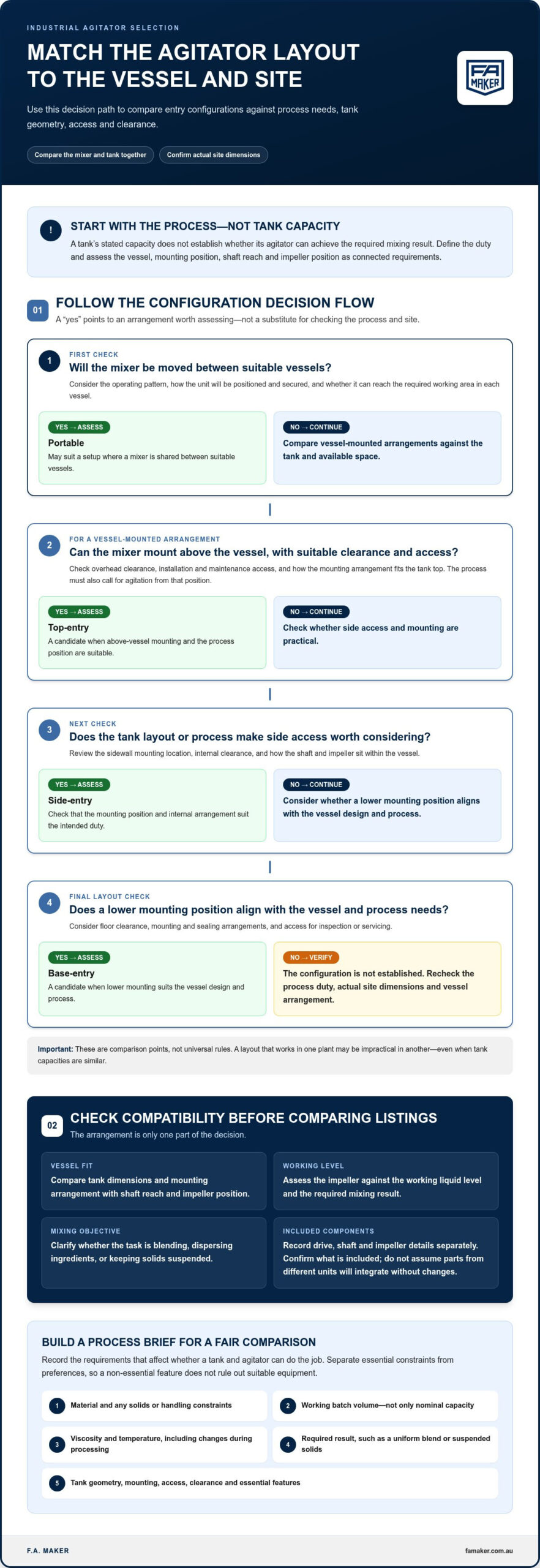
Once the process duty is clear, compare agitator arrangements against the vessel and the space around it. Each layout affects installation, access and how the mixer fits the tank. A configuration that works in one plant may be impractical in another, even when the tanks have similar capacities.
Tank geometry and agitator configuration must be assessed together because vessel dimensions, mounting position and shaft reach affect whether the mixer can perform the intended duty.
| Arrangement | Points to assess | May suit when |
|---|---|---|
| Top-entry | Check overhead clearance, installation and maintenance access, and how the mounting arrangement fits the tank top. | A mixer can be mounted above the vessel and the process calls for agitation from that position. |
| Side-entry | Review the sidewall mounting location, internal clearance and how the shaft and impeller sit within the vessel. | The tank layout or process requirements make side access worth considering. |
| Base-entry | Consider floor clearance, mounting and sealing arrangements, and access for inspection or servicing. | A lower mounting position aligns with the vessel design and process needs. |
| Portable | Assess how the unit will be positioned and secured, and whether it can reach the required working area in each vessel. | Operating patterns involve suitable vessels and moving the mixer between them. |
These are comparison points, not universal rules. Limited headroom, for example, may make a top-entry arrangement difficult to install, while a portable mixer may suit a setup where equipment is shared between vessels. Neither observation replaces checking the process duty and actual site dimensions. Choosing the Right Industrial Mixing System also covers viscosity, process type and equipment selection.
Compare the tank’s dimensions and mounting arrangement with the mixer’s shaft reach and impeller position. Assess the impeller against the working liquid level and required mixing result, rather than selecting it simply because it fits the shaft. Product properties matter too: blending liquids may call for a different mixing action from keeping solids suspended.
Record the drive, shaft and impeller details as separate specification items. Don’t assume a listing includes every component needed for operation, or that parts from different units will integrate without changes. Confirming what is included helps distinguish a complete arrangement from a tank or mixer that needs additional components. The used industrial mixers and blenders guide covers broader mixer-selection considerations.
Use these criteria to compare each industrial agitator tank for sale with your process brief and site constraints. F.A. Maker supplies used stainless steel tanks and industrial mixers. Explore its equipment range at F.A. Maker.
Used equipment needs a measured assessment, not a blanket pass or fail. Condition matters in relation to the intended process: a visible mark may need investigation, while a tank that appears sound may still be unsuitable for the required duty. Use the steps below to structure a review of an industrial agitator tank for sale, without treating a listing or visual check as proof of performance.
Keep observations separate from conclusions. A photograph can document a surface mark or repair, but it can’t confirm internal condition, material suitability or weld integrity. Equipment records provide context, but their value depends on what they cover and whether the information relates to the unit being considered.
For a stainless steel vessel, record the stated material and note any visible areas that need closer assessment. Don’t assume an exterior inspection represents the condition of internal surfaces or product-contact areas. If the process depends on specific material or cleanliness requirements, have those points technically assessed against the application.
Review the drive, shaft, impeller and mounting as a working assembly. Consider whether the arrangement matches the required mixing duty and whether the shaft can reach the intended working area within the tank. Identify missing or mismatched parts rather than assuming they can be replaced or integrated without further work.
Also document electrical and control interfaces, vessel connections, installation access and available site clearance. These factors can affect how the equipment fits into the production line, even if its basic configuration appears suitable. Technical verification of operation, condition or process performance requires a qualified assessment. Don’t describe an individual unit as inspected or tested unless that work has actually been completed.
Keep a clear record of what is documented, what is visibly observed and what still needs technical verification. This gives the purchase decision a sound basis and ties equipment condition to the duty it must perform.
A listing can look suitable by capacity or configuration while leaving important purchase questions unanswered. Compare each option against the process brief, condition, available documentation, integration work and delivery requirements. Assessing these factors separately helps prevent a decision based on a short equipment description alone.
Neither new nor used equipment is automatically the better choice. A used unit may align with the duty and site requirements, while a new system may suit a project with requirements that existing equipment can’t meet. Judge each against the same criteria: process fit, condition, records, required modifications and the practical steps needed to put it into service.
A complete tank-and-agitator system can make it easier to assess vessel and mixer compatibility as a whole, provided its specifications match the intended duty. Review what the package includes and whether its components, mounting and interfaces suit the process and production line. “Complete” describes the grouping, not proof of operational suitability.
Equipment selection should account for the route from its current position to the intended installation point. Record the tank and mixer dimensions and weight, then compare them with access at both ends, including doorways, internal routes and space for unloading and positioning. Consider how the unit will be handled inside the site, where it will be placed, and what needs to happen before installation.
Sequence matters. Access for moving the vessel may change after surrounding equipment is installed, while the mixer may need a different handling or assembly plan. Include these constraints in the comparison before settling on an option. F.A. Maker’s industrial machinery relocation services cover planning considerations for moving industrial equipment.
Use a consistent comparison record for every industrial agitator tank for sale. Note process fit, known condition, documentation, integration requirements and transport considerations separately. This makes trade-offs visible without relying on assumptions about age, completeness or listing language.
Explore F.A. Maker’s used tanks, industrial mixers and machinery relocation services for equipment sourcing and relocation planning.
A concise purchase brief turns process needs into a consistent basis for reviewing equipment. It also separates non-negotiable requirements from preferences, so you can assess a listing on its fit rather than its headline description. Use the template below before comparing an industrial agitator tank for sale.
Describe the process in plain operational terms, then record vessel and agitator requirements separately. If a detail is unknown, mark it for technical review rather than filling the gap with an assumption.
Mark each item as essential, preferred or still to be determined. For example, a defined working batch volume may be essential, while a preferred mounting arrangement could remain flexible if another option meets the process and site constraints. This classification keeps the brief useful without turning an unverified feature into a selection requirement.
Use the same brief to compare each suitable option. F.A. Maker supplies used stainless steel tanks and industrial mixers, equipment categories relevant to buyers sourcing a tank-and-agitator arrangement. Compare a package and separately sourced components against the same process, compatibility and site requirements.
Keep decision factors distinct as you review options. Record what is known about equipment condition and documentation, what requires technical assessment, and what integration work may be needed. Include transport and installation in the purchase plan: dimensions, weight, access and handling sequence can affect whether equipment can be moved into its intended position. F.A. Maker also provides machinery relocation services, making relocation a practical consideration alongside equipment sourcing.
A clear brief won’t make every listing suitable, but it gives you a disciplined way to identify where an option fits and where further assessment is needed. To discuss your industrial equipment requirements with F.A. Maker, discuss your industrial equipment requirements.
Before committing to an industrial agitator tank for sale, involve the people responsible for production, maintenance and site preparation. Their input can surface practical requirements that are easy to miss in an equipment comparison, such as routine access, connection points or the order in which machinery must be moved and installed.
Keep the brief available as the purchase progresses. If process conditions or site constraints change, update it and reassess shortlisted equipment against the revised requirements. This creates a clear record of why an option was considered suitable and which details still need technical review.
F.A. Maker supplies used stainless steel tanks and industrial mixers for process equipment sourcing. Explore used tank and mixer options with F.A. Maker as a practical next step in planning your purchase.
A considered brief gives your team a stronger basis for moving from equipment search to a well-planned installation.
An industrial agitator tank is a process vessel fitted, or intended to be fitted, with mechanical equipment that moves or mixes its contents. Depending on the arrangement, the equipment may include a drive, shaft and impeller. A listing might describe the vessel and agitator together or refer to one component only, so identify what is included before comparing it with your production process requirements.
Choose by matching the equipment to the product and the result your process needs, rather than by capacity alone. A duty involving a thickening product, for example, may place different demands on the mixer than a straightforward liquid blend. Consider batch size, temperature, product behaviour, mixing objective and available installation space. Use these criteria to rule out options that don’t align with the actual operating conditions.
A top-entry agitator is mounted above the vessel, with its shaft extending down into the contents. A side-entry agitator enters through the tank wall. The mounting position affects the space required around the vessel, equipment access and how the mixer fits the tank. Compare both arrangements against the vessel design and process duty; neither layout suits every application.
Yes, a separate agitator may be suitable for an existing tank if the mixer and vessel are compatible with the intended duty. Check the tank’s mounting point, dimensions and internal clearance against the agitator’s shaft reach and impeller position. Also account for connections and controls. If the tank’s original specifications or drawings are available, they can help clarify interfaces for technical review.
Start by matching the unit’s identification details and available records to the equipment being offered. Note visible corrosion, deformation, repairs, leaks or missing parts, and record their locations. These observations help guide further assessment but don’t establish internal condition or operating performance. For a purchase decision, separate what you can see from what needs technical verification, and relate both to the proposed process duty.
Suitability depends on whether the vessel and mixer can handle the product under the actual operating conditions. Consider how the product behaves during processing, including changes in viscosity or the presence of solids, and define the required mixing result. A unit suitable for blending one liquid may not achieve the same result with a different material. Use product and process details to support a technical assessment.
Provide a short description of the product, mixing objective, working batch volume and operating temperature. Include known material properties, preferred vessel material and agitator arrangement, plus dimensions or site constraints that affect installation. State whether you need a complete system or are matching a mixer to an existing tank. Available equipment records, drawings and identification details can also help clarify the search requirements.
An industrial agitator tank can be relocated if the move is planned around the equipment and both sites. Dimensions, weight, lifting and handling needs, route access and the intended installation position all affect the relocation plan. Consider when the vessel and mixer will be moved and how they’ll enter the production area. F.A. Maker provides industrial machinery relocation services as part of its industrial equipment offering.