

A mixer and a blender do not always do the same job. Mixing is a broad term for combining materials, while blending usually means distributing dry powders evenly. The right industrial blending equipment for powders depends on the materials, batch size and production process, not just the machine’s name.
That distinction matters when comparing equipment. Particle size, density and flowability affect how powders move and combine. Batch volume and cleaning requirements also influence the equipment and its configuration.
This guide explains how mixing differs from blending and outlines practical factors for comparing blender types, capacity, plant layout and stainless-steel requirements. It also covers cleaning and contamination control, helping you focus on equipment suited to your process rather than relying on a label alone.
Start by matching powder properties to the blender’s material and contact surfaces. Consider particle size, shape, density and flowability, then assess whether the powder may cause corrosion or abrasion. Abrasive material can wear surfaces over time, while corrosion can complicate cleaning. These factors matter in manufacturing because residue from one batch can affect the next batch’s composition and consistency.
Cleaning access is part of equipment selection, not a task to leave until production begins. Accessible components, smooth surfaces and parts that can be disassembled help operators clean powder-contact areas thoroughly. For example, powder trapped around a hard-to-reach joint may remain after routine cleaning. A design that opens for inspection makes those areas easier to identify and clean between batches. The cleaning method should suit both the equipment and the materials processed.
In Australia, practical options for sanitary or food-grade powder blending include stainless-steel equipment designed for accessible cleaning and intermediate bulk container (IBC) blending. These are equipment and process choices, not a guarantee of food-grade certification. The right option depends on the powder, cleaning requirements and production process. Smooth surfaces, accessible components and easy disassembly support cleaning and help reduce the risk of cross-contamination between products.
IBC blending takes place inside the container, so the container can be cleaned or changed between batches instead of cleaning the blender itself. Switching between IBC sizes on the same blending device can support different batch volumes. No single IBC capacity suits every process. Choose a capacity based on the required batch volume, the powder’s handling properties and the space available for moving and storing containers.
For each changeover, follow a defined sequence: empty the previous batch, inspect powder-contact areas, clean them using a method suited to the material, then check for visible residue before loading the next batch. Pay particular attention to outlets, seals, covers and transfer points, where powder can collect. Chemical powders also require adequate cleaning between batches to reduce contamination risk. Base the sequence on the materials involved rather than assuming one method suits every powder.
Finally, connect cleaning checks to blend quality. Representative samples from different stages can help monitor consistency, while residue checks address contamination between batches. Under-blending may leave pockets of unmixed powder; over-blending can reduce particle size and alter physical or chemical properties. If a powder is abrasive, corrosive or difficult to remove, account for those characteristics when selecting equipment and planning changeovers.
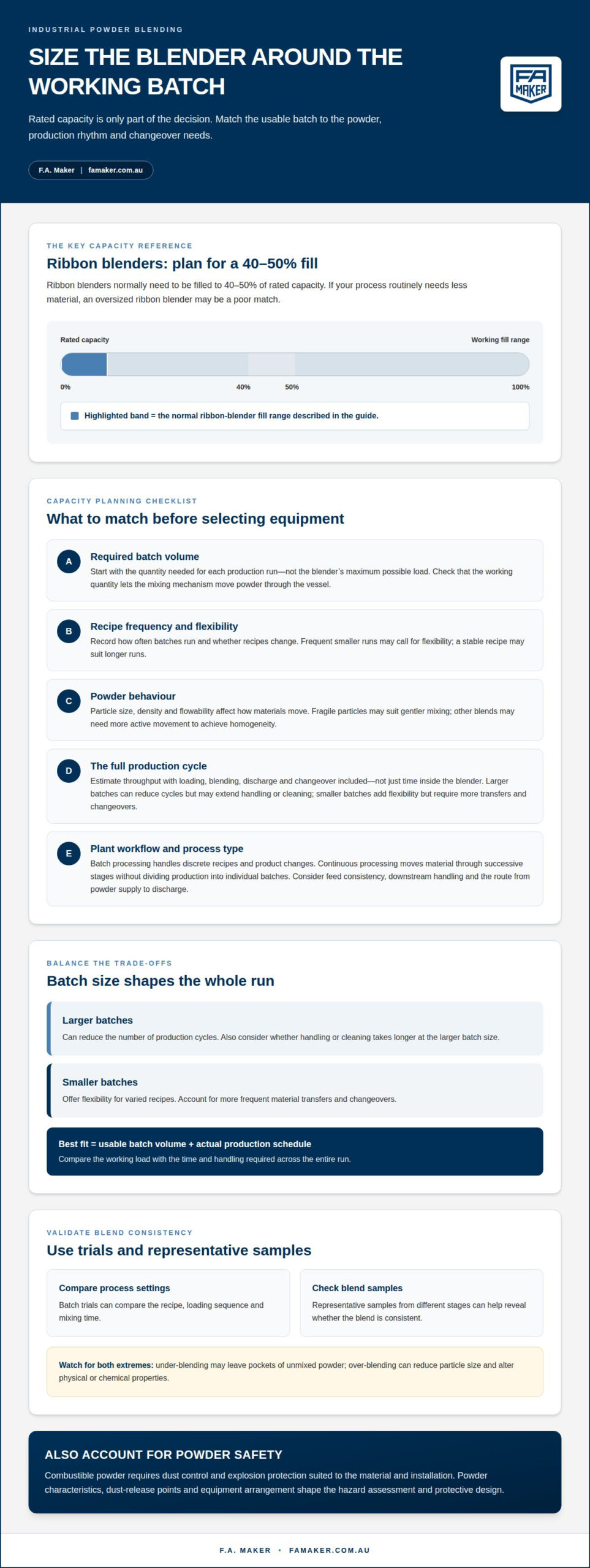
Start with the quantity needed for each production run, not the blender’s maximum possible load. Record the target batch volume, how often batches run and whether recipes change between runs. For example, a line making several powder formulations may need frequent smaller batches, while a stable recipe may suit longer runs. These requirements shape equipment capacity and the time available for loading, blending, discharge and cleaning.
Rated capacity alone doesn’t tell you whether a blender will mix effectively at your working load. Ribbon blenders normally need to be filled to 40-50% of their rated capacity. A process that routinely needs less material may therefore be a poor match for an oversized ribbon blender. The working quantity must allow the mixing mechanism to move the powder through the vessel rather than leaving material outside the effective mixing zone.
Powder behaviour also affects practical batch size. Particle size, density and flowability influence how materials move through a blender. Gentle mixing may suit fragile particles, while another blend may need more active movement to achieve homogeneity. Batch trials can compare the recipe, loading sequence and mixing time. Representative samples from different stages help reveal whether the blend is consistent.
Throughput depends on more than the quantity loaded. Include loading, blending, discharge and changeover when estimating how many batches fit into a production shift. A larger batch can reduce the number of cycles, but may extend handling or cleaning. Smaller batches offer flexibility for varied recipes, yet require more frequent material transfers and changeovers. The best fit balances usable batch volume with the actual production schedule.
Batch processing suits operations that need discrete recipes, controlled quantities or product changeovers. Continuous processing moves material through successive stages without dividing production into individual batches. The right arrangement depends on recipe variation, feed consistency, downstream handling and plant workflow. Map the route from powder supply to blending and discharge. A batch blender needs loading and receiving points that fit the production layout.
Combustible powder requires dust control and explosion protection suited to the material and installation. There is no universal setup: powder characteristics, dust-release points and equipment arrangement shape the hazard assessment and protective design. Include these considerations when assessing batch size, feed and discharge interfaces, rather than treating dust management as an add-on.
For a process built around ribbon blending, industrial mixers and blenders can be considered alongside the required working batch and production sequence.
Powder blending combines dry ingredients into a uniform product, while mixing can describe combining materials more broadly. This distinction helps define the equipment’s job before comparing designs. Industrial blending equipment for powders must suit the application and the mixing intensity required. Some ingredients need gentle movement; others require more active mixing to reach a homogeneous blend.
Ribbon blenders, V-blenders and double-cone blenders are used for industrial powder blending. Ribbon blenders use an internal mechanism to move powder through the vessel. V-blenders and double-cone blenders rotate their vessels, moving material through the blend. As these designs produce different movement patterns, assess how each handles your specific powder combination rather than choosing by machine name alone.
Materials and production goals should guide the comparison. Particle size, shape, density and flowability affect how ingredients move during blending. Consider whether the process prioritises gentle handling, efficient movement or a defined level of blend uniformity. Industrial blending equipment for powders should also match the required batch volume and production sequence. A machine suited to one recipe may not suit another with different material properties.
To choose a powder blender, define the desired blend outcome, identify the materials and expected throughput, then compare the mixing action with those requirements. Assess representative samples from different stages to monitor consistency. Under-blending can leave pockets of unmixed ingredients; over-blending may reduce particle size and affect physical or chemical properties. Sampling and process observations are useful parts of equipment evaluation.
Australian safety requirements for industrial powder mixers depend on the powder hazard and the installation. Consider dust release, dust control and explosion protection as part of process design. The material and equipment arrangement inform the measures needed, so a generic specification cannot address every plant or powder.
Australian suppliers and manufacturers offer industrial powder blending equipment in several configurations, including ribbon, V and double-cone designs. Compare options by mixing action, material suitability, throughput and the uniformity the process requires. Supplier descriptions are a starting point, but the practical choice depends on how the equipment fits actual production conditions. These criteria help narrow the options without assuming one blender type suits every application.
Finish the comparison by matching each design’s advantages and limitations to the application. The required mixing intensity varies by powder: some need gentle blending, while others need more active mixing to achieve homogeneity.
Plan the powder route before positioning a blender. Map each transfer from receiving and storage through feeding, blending, discharge and packing. For example, a batch process may move powder from a storage vessel into a blender, then send the finished blend to a packing point. Each hand-off needs a workable connection, so the layout supports product flow rather than adding unnecessary handling.
Plant dimensions are only one part of the space assessment. Include the blender’s position, feed and discharge paths, operator and cleaning access, and room to handle containers. A compact installation can still be difficult to operate if a discharge point sits behind another machine. Consider how covers open and components are accessed, then position equipment so routine cleaning and inspection fit the available area.
Powder properties influence the transfer method. Particle size, shape, density and flowability affect how material moves from storage into the blender. A free-flowing ingredient may feed differently from a powder that tends to bridge or generate dust. Review the complete route, including chutes, hoppers and transfer points. A suitable blender cannot compensate for interruptions before material reaches the vessel.
Match the blender’s discharge to the next production stage. A batch may move into an intermediate container, a downstream process or a packing line. For example, a plant filling bags needs a clear route from the blender outlet to the packing area, without crossing incoming ingredients. Separating these routes can simplify material identification and reduce unnecessary movement through the production space.
Compare transfer methods with the plant’s physical arrangement and process needs. Gravity transfer depends on suitable equipment positioning, while mechanical conveying can connect equipment along a different route. Each method affects access, handling and how easily powder can be removed from the transfer path during a product change. Choose an arrangement that fits the actual material route, rather than designing around the blender alone.
Dust control also belongs in the layout plan. Identify where powder is exposed during loading, discharge and transfer, then account for those points when arranging extraction and containment. For combustible powders, the material hazard and installation inform the required protection. Mark potential dust-release locations on the process drawing so they are considered alongside equipment placement.
Before installation, trace a representative production run on the plant layout. Follow the ingredients from receipt to storage, through blending, and onward to packing or the next process. Mark operator access, cleaning points, transfer connections and container movement areas. This practical walkthrough can reveal conflicts before equipment placement is finalised, such as a blocked access route or a transfer path crossing finished-product handling.
Stainless steel is a material choice, not proof that a blender suits every powder. Start by checking how the ingredients interact with product-contact surfaces. Corrosive powders can affect equipment materials, while abrasive particles can wear them during repeated production. A pharmaceutical blend, for example, may have different contamination controls from an industrial mineral powder. Match material selection to the product, cleaning method and operating conditions.
Inspect the surfaces and contact areas that powders encounter, including the vessel, outlet, covers and seals. Smooth surfaces, accessible components and easy disassembly support thorough cleaning between batches. Look closely at joints and discharge points, where residue may collect after ingredients are combined. A surface that appears clean from outside may still conceal powder in a hard-to-reach area, so access for inspection matters as much as the vessel material.
Stainless-steel construction alone does not establish sanitary or food-grade suitability. The complete equipment design and cleaning process matter, particularly for food manufacturing or pharmaceutical applications. Consider whether operators can reach product-contact areas, remove parts for cleaning and inspect the equipment before the next batch. If a process uses several powders, changeover procedures should address residue from the previous material and help prevent cross-contamination.
Assess blend performance alongside material compatibility. A suitable machine must mix consistently and produce a homogeneous blend, not merely have stainless-steel surfaces. Powder properties affect movement through the vessel, and the mixing action must suit the ingredients. Take representative samples at different process stages to monitor consistency. Under-blending can leave unmixed pockets; over-blending can reduce particle size and affect physical or chemical properties.
For an existing plant, assess the machine as part of the full product-contact route. Trace powder from feed point to discharge, including transfer connections and any receiving vessel. A stainless-steel blender connected to a surface or component that retains residue can still create a cleaning challenge. Include surrounding transfer points in changeover planning. If the process handles a range of products, evaluate the cleaning sequence against the most difficult powder to remove.
Use a practical selection sequence: identify the powders and their material effects, define cleaning and contamination controls, then assess surface access and blend consistency. Finally, examine the equipment’s condition and product-contact areas before settling on a configuration. This approach keeps stainless steel in context: it is one part of equipment suitability, alongside process performance and cleanability. Explore stainless-steel process equipment options as part of your equipment assessment.
F.A. Maker supplies industrial mixing and blending equipment for powder processes. Its range includes Industrial Mixers and Blenders, including ribbon blenders, for production requirements shaped by material properties, batch volumes and plant layout.
For a broader process line, Used Stainless Steel Tanks, Pumps and Valves, and Centrifuges and Separators may also be relevant. Consider these alongside a blender when planning material storage, transfer and downstream processing. The right combination depends on how powders move through your operation and the needs of each process stage.
If you’re assessing equipment for a specific powder application, contact F.A. Maker to discuss your requirements.
Turn your production priorities into a clear equipment brief. Record the required blend outcome, the powders involved, expected batch pattern, cleaning needs and where the machine must connect with the existing line. This gives equipment discussions a practical starting point and keeps selection focused on the work your plant needs to perform.
F.A. Maker supplies Industrial Mixers and Blenders, Used Stainless Steel Tanks, and Centrifuges and Separators. These options can help when assessing a blending machine alongside related process equipment. The right configuration depends on how each item fits your production requirements, rather than on a machine label alone.
With a focused brief, you can discuss industrial blending equipment for powders in terms of the operating conditions that matter to your site. Contact F.A. Maker to discuss your equipment requirements and take the next step with confidence.
Mixing is the broader term for combining materials; blending usually means distributing dry powders evenly through a mixture. For example, adding several dry ingredients to create a consistent recipe is powder blending. This distinction helps define the required result: if each ingredient must be evenly represented in the finished batch, assess the process by blend uniformity, not simply by whether the materials have been combined.
Common options include ribbon, V and double-cone blenders, as well as IBC blending systems. Each handles powder movement differently, so selection depends on the application and required blend outcome. Ribbon blenders are one option for industrial production; V and double-cone designs use a rotating vessel. IBC systems blend inside the container, and switching container sizes can support different batch volumes with the same blending device.
Ribbon blenders use an internal mechanism to move powder, while tumble blenders rely on vessel rotation. Paddle mixers use paddles to move material. These differences affect how powders circulate, so no single type suits every recipe. Compare the materials, desired mixing intensity and blend uniformity, then assess the finished blend using representative samples. A process trial can reveal whether the mixing action suits the product.
Available batch capacity varies by blender and process; size the equipment around the powder volume required per batch, not rated capacity alone. Ribbon blenders normally need a fill level of 40-50% of rated capacity. IBC blending can accommodate different batch volumes by switching container sizes. Production capacity also depends on loading, mixing, discharge and changeover time, so consider the complete cycle when planning throughput.
After a batch, empty the blender and clean product-contact areas using a method suited to the powder and equipment. Inspect outlets, seals, joints and covers for trapped residue, then ensure accessible components are clean before loading the next material. Follow the equipment’s maintenance requirements for inspection and care. For ingredient changeovers, include connected transfer points in cleaning checks to help limit carryover.
F.A. Maker is identified as a supplier of industrial mixers and blenders.