

An auction isn’t always the most practical way to buy used industrial equipment. The right choice depends on more than the bidding format: equipment condition, process fit, available technical information and the work involved in moving and installing it all matter. If you’re comparing industrial equipment auction alternatives, use these factors to assess the terms and risks of each route.
This guide compares auctions with direct sourcing and other common ways to find used equipment. It outlines what to review in equipment information, how to prepare for an inspection and what to include in relocation planning, so you can choose an approach that fits your purchasing process and site requirements.
We’ll look at the trade-offs between buying at auction and sourcing through a specialist supplier or private seller, including how each route can affect selection and the information available to you. For process equipment, considering related categories such as tanks, mixers, mills and conveyors can help you plan for connected production needs. F.A. Maker supplies used industrial process equipment and provides machinery relocation services for the work that follows equipment selection.
An auction alternative is another way to source used equipment, such as buying directly from a specialist supplier or negotiating a private sale with an owner. It doesn’t mean auctions are unsuitable. Comparing routes helps you judge how each one supports your equipment requirements, information needs and purchasing process.
That comparison matters for process equipment. A search for a stainless steel tank, centrifuge, mixer, pump or conveyor has different technical considerations from a search for an excavator or other earthmoving machinery. Capacity, materials, connections and the machine’s role in an existing line can all affect whether it suits the application. An auction may offer a broad set of lots, but a large selection does not establish that any particular machine meets your process requirements.
Base the sourcing decision on equipment fit, the information available to assess it and the logistics of getting it into operation. Buyers comparing industrial equipment auction alternatives can use these factors to identify which route best matches their needs. Timing matters too: an auction calendar and bidding window set a defined pace, while a direct purchase follows its own negotiation and transaction process. In either case, inspection access, documentation and transport planning affect the work involved.
An auction may suit buyers who value competitive bidding and the chance to review multiple listed lots through one sale. Auction formats vary; the types of auctions for industrial equipment can include different bidding approaches. The sale date, bidding rules and terms define the process, so understand the timetable before participating. Lot details and inspection arrangements vary, and can affect how thoroughly you can assess equipment before bidding.
For process equipment, the suitability of a particular machine can matter more than the size of the selection. Direct sourcing provides an opportunity to discuss the application, required capacity and available documentation as part of the purchase process. A private sale can connect a buyer with an owner, though the information and steps involved depend on the parties. These routes aren’t inherently safer, cheaper or faster. Their value depends on how well the process supports the buyer’s requirements.
Non-auction routes differ in how buyers find equipment, receive information and agree on a transaction. With a specialist supplier, the buyer can start with a process requirement and explore relevant equipment categories. A private sale is negotiated with the current owner. Brokers introduce or represent buyers and sellers, while an expression of interest invites offers under a process set for that sale. None of these routes follows one standard set of terms.
Whichever route you consider, anchor the assessment to the application. A machine’s name or broad category is only a starting point. Capacity, materials, operating requirements, connections and its role in the line all affect suitability. Compare available specifications and condition details with your requirements. Then account for practical steps after selection, including inspection arrangements, disconnection, transport and installation planning.
Start by recording what the process needs from the equipment: its function, required capacity, materials handled and operating conditions. This brief helps focus a search on relevant categories rather than treating every listing as an equivalent option. For example, a requirement might point towards a stainless steel tank, separator, mixer or pump. Evaluate the technical fit and available information, not just the route used to buy the equipment.
Direct sourcing can also help you consider adjacent requirements. A process may involve several stages, so looking at related equipment categories can clarify what needs to work together. F.A. Maker supplies used industrial process equipment, including tanks, separators, mixers, pumps, mills and conveyors. Buyers can consider equipment across process stages, while assessing each machine against its particular application.
In a private sale, the buyer deals directly with the equipment owner. The parties establish how information is shared, how inspection is arranged and how they’ll proceed with an offer. A broker or intermediary can connect the parties or coordinate communication, but the role and transaction steps depend on the arrangement.
An expression of interest differs from open bidding. Buyers submit an offer or proposal according to the sale’s stated requirements, which may set a deadline or request particular details. The process doesn’t guarantee acceptance or a particular outcome. Across these industrial equipment auction alternatives, sale terms, documentation and inspection access depend on the equipment and transaction. For used process equipment and machinery relocation, explore F.A. Maker’s industrial equipment range.
Each sourcing route has a different process for finding equipment, reviewing information and managing timing. An auction can suit a buyer comfortable with competitive bidding and a defined sale schedule. Direct sourcing may suit a specification-led search where discussing the application is useful. Neither route guarantees a particular price, equipment condition or result.
Choose the sourcing method that fits your purchase criteria, not the format that offers the most listings. Use the comparison below to see where each route may align with your requirements, then assess the specific sale and machine.
| Route | Selection process | Information flow | Timing control | Logistics considerations |
|---|---|---|---|---|
| Auction | Choose from listed lots and bid under the sale rules. | Lot-specific details and inspection arrangements vary. | Sale dates and bidding deadlines set the pace. | Confirm collection requirements and plan transport around the sale terms. |
| Specialist direct sourcing | Discuss the application and relevant equipment categories with a supplier such as F.A. Maker. | Compare available machine information with process requirements. | Negotiation and purchase steps depend on the transaction. | Plan inspection, disconnection and relocation for the selected machine. |
| Private sale | Deal directly with the equipment owner. | Information sharing and inspection access depend on the parties. | Buyer and seller agree on the transaction process. | Coordinate access, collection and transport with the owner. |
| Brokered or tender-based | An intermediary connects parties, or buyers submit offers under stated requirements. | Information and communication follow the specific arrangement. | Submission periods or transaction milestones may apply. | Clarify handover and movement steps as part of the sale process. |
The table is a guide, not a ranking. Competitive bidding may suit a purchase where a listed lot meets the requirement and the terms work for the buyer. A direct discussion may be more useful when the search depends on specific requirements or explaining the intended application. Before deciding, compare the documentation, inspection access and transaction steps for the actual equipment and sale.
For a tank, compare its available specifications with process requirements, including capacity and materials. A centrifuge or mixer also needs to suit its intended role and operating conditions. In direct sourcing, discussing the application can help focus the search, but it doesn’t replace reviewing machine information. Buyers assessing tank requirements in depth can use this used stainless steel tank sourcing guide.
Inspection access, equipment records and transaction steps differ by route and sale. Treat transport and relocation as a separate workstream: even a suitable machine must be moved in a way that fits the site and project plan. Include these practical requirements in the comparison rather than assuming the purchase method settles them. Plan the move alongside equipment selection, including how the machine will be disconnected, lifted and transported. For physical handling and site setup, sourcing industrial equipment and tool rentals from services like Pahrump Rentals & Hardware can help streamline local project requirements during installation.
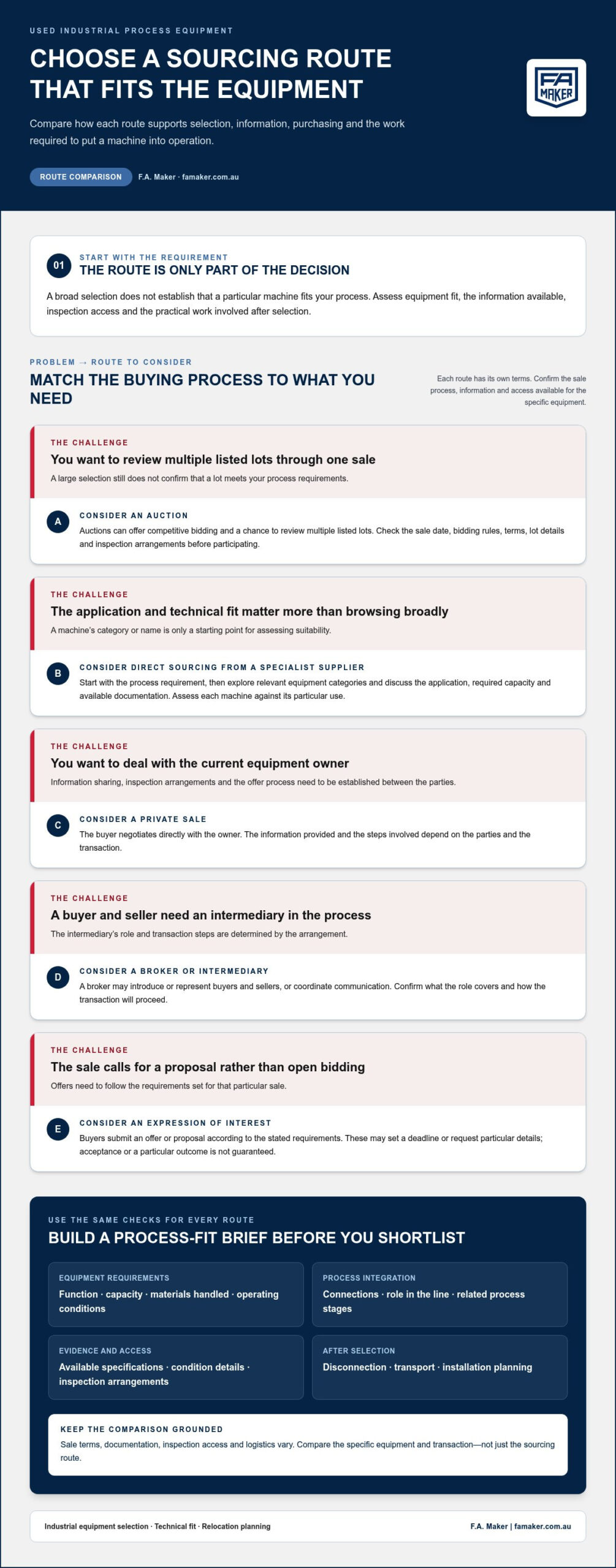
A structured search helps separate the process requirement from the purchasing method. Before comparing industrial equipment auction alternatives, record what the equipment must do, what information you need to assess it and what will be involved in moving it to site. Then compare the available routes against those requirements.
Write down the required function, target throughput or capacity, materials the equipment will contact or process, operating requirements and available site space. Identify essential documentation and inspection questions, such as which specifications you need to judge process fit and what condition information is available. If the equipment must integrate with other line assets, record the relevant connections and operating interfaces; for complex industrial flow systems, consulting specialists like Pro-Mech Engineering Solutions Pty. Ltd. can help define precise valve and integration specifications. These details make comparisons more specific.
Keep the machine assessment distinct from commercial terms. First consider whether the equipment appears to meet the process requirement based on available information. Then assess the sale terms and purchasing steps. Account separately for relocation and installation needs, which may affect the project plan even when the equipment itself is suitable. For wider context on the purchase decision, compare the requirements of used and new equipment for your application.
Consider inspection access early, including whether the machine can be viewed in its current setting and what information can be reviewed beforehand. For relocation, map the route from the equipment’s position to the loading point, and note access restrictions, lifting requirements, disconnection work and transport constraints. The relocation scope depends on the equipment and both sites, so keep it as a distinct planning task rather than assuming the purchase route covers it. For separation equipment, compare the machine’s role and available specifications with the requirements of the process.
Use the checklist to build a clear brief before approaching the market. To explore used process equipment categories and machinery relocation, view F.A. Maker’s equipment and relocation services.
For buyers considering industrial equipment auction alternatives, F.A. Maker offers a direct-sourcing route focused on used industrial process equipment. The Australian business supplies machinery across several stages of industrial processing and also provides machinery relocation services.
A supplier-led route can be useful when the search is defined by a process requirement rather than a broad machinery category. Consider the equipment’s intended function and how it relates to other stages of production. The specific machine, its available information and its fit for the application remain central to any evaluation.
F.A. Maker’s equipment categories include stainless steel tanks, centrifuges, separators, industrial mixers, pumps, mills and conveyors. These are process-equipment categories, not construction machinery. Looking across related categories can help you consider how equipment may fit into a wider line, such as conveying material between process stages or pairing a mixer with other equipment. Suitability depends on the requirements of the individual application.
Keep the search criteria specific. A buyer looking for a tank needs to assess its role in the process, while a search for a centrifuge or separator centres on the separation task. A pump, mill or conveyor has a different function. Comparing the relevant category with the process need helps narrow the search without assuming that equipment in the same category is interchangeable.
Equipment selection is only one part of a purchase plan. Before committing, consider how the machine will be accessed, disconnected, lifted, transported and positioned at the destination. Site access and equipment requirements can shape the relocation work, so account for the move alongside the purchase rather than treating it as an afterthought.
F.A. Maker provides machinery relocation services for industrial equipment. This allows buyers to include relocation in the overall equipment decision, with the scope shaped by the machine and project requirements. Planning the movement early helps clarify the practical steps between selecting equipment and placing it at the intended site.
F.A. Maker is an Australian, family-owned supplier with a history dating back to the 1920s. Buyers can compare its used industrial process equipment categories with their process needs, then factor relocation into the broader plan. To explore equipment and relocation services, explore F.A. Maker.
Before beginning a search, put the purchase brief into a form your team can use to assess options consistently. Record essential operating requirements, the information still needed to make a decision and practical constraints that could affect the project. This gives each potential route a clear test, whether you’re reviewing a listed lot or considering a direct purchase.
Use that brief to focus your search rather than trying to compare every available machine. If a particular requirement remains unresolved, identify it before progressing: a missing specification, an uncertain fit with the process or a relocation task that needs planning. Clear priorities keep the decision grounded in operational needs.
For buyers assessing industrial equipment auction alternatives, a specialist supplier is one route to consider. Explore used industrial equipment from F.A. Maker and compare its process equipment and machinery relocation services with your project requirements. A well-defined brief is a practical starting point for a sound equipment decision.
No. Industrial equipment auction alternatives include direct purchases from specialist suppliers, private sales with equipment owners, and brokered or tender-based transactions. Each has its own process for sharing information, reviewing equipment and submitting offers. For example, a buyer sourcing a pump for an existing production line could consider a direct supplier discussion as well as auction listings, then compare the available details with the line’s requirements.
Not automatically. A direct purchase may allow the buyer to discuss the intended application, while an auction may suit someone who wants to bid on a listed lot under a set sale process. Neither route guarantees better condition, a lower price or a better match. Compare the machine’s available specifications and condition information with your requirements, then weigh them against the purchase terms and time available for assessment.
The available options depend on the auction’s terms and the stage of the transaction, so read those terms before bidding. If you identify a mismatch before the sale, compare the equipment details with your requirements and decide whether the uncertainty is acceptable. If the issue becomes apparent after purchase, don’t assume the sale can be reversed. The written conditions determine the next steps.
Yes. Buyers can purchase through a direct supplier, negotiate with an equipment owner, or take part in a brokered or expression-of-interest process. These routes don’t require competitive auction bidding, though they may involve negotiation or submission requirements. For example, an expression of interest may ask buyers to provide an offer by a stated deadline. The specific sale process determines the information and steps involved.
Gather enough detail to assess whether the equipment suits its intended role. Useful information can include the machine’s specifications, capacity, materials of construction, dimensions, available condition records and relevant maintenance history. For a pump, confirm the details that matter to the process, such as required connections and operating conditions. Record any gaps and consider whether inspection or technical review can address them before proceeding.
Yes, machinery relocation can be arranged after purchase, but it’s sensible to plan the move before committing to a machine. Access, lifting requirements, disconnection and transport can affect how equipment is removed and delivered. F.A. Maker provides machinery relocation services for industrial equipment. The work involved depends on the equipment and project, so factor the move into the purchase plan rather than treating it as an afterthought.
They can be, provided the listed equipment and sale process suit the buyer’s requirements. A lot may be relevant to a process application, but its category alone doesn’t establish capacity, material compatibility or condition. Review the available information and inspection arrangements against the intended use. If a key process requirement can’t be assessed from the lot details, consider whether another sourcing route gives you a more suitable way to evaluate the equipment.