

A heavy machine can be ready to move and still be difficult to lift safely from its current position. An industrial equipment rigging company plans the lift around the load’s weight, balance, required reach and site constraints, then selects suitable cranes and rigging gear. The work may involve more than lifting: equipment may also need to be dismantled, repositioned and reassembled as part of a relocation or installation.
Rigging requires careful coordination because heavy equipment, restricted access and nearby obstructions can affect how a move is carried out. This article explains the equipment used in industrial rigging, how crane capacity is matched to a lift, and the planning and safety considerations that shape the work. It also outlines how rigging supports machinery moves across industries, so you can understand what a project may involve before deciding on next steps.
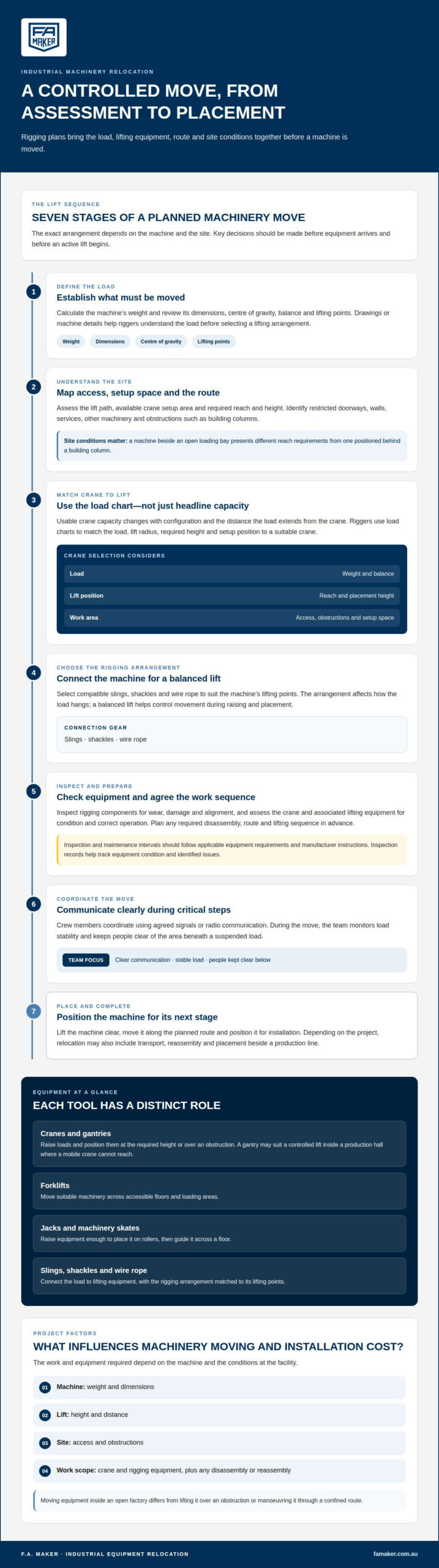
Industrial rigging uses cranes, forklifts, gantries, jacks and machinery skates to position heavy loads. Slings, shackles and wire rope connect a machine to lifting equipment. The right combination depends on the load’s weight, balance, lifting points, required height and site access. For example, a gantry may suit a controlled lift inside a production hall where a mobile crane cannot reach.
Professional riggers bring the equipment knowledge and coordination needed to manage complex moves. A heavy mixer or separator can be difficult to manoeuvre through a manufacturing plant, especially near walls, services or other machinery. Specialists assess the load and route, then choose lifting gear to support stable movement. Crew members coordinate the lift using agreed signals or radio communication, helping avoid confusion during critical steps.
Typical equipment has a distinct role in the lift:
Before lifting, riggers calculate the load and review drawings or machine details. They inspect each rigging component for wear, damage and alignment, then assess the lift path and potential obstructions. During the move, the team monitors load stability and keeps people clear of the area beneath a suspended load. These steps are especially important when a machine must pass through a restricted doorway or be placed precisely beside a production line.
What factors affect the cost of machinery moving and installation? The main factors are the machine’s weight and dimensions, lift height and distance, site access, the crane and rigging equipment required, and whether disassembly or reassembly is needed. Moving equipment inside an open factory differs from lifting it over an obstruction or manoeuvring it through a confined route.
Which industrial rigging companies operate near me in Australia? The right provider depends on the facility’s state or territory, the lift requirements and the equipment needed on site. For machinery moves, F.A. Maker provides Machinery Relocation Services, including project planning, disassembly, transport and reassembly.
A professional machinery relocation service brings planning and communication into one organised process. The team assesses the load, selects the rigging arrangement, plans the machinery’s route and coordinates the lifting work. For a production-line relocation, this can include lifting a machine clear, moving it through the facility and positioning it for installation. A defined sequence supports a controlled move and helps protect the equipment.
Crane selection starts with the load’s weight and the reach required at the site. A crane’s stated capacity does not describe every lift it can perform. Usable capacity changes with the crane configuration and the distance the load must extend from it. Riggers use load charts to match these conditions to a suitable crane, then account for the lifting arrangement and site obstructions. For example, a machine behind a building column may require a different reach from one lifted beside an open loading bay.
Project planning also considers the load’s dimensions, centre of gravity, lifting points and the surface available for crane setup. Slings and shackles connect machinery to the crane, and their arrangement affects how the load hangs. A balanced lift helps control movement during raising and placement. If access is restricted, the rigging plan may need a different crane position or lifting sequence. Make these decisions before equipment arrives on site, not during an active lift.
Crane hire can suit a project when the required capacity or configuration is specific to the job. Start by defining the load, lift radius, required height and available setup space. The crane and lifting equipment must work together under those conditions. A crane capable of lifting a machine in one position may have less capacity at greater reach. This is why a load chart, rather than a single headline capacity, guides equipment selection.
Crane maintenance supports reliable operation across repeated projects. Before a lift, the team should assess the crane and associated lifting equipment for condition, visible damage and correct operation. Inspection and maintenance intervals should follow the applicable equipment requirements and manufacturer instructions. Nobles states that lifting equipment in Australia should be inspected in accordance with the relevant Australian Standard. Inspection records help teams track equipment condition and address identified issues before lifting.
Hire arrangements also depend on how the crane will be used on site. A planned lift involving a brewery tank, for example, may require precise placement within an existing production area. The crane’s reach, setup position and coordination with slings all affect the plan. A lifting team should coordinate crane selection with the load and work sequence, keeping equipment capacity aligned with site conditions. This project-specific approach supports safe planning and operational compliance without relying on a crane’s maximum rating alone.
Industrial rigging providers differ in the projects they plan and the equipment they handle. A crane contractor may focus on lifting and rigging, while a machinery relocation team may coordinate removal, transport, installation and positioning. These activities can overlap, but rigging does not necessarily include transportation. For example, a contractor may lift a production machine inside a factory without moving it off site.
Specialities also vary by load and work environment. Construction and infrastructure projects can involve positioning structural components or production assets, while a manufacturing site may need machinery moved around an operating plant. Some projects require disassembly before a lift and reassembly after placement. Others focus on a controlled removal or installation. Define the scope to match the contractor’s equipment, crew and experience to the task.
Safety systems are another point of distinction. The International Organization for Standardization (ISO) identifies ISO 45001 as a safety standard that reputable rigging companies adhere to. For a project team, this provides a useful reference when assessing how a contractor manages safety. It does not replace a clear, site-specific plan for the proposed lift, access route and work sequence.
Before engaging a contractor, assess the project against practical capability areas:
A portfolio is most useful when it shows the type of work, not just the equipment pictured. A contractor that has handled a bottling line, for instance, may understand access and positioning around connected production equipment. A construction lift has different constraints from a machinery installation inside an existing plant. Reputation and customer support matter, too, because project changes can affect sequencing, access and coordination.
Inspection practices help establish whether the proposed equipment is suitable for the job. A sound process includes checking rigging components for wear, damage and alignment before lifting. The contractor should also explain how the lift will be coordinated, including hand signals or radio communication where needed. These details clarify responsibilities and make the work sequence understandable to site personnel.
For any project, the right speciality is the one that matches the load and full scope. Compare the contractor’s relevant portfolio, resources, capacity, manpower, reputation and customer support with the task. A clear scope, such as removing and reinstalling a machine, makes those capabilities easier to assess.
Industrial rigging supports projects across Australia wherever production equipment must be installed, repositioned or removed. Applications differ by industry: a food processor may need a filler placed within an existing line, while a manufacturer may need a mixer moved to another production area. The equipment, access route and operating environment shape the lift plan. Rigging can be part of a larger relocation, but lifting alone does not automatically include transportation.
In food and beverage processing, equipment layouts often connect several stages of production. A bottle filler, for example, must fit its intended position relative to the surrounding line. A rigging plan can account for the machine’s dimensions, access through the facility and placement sequence. At a dairy or beverage site, production requirements and nearby equipment influence when a move can take place and how the work area is managed.
Manufacturing sites use a wide range of machinery, so project scope depends on the specific asset and its function. An industrial mixer may need lifting for installation, while a production machine may need removal before a replacement is positioned. Each application calls for a defined sequence: identify the equipment, establish the route, plan the lift and coordinate placement with the facility’s operations.
Construction and infrastructure projects may have different site constraints from an established factory. A construction site can change as work progresses, affecting access for cranes and delivery vehicles. At an infrastructure facility, existing structures and operating equipment can limit where a lift is set up. The rigging team should relate equipment positioning to the site plan rather than treating each lift as an isolated task.
For projects involving international equipment supply, rigging may follow delivery to the Australian facility. The local work still depends on the machine’s dimensions, lifting points, route and final position. Supplying equipment and rigging it into place are distinct activities, so the project scope should clarify where lifting, movement and installation responsibilities begin and end.
To discuss a project clearly, define the equipment, its destination and the work required around it. A facility manager relocating a mixer, for instance, can specify whether the task involves positioning only or includes removal and reinstallation. This distinction helps frame the lift plan around the actual operation, site layout and machinery’s role in production.
Industrial rigging has no single price because every move involves different equipment, access and work. The price depends on the project and is provided after a quote request. In an Australian factory, moving a compact machine across an open floor differs from lifting a large unit into position above nearby equipment. The load, route and installation scope all affect the work required.
Load characteristics influence the lifting plan and resources. Weight, dimensions, centre of gravity and available lifting points help determine the crane and rigging gear required. A tall machine may need careful positioning through a doorway, while an uneven load may require a specific sling arrangement. Height and reach matter too, because crane capacity depends on the lift configuration, not only its stated maximum capacity.
Site conditions shape the job. Restricted access, overhead obstructions, uneven setup areas and limited working space can change equipment choices or the movement sequence. For example, a machine behind a fixed production line may need a different approach from one beside a loading bay. Planning also accounts for the route from the machine’s current position to its destination, including turns and clearance points.
The quoted scope should distinguish lifting from related tasks. Machinery relocation may include preparation, disassembly, internal movement, placement and reassembly. Transport between facilities is a separate consideration and should be identified in the project requirements. Lifting a machine onto a prepared pad is different from removing and installing it within an operating production area.
Common cost drivers include:
To help define a quote, provide the machine’s identification and dimensions, its current and intended positions, and any available layout drawings. Explain whether the work includes relocation, installation or both. For a brewery machine, for instance, describing its location within the production area helps clarify access and the work sequence. Clear project details make it easier to match the proposed scope and equipment to the move.
For machinery planning connected to production equipment, discuss your equipment requirements as part of defining the project scope.
F.A. Maker is a practical next step when planning a machinery move also involves sourcing processing equipment. Its range includes Industrial Mixers and Blenders, Used Stainless Steel Tanks, Centrifuges and Separators, and Pumps and Valves. These options may suit facilities upgrading production equipment or considering replacement machinery alongside a relocation project.
For example, a processing site planning a new mixing line can explore industrial mixers and blenders, while a facility reviewing its liquid-handling setup may consider pumps and valves. Matching the equipment category to the production task helps clarify operational needs before finalising a machinery plan.
Contact F.A. Maker to discuss the processing equipment relevant to your project.
A machinery move is also a useful opportunity to review how the production line will operate after installation. Consider the equipment’s role, its place in the process and whether the planned layout supports the next production stage. This broader view keeps relocation decisions connected to operational needs rather than treating the lift as an isolated task.
An industrial equipment rigging company can coordinate the physical move, while equipment sourcing decisions shape what the facility needs in its new setup. F.A. Maker offers Industrial Mixers and Blenders, Used Stainless Steel Tanks, and Centrifuges and Separators for processing operations. These categories may be relevant when a project involves reviewing or changing production equipment alongside a planned move.
Set out the machinery involved and the intended production outcome, then take the next step in planning. Contact F.A. Maker about your rigging project to discuss how machinery relocation fits your equipment requirements. A clear plan gives your team a practical starting point for the work ahead.
Rigging prepares machinery or another heavy load for controlled movement and placement. The work can include selecting attachment points, connecting lifting gear, directing the lift and positioning the load at its destination. For a production machine, the rigging sequence may need to account for protruding components or a centre of gravity that shifts during handling. The scope may also include disassembly or reassembly when the equipment’s size limits access.
Rigging safety depends on planning, equipment condition and clear coordination during the lift. Teams inspect components before use, agree on hand signals or radio communication, and keep people clear of the suspended load area. They also monitor load stability and prepare for interruptions, such as changing weather or equipment problems. In New South Wales, SafeWork NSW guidelines are relevant to rigging safety.
Services can include lifting, machinery removal, relocation, installation, disassembly and reassembly. Transportation may be coordinated with a separate industrial transport team, so do not assume it forms part of every rigging job. F.A. Maker provides Machinery Relocation Services for industrial processing equipment, including project planning, disassembly, transport and reassembly. The required scope depends on whether machinery is moving within one facility or between locations.
Start by establishing which licences and insurance documents apply to the specific work and location. A suitable contractor should be able to explain its credentials and provide relevant documentation for the project scope. Also assess its past work, lifting capacity, manpower, equipment and approach to site coordination. For a machinery installation, experience with similar loads and confined production areas can be especially relevant.
A site assessment connects the machine’s details with its route and final position. The team reviews load weight, height and travel distance, then considers access limits, obstructions and the available setup area. Layout drawings can help identify narrow passages or nearby structures. The plan then sets out the equipment arrangement, movement sequence and communication method, with changes addressed before the lift proceeds.
A machinery relocation typically starts by defining the equipment, destination and work scope. If the machine cannot pass through the available route intact, the process may include disassembly. The team then coordinates lifting and movement, positions the equipment at its destination, and completes reassembly where required. Transport between facilities may also form part of a wider project, coordinated with industrial transportation teams.
Rigging hazards include power-line contact, shock loading, falling equipment or debris, slips, equipment failure and pinch points. Teams reduce exposure by inspecting components, controlling access around the lift and coordinating instructions clearly. They also monitor load stability and plan for disruptions, including adverse weather. A defined movement path helps identify where machinery, personnel or site conditions could create additional risks.