

A separator is one part of liquid-solid separation, a process that removes solid particles from a liquid slurry through filtration, gravity settling or centrifugation. Industrial solids separation equipment uses these methods to separate the phases, recover solids or liquid, or prepare material for further processing. The right method depends on the slurry and what the process needs to recover.
Filtration passes the mixture through a medium that retains solids while liquid flows through. Sedimentation lets particles settle before the clearer liquid is decanted, while centrifugation spins the mixture to move solids outward from the liquid. In practice, pretreatment and solids concentration can reduce the amount of slurry entering the separation stage.
This guide explains how the methods work, how continuous and batch equipment handle slurries, and where separation is used in industries such as mining, food, chemicals, coatings, ceramics and water treatment. It also covers the process factors that shape equipment selection, helping you understand how a separation system fits into a wider production line.
Liquid-solid separation removes suspended or mixed solids from a liquid slurry. It can recover the solid, clarify the liquid, or prepare both streams for reuse or further treatment. For example, a mineral-processing plant may separate tailings solids from water to support water recovery and reduce environmental impact.
Centrifugation separates phases by spinning the slurry. Centrifugal force moves denser solids towards the bowl wall, while the liquid stays nearer the centre. The separated streams can then be discharged continuously or collected for the next process step. This method is useful when gravity settling alone cannot deliver the required separation rate.
In an industrial centrifuge, the rotating bowl creates the separation force. A decanter centrifuge has a scroll conveyor inside the bowl that moves settled solids towards a discharge point while clarified liquid exits separately. Feed rate, bowl speed, slurry consistency and particle characteristics all affect performance. A change in feed composition can shift the balance between liquid clarity and solids dryness.
Decanter centrifuges can support tailings treatment by separating water from mineral solids. Recovering liquid can reduce the need for additional process water, while discharged solids move to handling or storage. Equipment must suit the slurry’s particle size, abrasiveness and throughput, as these properties affect wear and separation results.
Operating costs include electricity for the drive, water for cleaning, and consumables such as lubricants and wear parts. Energy use depends on motor load and operating hours; water and consumable use vary with cleaning frequency, slurry characteristics and equipment design.
For Australian procurement, F.A. Maker offers centrifuges and separators, including decanters. Other suppliers and manufacturers also serve industrial process requirements, with equipment selected against the material, process duty and required output.
Installation requires a suitable foundation, correctly aligned connections, and integration with feed, discharge and control systems. During operation, monitor feed conditions, vibration, separation quality and discharge. Maintenance includes inspecting and cleaning wetted areas, checking wear components, and servicing rotating assemblies according to equipment requirements.
Common failure modes include imbalance from uneven solids build-up, blocked outlets, worn scrolls and leaking seals. Hazards include contact with rotating components, unexpected movement during maintenance, noise, hot surfaces and exposure to process chemicals. Guards, safe isolation before inspection, and controlled cleaning help manage these risks.
At its simplest, centrifugation separates the two phases by their position during rotation: solids move outward to the slurry’s edge, while liquid stays near the centre. The spinning action places the solid and liquid portions in different locations without changing what either portion is.
Once the phases occupy separate positions, the process can recover the solid fraction, the liquid fraction, or both, depending on the objective. The defining action is the same: spinning moves solids to the edge and leaves liquid near the centre. This is the basic principle behind centrifugation of a liquid-solid mixture.
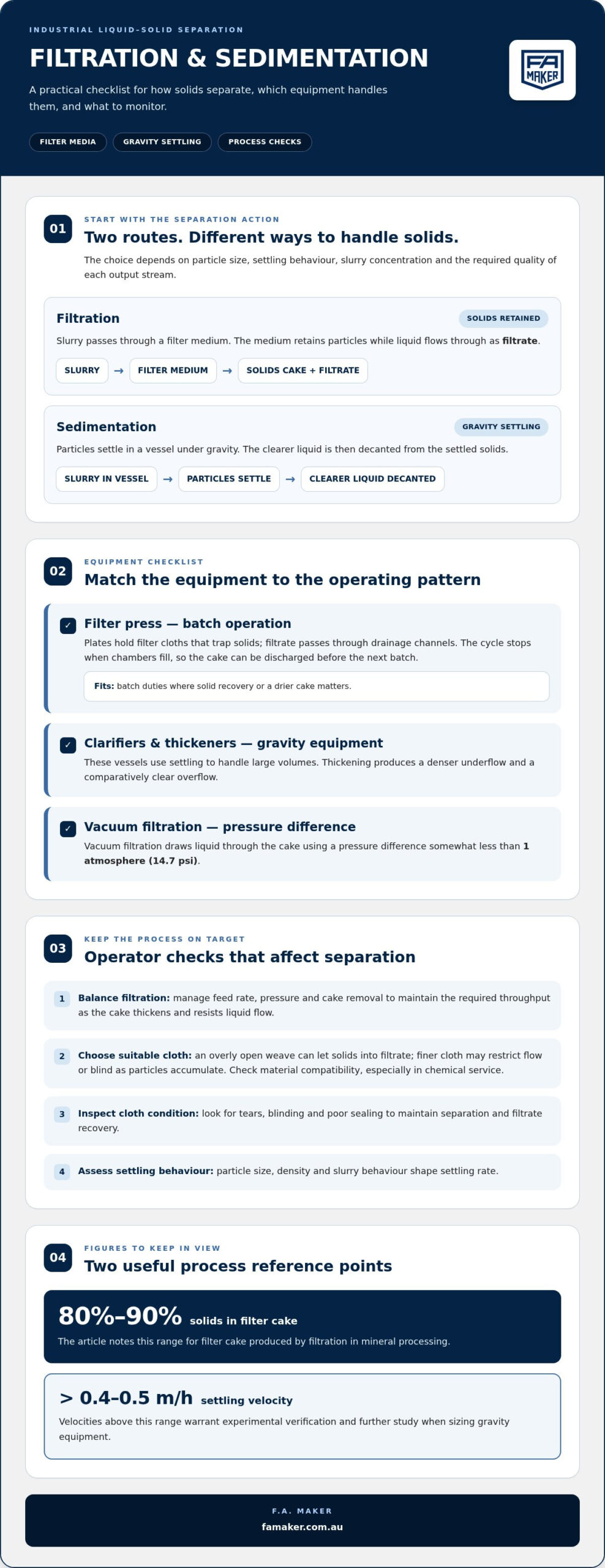
Filtration and sedimentation separate solids from liquid in different ways. A filter medium retains particles as slurry passes through, while liquid flows onward as filtrate. Sedimentation uses gravity to settle particles in a vessel before clearer liquid is decanted. The choice depends on particle size, settling behaviour, slurry concentration and the required quality of each output stream.
In filtration, solids collect on the filter medium and form a cake. As the cake thickens, it can capture finer particles, but it also resists liquid flow. Operators balance feed rate, pressure and cake removal to maintain the required throughput. Vacuum filtration draws liquid through the cake using a pressure difference somewhat less than 1 atmosphere (14.7 psi).
A filter press handles slurry in batches. Its plates hold filter cloths that trap solids while filtrate passes through drainage channels. Once the chambers fill, the cycle stops so the cake can be discharged before another batch begins. Filter presses suit batch duties where solid recovery or a drier cake matters. In mineral processing, filtration can produce filter cake containing 80%-90% solids.
Cloth selection affects filtration rate, particle retention and cake release. Cloth with too open a weave can let solids into the filtrate; finer cloth may restrict flow or blind as particles accumulate. Material compatibility also matters, particularly in chemical service. Regularly inspect for tears, blinding and poor sealing to maintain separation and filtrate recovery.
Sedimentation equipment allows particles to settle before liquid leaves the vessel. Clarifiers and thickeners use gravity to handle large volumes, with thickening producing a denser underflow and comparatively clear overflow. In sizing gravity equipment, settling velocities above 0.4-0.5 m/h warrant experimental verification and further study. Particle size, density and slurry behaviour shape the settling rate.
For continuous water treatment, a clarifier can separate settleable solids before downstream filtration. For batch production, a press can collect solids and recover filtrate in distinct operating cycles. A belt filter press removes water by squeezing and shearing slurry between two endless filter belts; it can operate at pressures up to 0.8 bar. The process choice should reflect whether the plant prioritises continuous flow, cake handling or liquid clarity.
F.A. Maker offers filter presses for industrial filtration duties. If a press suits the process, review the available filter press equipment as part of planning filtration and filtrate recovery.
If a gold-processing slurry requires solid-liquid separation, a countercurrent decantation circuit or a filter can recover solution containing most of the cyanide and copper cyanide species. These are two separation options for that slurry, with solution recovery identified as their purpose. The example links the choice of process to recovering solution while separating the solid and liquid portions.
More broadly, the paper describes mechanical separation equipment as relying on sedimentation or filtration, with the possible exception of impingement equipment. This description places the main equipment approaches in one of those two process categories while retaining impingement equipment as a possible exception. Sedimentation and filtration therefore provide the framework for describing mechanical separation, while the gold-processing example identifies a recovery application within that framework.
Separation duties vary across Australian industries because slurries differ in their solids, liquids and product requirements. Food processing may remove suspended material from a product stream, while a chemical plant may recover solids or clarify process liquid. Equipment choice depends on the required output quality, material compatibility and whether the process runs continuously or in batches.
In food and beverage production, separation can clarify liquid ingredients or remove solids before a later processing step. Dairy and brewery streams, for example, may contain suspended material that affects product consistency or downstream treatment. Centrifugal force separates phases by density, while filtration retains particles on a medium. Product-contact materials and cleaning procedures matter because residues can affect subsequent batches.
Chemical slurries require attention to both liquid and solid properties. Corrosive or reactive mixtures may require specialised membrane- or centrifuge-based systems selected for compatibility with the process. Coatings and ceramics can produce fine-particle slurries; filtration or sedimentation can separate solids for recovery, liquid reuse or controlled handling. Particle size and settling behaviour help determine which mechanical process is suitable.
Mining uses solid-liquid separation to recover solids, liquid, both streams, or to clean liquid before discharge. Tailings thickening uses a large-area circular tank: solids settle into a denser underflow, while a comparatively clear overflow can return to the process. Recovering this water can reduce demand for additional supply and help minimise the environmental impact of tailings management. Clarifiers and thickeners use gravity to settle solids while handling large volumes.
Water treatment applications include removing suspended particles before further treatment or reuse. The separation stage may combine gravity settling with filtration, depending on the incoming water and required downstream process. Some filtered waters have a turbidity target below 0.1 NTU at the 95th percentile and a maximum of 0.3 NTU. These values illustrate how a defined water-quality objective can shape process design.
Australian work health and safety and environmental requirements operate through applicable Commonwealth, state or territory frameworks, with obligations shaped by the site and process. Operators need to account for machinery hazards, chemical exposure, waste handling and discharge conditions when designing and operating a system.
For mining tailings, assess slurry characteristics, decide whether water or solids recovery is the priority, then select and integrate suitable equipment. Centrifugal force can support separation where density differences matter; gravity sedimentation suits settling solids and large-volume duties. In every application, performance depends on matching the process to the material and intended output.
Continuous systems separate a moving slurry without stopping production for each batch. Their design depends on the separation objective, feed behaviour and the next process stage.
Mechanical separation and sedimentation are two common approaches. Filtration retains particles on a medium, while gravity settling lets them collect before liquid moves onward. Flotation uses tiny air bubbles that attach to particles and carry them to the surface for removal. Choose a method according to whether the process prioritises solids recovery, liquid clarification or both, and whether the slurry must flow continuously.
Choose equipment by assessing particle size, slurry consistency, required throughput and whether the process runs continuously or in batches. Fine particles may need different treatment from coarse, granular solids; thick sludge also behaves differently from dilute feed. First define the target output, then assess feed variability, industry requirements, budget and maintenance demands. Together, these factors determine which method suits the process.
In mineral processing, separation can recover solids, process liquid, both streams, or clean liquid before discharge. A hydrocyclone can make fine particle-size cuts as a pretreatment or solids-conditioning step before another separator. It spins liquid inside a stationary chamber, unlike a centrifuge, whose chamber rotates. Hydrocyclones are most effective with granular particles whose specific gravity is about three times that of the liquid.
For liquid screening, a vibratory sieve moves slurry across a screen surface. Liquid and particles smaller than the openings pass through, while larger solids remain for removal. Screen aperture, feed rate and the slurry’s tendency to blind the mesh affect performance. Vibratory screening can therefore serve as an initial separation step when oversized particles need to be removed before downstream treatment.
A rotary drum filter can process slurry continuously as its rotating surface forms a filter cake. A reversed air blast and scraper knife remove the partially dried cake as the drum turns. This arrangement suits large slurry volumes where regular cake discharge is part of the process. The filtrate and removed solids can then be directed to separate recovery or handling stages.
For reliable continuous operation, consider feed distribution, solids discharge and cleaning access. Buildup on a screen or rotating surface can restrict flow and disrupt separation. Maintenance planning should account for wear on contact surfaces, screen condition, scraper performance and the route for discharged solids. In a mineral plant, aligning these checks with feed conditions and downstream processing helps maintain consistent separation.
Australian plants use centrifuges, decanters, filter presses, rotary vacuum filters, screens, hydrocyclones, clarifiers, thickeners, flotation systems and membranes. Each method suits a different feed or separation duty, so equipment selection should start with the material and required output.
A practical process train often combines equipment rather than relying on one separator. A screen can remove coarse material before a hydrocyclone makes a fine particle-size cut. The hydrocyclone conditions solids for a later separation step; it spins liquid inside a stationary chamber, unlike a centrifuge, whose chamber rotates. Granular particles with a specific gravity about three times that of the liquid suit hydrocyclone separation.
For large-volume liquid duties, clarifiers and thickeners use gravity to settle solids. A thickener produces a denser underflow and a comparatively clear overflow. In continuous countercurrent decantation, a series of thickeners moves underflow upstream, so concentrated solids and clarified liquid travel in opposite directions. This arrangement can support solution recovery in mineral processing.
Filtration equipment suits different operating patterns. Filter presses handle batch jobs, while rotary vacuum filters process large slurry volumes. Disc filters handle demanding mineral-processing duties, including dewatering lead-zinc-copper concentrate, low-grade iron ore-taconite, coal and aluminum hydrate. Choose according to the feed, cake-handling requirements and whether the operation needs batch or continuous processing.
Flotation separates particles by attaching air bubbles to solids and carrying them to the surface for removal. Rotor-stator devices whip air into the fluid; dissolved-air flotation releases pressurised air into a tank, where escaping bubbles attach to particles. Membrane separation uses pressure to move liquid through a membrane while retaining tiny solid particles. Each method suits different materials and process objectives.
Select equipment according to the separation objective: recover solids, recover liquid, recover both, or clean liquid before discharge. Then assess particle size, slurry consistency, throughput, process continuity, industry requirements, budget and maintenance demands. Chemical-processing slurries involving corrosive or reactive materials may require specialised membrane- or centrifuge-based systems.
For mineral circuits, consider lower-cost, high-throughput pretreatment before expensive separation operations. A hydrocyclone can condition feed; a thickener can concentrate solids; filtration can then produce a manageable cake. Matching each stage to the material helps prevent downstream separators from handling unnecessary slurry volume.
To assess processing equipment options for your operation, discuss your equipment requirements.
F.A. Maker supplies used stainless steel tanks and process equipment for Australian production operations. Its range includes centrifuges and separators, industrial mixers and blenders, and pumps and valves to support separation processes and related production stages.
These products support different stages of a process line: centrifuges and separators handle separation duties, pumps and valves move and control process streams, and mixers and blenders prepare materials before processing. Consider F.A. Maker when sourcing equipment for a production setup or reviewing machinery for an existing line.
For equipment enquiries, contact F.A. Maker or visit famaker.com.au.
Turn the separation requirement into a practical equipment brief before narrowing your options. Record how the slurry changes during production, where each output stream goes, and how the separator must connect with upstream and downstream machinery. Include available floor space, utility connections, cleaning access and the operating pattern. This gives your team a clear basis for assessing industrial solids separation equipment against the full process, rather than an isolated task.
F.A. Maker offers Used Stainless Steel Tanks, Centrifuges and Separators, and Industrial Mixers and Blenders. These categories can be useful when reviewing equipment for separation, material preparation and process-line integration. A concise brief describing your application and intended outputs can focus the discussion on equipment suited to your operation.
Use your process requirements as the starting point, then contact F.A. Maker about your process to discuss the next step. A structured equipment review can help you move forward with a clearer view of the production line.
Each method handles different feed conditions and separation targets. Screens retain particles larger than their openings, making them useful for coarse material. Centrifuges separate phases by density and suit slurries where settling needs to be accelerated. Filters capture solids on a medium, while clarifiers let particles settle in a tank. For example, a plant might screen incoming slurry first, then use a centrifuge or filter to meet its required output quality.
Capacity and separation efficiency depend on equipment design and the material being processed, so there is no single representative figure. Feed flow, particle size, solids concentration, viscosity and the required clarity or dryness all affect performance. A dilute slurry with fine particles, for instance, presents a different duty from a thick feed containing coarse solids. Compare equipment using the same feed conditions and target outputs, including expected variation during normal operations.