

What if the biggest constraint in an oversized equipment move isn’t the machine itself, but the route or site it needs to pass through? Working out how to move oversized equipment takes more than booking transport. Unverified dimensions, weight or lifting points can affect handling, access, safety and production schedules.
These risks are easier to manage when the equipment, route and destination are planned as one project. A structured process helps identify constraints early, coordinate handling and reduce avoidable damage, injury and operational disruption.
This guide covers the planning sequence before a move is booked, from confirming machine specifications and lifting requirements to checking site and route access. It also explains transport coordination, applicable Australian requirements and practical ways to align a relocation with facility operations. Use it to make informed decisions before moving day, whether you’re relocating one machine or planning a broader processing facility transition.
A suitable truck is only one part of an industrial equipment move. The plan must account for the machine’s dimensions and mass, how it can be lifted, the path out of the facility, the transport route and conditions at the destination. A constraint at one stage can affect the next. Restricted access may change the loading approach, while the receiving floor or available space may determine where and how equipment can be positioned.
There’s no single method for every move. A tank, centrifuge, mixer or conveyor presents different handling and access considerations, which can also vary with the facility layout. The question is not simply whether the equipment can be transported, but whether each stage can be completed safely and in sequence.
Early coordination connects equipment details, site access and handling decisions before they become avoidable risks on moving day.
Transport dimensions and lifting requirements are related, but they aren’t interchangeable. Overall length, width and height help establish whether equipment can pass through doorways, around corners and along its intended route. Mass informs lifting and transport planning, while the centre of gravity affects how a load may behave when raised or shifted. Shape matters too: a tall tank, an unevenly weighted centrifuge or a long conveyor may need a different approach from a compact mixer.
Fixed bases, projecting motors, guards, pipe connections and other attachments can change the equipment’s handling envelope. Fragile connections may need protection or disconnection before movement. Record the machine as it will actually be moved, including components that will remain attached, rather than relying only on a standard equipment description.
Unverified dimensions can create problems at the exit, loading area or destination. A machine may not clear a doorway, fit the planned lifting space or align with the unloading area. If the route includes tight turns, low clearances, uneven surfaces or shared operational zones, discovering a constraint during the move can force changes to the sequence or equipment arrangements.
Rushed preparation can expose components to impact, strain or uncontrolled movement. Disconnection, access preparation and coordination with facility operations all take planning. Delays can extend a shutdown or interfere with production schedules. The receiving site needs preparation too, including clear access and an agreed delivery position. Otherwise, equipment may arrive before the people, space or arrangements needed to receive it are ready.
A truck that can carry the load doesn’t make the move straightforward on its own. Lifting, securing, route access and delivery all need to work together. That is why how to move oversized equipment depends on the equipment type and conditions at both sites. Treating the move as a connected sequence helps reveal constraints early and gives the facility team time to coordinate next steps.
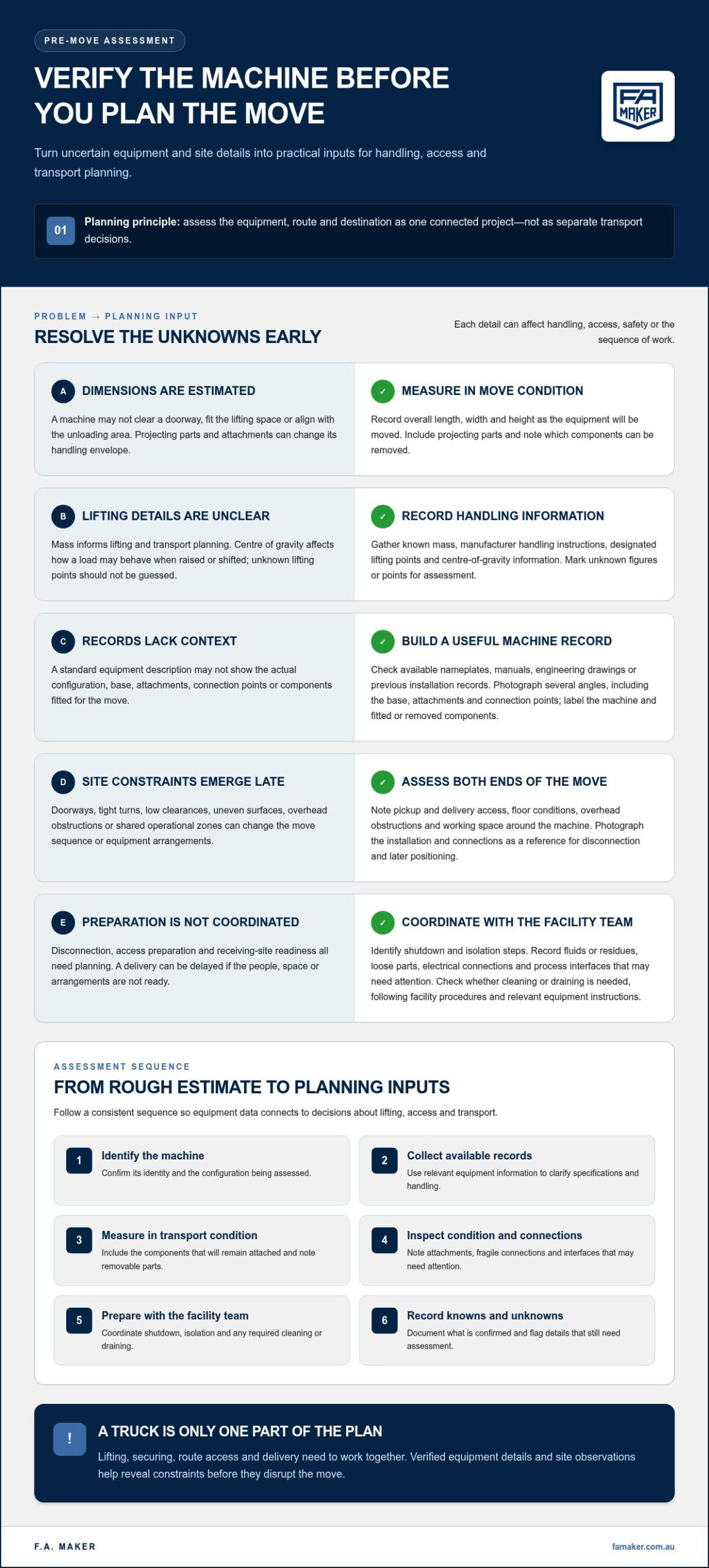
A useful assessment turns a rough estimate into practical planning inputs. Follow a consistent sequence: identify the machine and its configuration, collect available records, measure it in transport condition, inspect its condition and connections, prepare it for assessment with the facility team, then record what is known and what remains uncertain. This connects equipment data to decisions about lifting, access and transport.
Verified equipment data gives the relocation team a sound basis for selecting handling arrangements and identifying constraints before work begins.
Record the machine’s overall length, width and height as it will be moved. Include projecting parts and note which components can be removed. Gather the known mass, manufacturer handling instructions, designated lifting points and centre-of-gravity information. If a figure or lifting point is unknown, mark it for assessment rather than estimating. A nameplate, manual, engineering drawing or previous installation record may help clarify details and show how the machine is intended to be handled.
Photographs add useful context. Capture the equipment from several angles, including its base, attachments and connection points. Label images with the machine identification and note which components are fitted or removed in each view. This record helps the relocation team compare the documented configuration with site conditions and spot details that may affect handling.
Coordinate with the facility team before inspecting or preparing machinery. Identify the required shutdown and isolation steps, and establish whether cleaning or draining is needed for the equipment’s process and condition. Record fluids or residues, loose parts, electrical connections and process interfaces that may need attention before disconnection. Preparation should follow the facility’s established procedures and the equipment’s relevant instructions.
Assess both ends of the move. Note pickup and delivery access, floor conditions, overhead obstructions and the working space around the machine. Photograph the current installation and connections so the team has a reference for disconnection and later positioning or reinstallation. Site observations matter as much as machine measurements: a dimension that looks manageable on paper may still restrict movement through a particular doorway or work area.
Keep measurements, source documents, photographs, inspection notes and unresolved questions together in a clear equipment record. Distinguish manufacturer information from site measurements and estimates, and note the equipment configuration shown in each photograph. This gives facility staff and the relocation team a shared reference, reducing the risk that different assumptions about attachments, dimensions or connections shape separate parts of the plan.
That record is the practical starting point for deciding how to move oversized equipment based on the actual machine and site. For industrial facilities planning a relocation, F.A. Maker’s machinery relocation services provide support for coordinating the move.
Choose lifting and transport arrangements as connected but separate decisions. The machine’s mass, lifting points, centre of gravity and geometry inform how it can be raised and loaded. Pickup access, available working space and receiving-site conditions affect whether that approach is practical. The transport vehicle must then suit the load and route, with a loading and restraint plan that accounts for the equipment’s configuration.
There’s no universal best option. A crane may suit equipment that needs to be lifted over an obstruction, while a forklift may suit a machine that can be safely accessed and handled with that equipment. A low-loader addresses road transport, but doesn’t determine how the machine is lifted onto it.
Start with verified equipment information and conditions at both sites. Consider whether the machine has suitable lifting points, how its centre of gravity affects stability, and whether nearby structures restrict lifting or manoeuvring. Lift planning and execution require a project-specific assessment by appropriately qualified personnel. Separately, assess the transport vehicle, loading access and how the equipment will be restrained for travel.
| Approach | Planning considerations |
|---|---|
| Crane | Assess lifting points, load balance, lifting path, overhead obstructions and space to position the crane. |
| Forklift | Assess equipment stability, access for the machine and forklift, floor conditions and clear manoeuvring space. |
| Low-loader | Assess the transport configuration, loading and unloading arrangements, load dimensions, route constraints and restraint plan. |
These are planning considerations, not a substitute for assessing a specific machine and site. The right combination depends on the equipment, access and delivery conditions. Where specialised material handling machinery is evaluated, consulting heavy lifting equipment providers such as Nortruck Forklifts can help match machine specifications to site requirements.
Route assessment connects the load’s dimensions and transport configuration with road and site conditions along the journey. Check clearances, road restrictions, bridge or access constraints, turns, construction works and entry conditions at both facilities. Consider the route as a whole: a transport arrangement that suits the pickup site may still encounter a restriction or access issue before delivery.
Oversize and overmass controls, approvals and other requirements depend on the load, vehicle, route and jurisdiction. In Australia, the Heavy Vehicle National Law applies in participating jurisdictions, while Western Australia and the Northern Territory have separate arrangements. Requirements can change, so check current National Heavy Vehicle Regulator (NHVR) guidance and the relevant state or territory road authority before finalising the move.
In practice, how to move oversized equipment means matching equipment data to the lift, loading method, transport configuration and route, then confirming that the receiving site can accept the delivery. Treating these as linked decisions helps reveal conflicts before they affect handling or scheduling.
Coordination starts with an agreed scope and sequence, not on the day equipment is lifted. Set out who is responsible for facility preparation, relocation activities and receiving-site readiness. Different teams may be involved, so name the responsible people and agree how decisions and changes will be communicated.
A practical sequence is:
Record the machine’s condition before handling and after delivery. Dated photographs and written notes can document visible damage, attachments and connection points, giving facility and relocation teams a shared reference during handover.
Before mobilisation, the facility team should confirm that shutdown, isolation and disconnection have been completed under its procedures. Prepare the equipment for the agreed handling approach, including securing or removing loose, projecting or vulnerable parts where required. Confirm pickup access is clear, lifting arrangements are coordinated, site controls are in place and everyone involved understands the communication process.
Agree how work will pause if site conditions differ from the plan. Clear communication helps prevent conflicting movements around the equipment and gives responsible people the opportunity to address a change before handling continues.
Loading should follow the project-specific lift plan, with personnel controlling positioning and load restraint rather than improvising on site. Transport should follow the agreed route and timing, along with any applicable approvals or conditions. If access, weather or other site circumstances require a change, communicate it through the agreed process so loading, transport and receiving arrangements stay aligned.
Prepare the receiving area before dispatch. Confirm unloading access, working space, the intended equipment position and who will accept delivery. Keep the equipment record with the handover so its condition can be compared with the pre-move documentation. This connects removal with delivery.
Move-day checklist:
For a coordinated industrial machinery move from shutdown through delivery, arrange machinery relocation support with F.A. Maker.
Coordinated machinery relocation support can be useful when a move involves several stages, site constraints or teams whose work must happen in sequence. Examples include equipment that needs careful lifting and transport, a pickup area with restricted access, a receiving site with limited working space, or a shutdown that must align with production requirements. The more these factors interact, the more useful it is to treat relocation as a project rather than a freight booking.
Not every machine move has the same level of complexity. The right support depends on the equipment, facility and transition being planned. A coordinated approach brings preparation, access, movement and delivery readiness into one project discussion, helping everyone work from the same scope and assumptions.
A clear project brief gives the relocation discussion a practical starting point. Include the equipment identification, available dimensions and weight information, and current photographs showing its configuration and connections. Add the pickup and destination locations, known access restrictions and operational timing requirements. Record what is known about disconnection, lifting, transport and installation, and flag information that still needs assessment rather than presenting an estimate as confirmed.
Relevant details may include:
This information helps distinguish a straightforward transport task from a move that needs coordination across a facility transition. It also gives the people involved a shared basis for identifying responsibilities, dependencies and outstanding decisions before work is scheduled.
One coordinated plan can align equipment preparation at the current site with access, transport arrangements and delivery readiness at the destination. That connection matters: a delay in disconnection can affect loading, while an unprepared receiving area can complicate delivery. Clear sequencing and communication help each team understand what must be ready before the next stage begins.
F.A. Maker provides professional machinery relocation services for industrial facility transitions. The company is family-owned and operated across several generations, and was founded in the 1920s. If you’re preparing a machinery relocation, outline the equipment, sites and operational requirements with F.A. Maker.
When considering how to move oversized equipment, the key decision is whether handling, access and timing constraints can be managed as separate tasks or need coordination as one relocation project. A clear project brief keeps planning focused on the actual machine and facility transition.
Turn the known constraints into a working project brief. Identify decisions that could affect production, access or delivery, then involve the relevant facility and relocation teams before committing to a shutdown window. This gives everyone a clear basis for resolving open questions and coordinating the transition.
If you’re planning how to move oversized equipment at your facility, F.A. Maker provides professional machinery relocation services. Start the discussion with the equipment and site requirements to establish the next planning steps for your project.
Plan your industrial machinery relocation with F.A. Maker and take the next step towards a well-coordinated facility transition.
There isn’t one dimension that defines every difficult move. Overall length, width and height matter, but mass, shape, lifting points, centre of gravity and the route between sites also affect handling and transport choices. For example, a compact machine with an uneven load may need careful lift assessment, while a longer unit may present access challenges. Record measurements and arrange a project-specific assessment before deciding how to move oversized equipment.
Some movements require permits or other approvals, depending on the load, route and applicable state or territory requirements. Don’t assume one national process covers every road or movement. Before arranging transport, check current National Heavy Vehicle Regulator guidance and requirements from the relevant road authority for the planned route. Include time for any required approvals in the project schedule, and revisit the checks if the route or load configuration changes.
That depends on the machine, its process connections and the handling plan. Electrical, fluid, ventilation and other services may need isolation or disconnection by responsible facility personnel before movement. Some attachments may also need to be secured or removed to prevent interference during handling. Use the equipment’s operating information and site procedures to guide preparation, and document the existing arrangement so connection points can be identified during later installation.
Start planning as soon as the relocation is known. There’s no reliable general lead-time estimate because timing depends on equipment records, site access, shutdown windows, transport arrangements and any route approvals. A move between operating facilities may also require agreement on delivery timing and receiving-site preparation. Build the schedule from verified project requirements, then give responsible teams time to resolve access or handling questions before confirming the move sequence.
Sometimes other parts of a factory can remain operational, but this depends on the equipment’s location, shutdown needs, lifting activity and site controls. Assess nearby processes, pedestrian and vehicle movements, and whether work areas can be separated effectively. Agree exclusion zones and movement controls with facility personnel before the move. Don’t assume production can continue uninterrupted until the site layout and proposed work sequence have been assessed.
Confirm that the receiving area is accessible, clear and suitable for the planned unloading method. Check that doorways and overhead clearances suit the equipment, and review floor conditions, working space and the intended position. Establish whether services or other installation arrangements need to be ready, and identify who will receive the equipment and complete the handover. Resolving these points before dispatch helps avoid holding the load or moving it unnecessarily after arrival.