

A production line move is decided before the first machine is lifted. Planning a production line move means assessing equipment condition and suitability, confirming the new site can accommodate the machinery and its utilities, and sequencing removal, transport, reinstallation and testing. These decisions shape how the line will operate after the move.
Relocation involves more than moving machines between buildings. Equipment dimensions, weight, connections, access routes, floor capacity and production flow all affect the setup. Gaps in planning can delay installation or disrupt operations.
This article explains how to assess equipment for relocation, upgrades or replacement, evaluate a new site, and plan its layout and utilities. It also covers documentation, transport and setup challenges, helping you organise the move around the production line and the receiving facility.
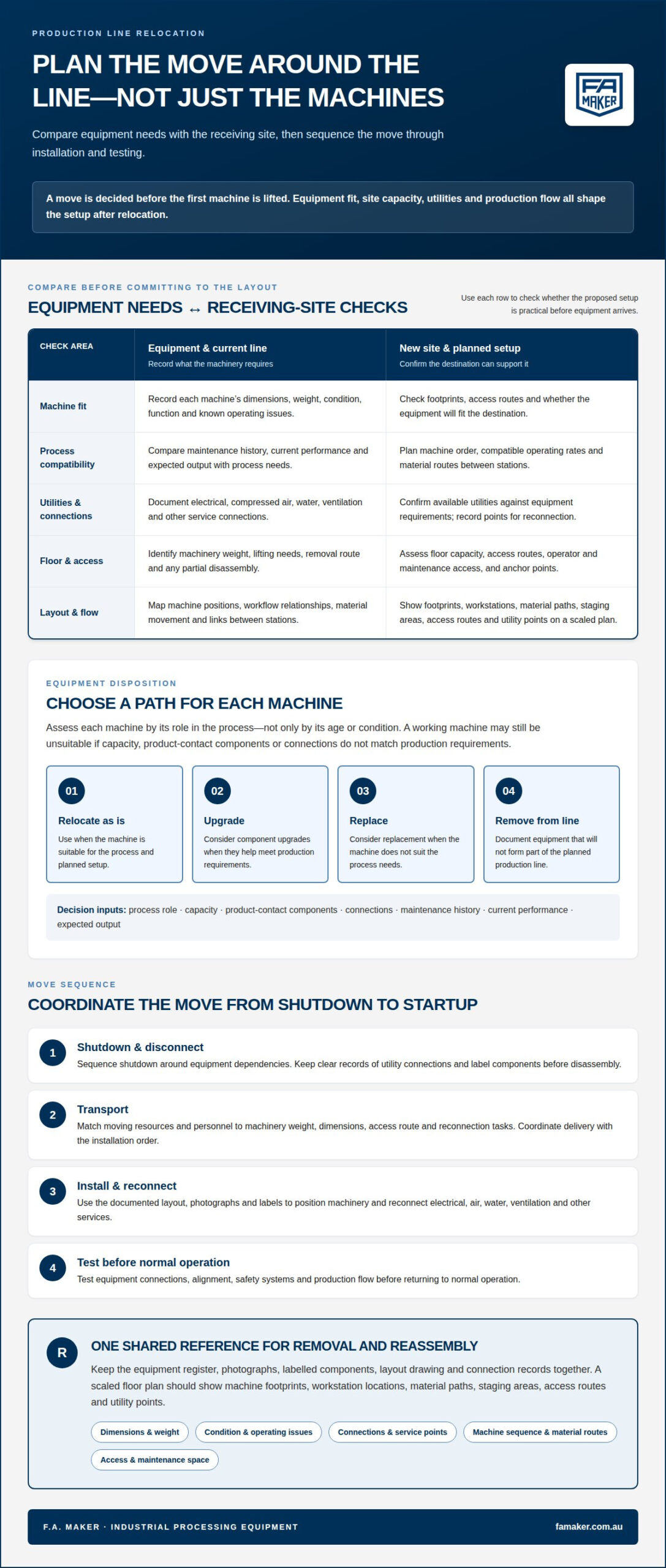
Start with an equipment register identifying each machine, its function, condition and place in the production sequence. Record dimensions, weight, photographs, service connections and known operating issues. Add a layout drawing showing machine positions, material routes and links between stations. This gives the relocation team a reference for removal and reassembly and helps identify equipment that may not fit the destination site.
For an Australian factory relocation, the equipment needed depends on machinery weight, dimensions and access. Moving resources may include cranes, gantries, forklifts or specialised skates. Specialist support may include machinery relocation crews, rigging teams, electrical and utility trades, and technicians for installation and commissioning. Equipment and personnel must suit the lift, route and reconnection tasks.
Assess each machine by its role in the process, not just its age or condition. A machine in working order may still be unsuitable if its capacity, product-contact components or connections do not match the new production requirements. Compare its maintenance history, current performance and expected output with process needs. Then decide whether to relocate it as is, upgrade components, replace it or remove it from the line.
Review the production sequence station by station. A filler, conveyor and packaging machine, for example, must operate at compatible rates and connect in the correct order. Consider whether automation changes are needed and whether manual tasks still suit the product and workflow. Aim for a configuration that supports consistent operation without unnecessary handling or bottlenecks.
Use the existing layout to plan equipment placement at the destination. Mark each machine’s footprint, service points, operator access and maintenance space. Include material flow and the route for components between stations. Engineers should also assess whether the floor can support each machine and whether anchor points meet manufacturer requirements. These checks help determine whether the proposed layout is practical before equipment arrives.
Compare the line’s current workflow with the intended setup. A move offers an opportunity to correct poor positioning, but changes should reflect process requirements and equipment compatibility. Document the chosen layout, machine sequence and planned upgrades together. Clear records help coordinate removal, transport and installation, reducing confusion during reassembly.
Before disassembly, document machine positions, connections and workflow relationships. Confirm the inventory and condition records support decisions about compatibility, workflow, safety and future scalability.
A production line arranges machines and workstations in the sequence used to make a product. Each station performs a defined task, so the layout should support a clear workflow from incoming materials to finished goods. In manufacturing, even a short detour between stations can add handling and make inventory harder to manage.
To create a move schedule and minimise downtime, define the timeline, resources, budget, objectives, milestones and performance indicators. Sequence shutdown, disconnection, transport, installation and testing around equipment dependencies. If production can be phased, keep critical processes running while other equipment moves, and schedule work during planned shutdowns where practical.
Begin the layout plan by mapping the current value stream: how materials, people and information move through production. Mark each process, hand-off, queue and inventory point. This can reveal unnecessary movement and bottlenecks before the line is recreated. For example, if packaging materials repeatedly cross the product route, positioning storage closer to the relevant station may reduce those crossings.
A lean plant layout groups connected processes to support flow rather than separating every machine by department. The right arrangement depends on product requirements, available space, maintenance access and safe movement. Keep material routes direct, provide workable access around equipment, and allow components to move between stations without obstructing operators or replenishment. A shorter route is useful only when it also supports safe operation and process needs.
Document the proposed arrangement in a scaled floor plan. Show machine footprints, workstation locations, material paths, staging areas, access routes and utility points. Add a sequence diagram linking each station to its upstream and downstream processes. These records give installation teams a shared reference and help identify layout conflicts before machinery is positioned.
Use the planned workflow to balance work across stations. If one operation takes longer than the next, work may accumulate between them or leave downstream equipment waiting. Redistributing tasks, adjusting station placement or adding a suitable buffer can help manage variation. The layout should also accommodate product variety without excessive handling or unnecessary inventory.
Keep the schedule and layout linked. A change to the order of installation can affect access, connections and the commissioning sequence. A structured production line relocation plan ties each milestone to the physical arrangement, helping teams coordinate work and track readiness before production restarts.
Start by defining why the existing facility no longer suits production. A company may need more floor space, better access to suppliers, a larger labour pool or closer proximity to customers. Compare these needs with the destination’s infrastructure, workforce availability, market access and operating requirements. A move that solves a space constraint may still create supply delays if key materials become harder to obtain.
Assess the new site against the production process, not just its total floor area. Measure access points, door clearances, internal routes and the space required for machinery, assembly and maintenance. Trace the intended route from the delivery point to each machine’s final position. A machine may fit in the production area but still be difficult to move through a doorway or around a structural obstruction.
To assess the floor, power, utilities and layout, compare equipment requirements with the facility’s physical capacity and service points. Confirm floor loading and anchor locations with engineering input, then compare electrical demand and utility connections with machine requirements. Map these findings onto a proposed layout before moving equipment.
Walk the proposed route with equipment dimensions and transport needs in hand. Check turning areas, ramps, columns and overhead obstructions, as well as access for lifting equipment. The floor must support machinery in its operating position, and anchor points must meet manufacturer requirements. If the route or placement conflicts with the equipment, revise the layout or prepare the area before transport.
Map the current process from incoming materials through each production station to dispatch. Record queues, handling steps and waiting time to identify bottlenecks. A station breakdown can slow or stop the entire line, so note where a single machine sets the pace. Use this process map to decide whether the new site should preserve the sequence or address a known constraint.
Site suitability also depends on the services connected to the machinery. Plot electrical, compressed-air, water, gas, data and communication points, along with process piping. Compare their positions with the proposed machine arrangement. Long or obstructed connection routes can complicate installation and limit maintenance access. Consider environmental conditions such as temperature and humidity where they may affect product quality or equipment operation.
Assess labour availability, supplier proximity and customer access alongside the physical facility. These factors affect how materials reach production and how finished goods leave the site. A suitable destination supports the whole process, from equipment installation through ongoing operation.
Disconnect, transport and recommission machinery in a documented sequence led by skilled personnel. Record each service connection before isolation and protect sensitive components during transport. Reconnect and test utilities before production resumes.
Build a connection schedule for every machine, not just the main production equipment. Include electrical supply, compressed air, water, gas, ventilation, data and communication lines, as well as process piping where used. Identify each connection point, isolation method, route and machine served. A bottle filler, for example, may rely on several services that must be restored in the correct order for its controls and process functions to work.
Before disconnection, photograph connection points and label both ends of each removable cable, hose or pipe. Link each label to the machine identifier and a connection drawing. Record unusual fittings, flow direction and control-system interfaces. This gives installation teams a clear reference and reduces the risk of connecting a service to the wrong machine or port.
Coordinate isolation with the production shutdown and removal sequence. State which machine is isolated first, who is responsible and when the equipment can be moved. Skilled electrical and mechanical personnel should handle work within their scope. Keep connection records with the machine’s transport documentation so they are available at the destination.
Protect utility interfaces and sensitive components during transport. Cap open pipework and hose ends to limit contamination or damage, and secure cables so they cannot snag or strain connectors. Protect motors, sensors and control systems from impact and movement. Mark components removed for transport and store them with their machine identification, rather than relying on memory during reassembly.
At the new facility, compare installed service points with the connection drawings before reconnection. Confirm that electrical service, compressed air, ventilation and other utilities suit the equipment’s operating demands. Check that routing does not obstruct access, create trip hazards or interfere with moving parts. A mismatch between planned connections and actual service locations can delay commissioning and affect output.
Bring systems online gradually and test individual machines before running the full line. Verify utility connections, safety systems, automation controls and communication between linked equipment. A dry run without product can reveal leaks, incorrect rotation, control faults or workflow interruptions. Record results and outstanding adjustments, then confirm the line operates as expected before returning it to production.
Keep utility records with the final installation documentation. Current drawings of connections and isolation points support maintenance and future changes. They also help teams identify the services critical to each station, so later adjustments can be planned without disrupting unrelated equipment.
A move brings technical and operational challenges beyond lifting and transport. Installation timing, site readiness, machine alignment and workforce preparation must fit together. If one task falls behind, equipment may arrive before its foundations, utilities or access routes are ready. A coordinated plan links each machine’s delivery to its installation sequence and assigned responsibilities.
In Australia, permit requirements depend on the work planned at the destination, such as structural changes or new building and utility work. Identify approvals relevant to the site and project scope before work begins. Safety planning should cover pre-move risk assessments, clear responsibilities, safe lifting and handling practices, and coordinated installation schedules.
Transport planning must account for machinery dimensions, weight, access and lifting requirements. Check the route from the current position to the loading area, then assess the destination route and staging space. Cranes, forklifts, gantries or specialised skates may suit different equipment and placements. Protect motors, sensors and control systems from impact, and label removed components so they return to the correct machine.
At the new facility, prepare foundations, floor repairs or reinforcement, utility connections and access routes before delivery. Match equipment arrival to installation order to avoid unnecessary temporary storage or blocked work areas. A contingency plan should cover transport interruptions, installation conflicts, schedule delays, equipment staging and temporary storage. Assign responsibility for each issue so teams can respond without losing sight of the critical path.
Recommissioning should progress from individual machine checks to a full-line test. Verify alignment, connections, safety systems and automation controls, then run a dry cycle to observe communication between stations. Once the line functions without product, test it with the intended materials and product specifications. This can reveal issues an empty run will not show, including handling faults or quality variation.
Validate output against defined production targets and quality criteria. Record performance indicators such as throughput, rejects, cycle times and stoppages, then compare results with the agreed baseline. If a station limits the line, adjust its setup or workflow before increasing production. Continue monitoring after startup to identify reliability or efficiency problems that emerge during normal operation.
For support coordinating machinery transport and installation, discuss a production line relocation.
Production line setup requires upfront investment in machinery, infrastructure and training. Train workers to operate production equipment, follow safety protocols and understand their roles. Automated standard operating procedures can guide workers through approved setup workflows and help reduce errors. Digital checklists can also help teams follow and document setup steps consistently.
Account for temperature and humidity in production line setup, as environmental conditions can affect product quality and machine efficiency. During relocation, laser tracking and other metrology techniques can support precise machinery transport. Following approved workflows and documenting setup steps can help teams prepare equipment consistently for operation.
F.A. Maker provides machinery relocation support for production line moves, helping businesses manage the practical transition of processing equipment. This support can be useful when machinery needs relocating or the new setup calls for different equipment. F.A. Maker’s range includes used stainless steel tanks, centrifuges and separators, industrial mixers and blenders, and pumps and valves.
For a planned move, consider how machinery requirements align with the intended process and facility layout. F.A. Maker supports machinery relocation and equipment needs as part of that planning, including when a line requires suitable processing equipment alongside the move.
Contact F.A. Maker to discuss your production line relocation requirements.
Planning a production line move also offers an opportunity to make the next phase of operation more deliberate. Use relocation decisions to clarify which process changes are essential, which can wait, and how the team will assess readiness to resume production. A clear handover between planning, installation and operations keeps those decisions connected.
Before the move proceeds, bring the key decisions into one working plan: the intended line configuration, site preparation, utility sequence, installation responsibilities and restart checks. Keep the plan current as practical details develop, so changes to one task are reflected in dependent tasks. This gives the team a shared basis for coordinating the transition and managing the return to production.
Where machinery relocation or processing equipment requirements form part of your next step, contact F.A. Maker to discuss your project. A considered plan gives your team a practical foundation for moving forward with confidence.
Planning a production line move starts with a clear operational objective and one person responsible for coordinating decisions. Define what must be ready before production can restart, such as priority products, available inventory and customer commitments. Agree who can approve changes during the move, and set go or no-go conditions for the production handover. This keeps operational priorities visible when installation decisions affect the restart plan.
First, set the move objective and assign decision owners. Then link each task to its prerequisites, such as site readiness before machinery installation and completed installation before production trials. Add approval points where the team must review progress before proceeding. Keep one controlled schedule and record changes, including their effect on dependent tasks. This makes conflicting instructions easier to spot and gives operations a clear basis for accepting the handover.
Plan for disruptions that could prevent the next task from starting, including delayed equipment, missing components, unavailable services, transport interruptions or a failed production test. For each scenario, name the responsible decision-maker, the response and the conditions for restarting work. For example, if a critical component is missing, define whether installation pauses or another planned task continues. Include supplier communication and workforce coverage so the team can make operational decisions without improvising.