

A tank relocation succeeds when the equipment move and production plan work together. For Australian facilities, stainless steel tank relocation services involve more than transport. Disconnection, handling, site access and the steps required before the tank returns to service all shape the project.
Start by gathering reliable information about the tank’s dimensions, weight and condition, along with the access available at both sites. These details help establish whether relocation is practical and what else the project team needs to assess.
This guide covers the key decisions, from collecting equipment and site details to coordinating shutdown, disconnection, transport and recommissioning. It also explains how a machinery relocation service can support planning. F.A. Maker works with industrial process equipment and provides machinery relocation services, helping facilities plan around the equipment and operational requirements involved.
Moving a stainless steel tank is an equipment and production-planning project, not simply a transport task. Early feasibility checks help identify issues before the move is scheduled. The tank’s dimensions, construction, condition and intended process use all affect whether it can be moved and used at its destination. Connections, installed attachments and nearby equipment may also change the work involved.
Stainless steel includes a range of grades and properties, so the material name alone doesn’t establish how a tank suits a process or how it should be moved. The properties and uses of stainless steel offer general background, but planning decisions should rely on information specific to the vessel, not its appearance.
An internal plant move and a relocation between Australian sites have different planning needs. An in-facility move depends on internal access, nearby equipment and production activities. A move between sites also involves the route between locations, transport access and coordination at both ends. In either case, stainless steel tank relocation services need to be planned around the particular tank and sites, rather than treated as a standard lift-and-shift task.
Start with available drawings, nameplate details, recorded dimensions and a history of modifications. These records help establish the tank’s configuration, but any gaps should be verified rather than filled with assumptions. Don’t infer capacity, material grade or other specifications from the tank’s shape or finish.
Record visible damage, corrosion, distortion, repairs and changes to fittings. Note where a closer inspection may be needed before handling decisions are made. Then compare the tank’s configuration and condition with its intended next use. A vessel that can be moved may still need a separate assessment to determine whether it suits the destination process.
Map the tank’s role in the process before setting a move window. Identify connected equipment, upstream and downstream dependencies, affected production areas and the shutdown window available to the site. This makes it easier to see which activities need coordination and where production may be interrupted.
Keep relocation planning separate from decisions about reconnecting the process line. The move plan covers the equipment and its transfer; reconnection and return to operation involve separate site procedures and technical decisions. Isolation, draining, cleaning and disconnection should follow suitable site procedures and be handled by qualified personnel.
There is no universal downtime estimate for a tank move. Duration depends on site conditions and project scope, including access, the tank’s configuration and production requirements. Defining these factors early gives the project team a useful basis for coordinating work, rather than relying on a generic timeframe.
Feasibility depends on the tank itself, what it has contained, access at the origin and destination, and how the vessel will be used next. Gather evidence before making assumptions about handling or transport. Appearance alone can’t confirm a tank’s grade, weight, pressure status or suitability for a particular process.
A useful pre-move checklist covers the tank’s verified identity and configuration, contents history, access at both sites and destination requirements. This gives the project team a practical starting point for planning stainless steel tank relocation services and identifying where further technical review is needed.
Bring together records that describe the vessel as it exists now, not just as it was originally supplied. Useful information includes:
Mark missing or uncertain specifications clearly instead of estimating them. A tank’s visible size doesn’t reliably establish its weight, and a photograph may not show changes made during its working life. Record the tank’s contents history too, as this can inform site procedures for preparing it for movement.
If records identify the vessel as a pressure vessel, or its process involves other specific technical requirements, flag that information for appropriate technical review. Don’t infer pressure status or process limits from the tank’s shape, fittings or construction alone.
Access can determine whether a proposed move is practical. Document the full path from the tank’s current position to the exit, then assess the receiving site. A clear doorway may lead to a restricted turn, limited headroom or a floor condition that needs assessment. Check the tank’s final operating position, not just the point where it enters the building.
For transport between Australian sites, assess route access and jurisdiction requirements for the specific project. Requirements can depend on the route and the characteristics of the load, so an access assessment at one site doesn’t establish that the full journey is suitable.
Document connections and attachments too. Note connected pipework, valves, platforms, motors and other fittings that may affect the tank’s configuration. This information supports planning, but doesn’t mean every attachment is automatically part of the same scope. F.A. Maker provides machinery relocation services for industrial equipment, including process equipment.
The decision isn’t only whether the tank can be moved. It’s whether keeping it makes sense for the destination process, considering condition, capacity, configuration and site constraints together. A tank may be physically relocatable but poorly suited to its next role. Another may remain a good fit even if moving it requires careful coordination. Neither relocation nor replacement is automatically the cheaper, faster or technically preferable option.
Compare both options against the same operating requirements. This keeps the decision focused on what the facility needs, rather than assumptions about moving existing equipment or buying another vessel. Stainless steel tank relocation services can support the relocation option, but the project still needs a tank-specific comparison.
Relocation may be practical when the vessel is in suitable condition, its capacity matches production needs and its configuration suits the destination. Consider whether the process will use the same functions and connections, or whether the operating arrangement would need to change. A tank that fits the new space but no longer suits the process may not be a useful asset there.
Compare the complexity of moving the existing vessel with the disruption involved in changing equipment. Account for the work and coordination associated with relocation, as well as the steps required to prepare an alternative for the process. Ask:
Clear answers strengthen the case for retaining a tank. Unresolved specifications or a mismatch with process requirements call for further assessment, not an automatic decision to move it.
Consider another vessel if the existing tank’s condition raises concerns, important specifications remain unknown, or its capacity and configuration don’t match the destination’s operating requirements. A replacement may differ in capacity, fittings and process suitability, so compare its documented details against the same requirements used to assess the existing tank. Don’t assume two vessels are equivalent based on appearance or material alone.
Include site constraints in the comparison. A vessel that better suits the process still needs to fit the available space and access conditions. Choosing another tank also doesn’t remove the need to plan equipment handling and production impacts. The preferred option depends on the combined requirements of the vessel, process and move.
F.A. Maker supplies used stainless steel tanks for facilities considering an alternative. The guide to sourcing used stainless steel tanks can help structure the information to compare. Aim for a project-specific decision: retain the existing tank when its condition and process fit support that choice, or assess another vessel when the requirements point elsewhere.
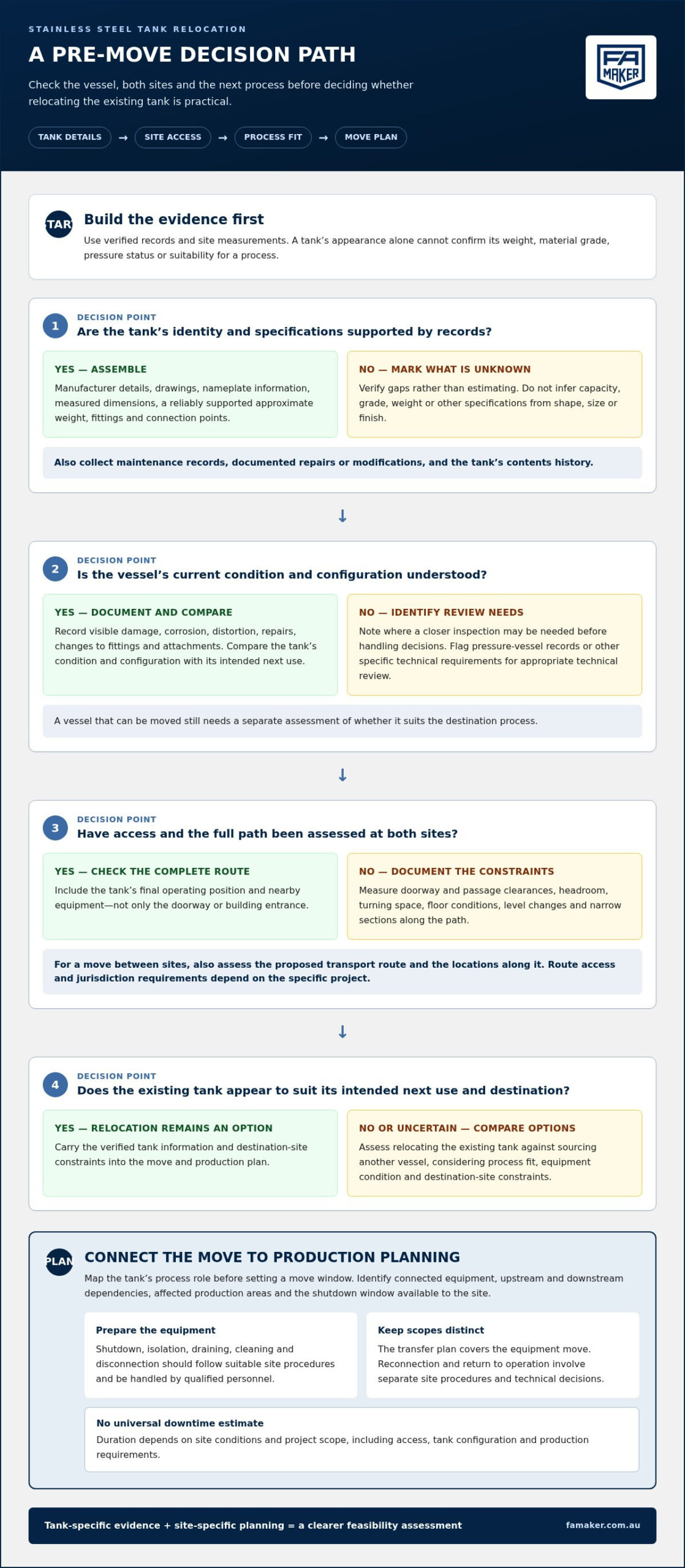
A clear sequence connects equipment information with site and production requirements. Start with a project brief, assemble the tank records, assess access at both locations, then coordinate handling and transport considerations with the facility’s shutdown plan. Stainless steel tank relocation services can support the equipment move, while site teams apply their procedures for process isolation and preparation.
Give the project team a shared reference point. Describe the tank, its current location, intended destination and known operating requirements. Attach available drawings, nameplate information, dimensions and photographs. Identify recorded modifications and gaps in the equipment information so assumptions aren’t mistaken for verified specifications.
Include the operational context too: the shutdown window, production dependencies, relevant site contacts and project-specific safety requirements. Note who is responsible for decisions at the origin and destination, and how updates will be shared. A brief that records both known facts and outstanding questions helps align planning without treating unknown details as settled.
Prepare the tank under appropriate site procedures. Plan isolation, draining, cleaning and disconnection with the facility’s responsible personnel, and have qualified personnel carry out the work. The method depends on the equipment, its contents history and site requirements. A general relocation plan shouldn’t replace the relevant site procedures.
Assess the path at both ends before setting handling arrangements. For an internal plant move, consider the route through the facility, clearances and the tank’s destination position. For a move between sites, assess access at the origin and destination separately from the public-road journey. A workable route inside each facility doesn’t establish that the full transport route is suitable.
Share the tank’s verified dimensions, available weight information, configuration and attachments with those coordinating the move. These details inform lifting, loading and transport planning. Don’t assume a particular method or equipment before the project requirements are assessed. Conditions at both sites and the tank’s actual configuration matter.
For Australian moves between sites, identify the proposed route and the states or territories it crosses. Applicable access or transport requirements can depend on the load and jurisdiction, so verify them for the project rather than relying on a general assumption. Keep this route review separate from the access assessment within each facility.
For wider planning context, F.A. Maker’s industrial machinery relocation services guide discusses considerations beyond the tank itself. To discuss a tank move as part of your equipment requirements, contact F.A. Maker about machinery relocation.
Relocating a process tank involves equipment decisions alongside production and site planning. F.A. Maker is a family-owned Australian industrial equipment business founded in the 1920s, and provides machinery relocation services for industrial process equipment. The company’s work with industrial machinery supports a practical discussion focused on the tank, its role in the facility and the requirements of the proposed move.
Each project has its own constraints. Tank records help establish what equipment is being moved, while access information and operational needs frame the planning discussion. Drawings may be incomplete, site routes may be restricted, or the shutdown window may affect coordination. Clear information separates what’s known from what still needs assessment and keeps planning grounded in the project’s actual requirements.
Industrial equipment operates within a wider production environment. A tank’s connections, position and role in the process can influence how a move is planned, even when relocation is the immediate focus. Experience with industrial machinery helps keep those relationships in view when considering handling and operational requirements. F.A. Maker’s family ownership and history, spanning several generations since its founding in the 1920s, are part of the business’s background, not a guarantee of a particular project result.
Good coordination depends on useful project information and realistic planning. Consider the tank alongside access at the origin and destination, process dependencies and site constraints. Stainless steel tank relocation services need to be understood in that project-specific context, rather than as a fixed package with identical steps for every facility.
Before discussing the project, assemble the information already available. The technical file doesn’t need to be complete, but identify gaps clearly instead of estimating missing specifications. A concise starting set includes:
This information helps frame the project discussion and highlight which equipment or site details need further attention. Keep decisions about isolation, draining, cleaning and disconnection within suitable facility procedures and the responsibilities of qualified personnel. These tasks depend on the tank and its use, so don’t assume they are included in every relocation scope.
F.A. Maker provides machinery relocation services for facilities moving industrial equipment, including stainless steel tanks. Share the available records, site conditions and operational priorities to begin a project-focused conversation. If you’re preparing a move, discuss a stainless steel tank relocation project with F.A. Maker.
Turn the relocation decision into a working project brief. Set out what the facility needs the tank to do at its destination, the operational constraints around the move and which equipment details still need review. This gives planning a practical focus and keeps decisions tied to the tank’s role in your process.
Stainless steel tank relocation services are most useful when planned around equipment and site requirements, rather than treated as transport in isolation. A focused discussion can help establish the project’s priorities and the information needed to plan the next stage.
Share your tank relocation requirements with F.A. Maker to take the next step with a clearer basis for planning. A well-defined starting point can make a complex equipment move easier to coordinate.
Protecting a tank starts with a handling plan based on its actual configuration and condition. Identify vulnerable fittings, protrusions, surface damage and modifications before movement, then ensure the handling approach accounts for them. Don’t use connected pipework or attachments as lifting or restraint points unless a qualified technical assessment establishes they are suitable. Plan stainless steel tank relocation services around the vessel’s documented details, and check its condition after the move.
Whether it must be empty depends on the tank, its previous contents and the proposed handling and transport arrangements. Residual liquid or product can affect weight and introduce risks, so don’t assume a tank is empty because it has been drained or appears clean. The facility should determine appropriate isolation, draining and cleaning procedures based on the contents history, and have qualified personnel carry them out before movement.
Don’t assume connected pipework can flex or move with the tank. Connections can restrain the vessel or be damaged if it shifts. The facility’s responsible personnel should determine how to isolate and disconnect the line under site procedures before movement. Whether and how to reconnect the process is a separate technical decision based on the line design and operating requirements.
There isn’t a reliable standard duration for every relocation. A short move within an open plant area differs from a project involving restricted access, extensive preparation or transport between sites. The schedule also depends on shutdown coordination and the project scope. Build the programme around confirmed site conditions and responsibilities, allowing time for required preparation rather than relying on a generic estimate.
Provide the tank’s identifying details, available drawings, dimensions, photographs and records of modifications. Add the current and destination locations, access information, intended process role and contents history. Note practical details too, including the orientation of connections, nearby obstructions, the available shutdown window and who is responsible for site decisions. Label uncertain information as unknown so it can be addressed rather than mistaken for a verified specification.
It may be possible, but feasibility depends on the tank’s dimensions and weight, the route and access conditions at both sites. For a large or unusual load, assess transport access and any applicable requirements for the specific journey. State and territory rules can differ, so interstate planning should account for each jurisdiction along the route rather than assuming one approval or assessment applies everywhere.
Yes. If records identify the tank as a pressure vessel, have an appropriately qualified person review its status and relevant technical documentation before handling decisions are made. Gather the nameplate details, drawings, inspection and maintenance records, and note any repairs or changes. Don’t infer pressure rating or suitability from appearance. Assessment for movement is separate from deciding whether the vessel remains suitable for service afterward.